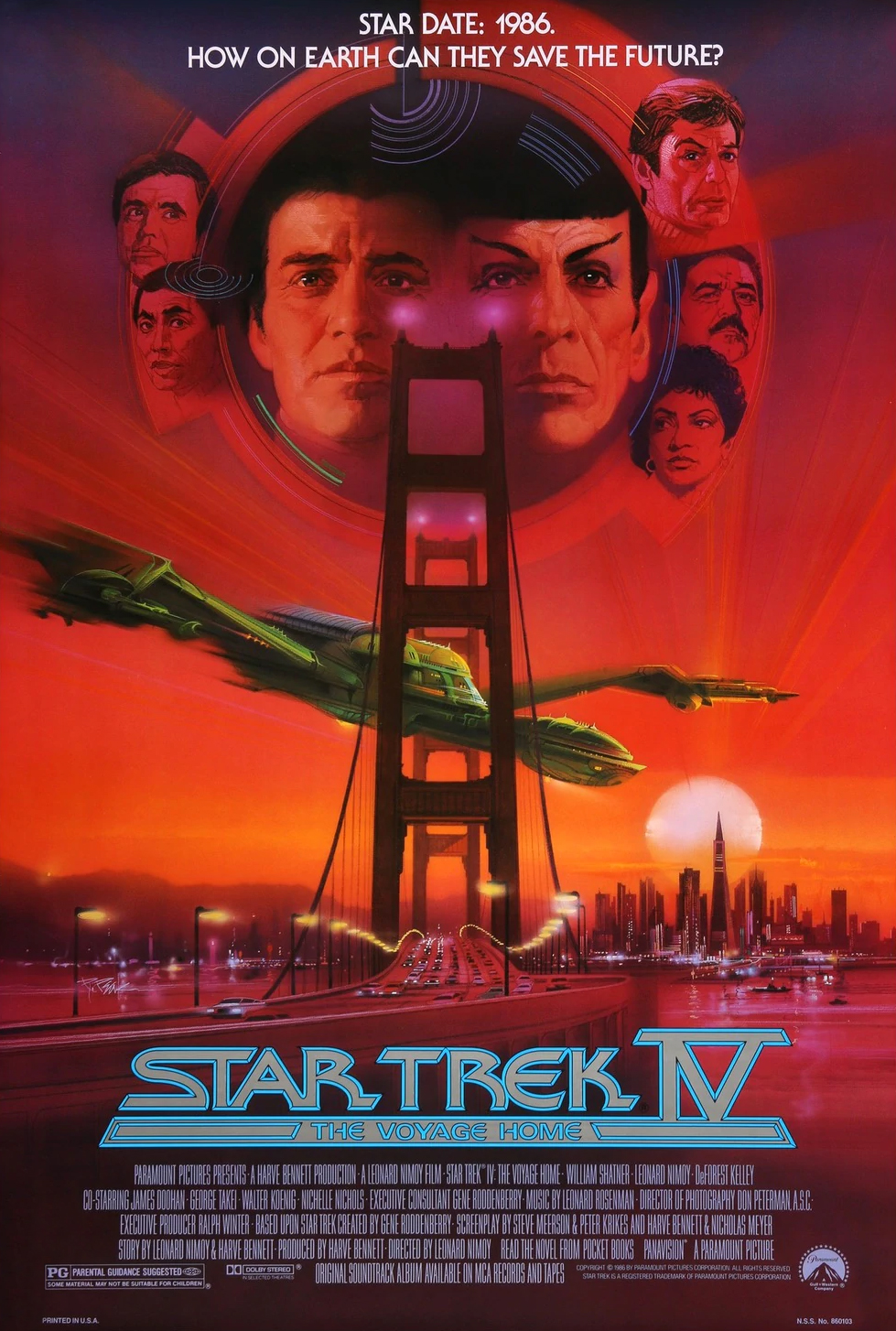
Star Trek IV: The Voyage Home (1986)

“The Cast and Crew of Star Trek wish to dedicate this film to the men and women of the spaceship Challenger whose courageous spirit shall live to the 23rd century and beyond…”

The opening remarks of The Voyage Home honoring the “courageous spirit” of those lost on The Challenger is a perfect encapsulation of the ethos of Star Trek.

Because it was always very much a franchise that was a social allegory for our world and by taking place in a sci-fi future, it was able to champion all that was good and valorous of people living through a space age even as they tried to reconcile with living with one another on earth with fraternity.

As a kid, Voyage Home was always my favorite Star Trek movie, and probably still remains so now. I’m not quite sure what it was exactly, though I do have some ideas. It’s important to acknowledge it right out front. Voyage Home has a wild and wonky premise full of a certain incredulity, but it’s also a good deal of fun.

Spock is back after Star Trek III, but now there is a new problem: Not only is Kirk a wanted man, but a frequency of humpback whale calls is causing chaos to reverberate all throughout the galaxy. Yes, you heard that right.

Kirk leads his fugitive compatriots on a Klingon ship with cloaking capabilities to time travel to the past — that is, the contemporary moment the film came out — 1986. The wheels start turning.

I’m no Star Trek savant, but it didn’t evade me that this is a subtle twist on the notable “City On The Edge of Forever” episode that sent Kirk and Spock (with his ear-concealing bandana) back in time to the soup lines of the Great Depression.

Voyage Home mines most of its comedy from your typical fish out of water premise, in this case pitting the Enterprise Crew of highly intelligent and advanced space cadets against a world that feels so analog and decidedly archaic to their sensibilities. Meanwhile, to the average guy on the street they look like helpless weirdoes.

A particularly memorable vignette involves a spiky-haired punk rocker on the bus with his blaring boombox. He does look rather like an alien to anyone left unawares from a different century. A little Vulcan nerve pinch gets the whole bus clapping with appreciation for curbing the noise.

Pairing Bones and McCoy off together is a pleasure in its own right, though it need not be expounded upon in depth here. The rest of the crew is entrusted to build a tank to carry the whales across the galaxy and also locate a nuclear reactor to help power their ship home.

Spock’s coming up to speed with the modern vernacular offers its own hilarity as does his commune with the whales in their enclosure at a Sausalito aquarium. It’s in plain view of everyone and another breach of societal norms. This just isn’t done in the 20th century. Spock has greater concerns as Kirk tries to guide him through this strange world like a blind man leading a blind Vulcan.

The resident biologist Dr. Gillian Taylor (Catherine Hicks) is incensed. She cares about these animals’ well-being deeply. Later, she offers a ride our two lovable nut jobs up in her pickup because she has a penchant for hard-luck cases.

The addition of Hicks in a fairly substantial role begins as a screwball comedy with her skeptical incredulousness around Kirk and Spock. It then builds into a kind of swelling romantic comedy served with a side of pizza pie. Somehow it plays as the less tragic inverse to Joan Collins turn in “City on The Edge of Forever.”

Because they push the boundaries of her belief and still, if she doesn’t quite have faith in their clear-eyed tall tales, she recognizes their shared mission to protect the whales. If it’s not quite faith, then her trust in them is rewarded in an extraordinary way as an unimaginable world of the 23rd century opens up before her eyes.

She always feels a bit out of step with the world around her, and then she finds these like-minded people, a little eccentric, and yet they suggest to her that she was made for so much more. It’s an extraordinary development.

Chekhov gets captured in a restricted area and is shipped off to a hospital in the city after he suffers an injury. Kirk and Bones lead a search and rescue mission masquerading in scrubs, then Gillian finds out the whales were shipped off early. They have to intercept them en route if they ever hope to save the whales and thereby the galaxy. No big deal.

Hanging out with the crew of the Enterprise in San Francisco sounds like a good time, and it’s a pleasure to assure everyone that it is. For such gargantuan stakes, Voyage Home feels surprisingly lightweight, lithe, and generally fun because we rarely feel burdened by them. It’s not bogged down by a lot of self-importance and this is to its credit. So it worked then, in my childhood, and it still holds up now eliciting the same kind of stirring reactions.

3.5/5 Stars

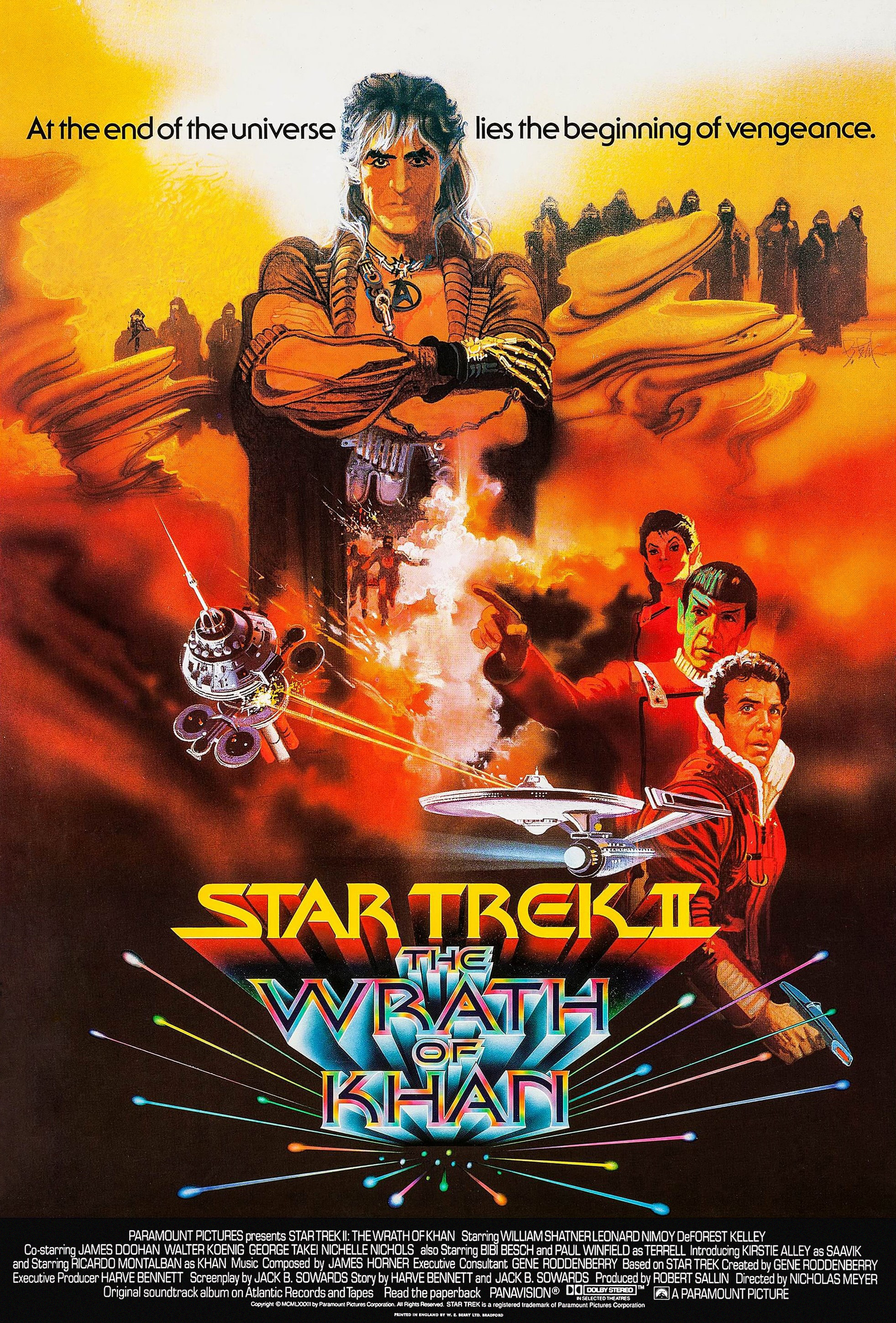
Star Trek II: The Wrath of Khan (1982)

If I had to take a stab at the age-old distinction, I would differentiate Star Trek and Star Wars like so.  Star Wars was a sci-fi Fairy tale and became something more. Star Trek began as a sci-fi allegory on TV and became something more. In a word: beloved.

The Wrath of Khan opens with a scenario involving the usual suspects on the USS Enterprise, except standing in for Kirk is a  Vulcan named Saavik; they must rescue the crew of the Kobayashi Maru, and it all goes terribly wrong.

Moments later we learn that the entire escapade was a simulation.  Kirk (William Shatner), now an admiral, was watching from the wings. It turns out the Kobayashi Maru is a “No-win scenario” elucidating the character of the ship’s commander. You can probably imagine how Kirk handled it in his day, very unconventionally.

Bones (DeForest Kelley) chides his friend to get back out there. He’s not made for a desk job; he’s meant out there on the edges of the galaxy with his crew and wits about him tackling the universe’s most pressing problems. The pull of the movie means he has no choice in the matter.

Captain Clark Terrell (Paul Winfield) and Chekhov (Walter Koenig) lead the crew of the USS Reliant to an uninhabited world; it’s part of an interdisciplinary project to use the newly devised Genesis technology’s immense power to revitalize desolate planets.

There’s something ominous about it after they beam down, and it’s true they are not alone getting ambushed by the vengeful Khan (Ricardo Montalban) who still holds a vendetta for Captain Kirk leaving him to die (see “Space Seed”).

Among his entourage of scavengers he keeps some burrowing creatures as pets and they make his two hostages highly compliant. Khan’s quick to commandeer the ship, and we know what his aims are before he’s put them into action.

A trap gets set to lure Kirk. The USS Enterprise is alerted and comes face to face with The USS Reliant. Their purported friends have treacherous intentions looking to blow them out of space from close range.

There’s a robust theatricality to Montalban’s villain that feels large and provocatively cunning as he holds onto a grudge going back to Star Trek‘s TV days. It’s an inspired piece of work not only in building out the story, but in having the actor back for another installment because he already has a built-in history.

It turns it in a fine chess match and a space opera with Kirk and Khan crossing wits and playing out their old grievances in outer space. It takes this scope and the unfamiliar if appreciated world of space ships, phasers, and light speed, distilling them down into something so intimate and human.

If you’re a cynic, you could say the action mostly involves the two foes talking to each other over video screens. If memory holds, they never actually share the same frame. Still, regardless of what you think of the special effects or the sheer eightiesness of the film’s sets and wardrobe, the story is grounded in a conflict that feels so primal and compelling.

And if that is what gives us a movie, then we must also consider the other relationships. Kirk once had a romantic relationship with one of the head technicians of the Genesis project Carol Marcus (Bibi Besch); her grown son has followed in her footsteps and has a major chip on his shoulder when it comes to Kirk. His notoriety certainly precedes him.

The film is at its best when its heroes are put under duress. Echoing the film’s opening, Kirk and Spock look to rescue them from an untenable situation as they fight back against Khan’s unreasonable demands and Scottie tries to salvage what’s left of the Enterprise in the obliterated engine room. Radioactivity is contained, but with a busted engine, prospects are grim.

Like the second installment in the Star Wars franchise, Empire Strikes Back, Khan is a film about the ultimate sacrifice for the ones you love. If Han Solo did just that in the prior film, Spock does it here. It’s hard to think of two more beloved characters to watch suffer and giving them up hurts.

It’s fitting that the movie references A Tale of Two Cities with Kirk quoting Sidney Carton in the closing moments, “It is a far, far better thing that I do, than I have ever done; it is a far, far better rest that I go to than I have ever known.” This injection of classic Dickens reinforces how Star Trek is always grounded in traditional human history even if it’s pushed onward into future centuries.

Our hero is laid to rest with Scottie’s bagpipes. It always feels a bit anachronistic and then we hear the refrains of “Amazing Grace” in deep space suggesting it can touch even the far reaches of the galaxy.

Kirk eulogizes his buddy saying, “Of my friend, I can only say this: of all the souls I have encountered in my travels, his was the most… human.” That is the profound paradox of this friendship.

Spock’s a fundamentally rational character, and yet all these human impulses are pleased to dwell inside of him. It’s part of what makes him compelling because if we required a manual to read and comprehend him, it would be seem straightforward.

Kirk is the live wire, the unconventional one, who hates to lose — most of all he hates to lose his crew and the people he cares about. Yet in their camaraderie, we see something so formative, and Spock to the end is a noble, loyal friend.

It’s true he does bear the most human of traits and that’s why we hold him so dear because he knows what it is to love and care about other people. He has a heart to go along with his head, continually surprising us with the depth of his humanity despite his stoic countenance.

Like all the great adventure films, Khan has drama grounded in deep relationships, including the primary villain. In such a pressure cooker, every minute of action feels pregnant with real meaning and consequence. It also helps when characters we love and respect are at stake caught up in the middle of it all.

4/5 Stars


Mickey 17 (2025)

It was my pleasure to see Mickey 17 and it was because I was in the company of new friends. The film itself comes with complex feelings. 

Bong Joon Ho joins forces with Robert Pattinson for a story that defies easy categorization. It’s full of a myriad of ideas in line with the South Korean’s usual preoccupations including class and pervasive humor. There are some potentially cute creatures and, if not cute, then they are decidedly more sympathetic than many of the humans we come in contact with. 

While watching the film following Mickey Barnes, a schlub of a man who signs his life away for an excursion to outer space, I couldn’t help but return to two reference points. The first being Star Wars: The Empire Strikes Back and then Ridley Scott’s Blade Runner.

We meet Mickey as he is discarded in a snow cave on an icy planet — ostensibly left for dead. Given his costume and the circumstances, it’s difficult not to see echoes of a frozen Luke Skywalker facing imminent danger in a Wampa’s lair. Except we are dealing with a drastically different world.

Because this is actually the umpteenth iteration of Mickey, and he is part of a program that prints copies of human beings to do the morally dubious dirty work no one else is willing to undertake. 

After all, since he can just come back as a new version of himself every day, what’s it to him if he contracts a deadly virus or gets eaten alive by a snow creature all in the service of the greater good? Most of the early montage is made up of Pattinson being moved around like a ragdoll Frankenstein constantly being tested and incinerated when his utility is used up. 

As you might imagine the connection I see to Blade Runner are these fundamental questions of what it means to be human and who we give dignity to. In other words, is this an inalienable human right? Because although he was a nobody back on earth, on the run with a wily conspirator Timo (Steven Yeun), Mickey still is a human with thoughts and feelings even as he’s relegated to second-class citizenship. He doesn’t want to die any more than anyone else, but he resigns himself to the cycles of life. 

Pattinson channels an accent like you’ve never heard from him before that has a bit of a young Steve Buscemi in it. It’s a bold choice but then for the entire movie, Pattison just goes for it because there’s no vainglory in a part like this if you’re squeamish about taking it to bizarre ends. 

For me, Bong’s latest film works best as a cosmic character piece with Pattinson front and center. There could be a version following his existential arc in outer space as he comes to terms with his station in life while falling in love.

However, because it’s 2 hours and 15 minutes, Mickey 17 attempts to be about a lot more with an epic scale. The primary problem is there doesn’t seem to be a compelling narrative thrust even as Mickey is part of a vague expedition to colonize a distant planet. 

The film’s most obvious villain is the failed political figurehead Kenneth Marshall (Mark Ruffalo), who now has aspirations to colonize space with a superior race of human beings no doubt made in his image; he’s no Marcus Garvey, and I won’t even begin to guess if he’s a caricature of other political figures as Ruffalo hams it up with all the self-aggrandizing buffoonery he can muster.

Toni Colette plays his wife who is primary confidante and probably the brains behind the operation a la Angela Lansbury in the Manchurian Candidate. However, the deficiency here is that they do feel too much like cartoons. What are their genuine motivations besides being easy to tear down and be infuriated by?

On a positive note, Naomi Ackie plays a security officer on the ship who, for some inexplicable reason, falls for Mickey becoming his advocate and protector. It is an ongoing theme in the movie that the women are strong, but with Nasha we would like to believe she sees something genuine and unsullied in Mickey’s personhood.

However, when she’s on screen it feels like Nasha stands for something as both a romantic being and a person of principle who heroically champions good. In the fashionable parlance of the age, she speaks truth to power. Still, Ackie plays it in such a way that the performance feels modulated and not simply driven by a platform or plot mechanics but by her genuine affection for Mickey. 

Two other notable heroines are the timorous scientist Dorothy, who becomes an ally with her chosen expertise, and then Kai, a grieving security officer who comes to Mickey’s aid when he goes before Kenneth Marshall for an arranged dinner. Marshall wants her for her superior genes, perfect for colonizing his new planet, but she turns out to be a person of compassion too — something he couldn’t care less about. It feels like a turning point in the story even as she all but disappears from much of the final act. 

The great leader has deigned to have this expendable at his table where he feeds him raw meat, and they pray and sing hymns with a bombastic faux religiosity. He prays only to be heard by others thinking he will be heard because of his flowery words.  

It’s one of many moments where we see this state-sanctioned religion derided for what it is by Bong. There is an irreverence that is prototypical for Bong, but it seems as if it is directed at what we might call “Christendom” or in this case the accouterments of religious culture that feels disingenuous and more about propping up leaders to accrue power than any kind of piety or true virtue. 

However, much like Parasite, if we dig under the surface, the framework of the world still functions on logic that we all comprehend. There are the aforementioned questions about what it means to be a human and whether or not that should ascribe us a certain dignity. 

And in the same sense, while Marshall and his wife prove to be a pernicious, narcissistic tandem as they look to eradicate the endemic ‘creepers’ in a contentious standoff, they fall into the age-old fallacy.

Because their whole economy is predicated on showmanship and creating fear around the “other.” Mickey knows these creatures have more to them because he has come face-to-face with them. In a weird way he is an intercessor so even as the humans cause destruction and needless death, there is a requirement for a scapegoat. Someone to atone for the blood that has already been shed…

So while Bong’s latest film is not without merit and there’s plenty to quibble about, it feels like the film falls admittedly short in one primary department. It languishes in telling a focused story even as there are plenty of individual performances to single out.

As an Asian-American, it seems like Steven Yeun has currently cornered the market on these kinds of skeevy or despicable characters which feels like his well-won prerogative to upend a generation of model minority stereotypes. He’s played ceaselessly interesting characters of late. Even Steve Park gets a chance in the limelight as he continues to build a wonderful second act for himself thanks to Wes Anderson. 

Mickey 17 gets his happy ending and in a sense, it feels well-deserved. In this way Bong allows himself to be a romantic at heart even in a world beholden to his comically dark proclivities. I commend the movie more for its themes than its storytelling and given Bong’s track record it seems a shame because he’s one of the foremost genre smugglers working today. 

3/5 Stars

James Whale: The Old Dark House (1932) and The Invisible Man (1933)

The Old Dark House (1932)

The Old Dark House has a disarming levity that broadsided me at first. James Whale, the man who famously gave us Frankenstein, has all of his notable features with the tinges of horror on hand for another ghastly delight, and then he goes and pokes fun at the whole setup. Raymond Massey is instantly pegged as a slightly stuffy husband. His wife, dazzling Gloria Stuart, a young ingenue has signed up for more than she bargained for with the outrageous downpour dousing them in the dead of night.

Then, there’s old reliable Melvyn Douglas playing his quintessential character type, always good for a wisecrack, with his feet kicked up, and his pipe tucked in his mouth as they proceed to get hopelessly lost. And of course, he can’t help but whistle a few fractured bars of “Singing in the Rain” when their waterlogged buggy has no recourse but become semi-amphibious.

Oftentimes bathos is used as a kind of criticism — this idea of anticlimax or a break of the mood — because it’s too jokey and therefore undermines all the groundwork put down before it. However, Whale seems to be doing something different.

At any rate, it’s not an out-and-out drama and so while somehow deconstructing his tropes and suggesting to his audience he knows precisely what he’s doing, we reap the benefit of the humor and the chills in ample measure. This is the underlying success of the film in a nutshell. It carries off both and becomes invariably more intriguing in the process.

Because The Old Dark House fits seamlessly into the tradition of Cat and the Canary, Hold That Ghost, House on Haunted Hill et al. A dark and stormy night is a genre given, but the abode itself must bring with it the unnerving idiosyncrasies to make the audience ill at ease. Rest assured. It does.

The proprietors include a white-haired gentleman trembling with timidity and his eternally deaf and priggish sister who condemns all blasphemers en masse. Their valet (Boris Karloff) might as well be a grunting prototype for the wolf man. All of this doesn’t quite suggest a warm and amicable atmosphere. It screams something else. But that’s just the beginning of the festivities…

If I’m to be terribly honest, it seems like an utter waste of Karloff’s talents, especially because I was barely aware he was playing the part. He gets partially overshadowed by the more verbal characters. Charles Laughton, for one, comes tottering through the front door soaked through as gregarious Sir William accompanied by his playful and rather giddy companion (Lilian Bond). Her lithe spirit mirrors Douglas, and they gel nicely. The night quickly turns them into an item. In fact, all the guests hang together.

One could wager it comes out of necessity. It’s a ghoulish space filled with funhouse angles and other parlor tricks. Locked upstairs is a decrepit patriarch and behind another closed door is crazy Saul, who makes a cameo appearance spouting the story of King Saul and David. You know the one, where malevolence came over Saul and he proceeded to spear the other man to death.

He finds a knife and brandishes it with a kind of giddy insanity we don’t know how to respond to. He could do anything. Douglas, the picture of casual confidence and charm for most of the picture, finds his own veneer unseated filling in for David. It’s these kinds of digressions that we never expected, and somehow they make the picture by leaving the audience totally nonplussed.

By the time The Old Dark House is wrapped up, it feels like the gold standard of this brand of haunted house movie because it’s just as much about being a mood piece — finding humor in these outlandish scenarios — and Whale does all of the above with assured aplomb.

4/5 Stars

The Invisible Man (1933)

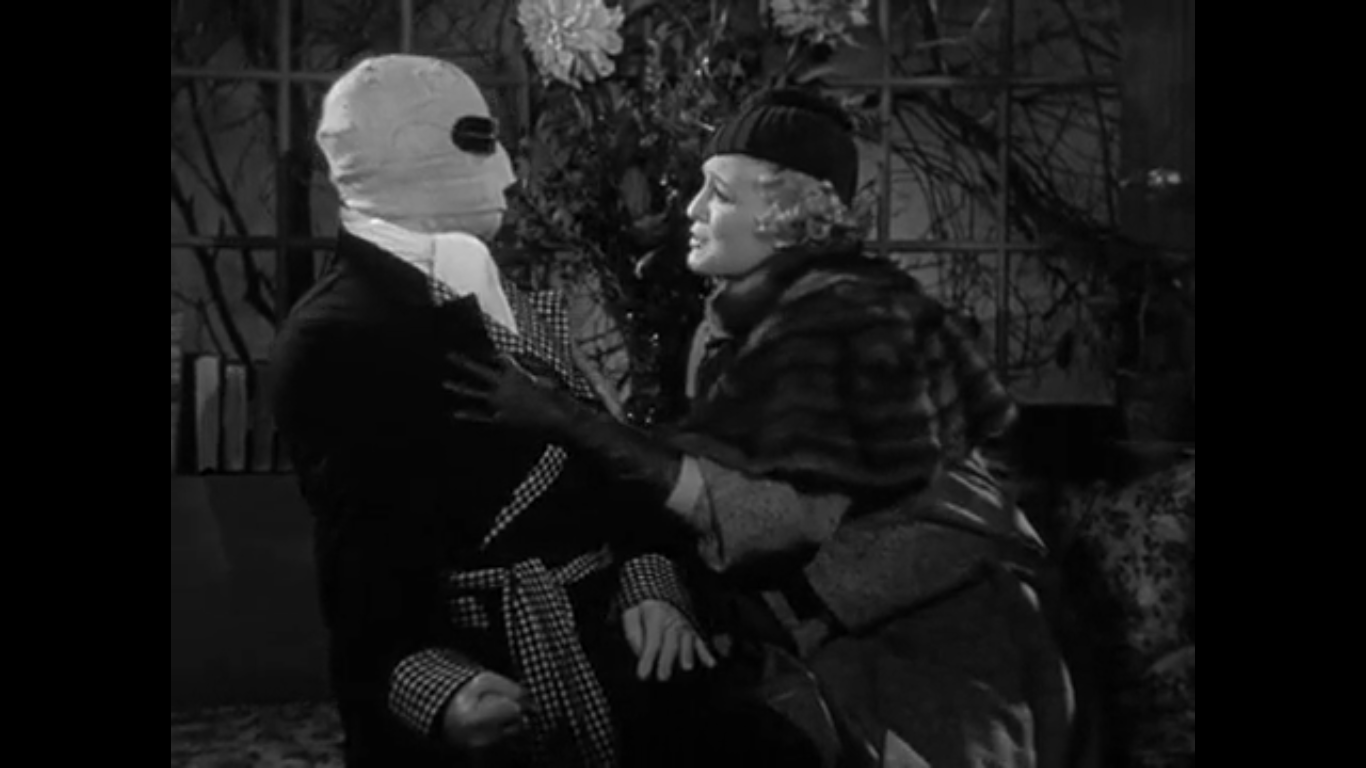
I always thought about The Invisible Man as a scientific marvel, but now I understand how he’s firmly planted in the realm of horror with added superhuman abilities. There’s something that feels somehow modern about Claude Rains’ portrayal of the eponymous character. It’s almost as if he’s the precursor to some enigmatic alien creature from Star Wars.

He’s unique and out of step with this more traditional setting of a bar and lowly establishment as local folks chew the fat and the incomparable Una O’Connor runs the place. One feels quintessentially British, albeit through the prism of the Hollywood dream factory. Rains is totally a movie machination born of smoke, mirrors, and special effects.

But it’s also as if this camouflage provided Rains the means to give one of his most ballistic and volatile performances. It’s not that he couldn’t play, wry, sly, or even bad-tempered, but his typical onscreen disposition was one of regality. He commands the room but in a very different way.

He’s seething one moment and then hysterical the next. The local constable rightly asserts, “He’s invisible. He gets those clothes off and we’ll never catch him for a thousand years!” It makes the stakes obvious. Soon thereafter the maniacal doctor commences a reign of terror making good on his threats by committing murders and diverting trains off their rails. He makes it clear he has the power to make the world grovel at his feet.

If it’s not obvious already, he’s taken on the mantle of a violent “Superman” cut out of the cloth of Dostoevsky’s Raskolnikov. What’s worse, there seems to be no one capable of stopping him.

What’s most fascinating is how the film builds the legitimacy of the Invisible Man. It’s not merely a sitcom-like trope where the invisible are given the freedom to pull practical jokes or take on a Groundhog Day-type disregard of worldly conventions. This is part of it, yes, until it becomes something more.

It turns into a story of fear and broader social implications broadcasted over the news and through every small town by word of mouth. He’s continually left unchecked and the drug he’s taking pumps him full of delusions of grandeur. It’s a drug and addiction of a different sort. Not even the affection of his former girlfriend (Gloria Stuart) can change his mind. He’s too far gone.

The special effects and the choreography get better and better as a crowd of bobbies forms a human dragnet to converge on him in the dead of night. He skips away with a policeman’s trousers sowing chaos and discord wherever he goes. But before anyone gets the idea The Invisible Man is a mere lark, we’re quickly shocked back to reality.

It has a jagged edge of vindictiveness which the production codes would make sure soon enough would never see the light of day (at least for a good many years). For now, it feels like a chilling, compact drama chock full of ideas, invention, and not a wasted minute of running time. It’s also without a doubt Rains’ finest entrance in a movie: It happens in the final frame.

4.5/5 Stars

The Incredible Shrinking Man (1957)

These old Jack Arnold films are a perfect example of how expectations don’t always meet reality. Because if you’re like me, you have a certain preconception about how these movies will go — how they will look — and thus you may have written them off. Part of this might be the fault of the movie posters and the sensationalized advertising, and it also might be chalked up to our cliche-filled cache of old sci-fi and monster movie imagery.

The Incredible Shrinking Man fits comfortably as a twee ’50s-era television rom-com. “Scott” Carey (Grant Williams) is on a vacation with his wife playfully arguing about who will get the beers from the galley of the boat. It’s a bit of levity even as they jockey around the roles of man and wife in a marriage.

Minutes later Scott’s engulfed by a curious mist that comes out over the sea, and it leaves him confounded. For the moment, there’s nothing more to say. Months later, they are back in their suburban life. The milkman stops by in the morning, Louise busies herself in the kitchen, and Scott gets ready for work. Except, this morning his pants are too big — the dry cleaners must have made a mistake — but then his shirt is too big also. It throws him off.

His wife doesn’t have any clue either and so he goes to his doctor for a physical. The genial doctor (William Schallert) tries to explain away the changes with the routine explanations. Because, to put it plainly, people don’t get shorter…unless they do. It’s true there is no medical precedent for what’s going on with Scott.

He’s put through all sorts of tests to make some sense of the change in his body. Finally, the researchers settle on something. The molecular cells in his body have gone through a rearrangement — no, not cancer — but an anti-cancer. In a eureka moment, they realize a cocktail of insecticide and radioactive mist, led to the adverse effects.

But the Incredible Shrinking Man is hardly a story obsessed with the nuclear age. Instead, the premise turns into a far more intriguing conceit about everything from emasculation to Scott becoming a sideshow attraction in the media with national notoriety. The phone rings off the hook and people hang around to gawk at the new pariah.

Going out to clear his head only makes matters worse. Normal, everyday scenarios like walking down a street corner or grabbing a cup of coffee only emphasize his size even as the carnival freak show makes him queasy. He’s one of them. It’s true that one of their members, Clarice, is the same size as him. Being with her is some small comfort to him. Still, even that doesn’t last. He continues to shrink.

Rapidly his loving marriage begins to dissolve around him correlated with his continually diminishing size. Louise hasn’t changed, but Scott is bitter now, understandably discontent, and prone to lash out at his wife regardless of what she tries to do. On a side note, it’s wonderful to simply sit back and appreciate the scale of everything and this is years before similar trickery would be pulled in a film like the Hobbit for instance.

Marvel at the perspectives. There’s the harrowing moment where the cat gets back into the house, and it becomes a fight for survival as the feline terrorizes the dollhouse Scott now inhabits. In the wake of the incident, he is pronounced dead though he’s really only trapped in the cellar with no possible way of climbing up the massive stairs.

The pervading sense of helplessness sets in as Louise leaves the house one last time prepared to sell their home at the behest of her brother. They drive off, and that’s the end of it. What a dismal arc it is when we consider the initial joy of the marriage. We almost forget all of this if only because of the immediacy of the journey Scott still has ahead of him.

This demarcation point sets up the latter stage of the film as it devolves into a Robinson Crusoesque adventure set in the basement. He wouldn’t have given a thought about only a year prior. Now it’s a moment-by-moment struggle.

Realizing he’s trapped, Scott seeks shelter in a forgotten matchbox. Then, he finds himself water and sustenance and even creates some tools — including a spear. The emergence of a tarantula makes it all too evident he is no longer on the top of the food chain. If he is to live another day, he must vanquish the other creature or die trying. When they face off, dread sets in like I haven’t felt in some time. It’s palpable and strangely compelling in some primordial way. It plays better than many of the glossier battles we are served up today courtesy of CGI.

This is not his only trial. There are great chasms to cross, then torrential floods of water; we take on his powerlessness and are privy to his weakness. The perspective is surprisingly weighty and although Grant Williams is hardly a famed actor, there’s something totally spent about his performance. Behind the scenes, he was sent to the hospital several times due to blisters and other ailments. And he goes through the final act of the movie barefoot and scraggly like a real trouper.

As the narrative continually builds on Scott’s story, it increasingly becomes a movie full of soliloquies and at times the verbosity may be ill-fitting, but what they do provide is something running in the face of all those preconceived notions we have about these exploitative-type movies. They actually do mean something. There is an import to what it is trying to express and get across (at least sometimes).

One evening he peeks out and looks up into the heavens. He has an epiphany. In this vast majesty of creation, he realizes it has to mean something, and therefore he must mean something too.  Suddenly the existential crisis of man is given center stage and in another stunning turn, the incredible shrinking man’s struggle is precisely our struggle, coming to terms with our place in the world — the vast infinite spaces of the galaxies as we ourselves are insignificant in comparison. It’s all relative but in a single moment, we are made to feel a lot like him. But if we make peace with our station in life perhaps it is more of a blessing than a curse.

4/5 Stars

It Came from Outer Space (1953)

It Came From Outer Space looks to check all the boxes when we consider prototypical 1950s Sci-Fi. Based on a treatment by Ray Bradbury, it was shot by director Jack Arnold in black and white to utilize 3D. These are only some of the trappings it offers up in line with much of what you would expect from the era.

Rather than be presumptuous, let’s take a brief moment to set the scene. It’s a basic premise. John Putnam (Richard Carlson) is an amateur astronomer with a telescope set up outside his house, and he’s soon-to-be-wed to the lovely local schoolteacher (the always alluring Barbara Rush).

He’s intrigued by a meteorite they watch dive toward the earth’s surface nearby. The next morning they’re at the crash site ready to explore the giant crater. Except, as he soon finds out, the impact wasn’t caused by a rock but by a spaceship. He catches a glimpse of it before it sinks back into the avalanche.

However, with modern man, eyewitnesses are important as is maintaining the status quo. So when Putnam sounds the alarm and sends shockwaves through the small local community, there’s a lot of skepticism and shaking of heads. After all, it’s one man trying to get people to believe him with the help of his girlfriend. There’s the publicity angle with the press looking for some juicy tidbits and even a man of science lets him down, finding his assertions highly improbable.

And yet they do exist. The alien lifeforms start taking on the likenesses of people around town but not as parasites. Their friends are kept alive, albeit hidden away, to keep hysteria from setting in. Because this is an infiltration that initially feels akin to the Invasion of The Body-Snatchers.

The local sheriff (Charles Drake) is initially cynical about their existence, and when he’s finally forced to accept the facts, he’s not going to take it lying down. He cannot trust that these creatures are harmless, simply trying to get back to their home planet without mishap or international incident.

To be fair, it’s a difficult pill to swallow given our own diet of Sci-Fi and monster movies. Surely this isn’t how they are supposed to work? Because to its credit, producer William Alland and Jack Arnold’s picture suggests so many of these long-held tropes of 50s Sci-Fi movies only to give us a surprisingly lucid alternative.

With the very roots of his story, Bradbury has struck out on a rather groundbreaking path. It’s not about hostile space invaders simply vaporizing and terrorizing Middle America, though this does appear to happen. Nor is it a straightforward paranoia tale made as an echo chamber to put a voice to the latent anxieties of the McCarthy Era.

What becomes evident is a more universal message about humanity. When we fear, when we cannot comprehend something, we have a tendency to lash out. We use science or conspiracy, jokes, and gossip to discredit and then insulate ourselves — maintaining a certain level of comfortability. Because if we really knew what was going on — the sinking feeling in the pit of our stomachs telling us all is not right — we would react in kind.

In some sense, the move posits, with all the obligatory space thrills included — we need not fear extra-terrestrials from outer space. What we should be wary of is the evil and violence inside ourselves — it’s these tendencies to see the worst in others and to suspect they are out to harm us. It settles for a worldview of enmity and malevolence over benevolence. When, in fact, the man from another planet is far more likely to be our neighbor than our foe.

Are these words too high-minded for such a tiny Sci-Fi flick? Perhaps. Is it easy to scoff at the special effects and liberal amounts of theremin music? Certainly. Is it strange seeing “The Professor,” Gilligan’s Island’s Russell Johnson, inhabited by an alien life form? Without a doubt.

But do yourself a favor and enjoy what it has to offer, then take a brief moment to consider what the film manages in its meager allotment of time. It’s not going to change the world; it’s not some great piece of cinema, but somewhere along the spectrum, it’s a classic in its own right.

3.5/5 Stars

Dune (2021): The Archetype for Modern Sci-Fi

For being such an influential piece of Science Fiction storytelling, I must admit I have very little history with Frank Herbert’s Dune. I was aware of David Lynch’s adaptation, and I’ve recently been dipping my toes into the impressive mythos of the original novel. 

It works in archetypes that feel exceedingly familiar because they’ve helped lay the groundwork for modern sci-fi as we know it. In a contemporary landscape that’s shifted toward stories highlighting the universality of heroism, there’s something intriguing about a story willing to dig into the ancient monomyths that have remained foundational for many cultures. 

There’s the tradition of the chosen one – in this case, young heir apparent Paul Atreides (Timothee Chamalet) – who has untapped potential as well as pedigree that might make him the Messiah who has been prophesied about for generations. 

This overtly spiritual language would certainly inform the worldbuilding of Star Wars and the hero’s journey of Luke Skywalker, conceived by George Lucas and ultimately captivating the world over. This is how Dune indirectly affected my entire childhood and I see it so clearly now. 

Because Dune’s reputation precedes it and for people like director Denis Villeneuve, the passion for this material is palpable. Obviously, his aspirations are to do justice to a piece of literature while giving it a visual resonance for a new generation. 

As this is the man who gave us the worlds of Arrival (2016) and Blade Runner 2049 (2017), Dune is hardly an aesthetic surprise. I know, since he is an avid cinephile, Lawrence of Arabia is a major touchstone for his latest film, and given the indelible desert locales, the comparison seems inevitable. After all, both of these films aspire for vast grandeur with the kind of scope other films merely dream of. 

Villeneuve’s sleek metallic drabness serves him again. It’s at one time immaculate and sometimes a bit soulless. However, this is less a full-on criticism and more so indicative of epics in the 21st century. In other words, it doesn’t have the vibrancy of Lawrence or the golden hues. Still, there’s a vague kind of wonder when we watch it blending real-life locations with digital magic while also underlining this ominous sense of oppression.  

My mind drifts easily to the oddly bewitching bagpipe and drum-infused score of Hans Zimmer. Like the organ in Interstellar, this rather unique choice does wonders in providing a layered soundscape to evoke the ever-expanding world in front of us. Zimmer’s work takes the individual images and transforms them into a full-bodied experience, lending some drama and emotion to a mise en scene otherwise running the risk of aloofness. 

Equally important is how famed elements like the sandworms or bits of technology are realized onscreen. Oftentimes this can be a detriment because these visions no longer live in the mind’s eye, once a creator has brought them into reality. However, that doesn’t mean we can’t marvel both at Herbert’s imagination and also how they have been brought to us. 

Although Timothee Chalamet is not my favorite actor, he functions as a fine avatar throughout this movie. Because he is the character Villeneuve identifies with, and he is our way into a story. Paul’s father (Oscar Isaac) and his family are displaced and called upon to govern the planet of Arrakis vacated by the Harkonnen, a brutish people who gained exorbitant wealth, but not without repercussion. 

Like all the grandest stories, it has this galactic scale but maintains a level of relational intimacy. It could work in no other fashion. It’s a pleasure to see Rebecca Ferguson given such a striking role that at first glance feels so subordinate but is almost covertly imbued with so much power. Because she is a member of the line of female Truth Sayers, even going so far as to pass down their sacred abilities to her adolescent son. In some fashion, Paul is a two-culture kid, different from others, and situated to be a priestly king, blending his two unique bloodlines. This pervasive biblical language is hard to totally dismiss. 

Stellan Skarsgaard and Charlotte Rampling show up almost unrecognizably and since I have no context for their characters, I appreciated their level of menace. It makes no difference whether they are good or bad. They are not to be trifled with. Jason Momoa arguably has an easier role, but still, he must be a likable mentor figure and a formidable warrior. He handles both with casual aplomb bringing a refreshing lightness to the movie which could otherwise be a completely dour affair. 

It is these characters against this backdrop who begin to suggest the primary thematic ideas passed down from Herbert and taken up by Villeneuve. There are themes ranging all over the spectrum from familiar social and political dynamics, wars of cultural influence, and certainly religious omens. There’s is something somehow Medieval and Machiavellian about it. It is a world of royals, serfs, and fiefdoms, and stratified hierarchies jockeying for survival. 

As alluded to before, one of the most overt representations has to do with the Fremen, a people native to the desserts of Arakkis who called the sand-swept world home long before their captors came to rule it. The Fremen, identified with a mostly illusory Zendaya, are rather reminiscent of the Tusken Raiders, although they are more charismatic and given a human face. They are fierce, loyal, attuned to the desert, and they know the treachery that comes with betrayal and the fundamental struggle to survive. 

The most unsurprising spoiler might be that this is, in fact, only part 1 of what’s envisioned to be a long saga. I’m hopeful that it might lithely move through the imminent films ahead instead of totally obliterating everything in its wake like a giant sandworm. Because this is the perpetuated fallacy of many serialized blockbusters. Hopefully Herbert’s work won’t suffer the same grisly fate signified by bloated runtimes and oversaturation. If you remember, David Lean only ever made one Lawrence of Arabia, and somehow I’m content with that.  Star Wars is a slightly different story, but that’s a subject for another time.  

4/5 Stars

Midnight Special (2016): A Story of Parenthood

Midnight_Special_(film)_poster

“These are words of the Lord…or the federal government.”

Derek Webb has a song called “Spirit.” For anyone with a religious upbringing, it might conjure up the “Holy Ghost” — the Helper meant to fill up Christian faithful as they worship God in their sanctuaries.

Webb is banking on these presuppositions when he turns the tables. Because of course, he’s talking about alcohol, and the gathering — the sanctuary he’s worshipping in — is a bar.

Watching Jef Nichols Midnight Special relates to this example for one very simple reason. It has the environment, even the rhetoric or liturgy many might recall from Sunday church services, and yet it’s been given an entirely new context. It suggests what a nefarious and deceptive thing cults and other dubious institutions might be by taking something so familiar and giving it their own tilt.

In this case, “The Ranch” is such a consortium of people; they feel like Luddites or Amish but given a bad name. Their head minister is Sam Shepard. His presence alone brings with it a bevy of connotations and previous traditions. Of course, he was famously featured in Terrence Malick’s naturalistic masterwork Days of Heaven. Shepard also helped conceive of Wim Wenders’s Paris, Texas, another catalyzing portrait of the near-mystical American mythos.

At least for me, there’s this implicit hope Midnight Special might be out to do much the same, having received the torch from its predecessors and then preparing to pass it on. Also because Jeff Nichols feels like one of the modern chroniclers of Middle America steeped in these same deep traditions of the past.

After all, we open in a roadside hotel room with an amber alert playing on the television. A little boy has been kidnapped and taken by two fugitives. Nichols uses these talking heads throughout the movie to do much of the expositional heavy lifting for him. Just about everything else he leaves oblique, and he seems satisfied with the overall vagueness.

In fact, the plot keeps the details purposefully obscured. Whether they are too obscured might be up for contention. All we know is this boy is being sought by a myriad of parties. He is in the care of a pair of fugitives with a conscience; it provides an inkling of who is really on the side of virtue in this muddled world.

Their names are Roy (Michael Shannon) and his faithful buddy Lucas (Joel Egerton). They can be characterized by their slow-walking, slow-talking demeanors — almost painfully so, but, again, maybe that’s the point. It’s excruciating to watch them.

They’re the ones being tracked by not only all manner of government agencies but members of the same cult that they used to be associated with. Their young charge is the prized possession of “The Ranch,” functioning as their presumed Messiah. March 6th is when they believe Judgment will come once and for all, and the day is fast approaching.

Meanwhile, the FBI swoops in on one of the religious commune’s meetings, only to clear the premises entirely. They conduct their own investigations of this extraordinary young boy, Alton, who seems to have transmitted government secrets. The NSA joins them in their search represented by a nerdy numbers-cruncher Paul Sevier (Adam Driver).

As played by Driver, he feels like a surprisingly average guy and if we are to understand anything about tropes, this is what makes him the key to the story. Because everyone else is clouded by protocol, rules, and regulations. The fact he is brilliant but also a lot like you and me, gives him the tools to understand other people and connect with them.

In some ways, they play on analogous themes to Arrival — simply wanting to understand those who are different than us. Leading with curiosity instead of fear. But he’s also a character who seems to function outside of everyone else in society. Rather like Truffaut in Close Encounters. It  almost feels like he has a higher calling altogether superseding convention.

To go with these other themes is a central idea of parenthood reminiscent of other stories bursting with all sorts of religious archetypes in their own right. Abraham loving his son dearly and yet being willing to give him up. Mary realizing her son was made for something far more than a temporal world. Even the Christian God who is acknowledged as giving up his only son for the sake of the entire world.

Roy is just a simple sort of fellow but he’s devoted to this boy believing his son has a purpose if only he can be protected. As Lucas muses, “Good people die every day believing in things.” Kirsten Dunst is the mentally exhausted mother who has been starved of the opportunity to love her son. It’s telling to watch her get him back only to struggle with the impending conclusion of the arc.

These elements are the most provocative of what the film has to offer, although they feel slightly underexplored in favor of a far more conventional Spielbergian homage. These are the tried and true even overfamiliar rhythms of sci-fi seen through the lens of Nichols. From the child-like perspective down to the government involvement, it’s a tale fit to the scale of an E.T. or Close Encounters.

Even as the performances of Midnight Special feel head and shoulders above Super 8, the other film somehow captures a bit more of the nostalgia and, dare I say, the childhood wonder of the Spielberg films — at least until Midnight Special‘s very last moments. Here it exterts itself as a bleak, bare-boned reimagination of the genre.

At the end of the day, maybe Jeff Nichols wasn’t entirely interested in any of these things. If anything, they all serve as part of his meditation on parenthood. Because when you take away all the dressings — the religious undertones and layerings of science fiction — what you’re left with is a fairly straightforward narrative.

It’s about knowing your child is special and wanting to protect them and hold on while slowly coming to grips with reality. You cannot always be there. You cannot always keep them from being hurt. And sometimes you have to let them go. Sometimes that’s the most loving thing you can do.

I’m still trying to decide if Midnight Special does an adequate job articulating all its things or if it’s merely me projecting my thoughts and feelings onto it. They might be one and the same. Regardless, I wasn’t fully satiated by Midnight Special, but does that really matter? Perhaps it is a litmus test of whether or not we have the true perspective to appreciate it. Who’s to say I’m not already too jaded to latch onto what it has to offer. I’ll let you be the judge.

3.5/5 Stars

Alphaville (1965) and Godard The Humanist?

alphaville 1.png

“That’s always how it is. You never understand anything and, in the end, it kills you.”

As a simple rule of thumb — a heuristic if you will — you can learn much about a person based on what camp they fall into when it comes to the Nouvelle Vague. For simplicity’s sake, let’s suggests we have Jean-Luc Godard, Francois Truffaut, and “Other” (We’ll unfairly stuff Rohmer, Chabrol, Rivette, The Left Bank, and all the rest here).

Many probably wouldn’t need this scenario. All it takes is a one-word, guttural response: “Godard” or “Truffaut” For me, it’s Truffaut. It’s as if the wavelength he operates on so often connects with me. Whereas with Godard it’s always more a matter of admiration for his prolific creative powers and the intellect buried in each of his projects. I appreciate him from an analytical distance.

From the outset, Alphaville epitomizes the dichotomy of Godard: both the brilliance and what can make him utterly maddening at times. He’s the perpetual visionary iconoclast and artistic maverick like few others before or after (and he’s still at it!).

We’re met with a blinking light, like an interrogation lamp, shining down on the audience. The opening voiceover relates, “Sometimes reality can be too complex to be conveyed by spoken word. Legend remolds it into a form that can be spread all across the world.” This is our introduction to the computerized brain and technological chimera: Alpha 60.

Godard’s protagonist functions a bit like a world-wearied Buster Keaton in his later years. Lines covering his stone face are perfect for suggesting that he’s seen the world. This alone makes him sufficient, but expatriate Eddy Considine was also known in France for his long connection with the serialized crime detective Lemmy Caution. Here he is tasked with missions, but as should be expected with noir storytelling, each successive leg feels more befuddling than the last.

Godard took Caution to the extreme, totally untethered out in his devised limbo of clunky Parisian sci-fi. It’s the profundity of taking the labels of the future (my labels, not his) and making them feel mundane, like the contemporary moment. Still, it’s hardly a stretch to call Alphaville a forerunner to HAL,  Blade Runner, or even Altman’s Long Goodbye, a film where you have a dissonance between worlds and time frames.

There is one moment when the all-knowing voice says something to the effect that there is never the past or the future. There is only the present — where we can exist right now. So, really, there is not an issue of incongruity because everything we see is accepted as it is, functioning in this landscape as one.

Godard, working with his famed collaborator Raoul Coutard, initially doesn’t even bother with chiaroscuro, but instead an utterly binary palette. Horizontal slats of darkness above strips of light or vice versa. A cigarette and gun in Caution’s hand are both visible, while his entire face is literally pitch black.

Getting to Alphaville and a hotel in the heart of this metropolis is a trip. The lobby feels conventional enough. This is a mere extension of the Parisian landscape. And yet he gets led to his room by a lady who looks suspiciously like a lady of a night (especially when her clothes start coming off), and Godard adds another lovely non-sequitur when a thug all of the sudden materializes in the bathroom leading to a stylized struggle.

Our tough guy runs for his gun on the bed and shots ring out through the room. He makes the agitated but lucid observation moments later, “Everything weird is normal” in this town. He’s never been more correct.

We get a suggestion of what Godard is playing with — the conventions and ideas he wants to tinker around with — as both an artistic and intellectual exercise. Beatrice, the first of several femme fatales, we find out, is a level-three seductress. It’s all too apparent the misogynism has not evaporated in this alternate world.

alphaville 2.png

Anna Karina appears next as the daughter of a high-ranking official with intimate knowledge of Alpha 60. Caution christens her a “pretty sphinx,” and she is an unsuspecting product of the disconcerting sci-fi dystopia that has overtaken society. Ironically, it comes packaged a lot like Paris in the 1960s run by capitalists.

As far as gadgets go, Caution employs a portable lighter-intercom slightly less ostentatious than Maxwell Smart’s shoe phone. There are government-sanctioned executions for those showing sentimentality, where the festivities are made into a bit of a water aerobics showcase. Another popular form of entertainment is theater executions — the electric chair in more diverting circumstances.

Logic is law. Tears and love are among those things outlawed. No one comprehends what “conscience” means anymore. I even made the initial assumption the books in the hotel rooms were Gideon Bibles. However, it turns out, “The Bible” is not theological but linguistic, in the form of a dictionary, as delivered by Jean-Pierre Leaud in a blink of a cameo. When words get eradicated from the cultural lexicon new editions are published and disseminated to the public.

As the tenets of society get more and more perplexing, Caution’s mission begins to spiral into chaos, toward the final destruction of the mechanical beast. Godard chops up cinematic reality with disruptive negative images that do feel otherworldly. There are car chases, murders, and corpses of those asphyxiated splayed on the floor. It seems Alphaville really is crumbling from the inside out.

The movie itself is full of these deconstructions, clever amalgams of Godard’s cultural proclivities, and his own personal wizardry. But if we are to fall back on my totally unessential litmus test, he rarely touches me to the degree Truffaut is capable of. There’s never the same laughter or warmth emanating from his characters.

Yes, in Breathless (1960) and Vivre sa Vie (1962) they come the closest and there are extended periods that speak to me, momentarily touching my heart and my soul, if I can be so transparent. But at a certain point, they end because Godard is not in the business of humanity as much as he is in the business of the mechanisms of cinema itself. He is the great artist. Truffaut the great humanist. In turn, each affinity made them into two of the most passionate filmmakers the world has ever known.

Both very avid, opinionated, obsessive cineastes. It even drove a wedge between them in later years after their catalytic collaborations in the early 60s. It’s not all that unsurprising. Arguably their most similar films conceptually, are vastly different in both vision and execution.

Consider Contempt (1963) and Day for Night (1973) or even Shoot The Piano Player (1961) and Alphaville (1965). The first pair act as two entirely singular odes to the art of filmmaking. The latter two are indebted to the glories of film noir and other cheap genre fare.

But again, it feels like Truffaut is far more capable of humanity. You never get the same sense of transparency from Godard. There is even a feeling he relishes his status as this cryptic figure — a reputation, I might add, he has maintained for most of his career.

And yet even Godard, with all his enigmatic stylings, can continually surprise me like so many others. This is his ability to morph with the times and take on new forms like a Bob Dylan — to make a flawed musical comparison. For me, it was the final line of his movie — all but forcing me to eat my words — forcing me to feel empathy.

Natascha remembers how to say “I love you” as they drive away from the hysteria of Alphaville back to the Outer Countries. For Godard, this is a heady statement, the height of sentimentality even. It’s unexpected but fitting, his constant muse throughout the 60s, Anna Karina, emblematic of his most fertile creative period, it’s her words that ultimately define Alphaville. I love you. Maybe Godard is a humanist after all. At the very least, Karina in all her affection helps to humanize him.

4/5 Stars

Note: Since writing this piece, Anna Karina passed away on December 14th, 2019. R.I.P. to a legend. 

Close Encounters of The Third Kind (1977): Sci-Fi, Spielberg, and Truffaut

close encounters of the third kind 1.png

Close Encounters is built on a mystery and Steven Spielberg’s follow-up to Jaws starts off in a jarring fashion challenging us to stay with him. Because he quickly throws us into the action and suggests this is a sci-fi tale on a global scale.

Bob Balaban, a cartographer-turned-French translator, speaks for all of us trying to figure out what’s going on, yelling out against whirring old WWII fighter engines, “I don’t understand!” Two lines of juxtaposed dialogue are all we need. The planes were reported missing in 1945. But they look brand new! It takes a moment to tease out the dramatic situation, but there we are. The question is how did this happen? As this is a Spielberg creation, we must point our gaze heavenward or more precisely to the outer reaches of the galaxy.

Francois Truffaut somehow feels like a special piece of casting. The Nouvelle Vague director and hero of Spielberg is cast as Lacombe, a French scientist leading a surprisingly cooperative international team.

It’s not simply because this is the only film he acted in that he didn’t also direct. It has to do with his temperament and the subject matter. There’s something serene and utterly profound about Truffaut. He’s deeply human and engaged and yet feels implacable even as everyone else — the Americans especially — seem frantic and harried. He’s a calming force in a literal maelstrom.

Because Spielberg immediately sets the picture up as not only a national but a global storyline with implications for the entire world. It’s not just higher-ups and government officials covertly working on the issue. Extraterrestrial life would mean potential hysteria, especially for the common man. In this regard, he introduces a few stand-ins.

One is Roy Neary (Richard Dreyfuss). He loves to tinker, isn’t a particularly devoted father or husband, and he’s a staunch believer his kiddos should grow up with the quality entertainment he had as a kid like Pinocchio, instead of vacuous putt-putt games.

If we are to be honest, Dreyfuss can be a perfectly genial hero in something like American Graffiti or even Jaws, but within this narrative, reflected by his family life, he often comes off whiny and obnoxious, and it hurts his rapport with the audience.

In this particular instance, there’s some difficulty in feeling a true human connection with him even as we are drawn and fascinated by what forces he might have witnessed because that is the million-dollar mystery propelling the picture and keeping humanity agog with visions of UFOs and the great unknown of outer space.

Yes, we are planted in the ’70s so if you want to blame his wife (Terri Garr) for not being a particular understanding or his children for being exasperating you can, but today it just makes him out to be a selfish dolt. This isn’t the same whimsy of some of his cinematic predecessors; it just feels like immaturity.

Sadly, without a substantial protagonist, a Hollywood blockbuster like this can feel intermittently detached and impersonal. It’s not based on lack of effort by the director or the actor. We simply don’t like the man.

It’s much more agreeable to stick with the sci-fi elements because this is where the film really has its deepest successes. Special effects hardly feel like a detriment. They are simple and practical casting just enough of a spell to hold up. But they are not there to do all the heavy lifting.

The first encounter happens when Roy is driving down a country road in his truck only to be ambushed by the most spellbinding sight he’s ever witnessed in his life. It’s greater than any Aurora Borealis and sends his car into a state of zero gravity. The only indication he has after the fact of what he’s just seen is a burning sunburn across the side of his face.

From that point on Roy is doggedly firm in his resolve. It’s almost a primordial urge. He has to see the beautiful lights again, he has to understand them, he needs everyone to appreciate them as much as he does.

One person who does is a single mother, Jillian Guiller, whose little boy Barry has some transcendental encounters in the evening hours, drawn to forces outside of himself — the same forces pulling Roy to something unnameable. In fact, they are the same forces Lacombe is so intent on learning more about. It leads his team traipsing around Mexico, India, Mongolia, etc. all on the trail of this great unexplainable mystery.

For Roy, unadulterated obsession sets in. He can’t get the image out of his head. His wife is frightened. His kids think he’s crazy, and they have every right to. He drags all the family out to stare at the sky. He loses his job. He starts shoveling dirt through the kitchen window with the whole neighborhood watching the spectacle.

With his wife driving off in a tizzy, trying to rescue her family from a maniacal husband who needs mental health, he goes back inside. They fail to see the final destination, the symbol so many people have subconsciously remembered. It’s a clue of where our story must travel.

That leads us to a family road trip — at least one my family took while I was in high school. One of the stops was Devil’s Tower, christened the first National Monument by Teddy Roosevelt in 1906. Like Mt. Rushmore in North By Northwest — which I coincidentally saw on the same vacation — Devil’s Tower is an iconic American symbol. Natural and still somehow mystifying even otherwordly. The perfect seat for our finale.

It’s a mesmerizing experience sitting atop Devil’s Tower taking in the bright lights, the musical patterns of communication putting John Williams’ talents to the best possible use. Though it would be lying to say it didn’t verge on monotony in patches, at its very best, Spielberg has an unabashed appreciation for the wide-eyed spectacle and his stroke of genius is taking a very concrete relic and making it so integral to this encounter.

There’s something totem-like, it is a monolith in its own right, and suggests something as ancient as time itself. His other choice is to make the creatures on the other end the most amiable beings imaginable. Years of watching The Thing from Another World and Body Snatchers taught a different paradigm, but Spielberg is an optimist at heart. It shows through and through as the story is carried away by the exponential magic of the final climactic moments.

In many regards, it is a taste. For those still capable of awe where special effects or time or comprehension don’t get in the way of enjoyment, those final moments can indeed be spellbinding. It’s true their trance-like grip reached out to me. The only regret is some of the momentary distractions leading us on this road. It takes a whole lot of roadblocks and digressions to finally get us to our close encounter.

There’s something else nagging inside me. Dreyfuss fulfilled his unerring obsession like an angelic pioneer sent off to the great unknown. He reached the apex as he conceived it. There is nothing more for him to do. Still, one must wonder how exactly are the wife and kids doing at his sister-in-laws? It seems Spielberg has conveniently left the problematic issues of earth behind for the extraterrestrial. Too bad we are not afforded the same luxury.

4/5 Stars


Note: I viewed the Director’s Cut although there is also the previous theatrical cut and the special edition featuring an extended “mothership” scene.