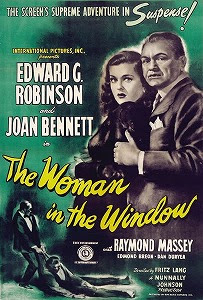
The Woman in the Window (1944) – Film-Noir

Starring Edward G. Robinson and Joan Bennett, this film-noir involves an ordinary psychology professor and a beautiful woman. The story begins at the club where the professor and his friends begin to discuss an enchanting portrait of a woman in a store window. He stays behind for a while longer and before he leaves he takes one last look at the painting. And there he meets the woman herself who then invites him over for a drink. However, her angry boyfriend comes by and he is left dead after a scuffle. Now the two perpetrators must cover up their murder and dispose of the body. That task goes to the professor and he naively dumps it out in the country leaving behind numerous clues. One of the professor’s friends is the district attorney and so he finds himself invited back to the scene of the crime. The professor is not suspected but the woman is blackmailed by a low life ex-cop who threatens to expose them if he doesn’t get his money. Much to the woman’s relief the blackmailer is killed but it comes too late for the professor. Or does it? This noir directed by Fritz Lang focuses on a mysterious woman and psychology. It also has one of the most abrupt, out of the blue endings. Every movie should not be resolved this way but I rather liked it one time around.

4/5 Stars

The Third Man (1949) – Film-Noir

In this film starring Joseph Cotten, Valli, and Orson Welles, an American western writer (Cotten) travels to post-war Vienna to meet a friend. Upon arriving he learns that his buddy has been killed in an accident. Not quite satisfied, he does some of his own investigating and along the way meets his friend’s beautiful lover (Valli). Together they try to cope and make sense of the loose ends. However, neither of them expected the shocking evidence which was to come. Who is the Third Man and where is he? Made in the film-noir fashion, The Third Man utilizes lighting and contrasting black and white cinematography effectively. The actual on location shooting in post-war Vienna helps add to the gritty realism. Although simple, the score comprised solely of zither music is no less powerful.

This movie will have you engrossed in the mysterious occurrences since The Third Man simply has some good twists. Whether Holly Martins is whisked away in a car, Harry Lime makes a dramatic entrance or Lime runs away into the sewer system, many of the moments are full of intrigue. I also think this is one of Orson Welles finest performances, because although his screen time is minimal, he has such a tremendous impact on the film. He portrays a very mysterious character in Harry Lime who certainly has his complexities. The ironic and abrupt ending seems to close the film just as it began. However, so much happens in the course of events. The film is even realistic in the language and dialogue, showing the differences between people. Because when it all comes down to it this film may revolve around one man, but it is really about the varying relationships between people.

5/5 Stars

What Ever Happened to Baby Jane? (1962)

This psychological thriller starring Bette Davis and Joan Crawford with Victor Buono, opens with the bratty vaudeville star Baby Jane Hudson. Her sister Blanche lives in her shadow but begrudgingly agrees to watch out for her sister. Now in the 1930s Blanche is the movie star and Jane is all but forgotten. After a mysterious accident, the film moves to the present where Blanche is confined to a wheelchair and Jane vengefully takes care of her. Because of Jane’s psychotic and often cruel behavior, Blanche tries getting help several times but to no avail. She is at the mercy of her sister, when Jane is not trying to renew her career with the help of a young accompanist. Ultimately  the truth is revealed and the film ends on a pitiful note. This film is full of suspense and Davis is absolutely creepy; never was one staircase so integral to a story either.

4.5/5 Stars

Anatomy of a Murder (1959)

251e0-anatomymurder2Starring Jimmy Stewart, George C. Scott, Lee Remick, and a cast of others, the film follows a small town lawyer (Stewart) as he defends a man who has committed murder. The whole case is complicated by the fact that the Lieutenant’s beautiful wife was supposedly raped by the murdered man. Now Stewart must battle it out in court using every strategy he knows in order to save his client. With the help of witnesses and evidence both sides have substantial cases. However, Stewart finds the topper in the dead man’s daughter, hoping this will save his client’s life. Despite the valiant effort of the prosecuting attorney and Stewart, everything is in the hands of the jury so now all they can do is wait. With an interesting score, a methodical story, and a great cast, this movie was a good one. The judge especially made this film enjoyable for me and you certainly cannot beat Stewart. It should also be noted that this film has one of the most famous movie posters of all time which was designed by Saul Bass.

4.5/5 Stars

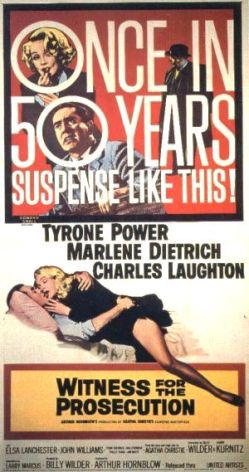
Witness for the Prosecution (1957)

Starring Charles Laughton, Tyrone Power, and Marlene Dietrich with direction by Billy Wilder, this courtroom drama follows the trial of a man accused of murder. Laughton is an English defense attorney just recovering from a heart attack. However, soon he gets so intrigued by Power’s case that he agrees to defend him. Power’s character Vole seems to be falsely accused for the murder of a widowed woman he hardly knew. He does have an alibi in his wife (Dietrich) but she seems to refute Vole’s words and the case takes a bad turn. Through a flashback we see into their complicated past. The befuddled Laughton finally catches a break and is able to prove Dietrich is lying. He has been victorious in defending Vole but then the plot takes a cruel twist. What was reality before now seems to be completely false. Adapted from a story by Agatha Christie, this film has good characters and a brilliant climax.

4.5/5 Stars

All the President’s Men (1976)

89d88-mv5bodaxmtc4odcxnf5bml5banbnxkftztcwndy0ntaymq-_v1-_sy317_cr80214317_Starring Robert Redford and Dustin Hoffman, this political thriller follows two young investigative journalists as they try to uncover the truth after a mysterious break in at the Watergate Hotel. The Washington Post is the only paper covering the issue that many have dismissed as an isolated event. These two men try to follow all the leads they have but they reach a dead end since no one seems willing to talk. However, with the help of the anonymous source Deep Throat, tireless searching, and a few witnesses, the pieces begin to come together. Little do they know the extent of what they have happened upon. Ultimately, their story about Watergate would lead to the scandal that ended in Richard Nixon’s resignation. This is not only an intriguing film, but it also holds tremendous historical importance.

4.5/5 Stars

The Silence of the Lambs (1991)

Starring Jodie Foster and Anthony Hopkins in two memorable performances, the film opens with a young FBI agent in training, Clarice Starling (Foster). A serial killer nicknamed Buffalo Bill is on the loose and Starling is given the assignment of talking to the incarcerated Hannibal Lecter (Hopkins). He formally was a brilliant psychiatrist and he turned into a cannibalistic killer. Lecter gives Starling hints on how to find the killer but not without forcing her to open up about her past. She closes in on the murderer and after some tense moments she finishes the job a hero. Now a certified FBI agent, Starling gets a call from Lecter who had escaped previously. He bids her farewell as chilling as ever and this time he is a free man. The acting was good and there were definitely some great thrills.

4.5/5 Stars

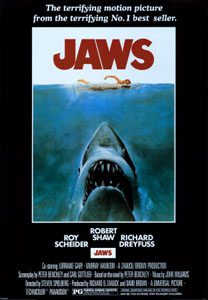
Jaws (1975)

This is arguably the first great modern blockbuster and it had such a tremendous cultural impact. Who knew a rogue shark, a wonderfully chilling score, and an isolated setting off the east coast could send so many shivers up the spines of audiences. Jaws is the classic man vs. nature story and proves how deadly it can turn out.

*May Contain Spoilers

The movie that kept millions of people from going in the Ocean in the 70s, Jaws tells of a shark terrorizing a tourist trap off the coast of Massachusetts. The policeman (Roy Scheider) must team up with a marine scientist (Richard Dreyfuss), and a hunter (Robert Shaw) to bring down the monster. Together they embark to try to hunt down and kill this menace of the deep. Little do they know how dangerous this creature is. When they finally meet they are in for a few unpleasant surprises. It is evident that either man or best must win or die. There is no compromise when man goes up against shark. This early Speilberg film was a glimpse of good thing to come and successfully began his great career.

5/5 Stars