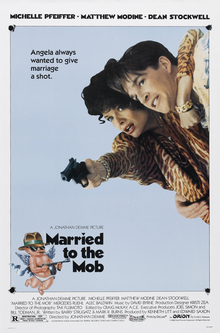
Married to The Mob (1988)

Although he’s not always easy to pin down across his oeuvre, Jonathan Demme’s collaboration with Tak Fujimoto in Married to the Mob elicits a visual style that can most easily be married with their work together in Something Wild. It feels free and easy yet still deeply empathetic through those trademark POV close-ups. In fact, it takes the gangster motif of Ray Liotta from the previous film a bit further.

One of the virtues of Married to the Mob is how it never takes itself too seriously, and it’s this awareness that makes it a pleasure to be a part of. Demme had some kinship with Martin Scorsese, and it’s like he’s readily exploring the other director’s usual milieu without totally giving himself over to the gratuitous nature of it all. Despite an opening hit on a train, plenty of gunplay, and the general immersion in the mob world, he’s not going to fully succumb to it.

Scorsese is fascinated by the dichotomy of the sacred and profane he found in his own boyhood community. However, Demme’s not about to make Mean Streets or even Goodfellas. Instead, he focuses his energies on someone who, in the predominantly patriarchal world, would normally be pushed to the periphery. It seems entirely fitting that he would focus on a mob wife (Michelle Pfeiffer), married into the organization while growing increasingly disillusioned with the lifestyle.

Her husband is one of the local kingpin’s cronies. Their son has been conning all the local kids in their affluent neighborhood out of their pocket change. There are firearms in the junk drawer, and furniture purloined from who knows where. Her husband’s satisfied with the bottom line. She has a conscience and desires a better life for her boy. It all goes back to the influence of one man: His name is Tony the Tiger.

Dean Stockwell, the journeyman who began as a child actor in Classic Hollywood and then famously ran in circles with Dennis Hopper during the counterculture era, left the industry behind only to come back quite spectacularly.

Paris, Texas, Blue Velvet, and even Quantum Leap are hard to forget, and yet, added to the list, you must include Tony the Tiger in Married to The Mob. He’s having so much fun relishing the part of a heavy, and it radiates out of him.

There’s hardly a need to go into the particulars because we’re all familiar with the archetype, and yet when he finally shows up in the movie, there’s something inimitable about him. It’s not what he is but how he does it that matters most.

He has a weakness for pretty girls. He’ll even kill for them, going so far as to knock off a rival. He’s ruthless, and in the same breath, he has a certain moral code of conduct. He believes in family and taking care of those who are loyal to him. Perhaps even those whom he’s hurt. After Angela’s husband is killed, he vows to take care of the man’s grieving widow, although his reach is a bit more hands-on than she would like.

When she gets up and leaves her present life behind, selling all their worldly possessions, and relocating her son to a much humbler neighborhood, it gives the movie something more. This is where it becomes a hybrid rom-com, and Matthew Modine and Michelle Pfeiffer stir up their chemistry.

They meet in an elevator in a grungy apartment building. He’s keeping surveillance on her, and she’s trying to get away from the mob. This is the subtext. She has the forthright honesty to ask him out on a date, and he accepts. It’s easy to suspect his motives, and yet there’s a sense he’s game and obviously smitten once he gets to know her.

This isn’t a rehash of Notorious, where the agent falls in love with the girl even as he belittles her reputation. It’s a lot more innocent and humane than that (although they are still bugging her apartment). We know he must fess up eventually.

Of course, it must hit some inflection point in their relationship. His superior gets involved, she finds out who he really is, and Tony is on the run after an attempt on his life. He carts Angela off to Miami for a weekend as he does his best to dodge his own jealous wife.

Everything must inevitably go wrong for him, but thankfully, it’s just as much about the comedy as it is hammering home the crime drama. Demme never allows us to lose affection for any of these characters, really.

If there’s any mild complaint, it’s only that the movie resolves itself quite easily. But again, it’s not looking to be The Departed. This point of view is not of interest, and so in its send-up, we get something that’s tonally so different and rather endearing.

With each subsequent film I watch of Demme, I’ve been increasingly smitten. Because you start with something like Silence of The Lambs only to feel out the rest of his filmography to find so many countless gems. These are movies with eccentricities, comic verve, wildly phenomenal soundtracks, and an eye for characters (and actors) who would often be disregarded by other directors. Michelle Pfeiffer’s Angela and then Dean Stockwell feel like a case and point in this movie.

4/5 Stars
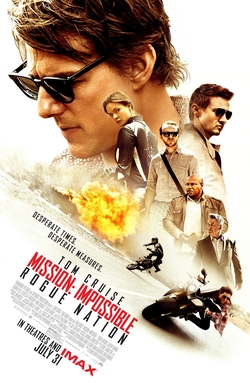
Mission Impossible: Rogue Nation (2015)

Imission_impossible_rogue_nation_postern the last decade or so arguably the greatest action/spy/thriller franchises have been Jason Bourne, James Bond, and Mission Impossible. To their credit, each series has crafted several passable films fortified by a few real stalwarts of the spy thriller genre. Although many of these series thrive on gadgetry, set pieces, and a cynical tone more at home in the modern millennium, one thing that set some of the better films apart were interesting female characters.

James Bond is an icon. Jason Bourne is a modern icon. Tom Cruise as an action hero is an icon on his own merit. But we expect that to a certain degree. What the cinematic world has not had for as long are phenomenal female action heroes and the parameters seem far more complicated than simply being adequate at kicking butt. For instance, Casino Royale boasted Vesper Lynd (Eva Green) arguably the greatest of the Bond Girls because she was far from simple eye candy — a throwaway sidekick — she actually was witty and interesting and tragic. All those things.

It’s also no surprise that writer-director Christopher McQuarrie teamed up with Tom Cruise yet again to follow up the surprising success of Edge of Tomorrow which showcased another strong female lead in Emily Blunt.

Thus,  in some ways, it makes sense that Rebecca Ferguson steals the show in Mission Impossible: Rogue Nation. But it’s not any less surprising. There are numerous other major names. Obviously, Cruise first and foremost then Jeremy Renner, Simon Pegg, Alec Baldwin, and Ving Rhames. But they’re all playing the parts that we’ve seen before. Computer geniuses. CIA Operatives. Rogue agents. Program Directors. There’s a shadowy villain played by Sean Harris and yet another organization with vague but nevertheless ominous intentions called “The Syndicate.” You get the picture.

But for the simple fact that female action stars are often few and far between on the big screen, Rebecca Ferguson is a true scene stealer. And she starts off quickly by subverting our expectations as an audience. She’s very pretty indeed but her role is not necessarily about her looks which is terribly refreshing. She’s smart, clever, enigmatic, and she seemingly has the most complicated trajectory in the entire film. As an audience, we don’t know where her loyalties lie although we have our suspicions. But more powerfully, she does not quite know herself. Best of all there are no overtly provocative scenes crammed into the story line with the sole objective to sell tickets.

Tom Cruise proves he can still carry a great action movie yet again and that’s because he’s playing it smart — surrounding himself with great talent — and benefiting from his supporting cast. Rogue Nation is not groundbreaking by any means but it’s wonderfully diverting with all the impossible missions, double crosses, and intrigue that we could want. What it sets out to do it does quite well and keeps us entertained in the process.

As a caveat, the fact that our main heroine is named Ilsa and because the film found its way to Casablanca amid its jet-setting, it made me eager for a little bit of Bogart & Bergman. Also, I wouldn’t mind catching a few reruns of Peter Graves. But that’s not to take away from this film. Enjoy it unabashedly. It really is a great deal of fun.

3.5/5 Stars

Blue Jasmine (2013)

90cbd-blue_jasmineThe emotionally unstable socialite Jasmine (Cate Blanchett) seems to think everyone in the world wants to listen to her talk and reminisce
This film shares a resemblance to Tennessee William’s A Streetcar Named Desire, and it can be know coincidence because Woody Allen knows his history.  On her part, Blanchett ironically shines as Jasmine, a woman who was married to a swindler (Alec Baldwin), has a nervous breakdown and then finds herself penniless in San Fran on her sister’s doorstep (Sally Hawkins). Jasmine is a snobbish jetsetter who had all the possessions that money could buy and a successful hubby. However, pull out the rug from under her and what’s left is a needy hypochondriac plagued by bouts of loneliness.  When she’s not jamming down pills chased by martinis, she’s feeling sorry for herself. She is also often prone to be unstable and throw tantrums. But by the end of this film she is all alone on a bench. No money, no family, not even any love life. Jasmine is a tough case because she is absolutely despicable and on top of that annoying, and yet we still have a small degree of sympathy for her. Allen’s film walks the tightrope between comedy and tragedy to great effect. 
 
4/5 Stars 


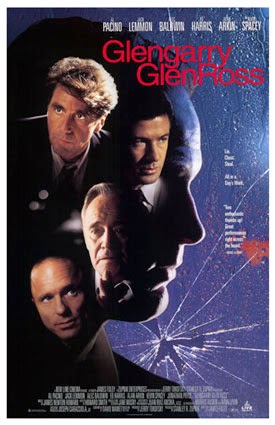
Glengarry Glen Ross (1992)

fa822-glengarrymovieIt’s a film about a despicable world which promotes despicable people and despicable behavior. That’s the world of the real estate salesmen in Glengarry Glen Ross. Here are men who use any mode necessary to close deals as they say. They finagle, lie, cheat and even steal because those are just tricks of the trade. Those who get the good leads are able to close more deals and make more bank. Those who get the leftovers struggle to swing something out of nothing. Shelley “The Machine” Levene (Jack Lemmon) is one of those struggling after many years of success in the business or racket, whichever you prefer. He has a lovely personality, rather like a hissing snake trying to seduce you before going in for the kill. On the flip side, he can be a real jerk and he is unscrupulous as all get out.

But that’s enough on Shelley. The office is run by rigid John Williamson (Kevin Spacey) who just follows his orders and does not budge an inch. Then there is Ricky Roma (Al Pacino), the top closer who is especially cynical but also a great admirer of Shelley’s skill. Dave Moss (Ed Harris) is a man with a big mouth and fiery temper not ready to sit by while other men outperform him. Finally, there’s George Aaronow (Alan Arkin) a man who humors Moss and is also fed up with his situation.

The wheels start turning when the Big Whigs send in a man named Blake (Alec Baldwin) to motivate the salesmen. It’s the survival of the fittest after all and they know what it takes to sell real estate so he encourages them to go and do likewise. His main tactics include berating, insults, and threats against their careers (They either get a car, a set of knives or the boot). Verbal attacks are sometimes more pernicious than physical beatings and that’s the truth here. They never relent even after Blake leaves because that’s the type of choice words that this environment fosters. One minute a salesman uses a polished voice to coerce a client then turns right around to bad mouth a colleague.

Moss on his part tries to pull Aaronow into his plan to steal the good leads from Williamson’s office. A desperate Levene tries to get better leads from an unrelenting Williamson as the veteran man struggles to convince clients and deal with his ill daughter. Roma, on his part, is at top form playing his client (Jonathan Pryce) and getting him to stay with a deal until it gets messed up. In the process we see all the pettiness, desperateness and corruption unleashed. The burglary goes down and it does not necessarily involve who you would think. Maybe it does. That’s not the point, though. The point is these men will do anything given the position they are in, but it’s not that simple because each one has their complexities. For instance, Levene and Roma are on very good terms and Moss and Aaronow seem very buddy, buddy. But ultimately it seems they look out for number one and that takes its toll on any human being.

The film is a biting drama brought to us through a fiery and sometimes brutal script from David Mamet, based on his play. Furthermore, the story is aided by an all-star cast of big names. Each one plays an equally despicable character. I knew Pacino, Spacey, Harris, and Arkin were up to the task because I had seen them before in tough or villainous roles. However, to his credit Jack Lemmon shows his versatility here since I absolutely despised him for once. That’s no easy task and he proved it to be possible. This film may be a black comedy, but there really should not be much to laugh at.

3.5/5 Stars