Roman Holiday (1953)

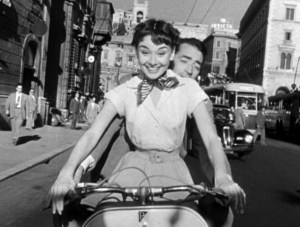
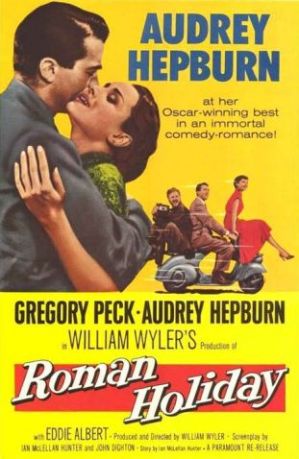
3fd3e-roman_holidayStarring Gregory Peck and Audrey Hepburn with direction by William Wyler, this movie has one of the greatest romances ever depicted on screen. Hepburn is a young princess named Ann on a trip to a foreign country. However, she is constantly bored from the rigidness of her life. On a whim she escapes in the night and finds herself sleepily wandering the streets of Rome. An American journalist (Peck) happens upon the disorientated princess and eventually decides to take her in since she seems lost. Soon enough he figures out just who she is and decides to take her through Rome with a friend (Eddie Albert) so they can get a scoop. Together they take her through the city to explore and secretly take candid photos.

However, Peck soon finds himself falling in love and he cannot bring himself to submit the article. With the thanks of the princess, they are left with the simple satisfaction that they were able to spend the day together. Peck and Hepburn are both wonderful in this one and the story is heartwarming and funny.

I tried to figure out why it is always so enjoyable coming back to this film. Was it the romantic chemistry of Peck and Hepburn, the timeless setting of Rome? Or perhaps is it the direction by William Wyler, the screenplay by blacklisted Dalton Trumbo, or the support work of Eddie Albert as Irving? Undoubtedly all of these wonderful occurrences play some part in making this film a classic.

Most of all it struck me that much like Jacques Tati’s Mr. Hulot’s Holiday, this is not just a film. It is quite like a vacation for the audience and we get to enjoy it along with all the main players. We get the privilege of taking part in all the adventure and the laughs. By the end we don’t want it to end but like any holiday we must say goodbye and wait until our next vacation comes around. Thus, it seems that Roman Holiday never gets old because the audience is constantly looking forward to the time away in 1950s Rome with our romantic stars.

5/5 Stars
The Lavender Hill Mob (1951)

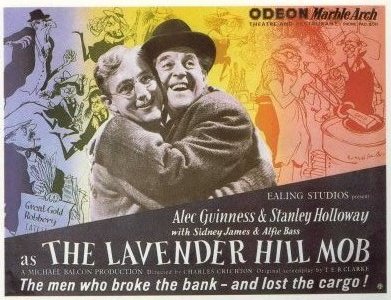
1dadb-the_lavender_hill_mobStarring Alec Guinness and David Holloway this Ealing Studios comedy-heist film begins with an older man recounting how he got away with a large amount of gold bullion. His job had been to ride with gold shipments while they were transported. However, soon he met a quirky fellow partial to art and together they devised a plan to get the gold. They enlisted the help of two small-time criminals. The day of the caper was far from smooth and they must improvise. With luck they get away and the two instigators take their prize to Paris. There they have disastrous results and arrive back in England eventually to even more craziness. This film had endearing characters and its share of comical moments. If you pay attention you can see a young Audrey Hepburn for a blink of an eye near the beginning too!

4.5/5 Stars

Star of the Month: Audrey Hepburn

As a young girl Audrey Hepburn lived in occupied Netherlands during WWII and she trained as a ballerina and she would continue this for a time before turning to acting. She had bit parts in a few films including The Lavender Hill Mob before getting her big chance as the title character of the Broadway play Gigi. It was after this that she hit the big time with her performance in Roman Holiday opposite Gregory Peck, and from that point on the film world was enamored with her.

Audrey Hepburn began as a timid yet graceful young woman who captivated audiences in films such as Roman Holiday and then Sabrina. However, over time she kept many of those qualities but also evolved into a tremendous actress and chic fashion icon. Into the 1960s she appeared in such classics as Breakfast at Tiffany’s which is possibly her most remembered role with an iconic wardrobe by Givenchy. Then, she went onto Charade with Cary Grant, and then My Fair Lady in 1964 with Rex Harrison. The first being a romantic thriller and the other a musical based off the work of George Bernard Shaw; very diverse roles to say the least. Two of her last great films came out in 1967. Wait Until Dark had her playing a blind victimized woman to perfection and then in Two for the Road she struggles through the ups and downs of a marriage with Albert Finney. Some films I did not even mention are Funny Face, Love in the Afternoon, A Nun’s Story, and How to Steal a Million. Whatever you think of her films I think it must be said that Ms. Hepburn was certainly captivating in each and every role. She is one of the icons who transcends the movies with her iconic fashion, her immense charity, and above all her humble grace.

Happy Birthday Audrey!

It is better late than never so I want to briefly acknowledge that today would have been the birthday of everybody’s favorite actress Miss Audrey Hepburn! She was a film and fashion icon with an elegant grace that radiated from her. From Roman Holiday to Breakfast at Tiffany’s she lights up the screen with her memorable portrayals. I doubt there will ever be another who could match the likes of Audrey.

Audrey Hepburn (Part 2)

Charade (1963)

Starring the romantic pair of Cary Grant and Audrey Hepburn, with Walter Matthau, James Coburn, and George Kennedy, this film is considered the best “Hitchcock film” which the director did not make. While on vacation, Grant and Hepburn first meet briefly and then she returns to her home Paris. Hepburn goes there only to find out her husband, who she wanted to divorce, has been murdered. When meeting with a CIA man (Matthau), she learns that her husband and three buddies stole some money during a war but the three chums never got their shares. Upon meeting Grant again, he agrees to help Regina (Hepburn) and also says he is looking for the money. Through a series of events the three other men are all killed and everything seems to point to Grant. Hepburn runs for her life with Grant close behind and winds up meeting the CIA man. However everything is not as it seems and after a shoot out Hepburn finally realizes the truth. Along with the thrills this movie has a nice score and a touch of comedy (including Grant’s many aliases).

8/10 rating

My Fair Lady (1964)
Adapted from the book and play Pygmalion, originally written by George Bernard Shaw, My Fair Lady stars Audrey Hepburn and Rex Harrison. It follows a speech therapist (Harrison) as he tries to win a bet that he can pass off a poor flower girl as a duchess. He takes Eliza Doolittle (Hepburn) and begins to train her, not as a person but as an experiment. Eliza eventually gets fed up with this treatment but at the same time also wants to become sophisticated. With Harrison’s help she does become that person and is no longer a subject to be experimented with. Putting together a good cast, plot, and songs, this film is quite good.

8/10 rating

Other Audrey Hepburn films I may watch in the future include: Funny Face (1957), Love in the Afternoon (1957), The Nun’s Story (1959), Two for the Road (1967), and Wait Until Dark (1967).

Audrey Hepburn can also be seen extremely briefly in the classic comedy-heist film The Lavender Hill Mob (1951)

Audrey Hepburn (Part 1)

0c1fc-audrey_hepburn_and_gregory_peck_on_vespa_in_roman_holiday_trailer

Audrey Hepburn began as a timid yet graceful young woman who captivated audiences. Over time she kept many of those qualities but also evolved into a tremendous actress and chic fashion icon. She was versatile acting in both romantic comedies and dramas. After her triumphal success in Roman Holiday she became beloved by many over the years.

Roman Holiday (1953)
Starring Gregory Peck and Audrey Hepburn with direction by William Wyler, this movie has one of the greatest romances ever depicted on screen. Hepburn is a young princess named Ann on a trip to a foreign country. However, she is constantly bored from the rigidness of her life. On a whim she escapes in the night and finds herself sleepily wandering the streets of Rome. An American journalist (Peck) happens upon the disorientated princess and eventually decides to take her in since she seems lost. Soon enough he figures out just who she is and decides to take her through Rome with a friend (Eddie Albert) so they can get a scoop. Together they take her through the city to explore and secretly take candid photos. However, Peck soon finds himself falling in love and he cannot bring himself to submit the article. With the thanks of the princess, they are left with the simple satisfaction that they were able to spend the day together. Peck and Hepburn are both wonderful in this one and the story is heartwarming and funny.

9/10 rating

Sabrina (1954)
Starring Audrey Hepburn, Humphrey Bogart, and William Holden, with director Billy Wilder, the film begins with Sabrina (Hepburn) as a young girl. She lives with her father who is a chauffeur for a rich family. Sabrina loves the younger playboy son (Holden) however he gives her no serious attention. Depressed, Sabrina wants to kill herself and her father decides to send her off to culinary school in France. Some time passes and the grown up Sabrina is a perfect lady. Soon she catches the eye of Holden back home and all her dreams come true when they spend time together at a party. However, his older practical brother (Bogart) does not like it one bit since Holden has a fiancee. Wanting to get Sabrina away from his brother, Linus wines and dines her so the strategic wedding will stay on schedule. He then gives her a one way ticket and sends her off. Only afterward does he realize his own feelings for Sabrina and thus he decides to follow her. This film overall is a charming romance that is worth seeing.

8/10 rating

Breakfast at Tiffany’s (1961)
Starring Audrey Hepburn and George Peppard, the movie follows the lavish lifestyle of the ditsy Holly Golightly. Moving into her apartment building, the down-on-his-luck writer Paul immediately grows fond of Holly’s quirky personality. Considering each other simply friends, Paul comes to one of Holly’s wild parties and they journey through New York together. However, although Paul is falling for Holly, his circumstances seem to prevent it and besides she is oblivious to his affection. Slowly they fall farther apart with Holly’s upcoming marriage to a wealthy man. In the end they do reconcile, embracing in the rain (of course). Holly has finally found a man who truly loves her and does not use her. The love story is an interesting one and Hepburn gives a lively performance. Henry Mancini’s “Moon River” is a wonderful addition to this film. I would say however that this is not my favorite film with Hepburn because it is certainly hard to top Roman Holiday.

8/10 rating