Detour (1945)

detour1Hollywood is really missing out, because with the direction that the industry has gone there really is no space for a film like Detour to be made by conventional methods anymore. It was shot in less than two weeks. It cost a minuscule amount compared to the contemporary A-Pictures, and yet it used its low production values as an advantage, not a curse.  Director Edgar G. Ulmer was the king of so-called B-films of Poverty Row and Detour was his shining gem. It feels a lot like the later film-noir D.O.A. because both have a main conceit that might be hard to swallow at first, but if you do that initially, you quickly find the film thoroughly rewarding on its own merit.

The sets are simple. A diner, a car, a hotel room, and that’s honestly about it. The actors are pretty obscure by today’s standards. Tom Neal was made for this role of the fateful victim Al Roberts, with his constantly pouting face and a pair of despondent eyes. As he sits glowering in a roadside diner it’s hard to imagine he’s ever smiled in his life. He’s a real sourpuss.

There was a time, back in the day, when he made a modest living as a piano player in a New York club. He had a girl named Sue, and he was relatively content playing the bouncy tune “I Can’t Believe You Fell in Love With Me” while making a few bucks. Now the song haunts him wherever he goes. Sue left to try her luck in Hollywood and soon after Al began his long hitchhike to California to rendezvous with her. On one unassuming evening, all his luck changed. Just like that.

An obliging fellow offered him a ride and they get on well enough. He’s a bookie, but not a bad fellow, so Charles Haskell and Al get on fine. Then they switch up driving duties and a little light rain starts coming down into the convertible. Al goes to put up the top because he assumes Haskell’s only asleep. But when he opens the side door, Haskell falls to the ground. DEAD! Al does what any normal human being would do and he freaks out. Should he dump the body? What should he do with the car? Did anyone see him? Will the people back at the rest stop be able to I.D. him? What will the cops say if they hear his story?

And so he ends up getting rid of Haskell (in a sense playing the role of guilt) and takes on the man’s identity. But wouldn’t you know it, the first person he picks up is the fiery Vera (Ann Savage), who looks apt to claw your eyes out. Of course, she too got a ride from the real Haskell and isn’t buying Al’s story. She’s got him on the rack and she’s not about to let him get off easy. She wants a cut, she wants to sell the car, and Vera’s the only one who is going to call the shots. Al is a stuck, trapped, and paranoid, as Vera waves blackmail in front of his face and won’t let him breathe. She’s got him around her finger and there’s absolutely nothing he can do. After all, who would believe his story?

But whether it’s fate or whatever you want to call it, he gets out of it much in the same way he got into it. The resolution makes me grin because it’s so wonderfully contrived. There’s a tacked on ending to mollify the Production Codes (because Al couldn’t get away with his crime), but although it is an easy fix, it hardly takes away the potency of Detour. I long for the days they made films like this. Ann Savage somehow is nastier and crueler in a few minutes than most any character is in an entire film. It’s a brilliant role and honestly, she’s not my favorite femme fatale, but she has to be one of the most notorious. She seriously sends shivers up the spine.

“Isn’t that a laugh? Haskell got me into this mess, and Haskell was getting me out of it. The police were searching for a dead man. I keep trying to forget what happened, and wonder what my life might’ve been if that car of Haskell’s hadn’t stopped. But one thing I don’t have to wonder about; I know. Someday a car will stop to pick me up that I never thumbed. Yes, fate or some mysterious force can put the finger on you or me for no good reason at all.” – Al Roberts

4/5 Stars

Comanche Station (1960)

Comanche_Station_FilmPosterComanche Station opens with a man who willfully goes into Comanche territory. We don’t quite know why at first, but through haggling and bartering he’s able to save a captured white woman. It doesn’t come out until much later but it turns out that Jefferson Cody’s (Randolph Scott) own wife was captured by Comanche well nigh 10 years ago and he has never stopped looking.

The saved damsel Nancy Lowe gets the wrong impression about Cody believing the gruff figure was only in it for the money and that is far from the truth, as he intends to take her back to her husband out of harms way. That’s until they’re joined out on the trail by Ben Lane (Claude Atkins) and his two hired guns. Akins in fact takes on a role almost identical to Lee Marvin a few years before and he’s not quite as memorable. However, his two stooge sidekicks are more interesting, because although they are “outlaws” in a sense, we cannot help but like them for their buffoonery and conflicted morals.

Lane looks to ambush Cody and Mrs. Lowe so he can snag the reward, but Dobie will not take part. The shootout ensues between Cody and Lane. Afterwards the searcher leads the lady back to the arms of her husband. This final installment of Budd Boetticher’s Ranown Cycle shares some similarities to Seven Men From Now, but there is a totally different feel because the visuals are very different.

3.5/5 Stars

The Tall T (1957)

The_Tall_T_1957_PosterThe Tall T is a little different riff on the Budd Boetticher western, because it follows a former ranch hand named Pat Brennan who makes a stop at a local stagecoach way station to pay a visit to some locals before riding into the nearby town. Quickly we can see that Brennan is a little more jovial and still as tough as many of the other figures Scott has played.

He also is a first rate ranch hand, and yet after a bet with his old boss he loses his horse, because a bull throws him. Brennan attempts to catch a ride with a stagecoach with happens to be carrying two honeymooners, the timid Mrs. Mims and her stuffy husband. Reluctantly he is allowed to ride shotgun with the old time driver Rintoon (Arthur Hunnicutt) and it ends up being a regrettable decision. Mistaken for the regular stage, the four are hold up by three merciless outlaws looking for a big payoff.

They are led by Frank Usher (Richard Boone in a villainous turn), but the most deadly is Chink (Henry Silva), who seems eager to knockoff as many people as possible. And so a tense game of life and death ensues.  Rintoon attempts to fight back,  Mims agrees to go the cowardly route and ride off to try and attain ransom money. Brennan simply bides his time.

Unrest begins to build between the outlaws and Brennan takes his chance to save Mrs. Mims from the leering Billy Jack and bloodthirsty Chink. As the old story goes, the ringleader Usher is the only one left, but he has one last trick up his sleeve.

O’Sullivan’s role felt relatively minor, but it was quite fun to see Have Gun Will Travel’s Richard Boone opposite Randolph Scott. It made for a relatively interesting conflict.

3.5/5 Stars

Seven Men From Now (1956)

220px-Poster_of_the_movie_Seven_Men_from_NowAlong with Detour, Budd Boetticher’s Seven Men from Now is undoubtedly one of the greatest B-films I have seen to date. It rejuvenated the career of Randolph Scott who plays gruff sheriff Ben Stride. We are introduced to the often stoic man when he walks into a dimly lit cave during a torrential downpour. There he meets two strangers and demonstrates his skill with a gun for the first time.

For the rest of the film, he comes alongside a couple from the East, struggling to move westward with all their possessions carted on a wagon. The husband John Greer (Walter Reed), is a chipper man, but not a very adept pioneer. His kindly wife Annie (Gail Russell) loves him in spite of this ineptitude. He doesn’t say much, but Stride seems to like them both as well or at least, he knows they won’t make it very far without help. So after helping them get their wagon out of some thick mud, he sticks by their side.

They are eventually joined by Bill Masters (Lee Marvin) and his accomplice Clete, who look to make some money in the wake of Stride. He willfully explains to the Greers how Stride used to be the sheriff in the town of Silver Springs, before his wife was killed by a group of bandits when they were robbing a Wells Fargo shipment. He made it his mission to track down the seven men who took part in the act. And so as an opportunistic schemer Masters is content with riding along with Stride until the opportune moment to score a big payoff.

In this way, he helps the Greers and Stride fend off some Apache and even puts a bullet through a man before Stride gets it. If we didn’t know better, we might think that Lee Marvin has gone to the good side for once. But that’s not so. He’s full of insinuations, flirtations, and veiled threats that somehow feel more ominous than a Vince Stone or Liberty Valance. It’s not just physical brutality but he is playing perhaps an even deadlier game of mental warfare. Against not only Stride, but Mrs. Greer, and her husband.

It’s around this point that Masters and Clete make a move. They alert Stride’s nemesis to his plans and just like that two men go and ambush the veteran sheriff. He knocks them both off after receiving a wounded leg that leaves him unconscious out in the canyon. Luckily the Greers come across him and John decides to take responsibility for what he has unknowingly done. He goes into town to face the music for the role he has ignorantly taken in this whole deadly affair. After discounting Greer as weak and spineless, Masters is finally forced to recant his previous statement.

What’s left is Ben Stride out in the canyon with the Wells Fargo shipment, but with two new bandits and Masters and Clete, it looks to be a bloody finale. After a bit of backstabbing, Ben Stride stands alone in the aftermath. He has completed his odyssey and he says goodbye to Ms. Greer with a new resolve to take on the role of deputy sheriff in Silver Springs. But it’s doubtful if that is the end of his story.

4/5 Stars


Review: Gun Crazy (1950)

guncrazy2

Bart has an intense obsession with guns. It’s what his life revolves around. It’s the only thing he wants to do as a boy and the only things he seems to think about. It becomes a problem when he breaks a store window, but during the following hearing, his sister and friends vouch for his character. He would never take a human life or kill. That’s not in his nature.

No matter, it is decided Bart should be sent off to a special preparatory school, and he only returns years later as a grown man recently off a stint in the army.  He’s back in his hometown not quite sure what his future plans will be, but his buddies are glad to see him. They shoot some, drink a few beers, and decide to take a jaunt to the carnival for a night of fun.

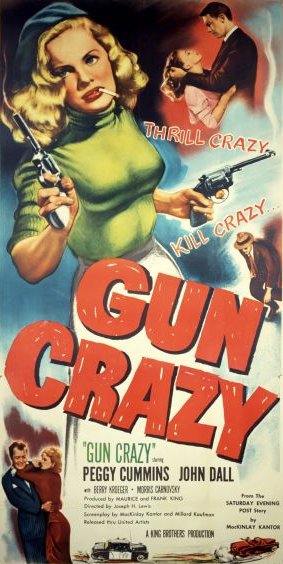
Their Bart meets the girls of his dreams. There’s a quality to John Dall that makes Bart into a pure victim of his circumstances. He’s quickly infatuated with the gun slinging and sensuous Peggy, who seems to share his one love. A goofy smile is plastered on his face as he faces off against her in an act of skill. He makes her uneasy and ultimately beats her. 

He gets a job with the carnival and spends as much time as he can with her when he’s not shooting guns. They are fed up with their boss and leave the migrant life behind. Marriage is on their radar, and they live it up with the money they have. But Peggy wants more and she wants to keep living the high life. 

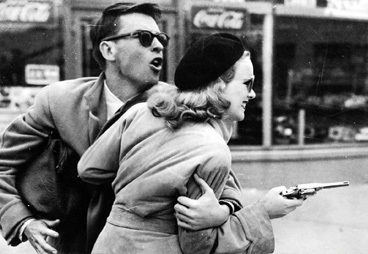
She wants to rob a gas station. It’s one little idea that soon blows way out of proportion. They are holding up banks, gas stations, and any place with money that they can lay their hands on. The pair is fugitives with exploits plastered all over the front pages and roadblocks waiting to stop them up. All the while Bart makes Peggy promise not to shoot anything because he still is totally opposed to killing people. 

It seems like things might end peaceably, except once again the gun-toting lovers are nearly flat broke so Peggy coaxes Bart into one last job to end all jobs. For the first time, despite their planning, just enough goes wrong to nearly botch their mission. Bart drives off and Peggy shoots a guard. He’s not the only one. 

 guncrazy1When Bart finds out, after the fact, he realizes they have just stepped up a level with murder stuck on them. The game is winding down and the only place Bart can turn is his hometown where his sister is. For good reason, she cannot stand Bart or Peggy who she sees as poisoning her brother. And it’s true. Bart seems different now, so paralyzed by fear that he even pulls a gun on his old friends.

The last ditch effort of Bart and Peggy is to literally head for the hills. The dragnet is sent out and the hounds are let loose. They hardly have a chance before dropping from exhaustion in a swamp. They’re trapped and a crazed Peggy looks to shoot it out to the death. But for once Bart breaks with her remembering his friends. It doesn’t help him much.

Gun Crazy is a B-film and yet it is easy to forget because the way Joseph H. Lewis constructed this film is so impressive in its economy. One scene that reflects this so beautifully is the long take from the back seat of the car. The camera does not change positioning and so we see a bank job from the outside, and it only helps to build up greater tension.

 We also have enough time to care about certain characters. We have enough time to see Peggy is really no good. Yet with her keen marksmanship, she is a different shade of femme-fatale who is still as deadly as any of her contemporaries. Along with They Live by Night (1948), this is one of the archetypal Bonnie and Clyde-esque films. Thank goodness this film’s title was changed from Deadly is the Female to the more apt Gun Crazy. That it is. 

4/5 Stars

Gun Crazy (1950) – Film-Noir

Starring John Dall and Peggy Cummins, the film opens with a young boy who is infatuated with guns. After stealing a gun from a hardware store, Bart is sent to reform school even though his friends and sister testify he would never kill a living thing with it. Bart spends some time in the army and finally returns home grown up. He goes to a carnival with old friends and meets a female sharpshooter. She gets him a job and they grow close only to be fired from the carnival. They get married and are happy for awhile but then she gives him a choice. Either they start robbing stores fro money or she will leave him. Reluctantly he agrees and they begin to get a little money robbing stores and gas stations. It is not enough so she convinces him to pull one last job so they can live a content life together. They begin working at a meat packing plant in preparation. The day arrives and they succeed but then Laurie shoots two people out of fear much to Bart’s horror. They must split up and the manhunt begins. The FBI track them down and the only place to go is back home. His old friends plead with him to surrender but they flee into the mountains with the authorities hot on their trail. They are trapped and Laurie is desperate once again but Bart cannot bear it anymore. Despite the tragic ending Bart ultimately redeems himself but it is too little too late. This was a precursor to Bonnie Clyde and it has its share of tense moments.

4/5 Stars