From its initiation in the opening shots, The Stunt Man is built out of a comic serendipity allowing it to execute its own sense of narrative rhythm. It leans into coincidence, cinematic logic, and what really necessitates reality. Consequently, all these themes lay the bedrock for what the film is as it blithely blends genre into a fluid creature with a penchant toward action, drama, romance, and the darkest most absurd sense of humor.
For a little bit of backdrop, Richard Benjamin was slated to direct the film in the early 1970s. Before him, two very telling directors were considered. The first was Francois Truffaut who made Day for Night (1973), a film that shares many of the same thematic elements as The Stunt Man. They both enter a full-fledged dialogue with the medium of film itself and the creative process behind it. At one time, Arthur Penn was also tapped. This seems uncanny as he would later helm Night Moves (1975) another movie involving a subplot of stuntmen flying planes and the like.
All said and done, this production was labyrinthian even by Hollywood standards. Filmed in 1978, it was finally released in 1980 at the dawn of a new decade. But given the subject matter, it somehow feels like a fitting representation of the industry.
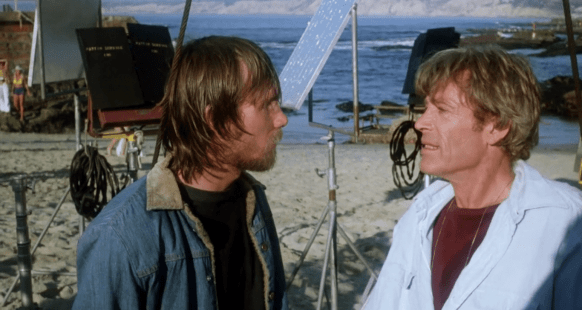
The Stunt Man, after all, is quite simple before it gets crazy. A fugitive (Steve Railsback) flees from the police utilizing his agility and Vietnam training to evade capture. Cameron breaks himself free from his handcuffs and then tries to blend into the beach scene at a nearby tourist trap in La Jolla. The ethereal theme music hums along, “Reality is your to define” and “What good are dreams in a world where nothing is at it seems.” The lyrics prove to be a portent.
Because they also just happen to be filming a movie — a WWI period piece led by the incomparable Eli Cross (Peter O’Toole) — and it’s drawn quite the crowd. The use of blood capsules at once leaves the audience gasping with horror and then the next cheering with adulation. It’s the magic of the movies in bodily form.
Where a woman peels off her facade to become someone else — a stunning leading lady (Barbara Hershey) for the scraggly-haired young man to carry off to safety like a knight in shining armor. However, the masses aren’t privy to some of the drama behind the scenes. A stunt man was tragically killed trying to get a crucial shot.
So the fugitive becomes a convenient figure, and Eli quickly pulls him into his production in a calculated move of madness. With the local police breathing down his neck about his filming schedule, he covers up the setback, keeping the ship aloft by turning the wanted man into their perished stunt man. It serves them both, and so they agree to the ludicrous alliance.
Thus, The Stunt Man takes the themes of Truffaut’s Day for Night to preposterous ends by cultivating this illusion of a patched-together reality played out on screen. Spurred on by a maniacal director, it creates a whole plot out of a dead man who is replaced by a stand-in.
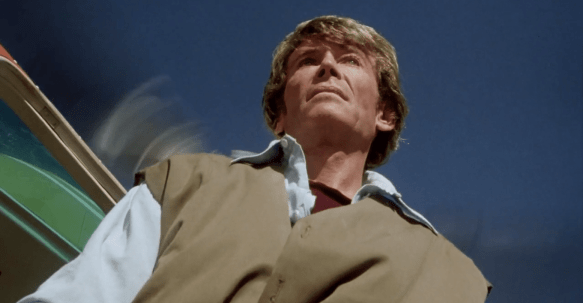
As he fluctuates between his chopper or his levitating crane, Eli blithely proclaims, “If God could do the tricks that we can do, he’d be a happy man.” It’s true there’s something powerful and deceptive about him. If he’s not the devil’s incarnate in a helicopter, then he might have at least made a deal with the fallen angel. He is symbolic of the director as madman — someone who likes spontaneity — and he will go to great lengths to preserve his art.
To the degree possible, the picture goes through the paces of an action movie and there are stakes, just not what we normally expect. Because there are payoffs and yet we know in some self-reflexive way they are all an illusion, more so than usual. What’s not false is the threat of death.
If Truffaut was fascinated in the artifice — this sense of relishing the reflection to life itself — then The Stunt Man gives it a sick twist. Where fiction and reality are like death-defying bedfellows. We rarely know when scenes are going horribly awry or strictly according to plan.
There’s this razor-thin line between stunt and sleights of hand and then disaster. Hence the reason this fugitive got his gig in the first place. It’s utter lunacy, and yet it’s a bit like watching a car wreck. Who’s going to turn away? We want to be wowed. And yet Cameron’s life hangs in the balance. He feels trapped inside the madness and Eli’s not about to let him escape.
Initially, he is taken in out of necessity and eventually disillusioned by the monster, even as he is driven toward his fateful conclusion. It’s inevitable. In none too many words, the show must go on, and Cross will go to the greatest lengths to make darn sure that it does. The script calls for it.
The ultimate joke is how it slaloms so fluidly between the heights of chaotic drama to this kind of absurd humor, sinking back into an uneasy equilibrium once the darkest devolutions have boiled over. This is what’s the most unsettling.
How the movie can be feel-good and joyous with a stunt man and leading lady embracing in a triumphant moment of euphoria. Likewise, the irascible, gargantuan personality of the director still comes off as strangely charismatic (thanks to O’Toole), but it drips with the delusional insanity of something like Apocalypse Now. In other words, you cannot marvel at the movie without shuddering and laughing rather uneasily at what movie magic entails.
Because The Stunt Man is not just about the art of being a stand-in and doing the impossible. It functions as an extension of the moviemaking process in its most harrowing iterations. We have to be a little mad. First, to make something like this, and then to sit in the dark and let it affect us so forcibly. Regardless, it’s an evocative and deeply unnerving ride. But isn’t that what we go to the movies for?
3.5/5 Stars
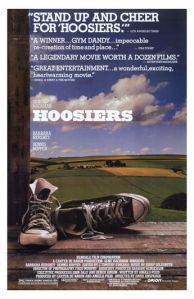 The last time I saw Hoosiers it was on VHS and I was only a boy and I hardly remember anything. Gene Hackman yelling. Dennis Hopper as a drunk. Jimmy the boy wonder, “The Picket Fence”, and of course Indiana basketball at its finest. But in those opening moments, as he drives into town and walks through the halls of his new home, I realized just how much I miss Gene Hackman. Yes, he’s still with us but the moment he decided to step out of the limelight and retire from his illustrious career as an actor, films got a little less exciting. His passionate often fiery charisma is dearly missed.
 4 Star Films