The Well (1951): A Noir about Racial Tension and Resolute Hope

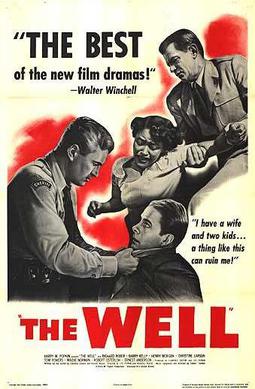
The film opens when a little black girl named Carolyn tumbles into a well buried beneath some weeds. There’s a melodramatic handling of the material, but already we see something rather uncommon with the period noir. Normally black characters live on the periphery of film noir if they exist at all.

Here Martha (Maidie Norman) and Ralph Crawford (Ernest Anderson) reach out to the local Sheriff Ben Kellogg (Richard Rober) when they learn their 5-year-old daughter has gone missing. They become the emotional center of this local drama with greater implications. As an aside, it’s a pleasure to see Ernest Anderson once again.

Those who recall him in This is Our Life (1942) will remember him to be a performer of tremendous intelligence and dignity. It’s only a shame the impediments of prejudice meant he never had a more sterling career. This film acts as a small recompense.

Upon closer inspection, The Well has shades of some other movies like Captive City or Phenix City Story where there is an adherence to faux realism as we kick around the beat meeting people, and getting to know the world they call home.

It’s fascinating to witness how this inciting incident — the disappearance of little Carolyn — sets the story in motion with Russell Rouse and Leo C. Popkin slowly turning the screw. Because it’s true there’s something rather insidious about this movie causing it to wheedle its way into our psyches.

It feels more relevant and more compelling than many of the old procedurals because of the subject of the case. It’s not just about a crime, but it’s complicated and made more tenuous with this added layer of racial tension, a very real issue even today.

Being a lifelong MASH aficionado, there’s something pleasing about Harry Morgan playing a central role as mining engineer Claude Packard. It’s quickly corroborated that he may have been the last person to see the girl; he’s a stranger from out of town, and curiously enough, he bought her a flower before sending her on her way.

It doesn’t take a genius to put all the pieces together and the racial element along with circumstantial evidence quickly brings the out-of-towner under the observation of the police.

The rumors quickly make the rounds throughout the neighborhood. In one brief vignette, a group of black students sits at a library conversing about race prejudice and a white man accused of a crime against a black child. It’s easy to forgive the blatant quality of this scene because it feels entirely unique for the era. I’ve never seen a moment like this before. But it’s not just a matter of the film feeling ahead of its time. After all, a lot can happen in 70 years, and values can change, though many things like racism feel deeply entrenched.

Still, there’s a complexity to the film that feels quite groundbreaking with something to speak to our current moment. Rather like Sam Fuller’s The Crimson Kimono, it’s a film about race, but it takes a somewhat nuanced approach.

The dramatic situation is obvious. Here there’s a white man being held for a crime against a black girl. The added wrinkle is that he didn’t actually commit a crime, but that doesn’t impact how the execution of justice is perceived by all bystanders on both sides of the racial line. It’s so easy to buy the message, “You can get away with murder if you’re the right color” because we’ve seen it play out so many countless times.

It’s also true Claude’s uncle is the highly influential businessman, Sam Packard (Barry Kelley) who runs a local construction company. He’s prepared to pay bail for his relation regardless of guilt or innocence. He doesn’t seem to care what the man did even as Claude vehemently pleads his innocence. If you’ve ever seen Kelly in another picture, he slides so easily into this role accentuated by his corpulent build and a pair of beady eyes.

From the outside looking in it’s so easy to view this as a miscarriage of justice where the authorities are steamrolled and wealth and privilege are able to get a white man out of anything. We’ve seen this before too.

At this point, retribution is all but expected, and it escalates with each successive confrontation between the divisive factions of blacks and whites. Once a tipping point is reached it’s like a never-ending feedback loop descending into chaos and quickly stoking the fires of unrest.

It strikes me how the mob is always going after the individuals in an almost faceless fashion. And both sides do it. There’s never a familiarity. It’s always swift and unfamiliar. But this kind of violence and hatred only breeds in anonymity where others are dehumanized and not dealt with as other human beings. It makes it easier to disassociate and perpetrate acts of malice.

It’s easy to gather the rest of the film is paved with this kind of violence. A full-blown riot is set to blow up the town and overwhelm any semblance of law and order. A movie like this also shows how the borders around language were so contrived. So many words were banned from motion pictures and yet the N-word flies so easily. It always catches me off guard, especially if we’re used to the normally manicured veneer of Classic Hollywood.

There are so many moments I can’t forget, but most of them are small observations. Take for instance, once when a white officer has a black kid up against the wall; he’s battered and bleeding, and he’s one of the perpetrators.

It turns out he was brawling with five white kids who the officer didn’t find a need to bring in. He gets a look from his superior and proceeds to get reassigned to phone duty so another officer can take this battered boy to the hospital. It’s a moment like this encapsulating something damning about law enforcement and the wheels of justice.

Part of me was expecting the film to detonate. With everything we witness, it’s all but inevitable. I’m hesitant to admit it, but I almost wanted it to. Instead, we get something else that’s closer to what we need. It feels like a near-timeless denouement because I need it as much today as audiences did back in 1951.

It shows people trying to help each other and trying to patch things up and figure things out. This is the hard work of reconciliation that’s not glamorous or easily cobbled together in a few solitary moments. And The Well’s also not a cloying feel-good balm to make all the bleeding hearts feel their work is done. It can’t patch over all the lingering wounds and racial tension. Not even time has done that.

Still, even as I mentioned Kelley is so easily identified and cast as a villain, the film uses this to say something more. He’s no saint, but he’s also a human being.

Billy Wilder was apparently interested in bringing the story to the screen in some form. I can see the parallels between Wilder’s Ace in The Hole/Big Carnival and this movie. However, whereas Wilder’s penchant is always toward portraying opportunistic cynicism, here we see something vying for the communal good.

Because of course, someone finally stumbles across Carolyn and that well. The movie switches directions as quickly as it starts. The whole town including mean old Mr. Packard and the accused Claude rally together their resources to rescue that little girl because there’s a chance she’s still alive and that’s all they require to act on.

That little girl becomes so crucial to this story representing so much more than her individual little frame. Forgive me, but I couldn’t help thinking about how George Floyd came to represent something else entirely in June of 2020.

I won’t try to come up with comparisons. All I know is that this movie deeply affected me, and I hope and pray that we might live in a world reflected in the rescue of that little girl. Because it says so much. If that little girl is alive now, over 70 years later (either in the film’s world or ours), I would hope she might stand as a beacon of what can be done.

What would it say about our towns if we were willing to go the extra mile to save the lost, the least of these, and the people who look different than us? It would suggest each of us has innumerable worth regardless of our skin color. It’s part of what makes us unique and individual.

These are not faceless beings lost in the masses but people known and loved. And what if it was not lip service or political PR, but actually lived out in our every day because it was the right thing to do. This feels like the movie I needed right now.

4.5/5 Stars

Note: I originally wrote this review in November 2021

711 Ocean Drive (1950): Joanne Dru and Edmond O’Brien

It serves the filmmakers to begin with an opening crawl about how organized crime tried to halt production of the movie, and they would have succeeded too if not for the bravery of the police on set. Whether or not it’s true, it plays as easy publicity for the film to feed off of. Today it feels needlessly trite.

Regardless, there is no movie without Edmond O’Brien. He’s more than up to the task as an electric wiz who works for the local telephone company. Mal Granger is a fairly likable guy; he’s free and easy with his money when a pal needs some help. In fact, he’s maybe a bit too free. His one vice is the horses, and he and his bookie know each other on a first name basis.

It’s Chippy (I wish we had more movies with Sammy White) who gives him big ideas: he can take his know-how and really go places. He’d be in high demand! Soon the connection is made, and he’s doing a lot of electrical work for Vince Wallace. Barry Kelley was made and no doubt typecast for playing seedy, slightly paunchy shysters. In this picture, he has an army of men relaying all the info from the race tracks.

Granger helps amplify their reach as they build a vast network that radiates out across Southern California. As purely a historical lesson, it is intriguing to watch O’Brien as he unfurls the latest technological gadgetry circa 1950.

They get so successful that the gangster’s legitimate business, Liberty Finance, catches the attention of the police. Soon enough one ambitious telephone repairman will be on their radar as well. Because he’s beginning to realize how important he is — he starts getting ideas of his own — he wants his due.

Although he has some faithful stalwarts around him like Chippy and Trudy (Dorothy Parker), it’s not a benevolent business. Because with every stride he makes, there’s always competition. The film’s next invention is an eastern syndicate run by a slyly imperious Otto Kruger. He moves all the chess pieces without taking part in any of the dirty work. He manages it all quite well with Palm Springs business meetings on the West Coast when needed.

For having prominent billing, and why not, Joanne Dru is quite tardy to the picture. We meet her in a nice hotel bar. She’s waiting for her husband (Don Porter), another underling in the syndicate, who has the task of wooing Granger. Their offer to cut him into their operation also comes with a veiled threat.

He’s not dumb, but he also sees the path of least resistance and with it exponential dollar signs. The pretty girl doesn’t hurt his eyes either. It hardly matters to him if she’s married. He starts shouldering in on the territory with his usual tenacity. It’s what sets him apart and simultaneously never leaves him satisfied.

The most sympathetic characters in the movie, Chippie, Trudy, and Gail, all have a threshold for contentment. Mal will never be satiated, and it’s his undoing. I didn’t note the parallel until this very moment, but he’s rather like King David if only for the fact he covets after another man’s wife and looks to end him. There is no going back.

Taking a page from Hitchcock, we are given a climax at a novel location. Granger tries to flee with his woman while the police pin them down near Boulder Dam. It’s a rather run-of-the-mill conclusion with running around, chasing hither and thither, and plenty of gunfire. It’s been done more expressively, but it gets the job done.

More than anything, we can appreciate the movie as a vehicle for O’Brien, as he was always an integral even ubiquitous noir character rather like Richard Conte. Here he’s given a different angle. We see his ambitions, his avarice, and ultimately, the corruption that overtakes him.

He’s still got a geniality about him and Dru surely helps to bring that out. Still, you’ve probably never seen him like this — at least if you were an audience member in the early ’50s. While it’s not top drawer, for those fond of O’Brien and Dru, it’s worth a look. Within the context of a fairly staid framework, you have characterizations drawing out the most enjoyable elements.

3.5/5 Stars

The Undercover Man (1949): Starring Glenn Ford

the undercover man 1.png

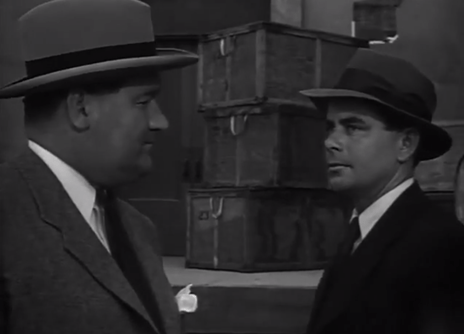
The Undercover Man gives off an early vibe akin to Anthony Mann’s T-Men thanks to a disclaimer reading something like this: Behind the big headlines are stories of ordinary men and women with extraordinary courage. This picture concerns one of those men.

However, the title is a bit of a misnomer. It is about government treasury agents, among them Frank Warren (Glenn Ford) and George Pappas (James Whitmore in his debut), but the real “undercover man” is the stoolie looking to spill the dope on the Big Fella — a stylized, faceless take on Al Capone.

As is, Joseph H. Lewis’s picture plays as more of an updated (or out of date) riff on the Untouchables and the Capone story. Instead of guns constantly blazing, they’re trying to get to the mob kingpin another way: His taxes. Thus, it relies on the persistence of our protagonists to see the story to completion.

While the characterizations are worthwhile — Glenn Ford was born to play these types of stalwart tough guy roles — the documentary-styled drama itself feels mostly stodgy and uninspired. Especially given the B mavericks pedigree for punchy and rather unnerving material with unconventional flourishes, it’s rather disappointing to admit this one feels quite run-of-the-mill — at least content-wise.

Lewis still develops engaging scenes from the outset including the botched rendezvous staged at the train station. After their crackerjack chomping canary gets it unceremoniously, Warren finds himself back at square one and growing testy by the minute. Because the mob has a hand in everything, and they’re leaning on everyone.

It goes beyond police corruption or paying everyone off. Even as they run around looking for leads, there are tight lips all around, because everyone’s scared. They have good reason to be. They’re suspicious of authority as much as organized crime. What assurance do they have their lives will not be impinged upon.

One of the movie’s most inspired figures is lawyer Edward O’Rourke (Barry Kelley), a paunchy, beady-eyed besuited fellow who oozes sliminess from his generally sociable demeanor.

While he’s not an out-and-out criminal type, he also has no morals. One foot is planted in the good citizens league and the other gladly helps the gangsters keep their stranglehold by wheedling out of all signs of trouble. He seems to also glean great delight by watching the government agents stand down, their hands normally tied. He always has a smart response for them.

Still, Frank’s latest mark, Salvatore Rocco (Anthony Carus) — an AWOL husband who is currently courting a showgirl (Kay Medford) — looks like his exorbitant greed might provide a bite. He’s willing to squawk for adequate compensation. Purely a two-bit opportunist. There’s only one way to deal with him…It’s one of the movie’s best set pieces as the informant races off, his daughter, Warren, and his assailants, all sprinting after him through the midday crowds.

For Warren, the job always gets in the way of his lovely marriage, and he and his wife (Nina Foch) especially suffer for it. They barely get any time together, and the rest of the time he’s crammed in a lousy hotel room bickering with his colleagues. Back amid the tranquility of his home life, he resolves to give up the whole business because the safety of his wife seems like too high a price to pay in the pursuit of justice. The visual dichotomy between the two spheres is especially evident due to Burnett Guffey’s characteristically stark photography

His decision could be the unceremonious end to the picture, but we get a bit more — a nighttime visit. It is the obvious entreaty for him to consider the crusade. He’s not one to see evil and run away with his tail between his legs.

None of this is much of a surprise as we cycle through yet another bookkeeper, this time one Sydney Gordon (Leo Penn), who is on the lam with his newlywed wife (Patricia Barry). The question is whether or not they can convince him to talk and if he does agree, can they even protect him?

The last few minutes are worth seeing through to the end specifically because the action falls on the two most compelling characters in the whole story. For the first time, our hero has O’Rourke on the back foot forcing his hand. He really is the crucial piece since, with the sides drawn up between the good guys and bad, he plays like the wild card. The ending is a foregone conclusion, although, on the road, there are several tense confrontations predating the more action-dominated days of Robert Stack’s Untouchables.

3/5 Stars