
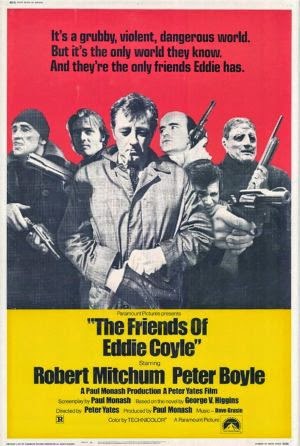
 In this precursor to other gritty Boston crime films like The Departed, Eddie “Fingers” Royle (Robert Mitchum) is a middle-aged truck driver who does some gun running on the side for the mob. On one occasion he got caught with his hand in the cookie jar, and it meant two more years of jail time. He’s seen the clink before.
Three men have been pulling off bank jobs in clear daylight using hostages and new guns each time. Eddie is the guy who has been delivering the guns, and he deals with a young thug (Steven Keats) who acquires the stolen merchandise.
Eddie also gets acquainted with F.B.I. agent Dave Folley (Richard Jordan) who tells Eddie his only way to dodge prison is to become an informer. Unbeknownst to Eddie, Folley has another informant working for him, in fact, it’s the man who set Eddie up. Now Eddie is thinking of himself and so he sets up the gunrunner Jackie because he has everything he needs. Folley closes in and nabs the guy. Eddie wants to be done with it, but Folley wants more. Eddie’s buddies who have been pulling the heists are his next victims, but Folley’s other man gives him the information faster and Royle is left with nothing to bargain with. To top it off, he is suspected to be the stool pigeon, and a hit is secretly planned on him. The middle-aged, hopeless, beat down, world-weary, nobody is knocked off and no one loses any sleep over it. The manipulative stooge reaps the benefit and agent Folley has what he wants. Royle was the one who got the short end of the stick. Some friends he had.
Peter Yates proves again after Bullitt that he can deliver on gritty crime films. He left San Francisco and car chases behind for Boston, Mass. and bank jobs. Murder seems prevalent everywhere and with the killing comes a wide array of tough guy types. The violence is not over the top and neither is the drama, but it is cool, collected and unsentimental.
I cannot help but compare Mitchum’s performance to earlier crime films of his like Out of the Past. He has some of the same grittiness and toughness, but he is decidedly wearier in this film. He has similar moral ambiguity, but his death is far more pitiful. There is no redemption here, and he is a lowlife loser to the end. Despite his rough edges and shady activity, it is difficult not to feel just a little sorry for the man. The film’s title only helps to point out the irony of his situation. We thought he was the rat, but it turned out it was someone else. He needed to find new friends, but then again it takes one to know one. They were a product of their environment and that environment was not the friendliest place to be.
4/5 Stars
“Look, I’m getin’ old, you hear? I spent most of my life hanging around crummy joints with a buncha punks drinkin’ the beer, eatin’ the hash and the hot dogs and watchin’ the other people go off to Florida while I’m sweatin’ out how I’m gonna pay the plumber. I done time and I stood up but I can’t take no more chances. Next time, it’s gonna be me goin’ to Florida.” ~ Eddie Coyle

 4 Star Films