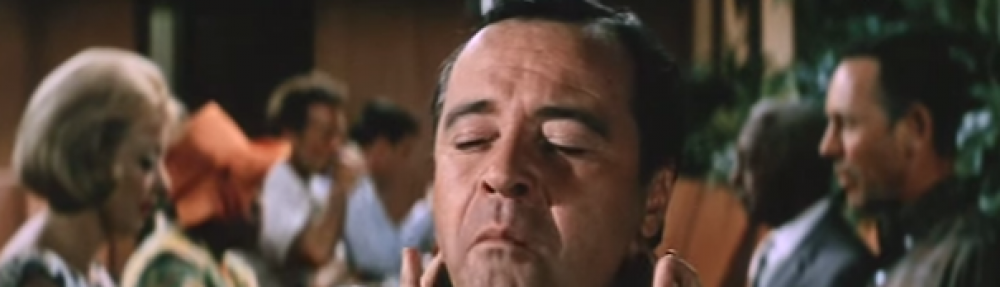
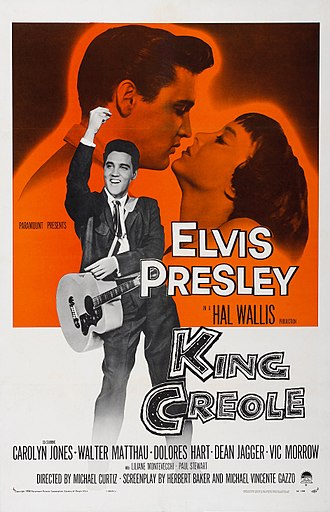
King Creole (1958)

It might be on the nose, but Elvis Presley doing a call and response rendition of “Crawfish” from his balcony with the lady vendor (jazz singer Kitty White) on the street below places us instantly in the movie’s milieu.

We’re in the French Quarter of New Orleans, a place blessed with so much musical culture thanks to the Black community. Like many films of the era, they exist on the periphery underrepresented and unappreciated, but they must be acknowledged.

King Creole came out at an earlier juncture in Elvis’s career. He still has license to be himself, and yet the cult of Elvis doesn’t completely overwhelm director Michael Curtiz’s picture. It’s about “The King” in so many ways, yes, but it still has an identity outside of him as a genuinely absorbing story.

His movie career went down hill when everything was about formula and easy cash grabs relying solely on his personality. King Creole actually has substance and danger because it functions as both a vehicle for him and a genuine showcase for his talents and the talents of the actors around him.

Danny Fisher (Elvis) is a teenager who works bussing tables, morning and night, while he tries to squeeze in high school. It’s a tough schedule to maintain, and he’s already failed one year. But his father (Dean Jagger) is out of work so he feels there’s no recourse but to continue in the dive establishment. Danny’s a good kid dealt a tough hand.

It gets even worse one evening when a couple of drunken thugs induce him to sing for them, and then start pushing around one of their lady friends (Carolyn Jones). He comes to her defense, but he has a target on his back and his new female companion causes a mini scandal (and fistfight) on the last day of school. He flunks out again and that’s the end of his short-lived scholastic career.

I feel compelled to bring up Blackboard Jungle because although they’re set in different places, we’re dealing with the same segment of society: struggling working-class teenagers.

You could easily see Elvis in a version of that film especially because it was one of the instigators of the rock ‘n roll craze in movies. King Creole also depicts  delinquency though not purely in an instructive sense. We feel like we are watching a movie that’s entertainment first without an attached agenda (aside from banking on Elvis’s stardom before he was drafted into the military).

It evokes the aesthetic of gangster movies of old with Bogart and Cagney, which were directed by Curtiz two decades prior. King Creole has a self-contained world. There’s nothing outside these sets and the interiors that make up the movie. And there’s a sweaty claustrophobia to the tenements and cruddy street corners.

The French Quarter positively oozes with atmosphere, but there’s no way to run away because everyone and everything is tied together. It just so happens that Maxie Fields (Walter Matthau) pulls most of the strings.

The money, economy, and the inertia of almost everyone gravitates in and around the big kahuna. It’s just the way he likes it. He calls for Danny since he’s heard about his voice and his tenacity. Also, Ronnie (Jones) is his girl and he’s a jealous, vindictive man. He likes to keep tabs on what’s his.

Danny takes a job singing at the only spot Maxie doesn’t have his hands in — the modest club King Creole — and he becomes a local hit. Meanwhile, he reluctantly falls in with a few ambitious street hoods led by Vic Morrow. They’re vying to join Maxie’s payroll.

It’s the old story of Danny trying to stay out of trouble, and yet he’s constantly drawn in by want of money and further ashamed of his father’s subservient role as a stooge at the local drugstore. He also starts seeing a pretty shop girl (Dolores Hart). Although his intentions seem far from honorable, there’s still something sympathetic and not fully-formed between them.

All the narrative sinews don’t fit together seamlessly, but I appreciate the dynamics with different actors rubbing up against one another like matchsticks. There is a gritty, operatic quality to it. The music elements are a case and point, allowing us to stretch the parameters of reality just a tinge as Elvis entertains his audience both in-camera and beyond the screen.

Carolyn Jones could be a kind of one note Carmen-like Vamp — the other woman pulling Danny into the web, and she does this, but it’s all in spite of her best efforts. She wants him to get away from Maxie and the same hold the gangster has over her own life. Perhaps in the back of her mind is the hope of some freedom and a life beyond for both of them outside of this private hell.

What can I say about Walter Matthau? It amuses me to even make this comparison because I had never thought about it until this film, but Matthau had a trajectory similar to Bogart’s. Based on how I perceive him in hindsight, I always find it funny he started out as a heavy, and over time he became not only a comic hero but a leading man and a love interest. Here he’s everything despicable and abhorrent about local crime.

Dean Jagger could play characters with such bearing and integrity, and yet in a picture like Bad Day at Black Rock or here, he isn’t squeamish about portraying a bona fide weakling. It’s not a showy part, but there is a sense of bravery to it.

Vic Morrow’s still fairly early in his evolution as he moves on from Blackboard Jungle in the next stage of his dashing hoodlum career. It would be easy to typecast him in the role since it fits so seamlessly.

The same might be said of Dolores Hart but for completely different reasons. She embodies the good girl of the movie reminiscent of Eva Marie Saint a few years earlier, representing a reach for something more tender and resolutely decent opposite Brando in On The Waterfront.

Hart’s eyes are always so vibrant even in black & white. I find it fitting when she divulges to Danny about Father Franklin, a man of the cloth she’s known her entire life — someone who’s excited to meet him. And yet Danny’s despondent over his own failings. He cannot bear walking into a church given his current crisis. Nellie represents a level of graciousness to him and of course, Hart famously gave up an ephemeral acting career to become a nun driven by a similar higher calling.

There’s weight to everything Danny does and every mistake comes back to haunt him. His sister (Jan Shepard) strikes up a relationship with the older owner (Paul Stewart) of the King Creole; their relationship also hangs in the balance.

We see Elvis at his most tortured and earnest because he actually gets some material to tear through and try his hand at acting. The part gives him even a small sliver of what Brando had in Waterfront or Dean in Rebel. You can’t put them on the same plane, but then Elvis did what they could never do on the stage with his voice and his pelvis. King Creole is the finest showcase he got to do both in the same film.

The fist fights are pretty epic, and they mean something. Violence is not glorified, but it is an integral and unabashed element of this story. It’s one of the few ways to bring equilibrium to the world.

I’m no pre-germ medical theorist, but a lot of these Classical Hollywood movies seem to function by their own unique humoral theory where you have imbalances of all these different fluid forces at work: the good and the evil, the apathetic and the weak. There’s constant interplay and war between them until finally some kind of stasis is found at the behest of the production code.

The bad is lost and all the abscesses, both corrupt and sullied, are excised until all that’s left in the primordial moral soup is the good. It doesn’t matter how wild the undulations. Finally, our hero is given an existence made up entirely of hope and happiness as everything is brought back into balance.

With the antagonist gone and the promise of a pretty girl’s love, Elvis is able to sing out one final ditty as all the most important people in his life look on with smiles. It’s a classic denouement that doesn’t devalue the seedy sides of humanity. It really is a fine piece of work and it just might be Elvis at his very best. It’s a shame his career took a more insipid trajectory going forward. Because he had so much more to offer beyond a pretty face and peppy music.

3.5/5 Stars
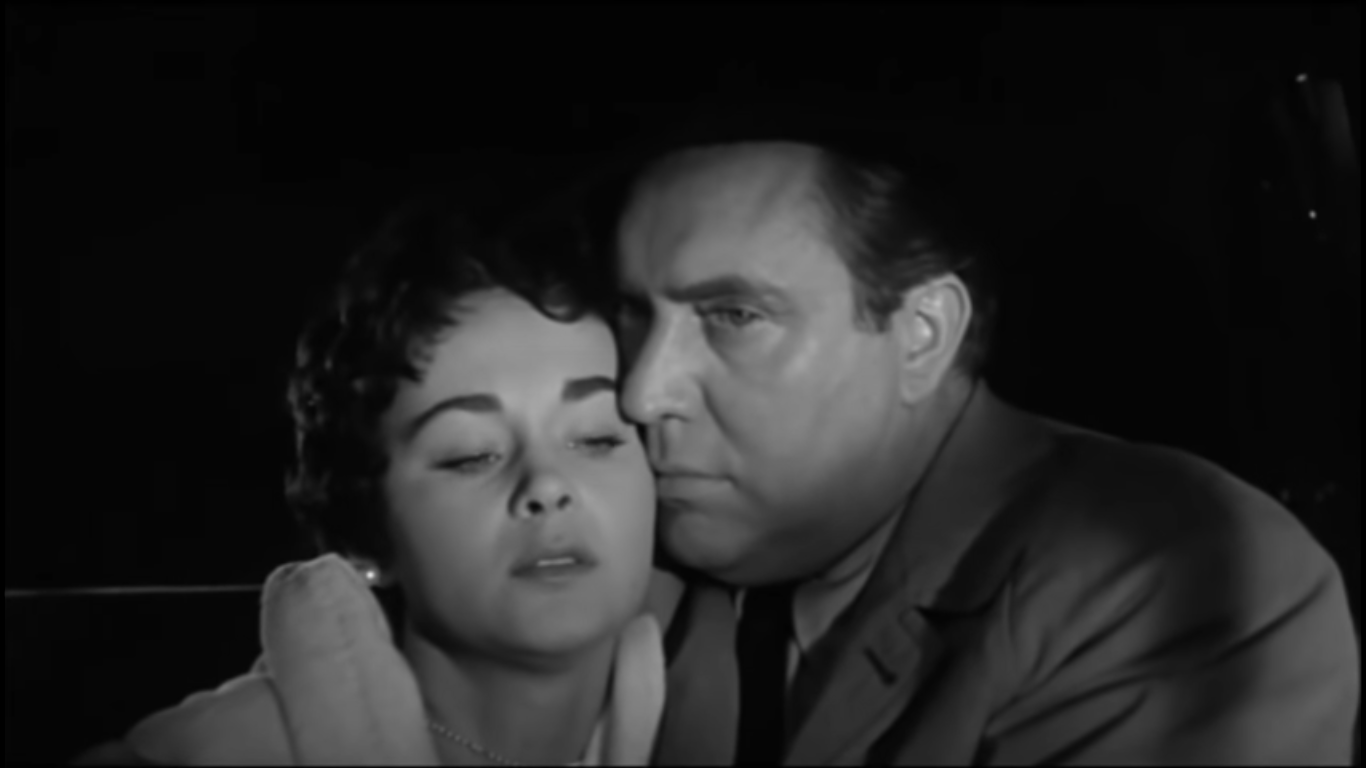
Shield For Murder (1954): Edmond O’Brien Gone Bad

In a movie like 711 Ocean Drive, Edmond O’Brien proved himself capable of being a cad over the course of his performance. With Shield for Murder, there’s no buildup or pretense. He establishes himself as a stone-cold killer right from the outset before we even get a peek at the credits. It’s a tough, uncompromising introduction and to his credit, he sells out to make his role of Barney Nolan one of his most memorable.

Having seen a decent number of his performances, I consider this a compliment because more often than not, he turned in spirited even gamely performances. Whether starring in B-grade features or supporting in A-listers, he had a knack of bringing something enviable to his parts — something you don’t soon forget.

In Shield for Murder, he’s a veteran cop with 16 years on the payroll. One of his colleagues (John Agar) is the first to the crime scene, and he gives Barney the benefit of the doubt because he owes the man his life. In truth, he idolizes him, and for very good reason. Barney’s the man who picked him off the street as a boy and straightened him out. You can’t just overwrite that history in a matter of minutes.

For the time being Barney is in the clear. After all, he’s on the side of law and order. At the police precinct, Emile Meyer brings a level-headed, no-nonsense stability to the role of the police chief. An in-office journalist provides a worm’s eye view of life inside the station’s walls. Being a veteran on the beat, he holds a jaundiced eye and remains skeptical of the crooked cop when everyone else believes in his integrity.

If noirish pictures require corruption and duplicitous activity in the shadow hours, then there also seems to be a prerequisite for female counterparts. The way the camera lingers over a scantily-clad Marla English looking herself over in the mirror almost feels indecent. It’s like another leering face.

What it does do so effectively is create a kind of instant juxtaposition. Because Patty Winters is the picture of innocence. English who was only 19 at the time, has such a warm face and this moment suggests a hint of insecurity more than any amount of vanity.

When we find out that she’s Barney’s girl, suddenly, their attraction fits together, and we can understand how they gravitate toward one another. They both hold something that the other does not. Even as her jealous beau orders her to give up her spot as a cigarette girl, he whisks her away to a model home.

Barney shows it to her proudly. It’s pre-furnished and the kitchen is full of all the latest appliances for modern living. They go to the master bedroom. It’s almost scandalous again, but they are so genuine and happy. This is the very evocation of the 1950s American Dream in suburbia. While he’s not rich, he’s a proud man. The money he acquires and buries on the premises are so he can take care of her. Never mind how he got it.

And yet that’s just it. If the pre-credits are like a violent sock to the gut, providing a first impression of this man, then all the humanizing events that follow cannot totally redeem his character. Surely there is a sliver of good in him. He hasn’t always been this way, but there’s also a sense it cannot make up for his sins.

First, it’s the bookmaker he shoots in the back. Then, it’s the deaf and mute witness left for dead on the stairs. These moments punctuate the story, and they act as staves between Barney and his friends. He’s driven away from them — holding secrets from them out of necessity.

In one memorable extended scene that feels a bit like an aside, Barney sits at the bar downing drinks. There’s a platinum blonde sitting nearby, who doesn’t speak for a moment. Carolyn Jones plays the woman, and she’s an effective foil for Patty — an alternative for the moment. They share a Spaghetti dinner, except Barney isn’t hungry. Instead, he pummels the two tails a local kingpin has set loose on him and leaves the family joint in a shambles.

The final act can only go one direction, and it’s the road of devastation. He becomes a wanted man on the run from his own colleagues, and the man leading the investigation is his best friend; no matter how uncomfortable the current situation , it cannot be any other way. It’s too late. Out of desperation and fear Barney wants to take Patty away. She doesn’t recognize the gravity of the situation. She becomes emotionally traumatized as he flees the scene.

Everything choice going forward only buys him more time. He dons his old policeman duds as a disguise. He seeks refuge with Richard Deacon, who’s hardly the criminal type. He’s busy poring over his academic textbooks as the desperate cop looks to broker a trip out of the country.

I’m pleased to say the finale actually works a bit better than the crescendo of 711 Ocean Drive, if only for the fact it localizes the action and makes it more accessible to all of us. We are able to understand the threat of the gunfight in such an intimate and ordinary setting. He has it out with a gunman at the Union Heights indoor swimming pool in a sea of shrieking bystanders.

But he must make it to his money at all costs. These final solitary moments we have with him totally crush any idealistic notions of the great American dream in post-war society. It blasts a hole right through the entire thing.

While Shield for Murder is blunt in its symbolism, there’s something rather poetic, even fitting, in how it chooses to wrap up the tragic trajectory of a cop who’s gone sour. He’s the good man — formerly a straight arrow — who watched his dream crumble around him. We see it firsthand. It’s brought on by his own aberrant desires.

However, thanks to O’Brien, it has everything you expect, nay demand, in a gritty crime picture totally immersed in murder and corruption. When the end titles come, they feel earned like the movie has delivered on the fatalism we want. There’s little that pretty or polished about it, and in the annals of noir that’s more than a good thing.

The star makes it more than worth the price of admission (especially in the 1950s). There’s probably not a sweatier protagonist, and in a noir film that plays like yet another compliment. He makes us feel his anxiety as well as his deceitfulness.

3.5/5 Stars

Last Train from Gun Hill (1959): Douglas Vs. Quinn

the last train from gun hill.pngThe action begins with a chase of sorts, except with the men pursuing a buckboard, carrying a woman and a young boy, it’s more like a game of cat-and-mouse. As a Native American maiden and a pretty one at that, they look to have their way with her. A horrible incident follows, and it’s a fairly frank depiction for the 1950s.
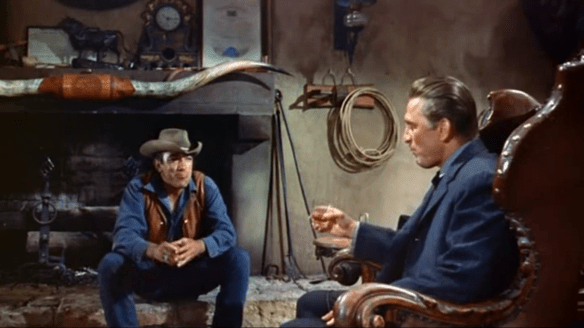
Meanwhile, a local Marshall (Kirk Douglas) can be found regaling the kiddos with a story about the olden days, 10 years prior. It’s strangely light in contrast to the preceding scene. This is precisely the point because never again will we see the Marshall with such a jovial demeanor. We must wait only minutes to comprehend how our pieces fit together. Because this young boy, his son, races to call upon his father. It is his wife who has been brutally ravaged and left for dead.

There are only a couple of clues to go by. The first is a deep scar on the cheek of one of the perpetrators. His wife did not give up without a fight. The second is an abandoned horse with an ornate saddle. He knows it well. It belongs to an old friend: cattle baron Craig Belden.

Because the man who raped Catherine Morgan was Belden’s gutless son. The other man was one of his many hired hands. If not already clear, the dramatic dilemma becomes even more tenuous. The Marshall wants justice and resolves to pay his old buddy a fateful house call.

Under any other circumstances, these two men would be meeting for a drink to wax nostalgic about old times — the glory days — because it’s true things were different back then. As we have a habit of doing, we memorialize our youth, and the friends and experiences we gird around us as young men commonly follow us our entire lives.

But now they must factor in their current lives. Morgan’s wife is dead. Belden’s last kin is his boy Rick (Earl Holliman). Family is everything to the two of them, and it finds them at odds across most fragile lines.

Soon enough, this western finds its tracks along with the lumbering steam engine barreling through the local town. It’s the age-old format gleaned from High Noon and 3:10 to Yuma. A showdown is inevitable. The train is the method by which locals keep time. It’s is a destination, a symbol, and a way in which to move from here to there. It brings people in and takes them out. Sometimes to leave and find a new life. Sometimes to end someone else’s life.

And yet, as alluded to already, this western is far more personal. This is its strength because Kirk Douglas and Anthony Quinn, as old chums, are pitted against each other under very unpleasant circumstances. But the story also requires someone who can stand up to Kirk Douglas as far as acting chops and screen presence go.

If not exact equals, they keep the playing field level based on their enduring differences. Neither is looking to budge. One, a marshall with an unassailable will. The other, a cattle baron who owns the entire town. They represent justice in two divergent forms, as individuals enacting the law as they see fit, whether through dictatorship or vigilantism.

The Marshall tries to drum up some allies in town. The stand-in for sheriff is always about taking the long view. That is, whatever will let him keep his craven neck alive. Realizing the whole town’s on Belden’s side, he settles in for the long haul, taking the young upstart prisoner and holding up inside an upstairs hotel room — his captive manacled to the bedpost. The stakes are set firmly in place, milking the tension to the nth degree. We know what must go down if no one budges.

the last train from gun hill 1.png

Earl Holliman’s not necessarily as adept at mind games as Robert Ryan in The Naked Spur or Glenn Ford in 3:10 to Yuma, but he proves he can play the jerk. He’s the detestable combination of an entitled rich kid and a spineless loser.

It’s a misnomer to say there are no sympathetic figures. Morgan makes the acquaintance of one on the train into Gun Hill. She too has a past with Belden. In a town and theatrical landscape literally dominated by men, Linda (Carolyn Jones) has to be strong and a bit of a pragmatist. For these very reasons, she wants to see the Marshall succeed in his foolhardy task.

So, in fact, he has one minor ally for the very reason she’s not completely against him, though she’s not looking to play hero. Nevertheless, she admires a man with manners and the moral compass to hold doggedly to his principles. In a passive way, she’s in his corner, if only because he has the gumption to stand up to her old beau. However, she comes to be more than just a mere observer. Linda gives him his lifeline for bringing his crazy plan to fruition.

With tension mounting, he leads his prisoner out of the hotel with the whole town watching, all the guns trained on him, and the 9 o’clock train arriving just as planned. He marches out with his shotgun square on his prisoner’s quivering jaw. He’ll get it if anyone moves and so we have a contentious stalemate. By some crazy circumstance, he might find a way to achieve justice yet. Because, again, the train is a symbol. It reflects what he might still be able to do if he can only get there.

In the end, it barely matters. It’s a partial spoiler yes, but this was always a story about relationships more than anything. The draw must blow up somehow before reverting to its most crucial point of conflict. It’s all over and yet we’ve reached the inevitable point of no return. A hesitant Marshall is called to draw on his best friend. He doesn’t want this.

But Belden is an equally proud man, and he lives by a certain creed of western masculinity. You must face a man for any personal affront to your being. There is no other way. Even if he has to die in an ensuing shootout, he’s done his paternal duty for his flesh and blood. One must question what the bloodshed accomplishes. In this film, it’s a fitting end of fatalism. Whether it could have been avoided is quite another matter.

3.5/5 Stars

Note: This review was written before the passing of Kirk Douglas on February 5th, 2020.