Meet Me in Las Vegas (1956)

Dan Dailey has the Texas charm played up a bit as he walks into the Sands Hotel on a first-name basis with everyone. He’s invested heavily in the place — meaning he’s lost a lot of money there.

There’s a blatant absurdity in the premise of Meet Me in Las Vegas. Sitting on the casino floor, Chuck Rodwell grabs hold of a passing woman for good luck (This would not fly today). However, this particular lady is the management’s new floor show, and she’s prepared to walk out if she has to perform in front of a bunch of grubby socialites having a good time and clinking their glasses and silverware. Cyd Charisse foreshadows her turn in the Ninotchka remake Silk Stockings by playing a surly, put-upon entertainer who castigates her indulgent employer (Jim Bachus).

In their subsequent meet-cute, she’s prepared to dress down the audacious Texan because she’s already in a foul mood, and what he does is uncalled for. And yet she just happens to have the magic touch! He literally can’t miss when he keeps her company and keeps hold of her hand like a rabbit’s foot. The hokey metaphor of the movie is clear: When they hold hands, something magical happens, just not romance, not yet, that is.

They both have someone in their corner. For Dan, it’s the dealer Lotzi (Oskar Karlweis) who always offers encouragement. For Cyd, it’s Sari (Lili Darvas) who has an impish sense of humor when it comes to men and her employer’s uptight attitude around them. They’re a couple of veterans with a genial old European charm.

Cara Williams shows up as an old confederate of Chuck’s. I’m sure she sees the opportunity for them to get together, rekindle flames, and maybe have a few laughs. She has a confident air about her.

Her presence turns Maria Corvier (Charisse) off completely. The contentious threesome shares a table during an evening floorshow, and Maria becomes more inebriated and uninhibited as the night goes on with the ambition to take back what’s hers (if it ever was hers). She hops up on the stage in her stupor and hams it up much to Chuck’s embarrassment. Perhaps it’s the first time she realizes she’s jealous for the affections of this man.

What makes the film a true delight is how the world is stuffed full of in-jokes and cameos. It’s not quite the Rat Pack and Ocean’s Eleven, but there’s a sense of this kind of ubiquitous celebrity. We see Debbie Reynolds and Vic Damone, performers who are familiar from director Roy Rowland’s earliest assignments, including Two Weeks with Love and Hit The Deck.

There’s a sweltering song from the always exquisite Lena Horne and a comic number very on brand with Jerry Colonia, primping his mustache surrounded by a stage of bodacious beauties.

Frank Sinatra getting lucky at the slot machine is a blink-and-you-miss-it gag, followed by Peter Lorre looking visibly demoralized, slowly being bled dry at the blackjack tables. Even Charisse’s husband, Tony Martin, shows up in a cameo that I didn’t catch immediately. Of everyone, it feels most unnatural to see George Chakiris as a young newlywed with his wife (Betty Lynn) out on the casino floor instead of the dance floor (Apparently, he had a number that was cut).

Cyd doing a volleyball ballet is something I never thought I’d see. It seems as unprecedented as it is bizarre, though she also manages to give it her usual stylized class. Forgotten Japanese star Mitsuko Sawamura does a charming duet with Dan Dailey of “Lucky Star,” which is decidedly absent of any cultural condescension.

For the story’s sake, Chuck finally takes Maria out to his ranch to introduce her to his irascible but loving mother (Agnes Moorehead) and his way of life. The upbeat rural charm of “The Gal with the Yaller Shoes” gets the point across, and Charisse is more than game to go along.

However, the real showstopper is a reworking of “Frankie and Johnny” back in Vegas, starring Cyd Charisse with John Brascia (of White Christmas fame) and the vocals of none other than Sammy Davis Jr. Yes, please.

If you look up “svelte” in the dictionary, it must be an entry on Cyd Charisse. Her numbers usually balance between two poles. There’s something so sophisticated about them, and yet they can be equally provocative. It’s all in the manner she pirouettes, slides, slinks, and slithers with her body. It defies banal description. It’s better witnessed.

How do you even begin to categorize something like this glitzy confection of a movie? The plot makes no rational sense, and there’s no reason to even try to justify it. People don’t act like this, but what do I know? I’m a Vegas novice. It’s also almost two hours long and probably could have used some trimming.

But the operative word is entertainment. Vegas is on full display, and it’s packed with all sorts of decadent delights. Every scene we get Cyd Charisse doing what Cyd Charisse does best draws us back into her inertia. It’s impossible to look away. In the end, it’s almost an afterthought to forgive the ludicrous script because it’s a blast, and Charisse does some more first-rate work.

3.5/5 Stars
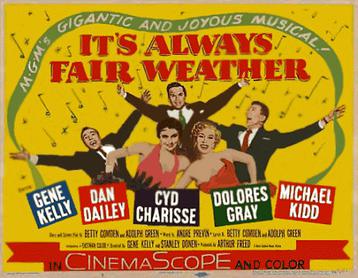
It’s Always Fair Weather (1955): A Musical For The TV Age

It's_Always_Fair_Weather_(1955_film)_poster_(yellow_background)

Conventional wisdom tells us you don’t make a musical quite like this. It’s a bit of a nostalgia piece and already it seems like American was ready to move on with life after WWIII.

It’s relatively straightforward to assume that It’s Always Fair Weather (1955) was a harbinger of a change in appeal with the general public because if we look back to Good News (1947), that’s arguably where the run of great MGM musicals began and they could hardly be stopped. There’s nothing drastically different about the foolproof formula or the players behind the scenes, for that matter. We still have Arthur Freed, Gene Kelly, Stanley Donen, Cyd Charisse, Adolph Green & Betty Comden, as well as any number of integral folks I failed to mention.

Well, we do have one primary demarcation, deserving some acknowledgment. Here is a musical with a cynical streak — something that feels incongruous, like oil and water almost. In the opening minutes, I don’t mind saying that I was of the same sentiment. It doesn’t seem like a musical.

We have three boys marching home: Ted (Gene Kelly), Doug (Dan Dailey), and Angie (Michael Kidd), victorious from the war and frequenting the bar they always called home before. But at some point, reality hits — the emering complications at home in a drama such as The Best Years of Our Lives (1946) or an insidious film noir a la The Blue Dahlia (1946) or Act of Violence (1948).

But you see, this picture sets up its premise when the three inseparable war buddies bet the hard-bitten bartender, come rain or shine or sleet, they’ll get back together in 10 years, because they’re the real deal. Time won’t dampen their friendship.

They share a drunken cab dance, escalating in a garbage can crescendo that’s got that same panache of old. However, the merriment dies dow,n and they realize they’re civilians now. The inevitable parting arrives, and they go there separate ways. Only time will tell what happens next…

The production itself shows parallel issues involving the passage of time to mirror the plot. Even in casting. Initially Green and Comden envisioned this project as a spiritual sequel to On The Town, reteaming that film’s stars. They got Kelly, but with new leadership at MGM headed by Dore Schary, Sinatra was out and Munshin wasn’t a big enough name. Thus, we got the underrated pair of Dailey — a quality dancer in his own right, and Kidd, a workhorse choreographer, who blessed audiences with the Barn raising scene in Seven Brides for Seven Brothers, among other efforts.

Still, undoubtedly, times have changed. Behind the scenes, Kelly was chafing with Donen. I suspect because the younger man had proved he could handle a highly successful picture on his own (Seven Brides with Seven Brothers), and he would continue to do so. The cracks in the collaboration were beginning to show.

And yet even as the film settles into the contemporary era, the ensuing themes become surprisingly resonant. The day is October 11th, 1955: 10 years to the day they split up, and things couldn’t be more different.

Ted never got married after his best girl dumped him and has stayed in Chicago working the crap tables, romancing dames, and recently winding up in the boxing racket with a young bull named Kid Mariachi. Doug has done well for himself, despite giving up his passion for painting, becoming a highly lucrative television advertising man. His sponsor spots for Molly Mop (voiced by the ubiquitous June Foray) are currently all the rage.

However, though married with a comfortable life, it doesn’t take a Sherlock Holmes to tell the years have left his stomach soft and his heart hard. Meanwhile, Angie’s married too with a whole house of kids and a loving wife who helps him run his burger joint: The Cordon Bleu.

The miracle is that they all keep there promise to be there! But as the euphoria subsides, they realize they have nothing in common. Beyond that, they can’t stand each other now, and it begins to gnaw at them. They’re ready to get on with their lives and accept this is how it goes when time marches on. Fate has other ideas.

It’s one shrewd advertising executive (Cyd Charisse) who spots an opportunity to reunite the boys on live television in the popular segment featured on Madeline Bradyville’s (Dolores Gray) nationally syndicated program. Ms. Jackie Leyton takes it upon herself to get Ted to the showing and enlists her colleagues to do the same with the other men.

She really is a marvel. Heading off any of his initial amorous advances and then taking on the male initiative to his complete bewilderment. On top of that, her Encyclopedic knowledge of any number of subjects has him speechless and wows the crowd at his boxing gym. Charisse doesn’t get too much time to flaunt her skill, but nevertheless, “Baby You Knock Me Out” is a comically upbeat number that does the trick.

Though the picture was shot in widescreen, it doesn’t necessarily lead to revolutionary musical numbers. However, much like Will Success Spoil Rock Hunter? the canvass is used on multiple occasions to draw out the limitations and satirize the “idiot boxes” fast becoming all the rage in the American household.

Meanwhile, things are just not going Ted’s way. Not only is he getting emasculated by this beautiful, befuddling woman, he learns from a dumb lug that a local gangster (Jay C. Flippen) has fixed his match. Kelly fails to have a truly singular moment until he pops on a pair of roller skates. We know it when he does the same charming shoulder shrug from Singin in the Rain that we are in for an indelible moment.

Sure enough, he goes gliding around studio street corners with ease, rolling and tapping his way along gayly until his curbside antics bring everything to a standstill — the masses cheering him on. It’s one of the first signs that fortunes might be turning.

It’s Always Fair Weather gets better and better with every passing minute maybe because it doesn’t ride the disillusionment all the way to the end. Even with commercialism, advertising, corruption, and whatever else, when we get out on the other side there is an underlying satisfaction to the ending.

Dolores Gray’s humorous “Thanks but no Thanks” complete with trap doors and rocketing male suitors off the stage, is another outrageous comic aside. Then, the three old buddies are brought together as part human interest story, part ratings gimmick. We think we know how it’ll go. It spells trainwreck in big, bold letters.

Well, that’s not quite right. Instead, we get a brawl captured by the candid cameras and broadcast the country over, complete with a confession by a top-level thug. It’s uproarious, fatuous, and far-fetched, but it’s also the exact catharsis we were begging for.

It reinforces values that we desperately hoped to be true, and it does it with a wink and a smile (along with plenty of broken tables and chairs). When friendship actually meant something. There was no Facebook or Skype or any faceless form of communication. To be with those people in the same space and share memories and go through galvanizing experiences together. That was all you had and sometimes, I would take one of those types of days over a boatload of the internet age’s connections.

Because I think most of us have gotten over Television. The medium has become status quo even quaint. It’s not killing us slowly (or maybe it already has), but the web is the new frontier just waiting to be eviscerated by a musical such as this. I would gladly watch that, but of course, such a project wouldn’t have names attached to it that mean so much to me: from Gene Kelly and Stanley Donen to my new favorite star Cyd Charisse.

Maybe It’s Always Fair Weather spelled that the classical Hollywood musical, as such, was dead, but even if contemporary reception was not stellar, it comes off today as a regularly insightful musical and satire. By now, I’d probably follow Kelly and Charisse to the moon and back again anyway.

4/5 Stars