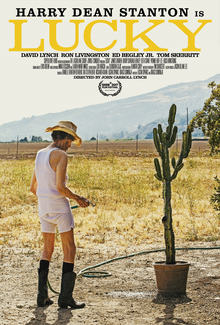
Lucky (2017)

Harry Dean Stanton, aka Lucky, feels like a bastion of a bygone era at the center of this story. The world around him still has the flavor of the West, though it has modernized. He is planted in a tradition reminiscent of The Misfits or Hud. Of course, he costarred with the likes of Paul Newman in Cool Hand Luke, and his credits are strewn with all sorts of footnotes to Classic Hollywood history, from westerns to revered cult classics and arguably his greatest achievement, Paris, Texas.

In his directorial debut, actor John Carroll Lynch made a love letter to his dear friend, and weak with illness, there’s a self-aware sense that this would be Stanton’s final film at 91 years of age. It proved to be true as he would pass away before the film was released in 2017. He always looked aged and world-weary decades earlier, and so you can only imagine what it is like to watch him here. Let’s make this clear. It’s an undisputed pleasure.

Because he’s a crotchety, ornery son of a gun, that’s most of the reason he’s still alive and kicking. His mornings are full of yoga in his underwear. He gets dressed in his cowboy boots and hat before stepping outside and walking everywhere he needs to go.

His favorite mental exercise is doing crossword puzzles at the local diner, he has favorite TV programs to watch, and he has a daily ritual of grabbing a carton of milk from the same family mart. All his rhythms are supported by the twang of harmonica music. It’s not quite Ry Cooder, but it gets the flavor across.

It’s unsurprising to say Lucky is profane and opinionated. He’s not afraid to say when he thinks someone has said something asinine; sometimes it just comes flying out because he’s in a foul mood. No one takes it personally. Because they know it belies a man who does have his share of tenderness.

There’s a collective responsibility where everyone cares for him, but they try not to press him too hard so he can live his life the way he wants. Still, there’s something idealized and idyllic about the small-town community.

If it’s not already apparent, Lucky has many obvious antecedents from The Straight Story by David Lynch and the road movies of Wim Wenders, like Paris, Texas. Of course, both of these films featured Stanton in critical roles. But there’s also something about the movie reminiscent of the contemporary movie Paterson by Jim Jarmusch.

Veterans like James Darren and David Lynch sit around the bar with Stanton, trading stories about romance and a lost tortoise named Mr. Roosevelt (who makes a very important cameo). It’s not some profound meeting of the minds, but to bask in their presence and see friends gathered together carries with it a special poignancy.

There are several specific passages, one where Stanton recounts his childhood and then another where he shares a conversation with a fellow veteran (Tom Skerritt), where there are very distinct echoes of Alvin Straight. It’s almost uncanny. Surely it’s not a coincidence. If they are not cut out of the same cloth, then they were formed under the same shared circumstances, be it the Depression or World War II.

Latin culture has a wonderful, well-deserved reputation for its hospitality and the importance it attributes to family across generations. When Lucky gets invited to a little boy’s fiesta for his birthday, he watches the scene, and though he’s totally welcome in that space, you can tell he desires what these people have. It’s communal and full of smiling people who know each other, who are close, and who share connections with one another.

He’s prided himself on being independent all his life, and yet he must come to terms with a life alone. Even though he makes a point of defining the difference between the choice of “being alone” and “loneliness,” that doesn’t make reality any easier to contend with. Then, Stanton elevates the moment by breaking into an impromptu rendition of “Volver, Volver.” Faces turn first surprised and then impressed that he knows all the words, and the mariachi players join in.  It feels like a final stirring statement looking back on a life of 91 years.

In terms of storytelling convention, Lucky is not totally without peer. We know this. The meditative swan song, allowing talents of yesteryear a final moment in the spotlight to reflect on their celluloid careers, is a very specific and still persistent guilty pleasure of mine.

Boris Karloff in Targets, John Wayne in The Shootist, Henry Fonda in On Golden Pond, and even Peter O’Toole in Venus. The list could probably go on and on. Stanton was never as big a star as these men, but he probably garners just a fiercely devoted following, if not more so.

Lucky gets one last scene in the bar with all his “friends.” It’s not exactly an uplifting sendoff. He says we’re all eventually going to go away and we’re left with ungatz…nothing. How do you respond in the face of the bleakness? Not being a particularly religious man, he lifts a Buddhist practice he heard about in an old war story. You just have to smile in the face of your fate and accept it…

It’s a sobering worldview to come to terms with, but one must confess there is something poetic about Stanton clomping off on a desert trail and walking off into the sunset one last time. It reminds me of another fellow of a very different disposition who was always predisposed to “Smile.” That was Charlie Chaplin’s Tramp because he was a creature of unreserved hope.

I’m not sure if anyone would immediately count Harry Dean Stanton as lucky. It almost seems a bitter irony. He never had matinee idol looks. He only earned his first starring role well into his 50s. He never won major awards or plaudits. Not even a swan song like Lucky could get him that. And yet here is a man who seemed to make his own luck and by the same token wound up having a fairly charmed life.

He worked with some indelible directors, featured in mainstream successes, and earned an ardent following as a cult favorite. When I watch him in a throwaway episode of Chuck as The Repo Man, my reaction isn’t one of derision, but appreciation. By now, he is baked into our popular culture. What an extraordinary career.

3.5/5 Stars
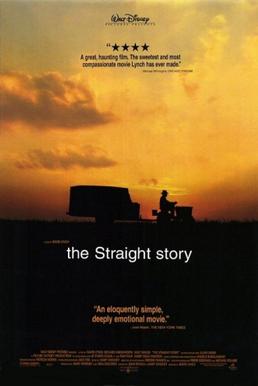
The Straight Story (1999)

The Straight Story is based on the real-life journey of one Alvin Straight to visit his brother, who suffered a stroke. What makes it extraordinary is that he lived hundreds of miles away, and Straight made the journey on his John Deere lawn mower, going about 5 mph!

The material doesn’t immediately scream David Lynch, a man who has left his mark with more bemusing visions of Middle America. Still, in keeping with the story’s ethos, Lynch taps into his midwestern roots in the most charming and straightforward manner.

There is a sense that The Straight Story was a movie out of a different era and even a different century. Whereas now even our eldest geriatrics interface with smartphones, have high-speed internet at their fingertips, and any number of technical marvels, there was a time, maybe 20 or 30 years ago, when men like Alvin Straight reached back into bygone generations.

Alvin can barely see and walks with the assistance of a cane, but he’s obstinate. He was a sniper during WWII. Eats franks by the campfire and always has his cigars handy for a puff or two in the evening as he ponders the stars. His wife, who’s gone now, bore 7 children, and he still lives with one of them, his grown daughter (Sissy Spacek). I won’t say people of his ilk don’t exist anymore, but as we get more and more modernized, it seems less and less commonplace.

There’s a sense of the late ’90s about the movie that I appreciate because I was alive then, albeit very young, on the cusp of the possibilities of a new millennium. The year prior, I traveled with my family across the very same Midwest, though we used a much more luxurious automobile (I had only minor experiences in Iowa with tractors and other implements that felt completely foreign to a California kid). For Alvin Straight, these were his lifeblood as common to him as the water he drinks and the air he breathes.

He gives a glimpse into his own life on his parents’ farm, where he and his brother learned what hard work was as they turned daily chores and tasks necessary for their survival into games that they could play even as they looked up at the stars at night, dreaming about what might be out there.

Time and disagreements soured their relationship, so now, as they stand old and gray, they’re estranged from one another. You understand how it happens. Their generation was not always the greatest at expressing themselves or sharing their emotions. Still, we know they are present, and the fact that Alvin willfully makes this trip shows how deep the bonds of brotherhood go. He speaks through actions.

The film’s boldest and most valuable asset is its sense of time. It is pregnant with silence and comfortable with slowness out of necessity. It goes at the kind of languid pace that’s necessitated by the whole premise of Alvin’s journey from the very beginning. That tractor’s not going to sprout extra engines and zoom forward. The journey is the essence of incremental progress toward an inevitable end.

Like Pilgrim’s Progress, there’s a process to the journey, and it’s made up of all of these various interactions. Each one along the road feels like a specific representation of the human experience as Straight comes in contact with all sorts of folks. Lost souls looking for direction, Good Samaritans, fellow war vets content chewing the fat, men handy with tractors or quick to offer shelter or some form of hospitality.

There’s something radical about these folks in their very simplicity, running counter to the way the culture has moved even 30 years on. What we appreciate about them is their candor; there’s a laconic spareness and a straightforward reality to these people and their dialogues.

Alvin’s not needy, but he’s always obliging for accommodation. Some people try and blow him off the road, horns blaring, but others see the nobility in his mission. He will not be dissuaded or moved because there is something or someone at the end of the road to make all of this worth it. There’s never a second thought of his going through with it.

Sure enough, he passes through the valley and over a hill to find a dilapidated farmhouse. He yells out to his brother, and out steps Lyle (Harry Dean Stanton). They sit down on the porch to share their presence with one another. Words would be nice, but they hardly feel necessary. In a generation so often distracted by so many things (especially cell phones), what a radical thing to be completely present with another human being. Again, it’s a dying art that Alvin Straight all but mastered.

If we were not primed already, it’s possible the ending might seem underwhelming, but then we spent this whole time with this man. It was about his journey, the people he meets along the way, and what he represents. There’s something in his sinew and his makeup worth taking note of.

Richard Farnsworth was an actor I was familiar with thanks to Anne of Green Gables on VHS. He was instantly likable in a series full of so much drama and theatrics; there was always something so genial and grounding about him. The Straight Story would wind up being his last film, and as he neared 80 years, he was stricken with cancer.

This film stands as a testament to what he was as an actor and human being. Plain, straightforward, but ultimately replete with all kinds of truth and goodness. I haven’t gotten trite of late, so allow me just this one digression. Disney doesn’t make movies like this anymore. But then again, how would they ever top a G-rated David Lynch film about a truly mythical tractor ride?

4/5 Stars

Note: This review was written before David Lynch’s passing on January 16, 2025

Blue Velvet (1986)

bluevelvet1It’s certainly not a news flash that I often have immense troubles dealing with black, satirical comedy. I think the difficulty for me lies in the dividing line between comedy and tragedy. Oftentimes, although I’m not always fond of violence or profanity, I can make a concession if there’s something deeper behind it. With Schindler’s List, this means watching the scenes of the Holocaust, because there are vital realities to be gleaned from that. In a Scorsese film, aside from being well made, I often see them utilizing profanity in such a way that shows the corruption and baseness that lies within mankind. Take Goodfellas for instance.

All this to say, Blue Velvet was hard to pronounce a verdict for. Without a doubt, David Lynch is a worthy director with his own surrealist vision, that is nevertheless polarizing to the viewing public. There is no doubt that his films are fascinating and in moments mesmerizing; there’s no arguing on that account.

However, Blue Velvet is a dark and brooding film, as are many others, but the big difference here is that all of that is buried under a thinly layered caricature of suburbia. These scenes are so superficial; almost stupid, because the dialogue seems torn off some billboard or magazine cover. There are flowers, white picket fences, and robins denoting the changing seasons. It reminded me of some precursor to American Beauty, except the ending was brighter and the depths seemed darker.

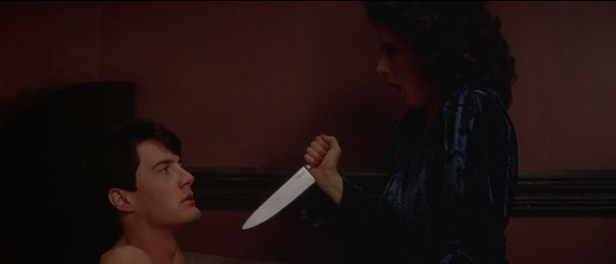
Under the surface lies something sinister and it all comes to a boil when Jefferey Beaumont (Kyle MacLachlan) returns to his hometown of Lumberton to visit his injured father in the hospital. The college boy comes across a severed ear, and it leads to stakeouts, and eventually brazen attempts to break into a mysterious woman’s apartment.

And as you would expect Jefferey gets in too deep, getting sucked into a twisted, subversive spiral that includes singer Dorothy Vallens (Isabella Rosellini), a sociopathic maniac named Frank (Dennis Hopper), and a whole lot of ambiguity. All things return to the status quo in this suburbia and we can go back to singing “Blue Velvet” and “In Dreams” in peace. But there’s this nagging sensation that Lynch’s treatment of this topic is utterly cruel. Isabella Rosellini gives a stellar performance that is a constant emotional roller coaster, while Dennis Hopper is the definition of a screwed up, drugged up, lunatic. These individuals have so much darkness and twisted caverns in their characters that it’s hard to leave them like this.

After all, this isn’t a big joke, and it shouldn’t be, but it’s hard to get away from that idea since the dichotomy between the two is separated here by a hair’s length. However, for others who find it easier to parse through the tonal problems I have with Blue Velvet, there’s undoubtedly a lot to take note of. This is one of those enigmatic films we leave with more question than answers; more confusion than clarity. It’s not always the easiest, but it can certainly be rewarding.

3.5/5 Stars