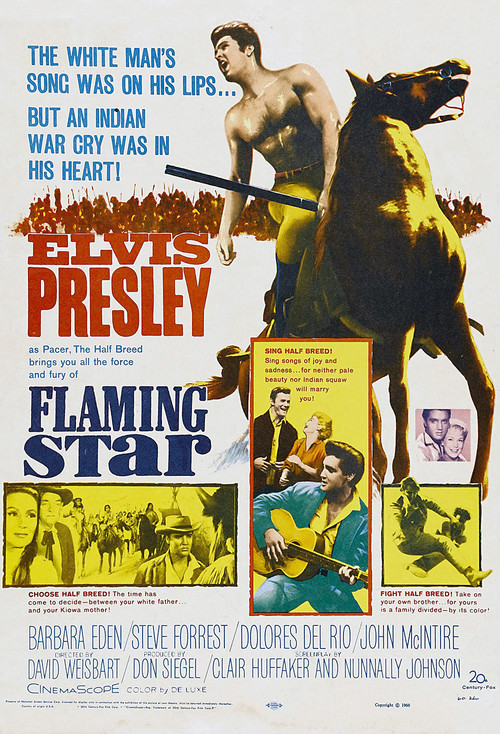
The Flaming Star (1960)

“No Ma. They ain’t my people. To tell the truth, I don’t know who’s my people. Maybe I don’t got any.” – Elvis as Pacer Burton

If I may be so bold The Flaming Star feels like an inflection point in Elvis Presley’s film career. It comes at a time where he’s still given the opportunity to act, and if he’s not some great talent, he’s certainly a charismatic performer in things like King Creole and  Clair Huffaker’s Flaming Star.

G.I. Blues came out the same year as Flaming Star, and it feels like a schematic for the rest of his films under Hal B. Wallis. They punched up the songs and mostly stripped down the plots. All they needed was Elvis as a commodity, not an actor, because that’s what tween audiences were paying for. Money talks.

Although you can hardly equate the two, The Flaming Star compares favorably to something like Rio Bravo in how a musical interlude is used only once within the broader narrative. Granted, this film is much more plot-driven than Hawks’s hangout movie.

I would not initially peg director Don Siegel for this kind of picture — it feels uncharacteristic — and yet you can see what he can bring to the movie, which at times has a ferocity and flashes of violence. Also, it’s about as far afield from a typical Elvis picture as you can get, being both an oater and a drama seething with family drama rather than cotton candy pap.

While initially the Native Americans make for a handy purveyor of conflict, there is another element that proves slightly more intriguing. Elvis’s parents are played by John McIntire and Dolores Del Rio so he’s part of a multi-ethnic family in a time where that is frowned upon as being scandalous. People like this are to be ostracized since they deviated from the status quo of cultural norms.

Because of its confluence of themes, it brought to mind two pictures in particular. Although Gunman’s Walk is more of a Cain and Abel story on the range, The Flaming Star provides a variation on these themes. Pacer (Elvis) and Clint (Steve Forrest) are far more benevolent, and yet in the broader society, there’s no denying that they are perceived differently.

Likewise, Bhowani Junction casts another famed dark-haired star, Ava Gardner, as a sympathetic mixed-race character. The story bristles with flaws out of the era, and yet its context allows it to court themes about personal identity and racism at a time when many of these themes were either sordid or commonly disregarded without much consideration.

Even the Native Americans are given some motivation, and they slowly grow into the movie as represented by Buffalo Horn (Rodolfo Acosta), a warrior who knows the Burtons even as he tries to protect his people’s way of life.

From his perspective, they must fight or else die with the influx of settlers; there’s also an especially aberrant strain of racism going through the white community. Given this context, it’s hard not to appreciate why the Indians have resorted to violence. Because there is very little middle ground. They see their way of life dwindling and slowly being made extinct.

In fact, the Burtons represent that middle, and they are on especially tenuous ground, caught between two warring sides as they look to maintain and defend their homestead. I imagined Barbara Eden would be a frothy love interest on the beach. Instead we get a young woman burning with anger. Her town grows wary and more prejudiced against the Burton family since they are left mostly unharmed while many loved ones in the white community have been killed.

Some of the beats of the movie feel inevitable, and it’s a credit to the performers that they are able to imbue them with meaning. I think of John McIntire when he eulogizes his wife. The story calls for her to be sacrificed, and yet he loved her dearly. He makes the loss stick so it means something consequential.

As they stand near her grave, he recites the words from Genesis: “And Adam called his wife Eve because she was the mother of all living.” Then, he looks up to God and asks him to take care of his wife. He means it sincerely.

Later, as their livelihood continues to crumble and fracture, Mr. Burton gives his blessing to Pacer, knowing what he feels led to do, turning away from the white community that now rejects him.

Although McIntire isn’t lauded or always well-remembered beyond the classic movie community, his performance here shows the breadth of his work. He could be a tough old cuss, and yet there’s such a moving humanity to him here.

He’s far from perfect, but we sympathize with him and the life he chose. He didn’t decide who he fell in love with; he wasn’t trying to make any kind of statement. He simply fell in love with a woman who didn’t look like him, got married, and raised two sons. Now in spite of his best efforts, his boys are forced to live with the consequences.

The flaming star itself is a dreamed up portent of death. It represents the fictions of a Hollywood movie frontier. And yet the very best of Hollywood comes out in the characters and Siegel’s commitment to punchy, economical drama.

3.5/5 Stars

La Otra (1946): Dolores Del Rio and Her Doppelganger

Recently some coworkers were waxing about what they would do if they won the power ball. How they would spend the money, where they would go, and also the drawbacks that come in the wake of what seems like a purely golden opportunity.

I’ve never much thought about it, but I do admit for those who are trapped in life (or at least with active imaginations), it’s easy to make the mental leap. I couldn’t get these conversations out of my head while watching Roberto Gavaldón’s La Otra.

It is a movie about a manicurist. Her work is menial and she takes no joy in it, doting over cosseted businessmen with lecherous intentions. It’s a way to survive though her prospects feel like a dead-end apart from her burgeoning romance with an earnest policeman. All throughout the workday before she runs off to spend an evening with her man (José Baviera), the garish lights above her workspace blare with the National lottery: 5 million! Almost as if to taunt her.

La Otra is built out of a premise not unfamiliar to noir. If you read production notes, it sounds like the picture was potentially slated for an English-language release with Bette Davis, though it was deemed too similar to one of her other recent projects. She would end up remaking it a generation later as Dead Ringers.

Because La Otra actually opens with a funeral. María Méndez rushes onto the scene late, and public perception is one of contempt. How improper of her to show up late to a funeral while her twin sister, Magdalena mourns the death of her husband. Although the widow is masked by her veil, we learn soon enough, Dolores Del Rio stars in both roles. Hence, La Otra.

The doppelganger is not a new phenomenon used in all sorts of mistaken identity comedies and certainly in melodrama. Here it feels like it serves a utility to the story, but there’s also something else. The movie plays with the dichotomy and preconceived notions between Mary, the Madonna, and Mary Magdalene, a sinful woman. The movie casts Del Rio in both of these rolls, and they continually shift and evolve over this muddied canvas of morality.

Tension (1949) with Richard Basehart worked the doppelganger angle thanks to hard contact lenses and Del Rio pulls it off by wearing glasses to play her manicurist self. Still, these are only the visual features. It does not consider personality changes.

Meanwhile, we realize in the wake of her husband’s death, Magdalena has come into a great sum of money. She chides her sister while she walks into her lavish closet, “You haven’t learned to face the world with the same weapons it uses.” Namely, cunning, cynicism, hypocrisy…crime.

Soon enough, María does learn what it takes to get ahead in noir, although she must also live with the consequences. Passages of the film feel quite literally like a silent movie, and then with dialogue the scenes come alive played against the otherworldly whirring modulations of the theremin.

La Otra hits its stride with its first twist cut against the chaotic pinata-infused celebration in the city square. María has the opportunity to take over her sister’s life and commandeers it using all the aforementioned weapons at her disposal. Going so far as to scald herself so her signature won’t be disputed.

Still, she is trapped in a life she was not expecting. Because her rash decision only considered the upside — not the tragedy hanging over her head. Instantly, she gains wealth and repute, leaving her life of destitution behind, but she also must give up her man lest she implicate herself in the new life she takes up in its stead.

But also a dashing suitor (Víctor Junco) slinks back into her life — a mysterious man from her sister’s own shrouded past. She’s more implicated than even she realized, and the film is imbued with this sense of Catholic penance. We watched men like James Cagney be sent to the electric chair for their sins, and this woman is resigned to her own fate…

What’s fascinating to me is how this film could have been made in Hollywood — with Bette Davis no less. However, it was made in Mexico and as a result Dolores Del Rio was given unadulterated star treatment. The way she’s dressed, lit, and given full reign over the movie, augments her regality but also her abilities as a screen personality. She owns the movie both in its moments of drama and pathos.

And although it was shot below the border in Mexico City with many actors we aren’t aware of, it functions like a stunning system in parallel with Hollywood. There’s a technical prowess and a commitment to classical storytelling. There’s gorgeous light and shadow, a commitment to the semiotic nature of visual narrative, and also a daring sense of invention.

It feels alive and emotive like all the greatest classic melodramas. Analogous endings could be cropped out of other movies, but as a dutiful policeman, now disaffected in his duties, wanders off into the night, the woman stares back at him through the bars confining her. Her face settles in such a way, first, we see the luminous contours of her eyes before she drops down and they are enveloped in an abyss of shadow.

These are the kind of moments that not necessary for telling a story, and yet somehow it feels elegant and imperative because this final image articulates so much of the journey of this movie and so much of the duality in many of these great melodramas of old. I never tire of them, and it’s always a pleasure to find a new addition to the canon regardless of where it originates from.

4/5 Stars

Cheyenne Autumn (1964): John Ford’s Western Swan Song

If we had to provide a broad sense of Cheyenne Autumn, it would be all about the mass Exodus of the Cheyenne in 1878 as they journey from the arid land they’ve been subjugated to back to the land the white man had promised to return to them all along.

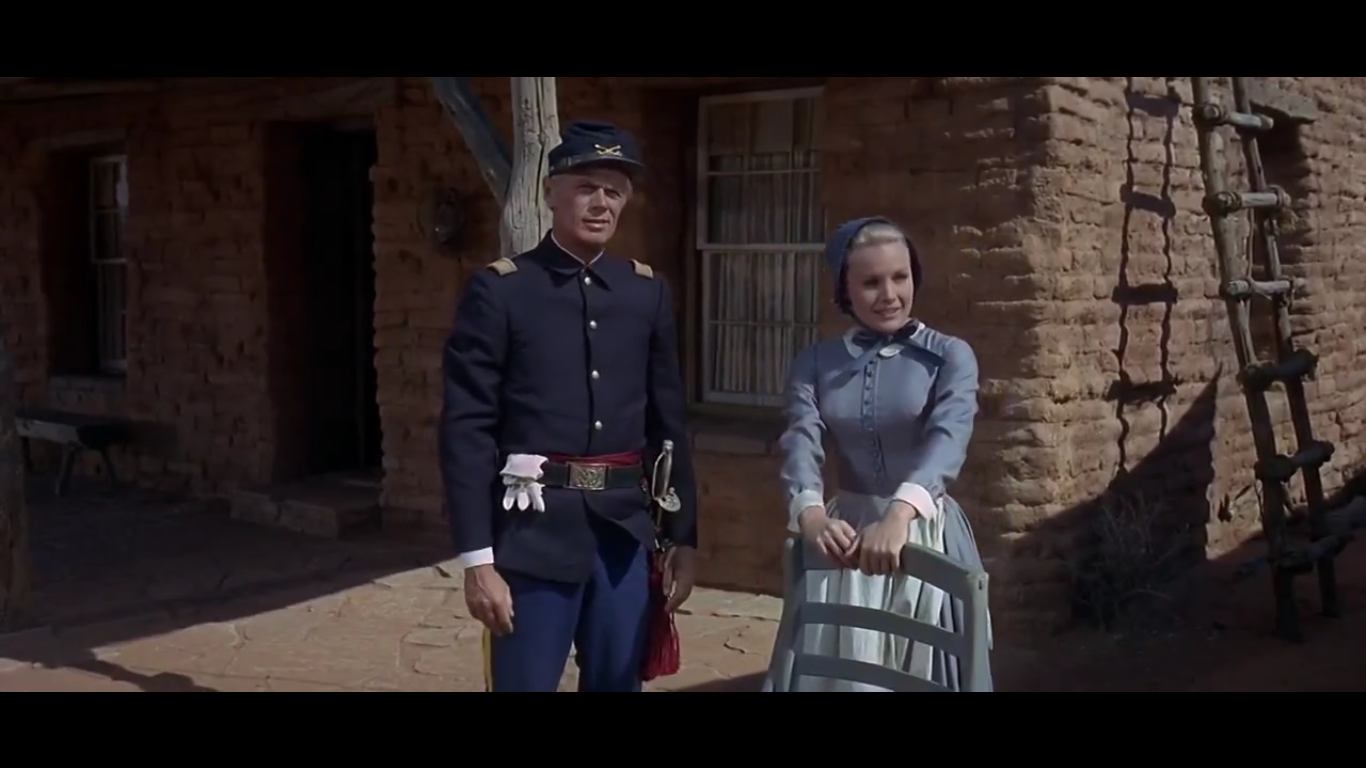
This is a Hollywood rendition so, obviously, it’s not expected to stick strictly to facts nor does it. The extras John Ford used throughout the picture were in fact Navajo, who spoke their native tongue. He also loaded up on a Hollywood cast headlined by Richard Widmark returning after Two Road Together, portraying an officer in the U.S. Army, Captain Thomas Archer, far more disillusioned in his post than his predecessor.

In the film’s opening grand gesture, the Cheyenne make the long trek hours early, in preparation for their meeting with the white man — a meeting that was supposed to come through on a wealth of promises. Everyone is there waiting anxiously at the military encampment. Among them, Deborah Wright (Carroll Baker) and her uncle have made it their life’s work to minister to the Native Americans as suggested by their benevolent Quaker faith.

The only people who don’t show up are the big wigs from Washington, offering yet another rejection and another sign of disrespect. As they leave the encampment, empty-handed once again, there’s in a sense of unease about it. Though the pompous blaggards back east have no concept of their egregious blunder, there’s no question reckoning will come in some form.

This is made apparent and for once in a Ford picture, beyond simply casting a sympathetic eye, the director finally seems to be acknowledging the grievances against the American Indians. Because they have to face arrogant, deceitful men who fatuously believe they have a right to everything they touch. They have no respect for the land, only what they can acquire from it. Soldiers who are supposed to be peacekeepers, as well as tacticians, are equally suspect.

In a fine bit of casting, Patrick Wayne plays a young upstart who has waited his whole life to have it out with the Cheyenne, and the circumstances make no difference to him, even if he has to create them himself. Other soldiers like Karl Malden’s commander espouse unprejudiced mentalities only to be frozen by the chain of command. It proves equally inimical, if not more so.

Under Archer’s command are also numerous steady, career soldiers like Mike Mazurki, Ben Johnson and Harry Carey Jr. To have the latter two in yet another Ford picture is certainly a fitting remembrance. They were as crucial to his work as any of the larger stars like John Wayne or James Stewart (more of him later).

Wagon Master and Rio Grande, from 1950, would be enough for many actors to build a reputation on. Even over a decade later, it’s a testament to this close-knit bunch that they still remained steadfast to the end. These are when the sentimentalities of the picture are most apparent.

In all candor, Cheyenne Autumn is long, at times arduous, but within that runtime, it speaks to so much, including Ford’s own legacy. This is what makes it such a fascinating final marker in his career. Again, it’s the side of the western movie he never truly showed before. It’s as if age has softened him to what he did not see before.

We’re in Monument Valley on the eve of a skirmish. We’ve seen this scene before but from the other side. Native Americans digging in to fight the cavalry on the other side of the canyon. This is not a battle between the heroes and villains but the victors and the victimized.

Whatever flaws come to the fore with a white director making a movie about Native Americans, so be it. They are present, but none of this can totally discount the interludes of natural beauty and deep affecting sympathy on display.

Initially, Ford had wanted to cast some version of Anthony Quinn, Richard Boone, or Woody Strode in the roles of the Indian chiefs. All men consequently had some Native American heritage. The parts of Little Wolf and Dull Knife ultimately were given to Mexican-American actors Ricardo Montalban and Gilbert Roland. The addition of Dolores Del Rio and a wordless Sal Mineo also feel equally peculiar. Mind you, these are only caveats mentioned in passing.

Cheyenne Autumn feels like a glorious mess of a film. It’s as epic as they come and striking for all its splendor; it’s also all over the place in terms of narrative. Perhaps Ford’s not totally invested here. This was never his main concern nor his forte. And in his final western, he does us a service by coming through with what he does best.

What else can we mention now but Monument Valley — the locale most closely identified with him — and yet it could just as easily be turned around and commended as the place he most identified with. Again, we can almost speak in parables because it can represent so many things from beauty to ruggedness from life and then death.

Take, for instance, when the chief elder is finally laid to rest, and the rocks are dislodged to form his burial chambers — off in the distance more of his people ride across the plateaus — it says everything that needs to be said. It is a moment of closure on all the images Ford himself ever captured in his home away from home.

As a short respite, John Ford provides a highly comedic Dodge City intermission with Jimmy Stewart, Arthur Kennedy, and John Carradine among others. You’ve never seen Wyatt Earp and Doc Holliday quite this jocular as they play poker, ride around in a buggy, and help rescue a floozie (Elizabeth Allen) running around with a parasol and a ripped dress.

Now it doesn’t make a whole lot of sense. It would be easy to cry foul for mixing disparate tones and totally flipping the script of the movie. This isn’t wrong, but it doesn’t fully take into account Ford’s intentions. He knows full well what he is doing, using the language of the moviegoing public bred on the epic. It injects brief levity into an otherwise dour picture. In fact, it might be too much levity, although it could make a fine comic western all its own.

Because I won’t pretend the drama doesn’t wear on. The beginning is far more compelling than the end, but the journey is of paramount importance and what it represents. Although Edward G. Robinson plays one voice of reason back east and Widmark plays another enlightened savior out in the field, not to mention Baker’s tireless quaker acting as a protector of the Cheyenne children, they are not all-powerful.

It’s as much a story of loss and failure as it is of tragedy and miscommunication. Again, this is not to say any of this is to be taken as truth and lines drawn in the sand when it comes to what the history books say. But Ford is working the only way he knows how, with the strokes of a painter on this canvas illuminating a story. He is making amends in an imperfect, fragile way. Do with it what you will.

While it’s not the glorious heights one might have guessed for John Ford’s final picture in Monument Valley and his final western, somehow it feels like a fitting capstone just the same. The tone says as much as anything else in the picture. It’s yet another elegy reminiscent of She Wore a Yellow Ribbon and many of his earlier works. Except this would be the last one. It was the autumn of his career as well.

3.5/5 Stars