
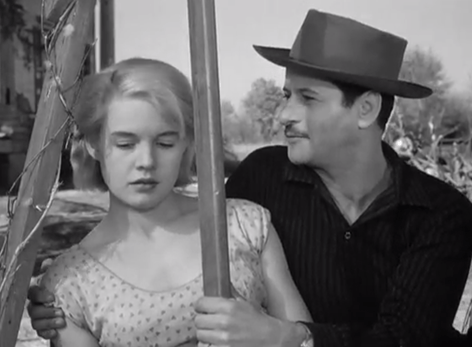
Elia Kazan had a fairly lucrative partnership with Tennessee Williams and the same could be said of his ongoing working relationship with Karl Malden. It’s fitting that all three are back for Baby Doll and yet it still manages to feel like a bit of an outlier in Kazan’s oeuvre thus far.
As per usual, Kazan invests great commitment in his actors and the emotional richness of their performances, which enter near hyper-realized heights. Because there would be no Baby Doll without Malden, Eli Wallach and of course, Carroll Baker. They must carry its weight and for what it’s worth, they manage the task quite well.
Malden is the bug-eyed hick, Archie Lee, who made a pact with the dying pappy of his virginal bride that he would take care of her. Whether he’s held sway on his side of the bargain is up for debate, as Baby Doll and he live in a home literally crumbling around them by the hour
He’s a narrow-minded cotton gin operator who has recently been hitting the skids due to competition. If you are looking for the bare minimums of the story, there you have them. The situations themselves venture on the absurd in this hardly fully-realized plot.
With their house a decrepit eyesore, the furniture soon gets taken away. Archie Lee’s just about at the end of his tether and so he sneaks out one night and commits an act of arson on a whole silo full of cotton. It’s a desperate attempt to give himself an advantage and direct some business his way.
It’s true many might be unaccustomed to comedy in a Kazan film because though it’s masked by typical antics, melodrama, and the risque veneer that precedes it, the humor is unquestionable. If it sounds like melodrama you only have to look at the performances to crack a grin because they do feel like over-the-top exaggerations.
The galvanizing moment, of course, is our first view of Baby Doll lounging in a crib-like bed, sucking on her thumb. Her husband peeps on her through a hole in the plaster giggling like a lecherous schoolboy when she wakes up. We have a Lolita archetype and no doubt the source of its censorship woes, which elicited a “Condemned” rating from the Catholic League of Decency.
What always stings more is hearing the N-word bandied around so inconsequentially as the African-American characters play an unheralded supporting role in the far-off periphery. There you see the hypocrisy. No one in the Catholic or Southern Christian communities probably saw it fit to condemn this element, no doubt considering it acceptable, even commonplace. It’s at least something worth acknowledging soberly.
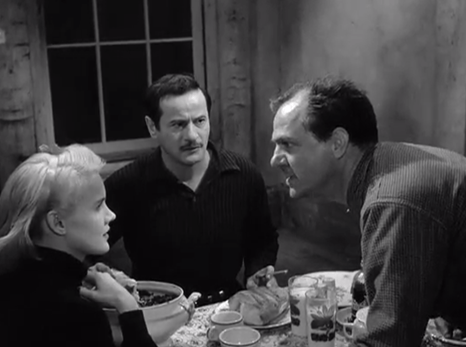
If Archie Lee is our entry point into this asinine world, then Baby Doll and Vacarro (Wallach) have the presence to keep us watching. In a momentary lapse in judgment watching Long Hot Summer, I mistook Lee Remick for Carrol Baker because they look vaguely similar at first glance. However, Baker does more than a southern belle here full of sing-song dialogue. There’s a tremor, an impediment to her speech which, comes off as strangely childlike. She boasts a cutesy name and enticing sensuality akin to Darling Jill from God’s Little Acre and really there’s the film we can draw the most parallels between.
Because Eli Wallach plays the other man who pays Archie Lee a visit the following day after the conflagration at his place. He’s derisively referred to as a “Whop” and so it’s easy for him to become the outsider with a chip on his shoulder. He’s willing to do what he needs to do in order to get back on top of the heap. Ironically, he lets Archie Lee in on his philosophy. He’s a proponent of “biblical justice,” an eye for an eye and a tooth for a tooth, though he obviously didn’t read the scriptures too closely.
Instead, he implements their “Good Neighbor Policy” and while the other man is out fixing his machines to take on a new cotton crop, Silva starts playing with his wife even sneaking into the house to toy with Baby Doll. But remember this is not A Streetcar Named Desire. Wallach has his own inner demons but he’s no Stanley Kowalski and Baby Doll’s no Blanche.
Their trajectories take them into different places as a drunken Archie Lee gets jealous of his wife’s suitor, going after his adversary with his shotgun. However, in the end, the stakes are slighter than its predecessors and yet there’s something novel and slightly refreshing in this. While Baby Doll is nowhere near the best of Kazan’s work its “otherness” makes it a risible endeavor out of left field.
3.5/5 Stars
 In style if not entirely in execution The Lineup exhibits some similarities to Murder by Contract from the same year. Both films choose to take hit men as their main characters and it becomes a surprisingly intriguing way to look at a crime. Because the killers are a certain brand of sociopath who make film criminals all the more compelling based on not only on the way they carry themselves or the actions they take but the very words that leave their lips.
 “Nobody throws me my own guns and says ride on. Nobody” ~ James Coburn as Britt
 Into the valley road the seven rather like the light brigade, at first simply preparing to train up and prepare their little village of farmers to fight back against the brutal outlaw Calvera (Eli Wallach). But there’s something that happens over time. When you spend time in close proximity with people, eating their food and sharing their shelter, it’s hard not to build a bond — a connection that holds you there. At first, it seems of little consequence when the enemy gets beaten back, but everyone knows they will return with a vengeance.
 And we get the final skirmish with guns blazing, bullets flying, and lives being put on the line. Here is a film where the final body count deeply matters. Not so much of the enemy, but of our heroes, because each one chisels out a little niche for themselves. Everyone has worth and importance even as they jockey for screen time and it pays off in the end. They fight with honor just as they die with honor. Perhaps it might seem futile, but not without significance. The little village is left in peace to live out their days in tranquility. Calvera’s final words echo in their ears: “You came back – for a place like this. Why? A man like you. Why?”


 4 Star Films