Wildcat (2024)

A version of this article was published in Film Inquiry.

“I am always highly irritated by people who imply that writing fiction is an escape from reality. It is a plunge into reality and it is very shocking to the system.” – Flannery O’Connor

As someone fascinated by story structure the biopic form is often a tough nut to crack. Cradle-to-grave entries in covering the breadth of a life, can either feel like rushed simulacrums or stodgy overlong hagiographies nailed to the floor.

The very best movies of this ilk inevitably evoke the spirit of their protagonist with the very sinews and bones of their structure. Hence a movie on Mishima that’s wild with heavily striking mise en scene. A Brian Wilson story that is empathetic, hallucinatory, and musical to the nth degree.

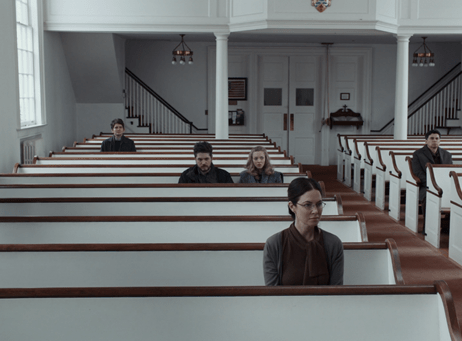
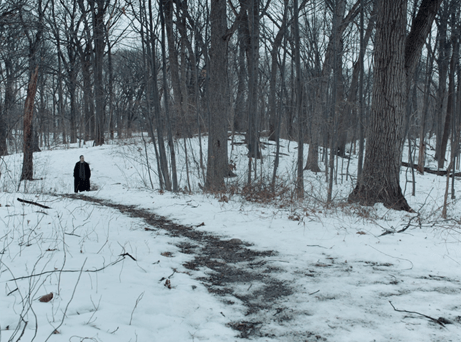
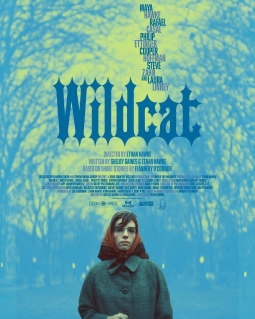
Director Ethan Hawke and his co-writer Shelby Gaines have found their own way to do service to famed southern Catholic author Flannery O’Connor. Because her life was famously banal — she lived in her Georgia town with her mother writing before her death at 39 — they tackle her formative years through the vivid imagination of her own literary works.

It’s important to note while this movie is full of fanciful and often humorous and grotesque portraits of humanity, it never feels like the escapism the author abhorred (One can imagine she would have choice words for a hothouse melodrama abruptly featured at the outset). O’Connor always was concerned with depicting the life she knew by unorthodox and often startling means. There was nothing conventional about it.

A Good Man is Hard to Find is case and point, one of her startling works where a self-righteous old hag ends up being shot to death by a wanted fugitive and in this precise moment she becomes a gracious person for the first time in her life. In the film when the gun shot goes off, we watch a young O’Connor (played by the director’s daughter Maya Hawke) go flailing backward from behind her typewriter. She feels her stories so profusely.

We watch her life during her early years as a young woman. There are stints at the illustrious Iowa Writer’s Workshop under the tutelage of Cal Lowell (Philip Ettinger). She pays a visit to a publisher who tries to tactfully give her feedback on her first novel Wise Blood. She’s quick to retort that she’s “amenable” to criticism but only if it does not attempt to neutralize her artistic vision.

There are segments of her returning to live with her mother Regina (Laura Linney) in a society where people want her to be the next Margaret Mitchell, penning the next Southern nostalgia lost cause classic like Gone With The Wind. Meanwhile, Flannery seems antithetical to this entire idea.

It’s evident she is a singular mind who will not settle when it comes to her writing. She tells the truth as spiny and ugly as it might be. This is my own experience with her work. I rarely enjoy it. I feel scandalized and assailed by it at every turn.

It’s difficult going and then she turns a story around and uses her characters and the bizarre scenarios to ambush me. Ironically, the saving grace of her stories are how they all revolve around the scandal of grace — our need to recognize and accept it in our own lives.

The threads of the movie’s narrative are tied together with earnest excerpts from her prayer journal and many of her most notable short stories. One that was my introduction to Flannery was “Revelation” where a self-righteous southern woman gets tackled in a waiting room by an indignant girl named Mary Grace. This comes only after a dream where Jesus comes to her and says she can only enter heaven as a negro or white trash. Perish the thought…

The other is “Parker’s Back” where a profligate covered in tattoos marries a devout woman and gets the image of Christ tattooed on his back to please only for his wife to beat him. He’s tossed out of the house, bloody and bruised, brought to the lowest point imaginable. Is this idolatry or as we watch the picture of Christ being bloodied in front of us, what are we to do with it exactly? It feels uncanny and uncomfortable, a perfect evocation of O’Connor’s sensibilities.

Delving into their conversations, it’s apparent Maya and Ethan Hawke have an abiding appreciation for this woman and her writing. There would be no other reason to make a movie like this with so much tender loving care. And so any mild criticism feels like putting kindred spirits under the chopping block. It need not be so. They feel like dear friends.

John Huston’s adaptation of Wise Blood has an intuitive handle on the Southern milieu and the absurd humor found in O’Connor’s work. She’s darkly funny. It seems to thrive while still getting to the perplexing themes at the core of a story that feels scandalizing as she tears through the Southern mentality with her incisive quill.

What Wildcat has is something so often absent from both film and art these days. It’s not squeamish about the tough conversations nor does it skirt over the most prickly issues, not only of America’s legacy but the very essence of the human experience.

There’s a weight and a gravity to it that’s felt in almost every frame. The only reprieves come from O’Connor’s own wit. This is all in service to its subject because Flannery was a young woman sincerely struggling to balance her aspirations to be a great writer and a devout person of faith in communion with God.

So often we are told these creatives and religious life are mutually exclusive. Which of course feels preposterous to O’Connor in the face of her Creator-God. It’s easy to be moved when she sits among her cohort at the writer’s workshop in Iowa — a midwestern institution that nevertheless maintains a reputation for the literati — and she says religion is not an electric blanket; it’s the cross.

It’s so difficult to take stories that live in our mind’s eye and bring them to the screen because then they are tangible and concrete. Endless possibilities of imagination are distilled down to distinct creative choices. Hawke’s film tailors its palette to a tempest-like existence that roils O’Connor’s soul as she seems to battle for life and death with her typewriter as her only weapon.

Is this a bit much? Perhaps and yet anyone who does write and cares about art or has suffered and struggled, recognizes that it doesn’t feel like hyperbole. It feels real and affecting — like something we understand intimately. In O’Connor, we see reflections of our own struggles in our creative endeavors.

Because we believe our words mean something and that life matters and questions of death and religion are not ancillary topics for dinner parties. They are the crux of our entire existence.

Cal, Flannery’s pen pal and hinted love interest, gives her Thomas Merton, and in this reference and watching her tumultuous struggle depicted on film, it’s difficult not to draw lines between Hawke’s performance and her father’s protagonist in First Reformed (Ettinger who plays Cal also had a crucial role in that film).

For that matter, one of the other integral scenes involves a priest played by Liam Neeson. It feels almost like a reprieve after his apostasy in Silence. He pays Flannery a visit as she’s bedridden, stricken with the lupus that killed her father, and currently unable to write.

Here he enters in to provide Flannery comfort and in all her internal struggles remind her of grace and grace abundantly — something given to her through the death and resurrection of the Jesus they believe in. There is immense power in this scene, even in its simplicity.

Because the storm outside her bedroom widow or even the lupus that’s ravaging her body almost feel like outward manifestations of the real struggle going on. Why does hardship often make us more aware of grace and our need for it in our lives whether we want to accept it or not. Pain is not easy. Happy, warm, affable stories are a lot more palatable.

O’Connor would never dare to be so disingenuous about her faith or her storytelling. And judging from her life and premature death, she was more than acquainted with troubles. She had an intimate relationship with them. Certainly this was not the life she had envisioned for herself.

Still, she ran the race of life even if it was on crutches. Perhaps not dissimilar to that hapless chicken walking backward. What’s more, she blessed all of us with her stories — signposts to help us along our own paths — shocking us back to reality.

I couldn’t get the image out of my head — first as Flannery picks up her new peacock from the train station and then the remarkable moment where its tail feathers fan out behind her in a glorious display. If other people saw her as that measly chicken, in the eyes of her Creator she really was that glorious peacock. What a gift it is.

4/5 Stars
First Reformed (2017)

firstreformed1.png

“You’re always in the Garden.  Even Jesus wasn’t always in the Garden, on his knees, sweating blood. He was on the Mount. He was in the marketplace. He was in the temple. But you, you’re always in the Garden.” 

Paul Schrader and Martin Scorsese unknowingly formed a legendary partnership in making Taxi Driver (1976) that has left an indelible mark on cinema. Despite their diverging backgrounds, it seemed like they were very much kindred spirits. At least, they understood each other.

Scorsese of course, grew up in the Catholic Church even considering becoming a priest. Schrader likewise, had a deeply religious upbringing rooted in reformed theology even attending Calvin College. Aside from both being cinephiles, each man has battled through his share of demons and yet they have come out on the other side no doubt wiser.

Thus, with the release of Scorsese’s deeply spiritual passion project Silence (2016) a couple years ago, it seems fitting Schrader followed up with First Reformed soon after. I’m not sure if it’s mere coincidence or not but by this time in their lives, with space for retrospection, they have come to a crossroads to make daring, personal pictures about religious faith.

The opening shot is instantly recognizable. We have the stark symmetry of a church steeple. The religious space lacks the same type of iconography as the Catholic Church because the Calvinists came from a  tradition foregoing any amount of pomp & circumstance for a stripped-down aesthetic. All the focus was on the cultivation of the spiritual life.

There still is history, as this particular church is just about to celebrate its 250th anniversary and it was once a stop on the Underground Railroad years before. The resident reverend’s tours include touting the Dutch Colonial architecture and showing wide-eyed kids the trap doors escaped slaves used to hide in.

Now it’s ironically also a spiritual museum-piece — a creaky religious relic — attended by a few stray parishioners. The real center of religious activities is at Abundant Life a well-meaning but somewhat sanitized megachurch set up across the road. Perfectly reflected by their cafeteria wall emblazoned with the words from Acts 2.

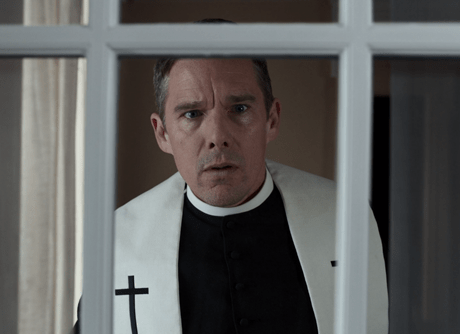
The story actually begins with an experiment of sorts. Reverend Ernst Toller (Ethan Hawke) will keep a journal for an entire year in a notebook and then he will destroy it. There is an obvious finality to this. He’s set himself a hard timeline.

Though he mentions word documents and digital files, he might as well come out of a Bresson picture. His possessions are few and far between. A well-worn Bible sits on his bedside table accompanied by the works of Thomas Merton and G.K. Chesterton. His landscape and surroundings are just as stark and humble. Interiors are kept equally simple and straightforward.

firstreformed3.png

The unadorned yet meticulous composition use geography whether structures or a bit of symmetry to set up scenes. Inside the church with the lines of pews that might be plucked directly from Winter Light (1963). Then, along a row of houses in a neighborhood as a car pulls up to a house.

One house he pays a call on belongs to Mary (Amanda Seyfried), a young pregnant woman, who grew up in the church and is now worried about her husband Michael’s mental stability as of late. She worries it will affect their future child. The reverend might be able to help.

Upon their first dialogue together, it becomes obvious he is not a learned man. He had a stint in jail for his environmental activism in Canada and currently holds down a job at the local Home Depot.

But he gives a cogent account of why he does not want to bring a child into the world. By 2050 all scientific analysis seems to suggest dire straits are ahead if we do not make radical changes on an international level. Because climate, water levels, and everything else will not leave man unimpeded.

His question is simple. How do you sanction bringing a girl into the world who is full of hope and naivete? Then, she grows up and as a woman, she looks you square in the eyes and says, “You knew it all along, didn’t you?” And yet you brought her into this world of death. Most of what the reverend does is listen to his grief. The only response possible is that the blackness is not a new phenomenon. Man, woman, and child are born to trouble. It seems small comfort.

firstreformed2.png

As the themes begin to interweave there are continuous nods to Ingmar Bergman’s Winter Light (1963) from the snow motif to a deeply troubled husband and even a female associate who takes a deep concern in the well-being of our protagonist. You can sense Schrader acknowledging his deep abiding affections for Robert Bresson — an obvious reference point being Diary of a Country Priest (1951) — with a man of faith suffering from a mysterious ailment. It only serves to exasperate his human relationships and give a physical manifestation to his existential crisis.

In maintaining the transcendental spirituality of the film, Tarkovsky levitations and Dreyer-like “resurrections” are also evoked and the list goes on and on. In fact, it amazes me how obvious and plentiful the allusions are. Schrader barely tries to hide his affinities for certain pictures. They are most assuredly there being represented and it’s generally satisfying.

But it is a film that is also born out of the mind who brought us Taxi Driver and the ties are closer than we might expect. Because it becomes more akin to the desolate alienation of Travis Bickle as the story plods on. After experiencing a tragic death and witnessing the ways the modern world functions, Toller seems to see the need for a martyr in an unjust world. He becomes increasingly alienated.

His life involves helping out with the homeless food line, sitting in on the youth small group, and of course, his tours and Sunday duties. But it’s the old conundrum. He feels confined to the walls of his church. It doesn’t seem like he’s necessary for anything aside from spiritual comfort. He has no true impact on people lives and he himself is struggling to keep in communication with God. Solitary prayer seems empty. Hence a nightly journal.

Something happens when he gets in a spat with a local big whig over negative publicity from a funeral for Michael Masana. It was held at a toxic waste dump with a choir singing an environmentally conscious Neil Young tune. Toller gets lambasted for his “political behavior,” though he was admittedly only upholding the man’s wishes. And yet he is beginning to question how people who proclaim to follow God cannot take a greater stake in preserving his creation.

In documenting Martin Luther King Jr.’s efforts, Ava DuVernay’s Selma (2015) was a call-to-action in the realm of social justice. For all those people who claim or at least strive to be good, morally upright people, it is clear this is a universal fight. Likewise, First Reformed is a call or at least a meditation on environmental justice because humans are meant to be stewards. It is not completely about extremism (though Toller begins to inch that way) but in some ways, we are meant to live radical lives. Full of radical love and a radical conception of justice for the earth and other human beings.

But one could say this is not the true punchline. For that we must revert back to some of the deep-set themes of Schrader’s career, returning once again to his first collaboration back with Martin Scorsese back in 1976.

Because First Reformed has one of the most abrupt endings in recent memory. It catches us off guard on numerous fronts. We must start with the ambiguity which is nothing new. Travis Bickle entered the pantheon of cinema characters partially due to the enigma that clouds his fate in Taxi Driver.

Most people who have ever been ambushed by the film will recall the ending. Travis goes on his crusade to clean up the filth and it’s a violent rampage in the eyes of the world but for him, it’s an act of triumphant heroism.

In the final moments, he’s back in his cab again — his personal cathedral — driving the streets and there’s his untouchable girl, Cybil Sheppard, who appears in the back seat. He sees her through his rearview window and rides off. It seems almost impossible to read it in the literal sense. How could this be? Is this his own personal delusion? Could this actually be real? I know my own inclinations but I don’t know what to believe.

First Reformed is much the same. Here we have the Reverend about to take his poison — looking to end his life — in the face of such a dreadful world. Then a door opens and there stands the one person who might save him, Mary, appearing in the doorway like an angel.

They embrace and then beginning kissing and we spiral around and around them in one of the most violently uninhibited camera setups in the film. We have broken out of the harsh asceticism of the entire movie thus far.

Is it about this salvation coming through the physical union between two people? This could be the Ordet-like resurrection or maybe like Taxi Driver it’s all part of the ultimate delusion. The bottom line is we don’t know and Schrader doesn’t tip us. Much like Silence, what’s paramount is what we fall back on in response.

Can we read this as a story of despair or hope? The words of Toller echo through my mind, “Wisdom is holding two contradictory truths in our minds simultaneously.” This is First Reformed at its finest, ever oscillating between the two defining poles of any life.

4/5 Stars


“There is not a square inch in the whole domain of our human existence over which Christ, who is Sovereign over all, does not cry, Mine!” – Dutch Prime Minister and Theologian Abraham Kuyper

Before Midnight (2013)

Before_MidnightWell, I was expecting great things from this film as the third installment in an intriguing romantic trilogy. I will admit that at first I thought it was decent but I was not blown away.

My favorite moment had to be near the middle when Jesse and Celine took a walk through the ancient streets of Greece. Their conversation was reminiscent of the previous two films and I appreciated that.

However, the beginning of the film was filled with family moments, discussions with friends and little time of Jesse and Celine alone like the years before.

When they finally were alone they were quick to argue and lose their tempers over familial issues and seemingly petty problems. Even to the end of the film, their relationship seemed perhaps more creaky than it had ever been.

However, over time I realized that these things that I did not like made the relationship of Jesse and Celine all the more realistic. They are not the starry-eyed kids or the young lovers meeting up for romance. They have children, strained relationships with former spouses, more wrinkles, full time jobs, and 40 years under their belts, and that is the way that real life often is. So I’ve been told.

I’m not sure if Celine and Jesse will ever be brought back to screen, but I know that I was ultimately satisfied with the place we left them at. As Ethan Hawke said it all began as a story about what might be, then it was a film about what should be, and Before Midnight was the film about what actually is. Linklater did us a favor by not giving into the conventions that we are so often used to, because he was never one to do that before, sunrise or sunset. His lovingly crafted romance would not sink to that level and should not sink to that level. It remained true to itself and even if it was not what I wanted, it was what was called for.

Who knows, 9 years down the road we might get another installment, until then I will be content with the love story Linklater, Hawke and Delphy so graciously gifted us. It’s not perfect by any means, but it’s genuine and that is far better.

4.5/5 Stars

Before Sunset (2004)

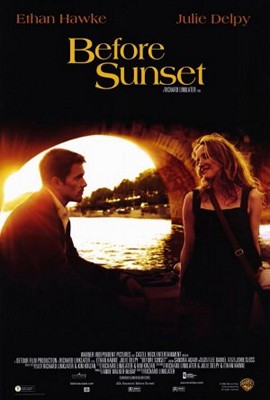
Before_SunsetIn this sequel to Before Sunrise we come back nine years later.

There is a certain degree of eagerness and nervousness as we wait to hear what happened in the months following Before Sunrise. We find out that Jesse and Celine did not actually meet 6 months after their first encounter. In all reality, what were we expecting? I myself had a secret hope that they would meet again. It’s the romantic in me, but that’s not how life ends up working out. Jesse showed up but the sudden death of Celine’s grandmother detained her. That’s one of the plights of this human existence.

Now Jesse is a writer who made a book about their evening together and one day in Paris while promoting his book there is Celine smiling through the window.

Here they are back together again nine years later with 1 hour to catch up before Jesse has to take a flight back to the States. With the passing of the years we now find ourselves watching an older, wiser, pair. They are both married now.

Jesse has lost the long hair and he is not quite so young in the face but it is still the same guy. Celine is still very pretty but more mature than the young French girl from the earlier film. Most importantly of all they still have a knack for deep, highly personal conversations.

A lot is covered as they chat through the streets of Paris. My most favorite moment however comes when Celine plays Jesse the Waltz she wrote. It is a beautiful little ballad in its own right and it shows her personal connection with Jesse that still lasts over all these years. What he encapsulated in his best selling book she documented in a song. We leave them once again as two slightly different people who still have a penchant for conversation, love and sentiment.

The film starts and like a blip on the radar it is already finished. In some regards it is rather disappointing, but not as unsatisfying as this short rendezvous must be for Jesse and Celine.

I have no bitterness, my sweet
I’ll never forget this one night thing
Even tomorrow, another arms
My heart will stay yours until I die

Let me sing you a waltz
Out of nowhere, out of my blues
Let me sing you a waltz

~A Waltz for a Night

4/5 Stars

Before Sunrise (1995)

Before_Sunrise_posterThis is a fascinating film not just about love and romance but higher, deeper concepts altogether. Without knowing the idea already existed, this is the film I always wanted to make in my head!

Two people meeting in a place under unusual circumstances (on a train in a foreign country), and then building a bond over a single day that evolves into something really special very, very quickly.

This is exactly happens with Ethan Hawke and Julie Delpy who do a wonderful job playing two genuine people who have their own set of ideas, aspirations, fears, memories and unique personalities to go with them.

They spend an evening in Vienna and create a memorable flashbulb moment out of it. One instant that sticks out in my mind is when they are sitting at a restaurant with many conversations going on around them. However, the two of them have pretend telephone conversations with other people. Through it Jesse and Celine learn how the other feels about them. It is so beautifully captured because they do not have to say it directly, but through this roundabout way they know.

Perhaps this film sounds like a bore to some and it may in fact be because a lot of it is talking. But Linklater and his collaborators frame it in such a way that I was very much engaged. Isn’t a lot of life talking anyways? In that way it had a spontaneous, realistic feel and that is thanks to a solid script along with the candid delivery of the leads. When I first saw Julie Delphy I had no idea she was French and it took me a while to catch on. She and Hawke play well off of each other and it is interesting to be able to eavesdrop on their conversations.

Before Sunrise was a pleasant surprise because it failed to fall into many of the normal conventions of romantic comedies and instead it rose above the mediocrity to tackle the ins and outs of love and life through frank and wonderfully unadulterated conversation. I cannot wait for more of Linklater’s trilogy.

4.5/5 Stars

Boyhood (2014)

13113-boyhood1Surely others have said this already but Boyhood struck a chord with me and it was the prettiest of melodies.  Pure and simple in its brilliance.

This is not my childhood by any means or my life or my family, but there are glimpses of it here. Quick flashbulbs or touchstones that for a brief instant take me back. Sometimes many years ago or just one or two. Nostalgia is the strangest type of memory for a young person, because we are transcending the space between the here and now, which we are so used to, and going to the “back then.”

12 years is a long time but even more so when you have fewer years under your belt. Thus, Boyhood in comparison to my own life is an epic film in every sense of the word. Whereas it might only be a wonderful coming-of-age tale for older generations, there is a feeling that this film in some small way represents where I’m coming from.

A film could never fully encapsulate or perfectly represent what it is to grow up in adolescence. It’s different for every child depending on where they live, what their family is like, and so on. But Boyhood is an unprecedented depiction of what that existence looks like to many young people. There is certainly something special and important in that.

1cce5-boyhood2There are so many different vignettes, almost like short films, characterizing each and every year in Mason Jr.’s life. We are given no blatant indication of time and place. It is all context clues, cultural references, and watching Mason and his family grow and evolve around him. Always innovative Richard Linklater does not hold out a giant megaphone saying this happened that year or this year. Instead, Mason’s story plays out like it would in the so-called “real world.” There are some major milestones or life-shaping moments that are shown, but most of this journey has to do with the little caches of time that make up life.

I feel drawn to do something that I don’t normally do, but Boyhood is such a unique film it deserves to be approached in a different light since to put it truthfully, it cannot be pigeonholed into any standard category.

Instead of trying to acknowledge the entire narrative of Mason’s life, which would be as impossible with him as with anyone else, I want to give reference to the many moments and bits and pieces that Linklater placed either by accident on purpose. The fact is Boyhood is chock full of these markers of the passage of time which make it a fascinating journey of human life.

Here we go, get ready:

Coldplay’s Yellow over the credits
Britney Speares fandom
Star War dilemma: Yoda vs. Grievous
Game Boys and Wave Boards
The Astros’ Rocket Roger Clemens
Harry Potter and the Half Blood Prince
The Landlord – Will Ferrell
High School Musical – We’re All in This Together
Wii Boxing with a Nunchuk
Presidential Election in 2008
Facebook profiles
The Dark Knight
Phoenix – 1901
Twilight books
War in Iraq and Afghanistan
Lady Gaga and Beyonce
Iphone Facetiming
Gotye – Somebody That I Used to Know
Atlas Genius – Trojan

and on and on….

c94ae-boyhood3Against this backdrop, the separation of Mason’s parents (Ethan Hawke and Patricia Arquette) takes center stage. Next, follows another failed relationship riddled with abuse. Switching cities and starting a new life followed by another step-dad and another failed marriage. Then, dad (Hawke) gets remarried and it actually works out. There’s peer pressure and experimentation. Girls become a big deal. Photography is a passion. Sister (Lorelei Linklater) goes through the rebellious phase. High School graduation comes around and college soon after. Breakups happen and life still continues ever onward.

You could make an argument that Linklater could have gone on longer. He could have wrapped everything up nice and neat or cheated and fast forwarded to the end. But that was not his way out and it did not have to be. College is a major moment of change, confusion, and finding oneself, so in a sense, it is a fitting place to leave Mason behind.

He remained introspective, philosophical, and aloof for the majority of his life, despite family of origins issues and the like. It is mind-boggling to think of all the people cycled in and out of his life. Ever changing and often forgotten.

Thus, Boyhood is a gift to us for a multitude of reasons, but hopefully, its visual biography of Mason Jr. will lead us down memory lane and cause us to consider our path. For most of us, we have more than 12 years in front of us. Let us use our time well and wholeheartedly navigate the realities of life whether it is movie worthy or not. It’s our life and that’s all that matters.

4.5/5 Stars

The Dead Poets Society (1989)

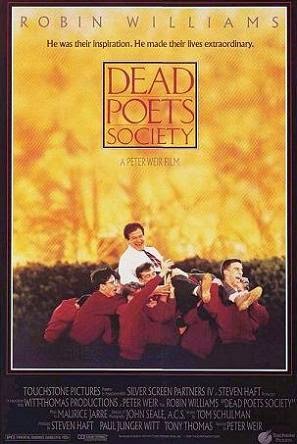
24bb0-dead_poets_societyDirected by Peter Weir and starring Robin Williams in a career-defining role, the film opens with the commencement of a prestigious all-boys school. There the boys say tearful goodbyes to their parents and get reacquainted with their chums. The strict and disciplined class regiment soon starts and everything is business as usual for these driven boys. 

However, their new English professor John Keating (Robin Williams) was a former student of Welton, and his teaching style is far from ordinary. His pupils first find him strange and then come to admire his methods. He instills them with the phrase “carpe diem,” has them rip out the stuffy introduction to their poetry textbooks, gets them to see the world from on top of their desks, and encourages them to call him “O Captain, My Captain.” Above all, he leads his students to seize the day, and think for themselves in the process.

 A group of his students re-launch the illegal Dead Poets Society that Keating himself had been a part of as a lad. There they share their thoughts, feelings, and ideas freely in defiance of the school. Charlie (Gale Hanson) for one puts an illicit article in the paper only to follow it by an audacious act that receives retribution from the Headmaster. Knox (Josh Charles) somewhat accidentally meets a girl who he immediately falls head over heels for. However, she already has a boyfriend, but the undaunted Knox will not be deterred, and he keeps seeing her. Against his father’s wishes, Neil (Robert Sean Leonard) takes up acting in a play only to receive his father’s immense disapproval later on. The outcome of this is tragic, and it ultimately leads to an investigation of Keating. Everything seems bleak for the boys as they either rat on Keating or risk expulsion. 

Keating is released and English returns to the same monotony. However, Keating’s impact cannot be destroyed that easily, and in one last act of the defiance the boys stand up for their Captain led by the formerly timid Todd (Ethan Hawke). I must say that although the film’s ending was inspiring, it left me wondering what the consequences were. Also, I did not really understand the point of The Dead Poets Society. The title would seem to be more aptly Carpe Diem. Putting that aside, there are some good performances here, and Robin Williams is truly a pleasure to watch. He could be my English teacher any day. There are some good lessons to be learned here too. Take note boys. 

4/5 Stars