James Whale: The Old Dark House (1932) and The Invisible Man (1933)

The Old Dark House (1932)

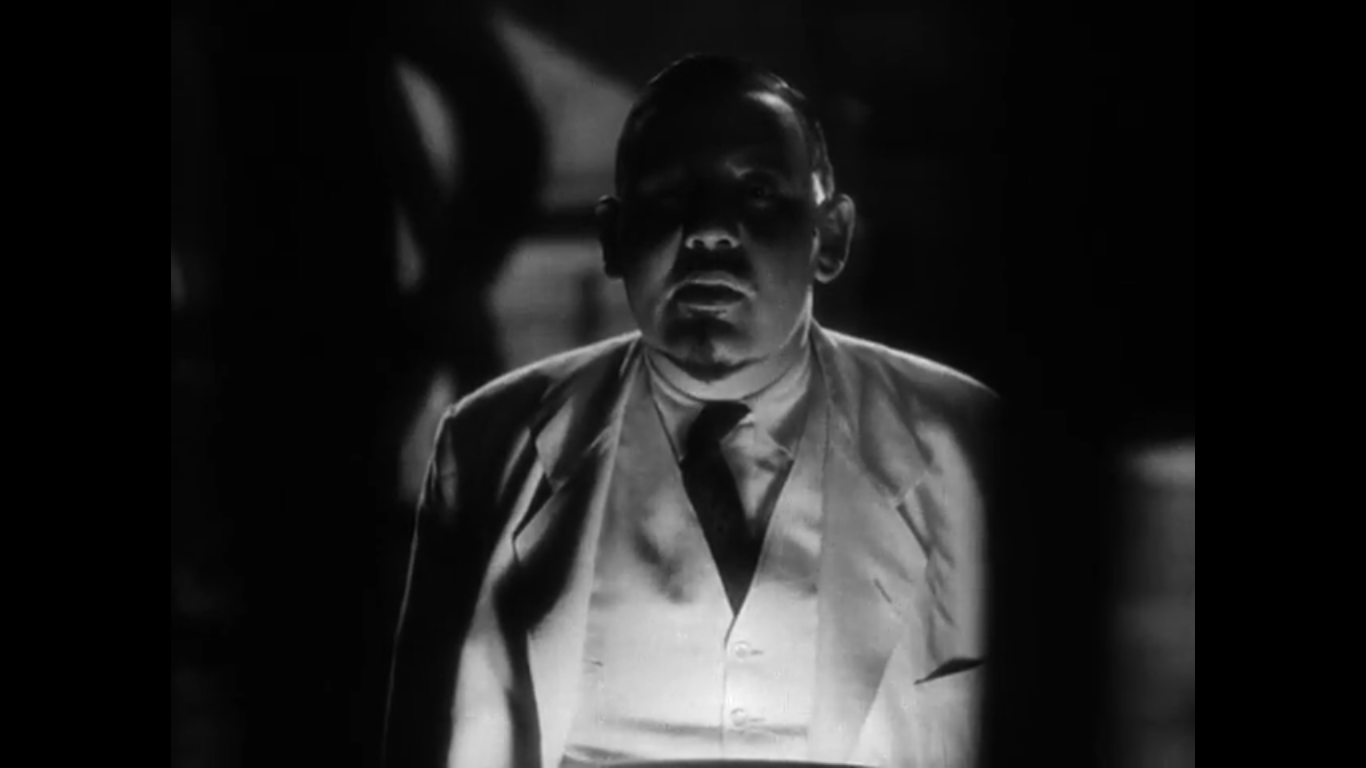
The Old Dark House has a disarming levity that broadsided me at first. James Whale, the man who famously gave us Frankenstein, has all of his notable features with the tinges of horror on hand for another ghastly delight, and then he goes and pokes fun at the whole setup. Raymond Massey is instantly pegged as a slightly stuffy husband. His wife, dazzling Gloria Stuart, a young ingenue has signed up for more than she bargained for with the outrageous downpour dousing them in the dead of night.

Then, there’s old reliable Melvyn Douglas playing his quintessential character type, always good for a wisecrack, with his feet kicked up, and his pipe tucked in his mouth as they proceed to get hopelessly lost. And of course, he can’t help but whistle a few fractured bars of “Singing in the Rain” when their waterlogged buggy has no recourse but become semi-amphibious.

Oftentimes bathos is used as a kind of criticism — this idea of anticlimax or a break of the mood — because it’s too jokey and therefore undermines all the groundwork put down before it. However, Whale seems to be doing something different.

At any rate, it’s not an out-and-out drama and so while somehow deconstructing his tropes and suggesting to his audience he knows precisely what he’s doing, we reap the benefit of the humor and the chills in ample measure. This is the underlying success of the film in a nutshell. It carries off both and becomes invariably more intriguing in the process.

Because The Old Dark House fits seamlessly into the tradition of Cat and the Canary, Hold That Ghost, House on Haunted Hill et al. A dark and stormy night is a genre given, but the abode itself must bring with it the unnerving idiosyncrasies to make the audience ill at ease. Rest assured. It does.

The proprietors include a white-haired gentleman trembling with timidity and his eternally deaf and priggish sister who condemns all blasphemers en masse. Their valet (Boris Karloff) might as well be a grunting prototype for the wolf man. All of this doesn’t quite suggest a warm and amicable atmosphere. It screams something else. But that’s just the beginning of the festivities…

If I’m to be terribly honest, it seems like an utter waste of Karloff’s talents, especially because I was barely aware he was playing the part. He gets partially overshadowed by the more verbal characters. Charles Laughton, for one, comes tottering through the front door soaked through as gregarious Sir William accompanied by his playful and rather giddy companion (Lilian Bond). Her lithe spirit mirrors Douglas, and they gel nicely. The night quickly turns them into an item. In fact, all the guests hang together.

One could wager it comes out of necessity. It’s a ghoulish space filled with funhouse angles and other parlor tricks. Locked upstairs is a decrepit patriarch and behind another closed door is crazy Saul, who makes a cameo appearance spouting the story of King Saul and David. You know the one, where malevolence came over Saul and he proceeded to spear the other man to death.

He finds a knife and brandishes it with a kind of giddy insanity we don’t know how to respond to. He could do anything. Douglas, the picture of casual confidence and charm for most of the picture, finds his own veneer unseated filling in for David. It’s these kinds of digressions that we never expected, and somehow they make the picture by leaving the audience totally nonplussed.

By the time The Old Dark House is wrapped up, it feels like the gold standard of this brand of haunted house movie because it’s just as much about being a mood piece — finding humor in these outlandish scenarios — and Whale does all of the above with assured aplomb.

4/5 Stars
The Invisible Man (1933)

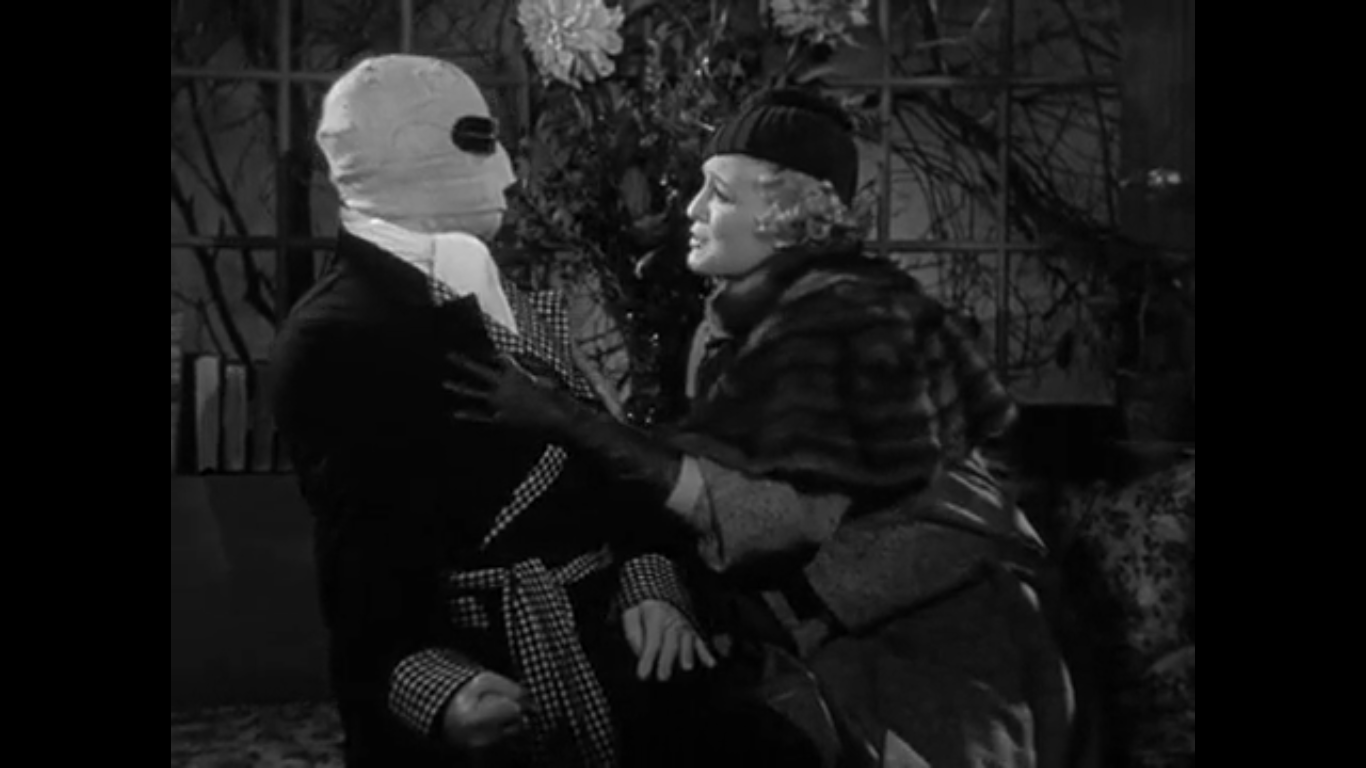
I always thought about The Invisible Man as a scientific marvel, but now I understand how he’s firmly planted in the realm of horror with added superhuman abilities. There’s something that feels somehow modern about Claude Rains’ portrayal of the eponymous character. It’s almost as if he’s the precursor to some enigmatic alien creature from Star Wars.

He’s unique and out of step with this more traditional setting of a bar and lowly establishment as local folks chew the fat and the incomparable Una O’Connor runs the place. One feels quintessentially British, albeit through the prism of the Hollywood dream factory. Rains is totally a movie machination born of smoke, mirrors, and special effects.

But it’s also as if this camouflage provided Rains the means to give one of his most ballistic and volatile performances. It’s not that he couldn’t play, wry, sly, or even bad-tempered, but his typical onscreen disposition was one of regality. He commands the room but in a very different way.

He’s seething one moment and then hysterical the next. The local constable rightly asserts, “He’s invisible. He gets those clothes off and we’ll never catch him for a thousand years!” It makes the stakes obvious. Soon thereafter the maniacal doctor commences a reign of terror making good on his threats by committing murders and diverting trains off their rails. He makes it clear he has the power to make the world grovel at his feet.

If it’s not obvious already, he’s taken on the mantle of a violent “Superman” cut out of the cloth of Dostoevsky’s Raskolnikov. What’s worse, there seems to be no one capable of stopping him.

What’s most fascinating is how the film builds the legitimacy of the Invisible Man. It’s not merely a sitcom-like trope where the invisible are given the freedom to pull practical jokes or take on a Groundhog Day-type disregard of worldly conventions. This is part of it, yes, until it becomes something more.

It turns into a story of fear and broader social implications broadcasted over the news and through every small town by word of mouth. He’s continually left unchecked and the drug he’s taking pumps him full of delusions of grandeur. It’s a drug and addiction of a different sort. Not even the affection of his former girlfriend (Gloria Stuart) can change his mind. He’s too far gone.

The special effects and the choreography get better and better as a crowd of bobbies forms a human dragnet to converge on him in the dead of night. He skips away with a policeman’s trousers sowing chaos and discord wherever he goes. But before anyone gets the idea The Invisible Man is a mere lark, we’re quickly shocked back to reality.

It has a jagged edge of vindictiveness which the production codes would make sure soon enough would never see the light of day (at least for a good many years). For now, it feels like a chilling, compact drama chock full of ideas, invention, and not a wasted minute of running time. It’s also without a doubt Rains’ finest entrance in a movie: It happens in the final frame.

4.5/5 Stars

Reviews: The Mummy, Island of Lost Souls, The Black Cat

The Mummy (1932)

There’s something deeply prescient about The Mummy beginning with an archeological expedition for The British Museum. If it’s not evident from the outset, the film is firmly planted in the reality of 1922 when Howard Carter famously discovered the tomb of Tutankhamun. This is only one historical example, but even I remember hearing about the exploits of this modern discovery.

Now we live in a world in dialogue with the history of colonialism from the cultural tension over the Elgin Marbles to the very idea of ancient antiquities being housed in museums themselves. Even if it’s mostly to capitalize on something the contemporary audience might be aware of, The Mummy makes it plain, this kind of potential cultural desecration is not a totally new idea from our “enlightened” age. It has deeply entrenched traditions.

The British expeditioners come from two different camps, and they must mediate the pull between doing their methodical work of cataloging and then following the finds that will gain the most press. Those who are fully committed know they are working for the cause of science and not for loot.

It begins with a young man who will not heed the terrible curse on a casket, and he awakens a creature from eons before. It is Imhotep (Boris Karloff), who enters back into the world fully prepared to take back what is rightfully his and reunite himself with his long-lost love by any means at his disposal.

The Mummy starts out promising, but it never quite nails down the extent of its mythology and everything feels far too convenient with the re-animated mummy capable of doing anything he pleases to serve his purposes (and the plot). He’s well-versed in mind control, he has what looks like a shortwave television, and he’s all but indestructible to human hands.

The flashback sequences of Egypt hearken back to the expressionistic imagery of silent cinema and here is where our director, Karl Freund, seems to show his origins as the fantastic cinematographer for revered works like Fritz Lang’s Metropolis.

The film’s other compelling theme involves a woman of Egyptian blood (Zita Johann), who almost functions as a doppelganger through time. One man falls in love with her in the present (David Manners) and another man loved her in the past. She’s effectively trapped between two worlds — one distantly remembered — and yet now dwelling in the body of a young woman, breathing and alive.

She is not prepared to make the kind of sacrifice asked of her and only the supernatural can save her. Karloff is expectedly chilling, but the pieces around him aren’t quite as enjoyable as his greatest monster movies.

3.5/5 Stars

Island of Lost Souls (1932)

“Mr. Parker, do you know what it means to feel like god?” – Dr. Moreau

Island of Lost Souls is the kind of movie that all but disappeared with the more stringent implementation of the production codes in 1934. It begins with an uneasy mood as a castaway is rescued by a not-too-genial sea captain, who’s anxious about dumping him at the first sign of land.

This is how our protagonist Richard Parker (Edward Arlen) catches a ride to shore on the Island of Dr. Moreau. There’s something rather uneasy about the whole setup and the movie frequents a landscape and a world not so foreign from The Most Dangerous Game. It’s as if an island conveniently eschews all traditional rules of law and order.

While the earlier film is harrowing, subjecting Joel McCrea and Fay Wray to a grueling game of high-stakes cat and mouse, this one is more thematically rich. This might be entirely thanks to H.G. Wells. He is the man who originally conceived of Dr. Moreau. However, something else must be attributed to Charles Laughton.

There’s a level of devilish forethought to Laughton’s performance. Although he’s not an entirely imposing figure, there’s something mischievous about him. Sometimes he comes off gleefully boyish even as he takes on these calculated and totally premeditated social experiments on his self-made ecosystem.

Parker knows nothing about the world he’s wandered into, but he is our stand-in representing everything inherently decent about humanity. And there is something deeper to this since he is white in the age of colonialism. While he might not necessarily bear the “white man’s burden,” certainly he’s aware of his place in the social hierarchy. He’s a benevolent figure. Dr. Moreau is this privileged mentality gone astray.

Judeo-Christian society would look back to Genesis, and the parallel imagery is made plain fairly quickly. There’s a specific order to the world, a created dichotomy between humans and beasts. Because Moreau has installed himself as god on his own private world. However, he has somehow perverted what is good in strange and troubling ways.

These themes get murkier when you start considering ideas of eugenics and even how the aforementioned production codes forbade the outright depiction of miscegenation or the mixing of races in romance. These are not synonymous terms when it comes to humans and beasts living on the island, but it’s hard not to see how predominantly white audiences at the time might conflate the two.

Because Moreau’s rudimentary imitation of creation has elements to mirror what we already know intuitively. His creatures live by basic laws shouted out by their de facto leader (Bela Lugosi), and they realize through roundabout means certain tenets. He has taught them what pain is, and he’s molded some like his prized creation Lota (Kathleen Burke) into his own human image.

If the Christian origin story hinges on a Fall from grace where Adam and Eve were deceived by the serpent and ate from the forbidden tree of knowledge of good and evil, then Island of Lost Souls has its own paradigm. Suddenly, these indigenous monstrosities of his realize their creator is mortal or at the very least they can rebel against him. The law is no more and it’s been disproven. There is no longer anyone willing to uphold or live by it. Namely, because they realize it’s fallacious.

Parker is mostly uninteresting as we watch his repugnance grow, and he looks to be reunited with his innocent love (Gloria Stuart). Meanwhile, the doctor toys with him and tries to set him up with Lota. Lota fits crucially into this deeply human narrative because there’s a suggestion of her “evolution” within the arc of the film even if it’s not in purely Darwinian terms. Because she has come to understand what sacrificial love is: laying one’s life down for one’s friends.

If nothing else, surely this shows her not to be a creature without reason or logic but predetermined with something deeper and more primal inside of her. I find it impressive how something that feels deeply exploitive could still come down on some deeply philosophical ideas without ever forfeiting its obligation to a paying audience. It’s the kind of genre film capable of triggering all sorts of ancillary conversations, and I’m all the more curious to return to Wells’s source work.

4/5 Stars

The Black Cat (1934)

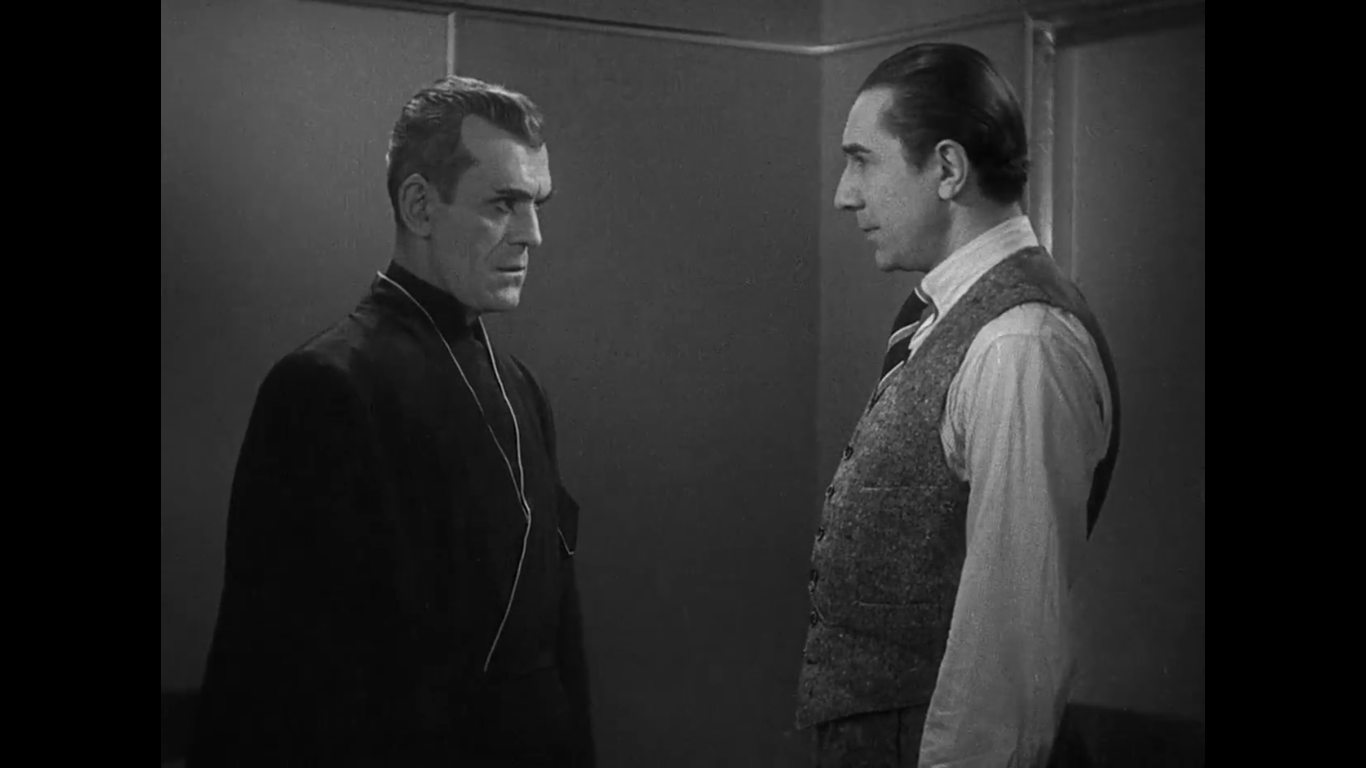
Each lineage of horror movies must have its own in-house aesthetic and stable of performers matched with specific technicians who come to exemplify a studio and their body of work. The Black Cat brings together much of what made Universal Pictures horror so lucrative from the studio, and it gathers together two of their most iconic stars: Bela Lugosi and Boris Karloff.

Although we’re not in Transylvania, the story picks up aboard a train traveling through Hungary, a typically foreign locale for a hometown audience. We meet a newlywed couple (David Manners and Julie Bishop) on their honeymoon only to have their compartment’s marital bliss disrupted by Lugosi’s Dr. Vitus Werdegast. He looks nice enough, but there’s always something menacing behind his eyes (even when he’s playing pleasant).

Inclement weather leads to a devasting crash and the couple and their newest acquaintance show up on the doorstep of one of his old friends, although I use the word friend loosely. Hjalmar Poe is a famed Austrian architect, and his abode lives up to his reputation. We must expect nothing less as we are welcomed into the home of the always foreboding Karloff.

For the rest of the picture, The Black Cat feels like an oblique tour throughout the art deco space with a subtle game of death going on between Karloff and Lugosi. Because instead of bringing two unsuspecting victims into their lair, this is much more a grudge match with two unsuspecting parties caught in the middle.

It becomes a world modulating between the polls of the supernatural and baloney. With a rogue gallery of Lugosi and Karloff, we know better, and as the good doctor demures, “There are many things under the sun.” His evocation of Ecliasstes has very ominous underpinnings.

But that’s not the only source of disquiet. The way the two actors lurk around the corridors, the very way they interact around the woman is unnerving. Karloff always seems to be leering and ogling even if that’s how his face is predisposed. Then, moments later, he’s caressing a chess piece in a disturbing manner. Or is it only our imaginations playing tricks on us?

There were lulls that I wouldn’t mistake for tension, and yet there is so much to be said about the architecture of that house even when the architecture of the film seems to fail. Because this aspect of the mise en scene embodies something that fits so perfectly with the personas of Karloff and Lugosi. Somehow always incongruous and ill at ease.

And the film never feels pulse-pounding; it’s outrageous, yes, but it also builds to these harrowing moments. They’re sinister and escalate into a final descent into the pit of Hades further accentuated by the lines of the architecture.

The ending nearly balks on the entire movie. It’s a wink and a joke that dares us to tell others about what we just saw. They’d never believe it because this is the apex of outlandish storytelling. The Black Cat‘s not great, nor is it mediocre; instead, it feels deeply alive with something probably more indebted to Edgar G. Ulmer than Allan Poe.

3.5/5 Stars