
 Body Snatchers works seamlessly and efficiently on multiple fronts, both as science fiction and social commentary. Don Siegel helms this film with his typical dynamic ease putting every minute of running time to good use. The screenwriter, Daniel Manwaring, put together perhaps one of the greatest political allegories ever penned and, on the whole, it’s a taut thriller combining sci-fi and horror to a tee.
It’s a wonderful bit of ethos that our main hero Miles Bennet (Kevin McCarthy) is a well-respected doctor, a genuine guy who over time gets transformed into a blubbering paranoid mess. It begs the question. What would evoke such a change in this man? Because it’s true. When he starts out he seems immeasurably chipper. Shrugging off a euphemistic “trip to Reno” and the subsequent alimony as if it were nothing. His practice is well-respected and his old beau, the beautifully elegant Becky Driscol (Dana Wynter) has returned to their idyllic town of Santa Mira, California.
The film’s amiable leads are able to suggest chemistry in only a matter of minutes. And though Wynter hardly seems indicative of a small town girl, it’s strangely of little consequence. While their relationship is integral to the narrative it’s only suggestive of the broader issue at hand — this epidemic of mass hysteria that slowly ingratiates itself on the small town.
It’s a systematic takeover — a silent killer– that runs city deep from the farmers to the police and everyone else in between. It comes slowly at first, only evident from a few seemingly incidental cases of psychological duress and odd coincidence. Dr. Bennet has sick patients leave messages with him frantically asking for help, only to reverse their pleas for help later. Then Wilma insists her Uncle Ira isn’t the same. There’s something different about him that she can’t quite put a finger on. The same goes for a young boy who repeatedly runs away from home insisting his mother isn’t his mother.
Once more Dr. Bennet finds the behavior odd but isn’t ready to come to a conclusion on it. But the epidemic continues and pretty soon Miles and Becky are horrified to find a faceless body at the residence of their close friends. It’s at this point where the full-blown hysteria begins to deluge them as well.
They must fight to stay awake as they try and get to the bottom of this nefarious scheme. But that’s precisely it. These alien lifeforms are using human seed pods to duplicate and replace people. For all intent and purposes, they look, move, and talk exactly the same. But perhaps the most telling human characteristic is absent. Their sense of feeling. Their emotions.
And as Miles and his girl frantically flee the invasion it continues to become more and more obvious that this paranoia-filled chiller is putting a voice to the anxiety of the age. Both in Hollywood and elsewhere. Both because of the Red Scare and the backlash caused by Joseph McCarthy’s witch hunts. Because that was the fear. That the Communists were infiltrating us. We couldn’t see them. We couldn’t weed them out because they were too well concealed. But another horror brought up by this film are the implications of having those you know and love turn against you and betray you.
All of that is in this film whether you want to acknowledge or not. But on a more cursory level, it certainly delivers on the horror and it’s the best kind of horror that’s not so much popping out at us. In those cases, the scare soon dies. It’s gone. But in the case of Body Snatchers, the horror is much more insidious as it burrows further and further into our brains. It has us unsettled from the first frame and it does not subside really until the film is over. Even with a “happy” ending, that cannot fully neutralize the impact of this 50s classic.
4.5/5 Stars
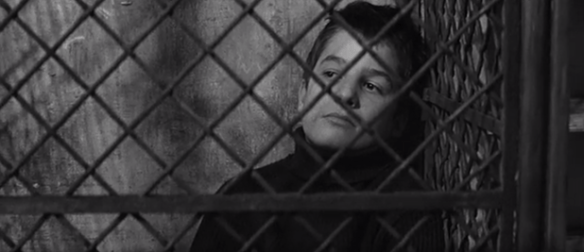
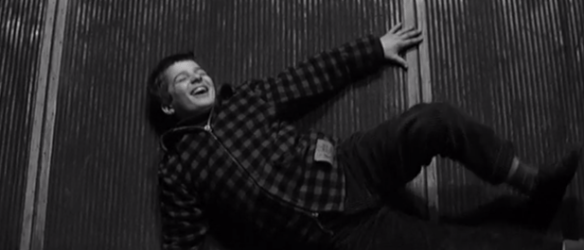
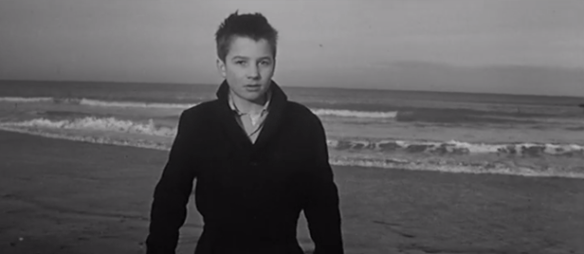


 “There live not three good men unhanged in England. And one of them is fat and grows old.”
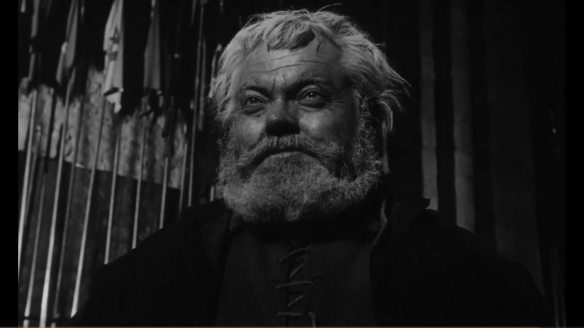 The triangle with Prince Hal (Keith Baxter) vying for the affection of his father King Henry IV (John Gielgud), while simultaneously holding onto his relationship with Falstaff is an integral element of what this film is digging around at. But there’s so much more there for eager eyes.
 And it’s only one high point. Aside from Welles’s towering performance, Jeanne Moreau stands out in her integral role as Doll Tearsheet, the aged knight’s bipolar lover who clings to him faithfully. The cast is rounded out by other notable individuals like John Gielgud, Margaret Rutherford, and Fernando Rey.
 The original title in Italian is Ladri di biclette and I’ve seen it translated different ways namely Bicycle Thieves or The Bicycle Thief. Personally, the latter seems more powerful because it develops the ambiguity of the film right in the title. It’s only until later when all the implications truly sink in.
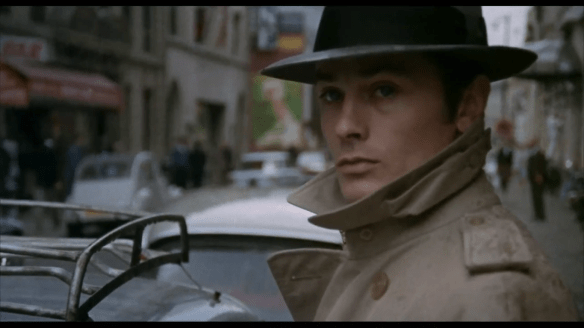 There is no solitude greater than that of the samurai unless it be that of a tiger in the jungle… perhaps…
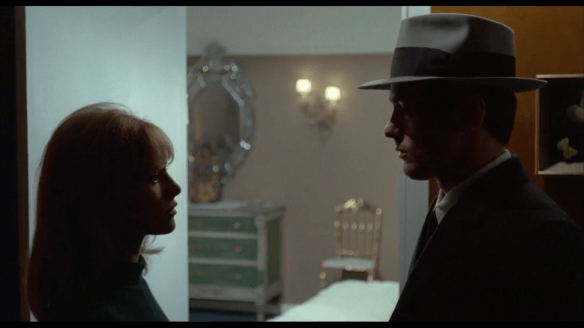 And though he does call on his lovely girlfriend (Nathalie Delon), who is absolutely devoted to him, as well as making eyes at the nightclub pianist who is the main eyewitness to his hit, Jef for all intent and purposes, is alone. It’s a kind of forced solitude, a self-made exile created by his trade. After he goes through with the hit, he must shut himself off more and more. That is his job.
 John Donne is noted for writing that no man is an island, but if this film is any indication, there might be a need to qualify that statement to suggest that some women are islands — at least when portrayed by the elegiac Monica Vitti. Red Desert begins with blurred images and a high-pitched piercing melody playing over the credits. From its opening moments, two things are evident. It gives off the general sense of industry and it features one of the most extraordinary uses of color ever with the blues and grays contrasting sharply with the brighter pigments.
 However, even if this word does reflect its share of beauty, it is Monica Vitti’s character who still embodies paranoia and disorientation with the modern civilization. In other words, she is the one out of step with the contemporary world that she finds herself in, due in part to an auto accident and a subsequent stint in a hospital. She is struggling to readjust to reality.
 As per usual with Antonioni, his film invariably feels to be altogether more preoccupied with form over content and that’s what is most interesting. It’s fascinating some of the environments he develops. Atmospheres full of billowing fog, wispy trees, stark alleyways, gridiron structures, and all the while the color red pops in every sequence. There’s no score in the typical sense, instead, the dialogue is backed by foghorns, machinery, and an occasional electronic sound effect.
 From the haunting opening notes of a lullaby to the otherworldly aerial shot floating over New York, Rosemary’s Baby is undeniably a stunning Hollywood debut for Roman Polanski.
 As a young boy, no hero was greater in my mind’s eye than Robin Hood and only Star Wars held a more honored spot in my childhood imagination. Because, to this day, Robin of Locksley remains the quintessential hero of mythical lore. Part historical truth mostly canonized myth and that’s the beauty of him. We can believe in him — see how he was in so many ways real but in the same instance larger than life.
 From what I know from Robin Hood folklore, specifically Howard Pyle’s seminal edition, the film is surprisingly true to many of the origin stories and tales that have long since proliferated. As an audience, we become privy to the first meetings of Robin and the formidable Little John (Alan Hale) who lays him out in the local stream after a bout with quarterstaffs. Then, in another instance, Robin provokes the portly Friar Tuck (Eugene Palette) who happens to be a master swordsman and a lover of good food and drink. Still, other vignettes include Robin’s successful masquerade as a lowly archer who wins the grand prize at the Sheriff of Nottingham’s Archery Tournament.
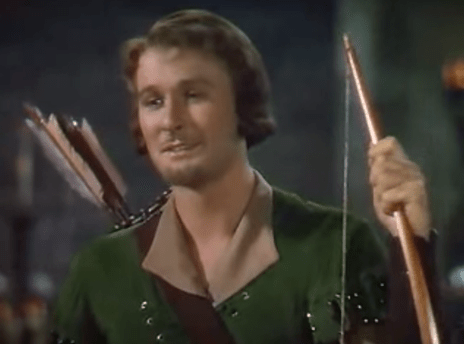 For me, the reason very few heroes surpass Robin Hood is based on his innumerable qualities. He’s a superior fighter with bow, sword or staff. He’s blessed with a wonderful wit and impressive leadership capabilities. He wins over the girl with his charm. He gets to live out in the forest with his best friends, eating great food. But most of all, he’s a rebel with a heart of gold, robbing the rich to feed the poor.
 4 Star Films