Imitation of Life (1959)

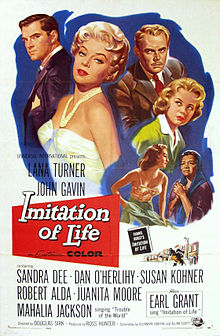
220px-Imitation_of_Life_1959_posterWhen I was watching the film I distinctly remember one instance I threw my head back in the air and just smiled to myself. How I love Douglas Sirk. He gives us something seemingly so superficial and decadent that plays so perfectly into those expectations and simultaneously steamrolls them with a not-so-veiled indictment unfurled on multiple fronts.

This was Douglas Sirk’s final film in his U.S. career. It’s another gorgeously rendered picture. A harsh social satire of the ambitions of an American Dreamer but also the inherent fissures that run through our society to its very roots. These issues have hardly changed with time or if they have changed, it’s simply the same problems given a facelift. The core wounds remain the same.

Imitation of Life is a story that starts in New York, of all places, at the beach. For the first time, Lora Meredith (Lana Turner) crosses paths with the kindly, God-fearing Annie Johnson (Juanita Moore) who looked after Lora’s daughter when she got lost in the crowd of vacationers.

In less than a comfortable position herself, Lora nevertheless offers her home up to Annie and her fair-skinned daughter Sarah Jane who strikes up a fast friendship with Susie while showing early signs of vehemently despising her African-American identity.

Those are the core aspects of the story as the glamorous single mother follows her aspirations to star on Broadway first with commercials and then small parts that lead her to something more. She finds an agent (Robert Alda) and ultimately earns the respect of a noted playwright (Dan O’Herlihy) who soon writes all her roles. The demands on her time mean that a fledgling romance with a photographer  (John Gavin) falls to the wayside and she hardly sees Susie.

Meanwhile, Annie remains a faithful friend by her side who keeps her house in order and looks after the girls as they slowly begin to mature into womanhood. And as they grow into women their own personal crises come to fruition. Sarah Jane (Susan Kohner) continues to try and pass as white while denouncing her mother. It gets so bad that she leaves home and changes her name to perform at dive bars where her mother hopefully won’t follow.

Susie’s (Sandra Dee) problems are of a different nature. She feels so alienated from her mother, the lady so often absent in her life, that she decides to attend college far away in Colorado. When Steve Archer (Gavin) drifts back into Lora’s life things are complicated by Susie’s obvious crush on him.

On both fronts of mother-daughter relationships, the film showcases its many themes playing out in vivid fashion. In fact, Imitation of Life feels all too resonate given the state of affairs in Hollywood and our world right now.

There’s this ongoing temptation to cheapen who you are for the sake of success. In this case, it applies to the theater and the career of Lora Meredith (Turner) but it could be in, let’s say, Hollywood or the corporate sector or any other endeavors. The jobs change but the people do not. Where you are forced to feel awful for not lowering yourself to other people’s level of sleaze and impropriety.

It’s a film about the fame monster and the industry dominated by a patriarchy where you are coaxed into making certain concessions so that people will like you and give you what you want. Just to maintain a career and your ambitions, your familial relationship, in this case, with a daughter is led to the point of deterioration. To this day, money and opulence, nice things and social standing, do not make up for an actual relationship. There’s no contest.

Ironically, only after the good fortune strikes and you have years of success do you begin to realize amidst the rush that the pinnacle has been reached and still something is missing.  That’s Lora’s realization. But just as fervently this can be a film of idealism and dreams. Seeing things the way they are and making them more and more into what you want them to be. Being the change. That’s Annie’s part.

It is also a film about racism — a fixture of society — and a troubling one that is still opening up innumerable wounds in the fabric of our society and they are wounds that must be acknowledged. There is a painful scene that while a girl is being berated and slapped by her alleged boyfriend a playfully jazzy score dances in the background and it’s this disconcerting contradiction — the kind of contradictions that are often easy to pick up on if you’re willing to see them.

People loathe themselves for the color of their skin and the stigma society puts on their personal identity. Someone’s life is driven by shame instead of an unswerving pride in who they were created to be. And whether we like to admit it or not, we’re all part of the problem where being white is seen as being normal or the status quo or what have you.

One of the most striking moments in the film for me is when Annie is recounting the Christmas story to the girls and they ask a very honest question. “Was Jesus White?” or “Was Jesus Black?” Because it seems like a question that devises some way of relating to this historical figure. But it also forces you to see the astronomical error in such ideologies of a  “white savior” or a “white man’s burden.” It simply cannot work. Nor does it work the other way.

Of course, as Annie sees so clearly, neither of these distinctions matter or any type of distinction because this was not a figure concerned with race or wealth or gender or respectability or any of that, at least in the sense that it holds importance to us. For him, as she sees it, it seems to have no negative effect on the relationship you could have with him. It doesn’t seem to matter and yet simultaneously it does immensely. Because it reflects our unique human identity.

Annie reflects those same types of ideals all throughout the film. You might take aim at her for being subservient or have qualms with something she does but it’s hard to question her sincerity or goodness. She has a prodigal daughter but just like the parable her maternal arms are always open and her daughter is never too far away for her to love Sarah Jane unconditionally even unto death.

I must admit it rubbed me the wrong way because Annie felt like yet another iteration of the mammy stereotype. One of Sarah Jane’s colleague even notes, “You had a mammy,” led to believe that the woman was simply an old housekeeper. But that’s the key. Annie Johnson is actually her mother. Aside from adding a searing undercurrent to the scene, it confirms she is not just a sideshow attraction for some southern charm. She is a parent and a friend and a person. In fact, the best scenes in the entire film belong unequivocally to Juanita Moore and Susan Kohner.

The original story the film is based on came out of a very different time in American history during the 1930s. Here it is updated and aware of the changing mores and difficult roads still to traverse thanks to the likes of Thurgood Marshall and his landmark case Brown v. Board in 1954 and the increased rumblings of the Civil Right Movement with the Bus Boycott and other peaceful initiatives spearheaded by Dr. King.

In the film’s closing moments Mahalia Jackson brings down the Lord’s house with her mournful dirge for Annie. And it is a bitter, heartwrenching moment of agony but that is not the final word. Because Annie was a tremendous person with an extravagant capacity for love.

Like Dr. King once orated in vivid Biblical imagery, “[I have gone] up to the mountain. And I’ve looked over. And I’ve seen the Promised Land. I may not get there with you. But I want you to know tonight, that we, as a people, will get to the promised land!” That is the hope. Even in this embittered world of ours there is still something to be longed for.

4.5/5 Stars
Review: Written on the Wind (1956)

written on the wind.png

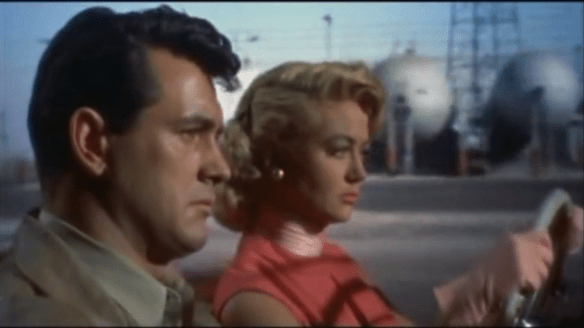
Douglas Sirk’s films are always lovely to look at, almost to the point of making you sick. The panoramas swell with color. They’re too perfect. The sets are gaudy — the cars the same — to the point of almost being unsightly in their over the top artificiality. Try to find any amount of authenticity and you will most likely fail.

The people within the frames are even more glamorous than the rooms they fill and arguably more colorful.  Namely the dashing Rock Hudson, a Sirkian mainstay and then Lauren Bacall, Dorothy Malone, and Robert Stack, all Hollywood talents playing character types with names and dialogue straight out of a trashy romance novella. We wouldn’t have it any other way. It’s exquisite.

Because everything is played with the utmost of seriousness from starting credits to the closing shot and yet it just doesn’t take. Sirk seems to be working against his material and that’s where the enjoyment of this picture really lies. It makes Written on the Wind the zenith of the soap opera tradition.

Like any good melodrama, it begins with a shooting, it ends with a murder inquest and the in between is filled in with drunkenness, romantic interplay, familial strife, impotence, fist fights, childhood dynamics, and anything else you can imagine in such a sleazy affair. Still, when everything has run its course, our leading man and his leading lady are able to drive through the pearly mansion gates off on a perfect life together.

Though Rock Huson and Lauren Bacall are arguably our stars, it is their fairly typical and straightforward roles lay the groundwork for the true show put on by Malone and Stack as the Hadley siblings.

Malone sheds her librarian role in The Big Sleep (1946) for the performance of her career as the uninhibited, diabolical, sex-crazed platinum blonde. And Stack is a far cry from Elliot Ness. He lives like he’s never even heard of prohibition as he lets his characterization go completely off the rails in a fantastic manner.

Their father (Robert Keith) is one of the richest oilmen around and they’ve grown up as brats accustomed to wealth and yet their lives are an utter shambles with flings, booze, and personal demons leaving a wake of tumult that rips through the tabloids.

Mitch Wayne (Hudson) and Lucy Moore (Bacall) meet in a boardroom as nice as you please. You would guess that romance is kindling except that the impetuous Kyle (Stack) inserts himself in the situation trying to win her over with jet flights and a steady stream of charm. Somehow it works and they are wedded soon thereafter. It has all the signs of a trainwreck given Kyle’s track record but miraculously it works for a while. But he’s devastated by some news from his local doctor (Ed Platt) which drives him back into a constant stupor and drunken tirades.

Meanwhile, his sister relishes watching him falter because they’ve never seen eye-to-eye on anything. Her main focus is seducing Mitch their lifelong friend who has never allowed himself to fall prey to her wiles. In retaliation, she looks to search out any man who can show her a decent time. She doesn’t much care who it is. But Mitch is hardly jealous for her, only protective, and his eyes are set on Lucy nee Moore anyways. If the entanglements aren’t clear already they present themselves obviously enough.  It’s gloriously sensationalized nonsense.

Still, so many others owe an undying debt to this film and those like it. Fassbinder came from here as did Todd Haynes. Dallas, Dynasty, or any other 80s soaps found their roots right here too. After all, this is the original version of “Who Shot J.R.” Thus, the debt must be paid to Sirk’s films and people have.

Because his style is very easy to admire. Contemporary audiences undoubtedly ate it up and we do now years later. The artificial interiors and the airbrushed Technicolor palette helps define what many people deem to be 1950s Hollywood. It’s luscious, easy on the eyes, decadent, all those apt superlatives. But if that was all that he had to offer, Sirk wouldn’t be as interesting to a great many people now.

It’s the very fact that he seems highly self-aware and he’s so wonderful at staging and creating this environment, beautifully photographed by his longtime collaborator Russell Metty, that the whole composition tells us something more. It’s rear projections and painted backdrops. Sets and stages that accentuate this piece of drama. It’s all sending us a collective wink to see if we get the joke. Those who do will be greatly rewarded.

4.5/5 Stars


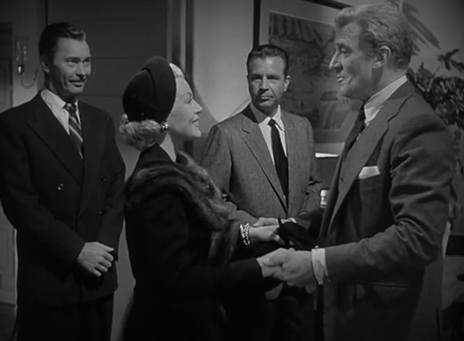
The Bad and the Beautiful (1952)

bad and the beautiful.png

The people making the decisions, at least some of them, undoubtedly knew that this title implied some sort of sordid melodrama, a Douglas Sirk picture anyone? And yet I do admit despite the emptiness in the title, there’s some truth to its implications. Hollywood often is this gaudy, outrageous, maniacal monster looking for people and things to gorge itself on.

Except this is no Sunset Boulevard (1950) or Ace in the Hole (1951) for that matter. It’s not quite as biting or even as tragic or twisted as Wilder’s films but that’s what comes with having Vincente Minnelli at the helm. But rather than critique that decision in any way I think someone like Minnelli thinks about such a picture in a way that Wilder never would. That in itself makes for interesting creative deviations.

First, the camera setups feel impeccable, like a Hitchcock or Ophuls, finding the perfect moments to bring attention to a shot and the precise instances to sit back and allow things to unfold. It’s utilizing a bit of a flashy framing device like a Letter to Three Women (1949) or All About Eve (1950) but in this case, it relates the story of one Hollywood producer through the eyes of the people who worked with him.

Jonathan Shields (Kirk Douglas) is a man whose father was one of the most hated men in Hollywood and also one of the most successful. Jonathan buries his father and with hardly a penny to his name looks to rise out of the ashes his dad left behind. He just might make good too. So as such, it’s another exploration of Hollywood top to bottom, starting very much at the bottom.

That’s part of what makes this story compelling as we watch an ambitious man claw his way from poverty row and B pictures using a joint partnership with another up-and-comer (Barry Sullivan) to slide his way into a gig as a big-time producer. It’s at these beginning stages where they succeed in making a name for themselves under producer Harry Pebbel (Walter Pidgeon).

For Sullivan, he is so closely tied to the business, it’s almost as if he’s wedded to the picture industry.  It’s both his life and obsession every waking hour. So when he’s done with one and waiting for the next he has what can best be termed, “the after picture blues.” He’s still trying to adopt his philosophy for women and apply it to his films — love them and leave them.

In passing, we get an eye into the bit players and the small-timers working behind the scenes just to make a decent day’s wage whether assistants or agents or pretty starlets moonlighting as companions at night. There’s even a very obvious current of sexual politics where women are naturally assumed to be at the beck and call of any higher up to pay them any favors. It’s the grimy, sleazy side of the business that continues to reveal itself in due time with connivers and drunks and suicidal wretches conveniently hidden by bright lights and trick photography.

bad and the beautiful 3

Further still, there are screen tests, meetings, rushes, and sound stages, makeup artists, and costume designers each a part of the unwieldy snake that makes up a film production. All the nitty-gritty that we conceive to be part of the movie-making whirly gig churning out pictures each and every year. They say if it’s not broke then don’t fix but what if it is broken and no one is fixing it? I write this right in the wake of Harvey Weinstein’s ousting due to a laundry list of accusations against him.

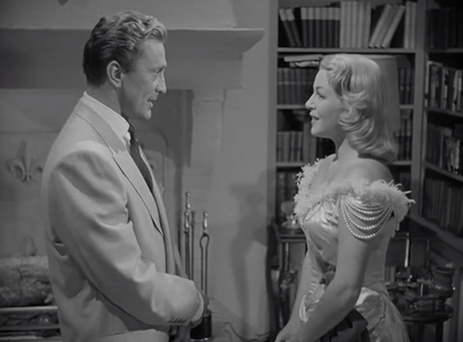
One of those involved in this beast receives a stellar introduction of her own. We meet Georgia Lorrison (Lana Turner) with her feet hanging down from the eaves of an old mansion that belonged to her deceased father. She like Shields comes from Hollywood royalty and she like him is also looking to get out of her father’s shadow.

Jonathan is derisively called “Genius Boy” and maybe he is but opportunistic might be a more applicable term. Still, when he makes his mind up, he cannot be stopped and when he deems this smalltime actress will be his next star, he makes it so.

The same goes for novelist turned screenwriter James Lee Bartlow (Dick Powell) who Jonathan is able to coax out to Hollywood albeit reluctantly and works his magic to get him to stay along with his southern belle of a wife (Gloria Grahame) who is completely mesmerized by this magical land out west. Again, Jonathan turns his new partnership into a lucrative success but not without marginalizing yet another person.

One of the most interesting suggestions made by the film is not how much Jonathan ruined his collaborators — alienated them yes — but he really helped their careers. In some ways, it reflects what happens with great men who are lightning rods and always thinking about the next big thing. They’re obsessed with ideas and connections, finding those relationships that will lead to power, wealth, acclaim, and awards. Any amount of honest-to-goodness friendship goes out the window.

But for all those who felt slighted, there’s almost no need to feel truly sorry for them because they bought into this industry with its promises and they bit into the fruit. Sure, their feathers got ruffled and their egos bruised but it goes with the territory.

For everything we want to make it out to be, it’s a tooth and claw operation and those who get ahead usually are the most ruthless of the bunch. Whether we should feel sorry for them or not is up for debate. But maybe we should because a mausoleum full of Academy Awards means nothing. A life of power will be ripped from you the day you die as will the wealth, elegance, and extravagance. It will all be gone. Then, you’re neither bad nor beautiful. You’re simply forgotten. In that respect, this films has meager glimpses of a Citizen Kane (1941) or even real-life figures like Orson Welles and David O. Selznick.

Except in the sensitive hands of Minnelli, this picture is neither an utter indictment of Hollywood nor does it take a complete nosedive in showing how far the man has fallen. It even reveals itself in the performance of Kirk Douglas who while still brimming with his usual intensity chooses to channel his character more so through the vein of charisma.

So if we cannot love or admire his dealings there’s still a modicum amount of respect we must hold for him. Everyone comes out with a shred of dignity and the film’s end is more lightly comic than we have any right to suppose. But then again, we’re not in the moviemaking business and they are.

4.5/5 Stars

Little Women (1933)

little women 1933 1

I still remember visiting Louisa May Alcott’s home in Massachusetts and of course, my sister read her magnum opus innumerable times when we were younger but for some reason, maybe it was a fear of what the title suggested, I still never cracked it open during my childhood. But I’ve always been intrigued by the story usually brought to me in snippets or in bits and pieces from films (namely the wonderful 1994 version).

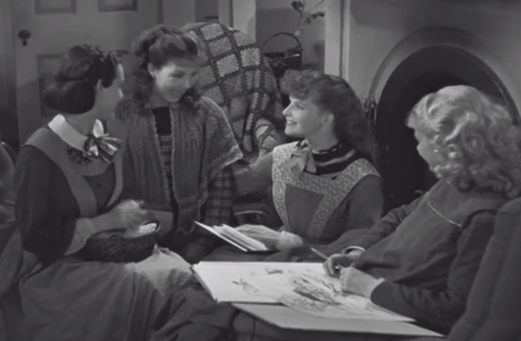
Here we have a quintessential Cukor picture that embodies the nobler side of humanity — the little women as represented by the March family — and it’s a winsome charmer, where the world seems vibrant and gay.

Despite their humble state, the March girls are cultivated by love and affection. They grew up playing at John Bunyan’s Pilgrim’s Progress when they were children and now as they become young women they have real burdens.

And yet their lives are still fortified by hope and the pure optimism of youth is captured within this picture. It provides access to that time of life which you wish you could hold onto. You see it most aggressively in Jo (Katharine Hepburn) — young, wild, and free as she is — her life full of frolicking and exuberance. She sees the world as perfect bliss surrounded by her mother and sisters — her father to return from the war at some point, a hero in her eyes.

Her next-door neighbor starts out a stranger and soon becomes one of her finest companions. Laurie (Douglass Montgomery) stirs up all her energy and welcomes being brought into the fold while his stately grandfather proves to have one of the most capacious hearts with which to bless the March girls with. Not to mention the fact that Laurie’s tutor Mr. Brook takes an immediate liking to Meg (Frances Dee) and she harbors a mutual fondness for his gentleness and good manners.

Even a life such as this is struck unmercifully by tragedy. Beth (Jean Parker) is stricken with scarlet fever after watching a neighbor’s baby die in her arms. These are the depths of woe. These are the moments for which the March family stands around the piano and sing a chorus of “Abide With Me.”

The shining moment arrives when the father of the house returns. He barely has any screen time in the entire picture because after all, this isn’t his film. But his presence is used exquisitely to aid how Cukor approaches the material. We look on as he sees each daughter and his wife until the camera’s focus turns completely on Beth bedridden and stricken with sickness as she is. Seeing her father the girl miraculously rises to her feet recalled to life after being incapacitated for so long. The miracle of the moment isn’t lost to us nor the imagery of her father arriving as a savior to lift her up. It’s deeply moving.

But it’s funny how life works. Things cannot and will not stay the same forever. Sisters mature. People grow up and share the company of men. We too grow and progress though we only seem to see it in others and not ourselves.

Jo cannot bear for her older sister Meg to get married – to be forced to watch things change within her household – still they do change and she must accept it. However, she cannot accept that Laurie is in love with her and she reacts to his professions the only way she knows how.

The final act follows Jo as she looks to pursue her career as a writer, Meg is happily married now, and Amy (Joan Bennett) is off to Europe with curmudgeon Aunt March. Time passes and old wounds slowly begin to heal, especially when Jo meets another person of peace in Professor Baehr (Paul Lukas). He is a man of great intellect but humble means and he encourages his “little friend” in her writing. Developing a relationship that they both cherish deeply.

Little Women has always been such a striking example of how life can end up so much different than we could ever imagine and yet in hindsight, there are hardly any complaints to be had. It’s never about the complaints but the difficult things that tear us apart only to tie us closer together. Because, at the end of this story, Jo has progressed so far and yet she still has her family and they love her as much as ever.

Katharine Hepburn feels perfectly at home in the role of Jo always the tomboy, independent, boisterous and such. She rumbles with “coarse talk” her favorite exclamation being “Christopher Columbus!”

I’ll try to head off any criticism that might suggest this adaptation is quaint or dated because I would argue that it’s recalling a different era that in so many ways boasted so much that we should yearn for today in our current world. People putting other’s before themselves — living only with what is necessary not in excess or in pursuit of some self-serving hedonism. These are people who cherish what family can give them and the simplicity of quality time and relationships.

Where Christmas festivities have nothing to do with gifts or monetary value but a spirit of giving and a joyful heart. The March sisters even have the original home theater putting on a performance of their own creation letting their imagination and creativity ignite.

What I respect deeply about this story is that it doesn’t feel like it has to be a romance. True, people get married and fall in love but that is not the pretense for the story. As their father entreats them in his letter, they are to “conqueror themselves.” Finding a man is not the point of their existence and this story makes it clear that life is so much more than that. It’s about love, selflessness, humility, and a great many other traits that we would do well to pursue.

4.5/5 Stars

Only Yesterday (1991)

only yesterday 1.png

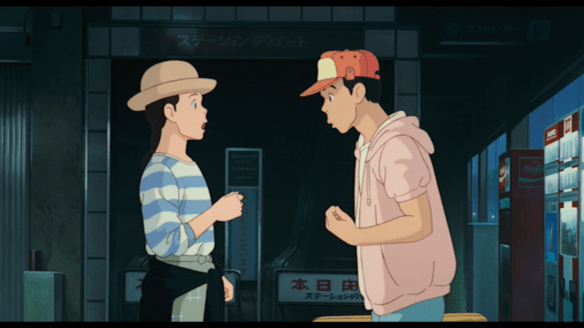
Only Yesterday’s opening images resonate with me because of their sheer familiarity. The reflections of urban life in a skyscraper. Office buildings with desks, computers, copy machines. All those necessities of the modern working world.  This is the personification of the status quo that many of us are used to, not simply in a place like Tokyo in the 1980s, but all over the world even right now. Many of us know that life intimately. It’s the first of innumerable moments where Only Yesterday will provide instances of immediate recognition.

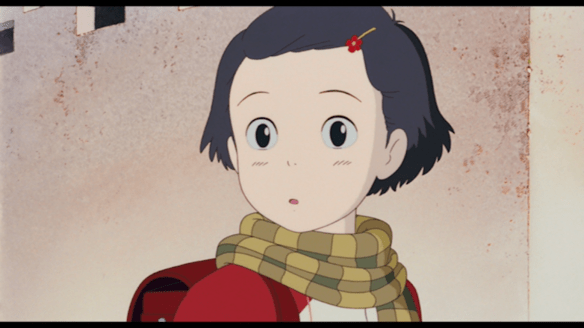
From what I gather, Only Yesterday redefined what anime was capable of and really what was considered appropriate subject matter for the medium. This is not only a children’s film though it looks back at adolescence. It’s equally a film for adults and a female audience with its narrative fluidly cycling between childhood memories and current recollections; the point of view belongs to a single independent working woman named Taeko.

These are the two distinct time frames that Isao Takahata’s film works within. In 1966 Taeko was just a girl. And it’s true that all those remembrances of childhood only exist as wisps of their former clarity. Visually the flashbacks are composed of minimalist watercolor backgrounds that manage to capture the transient nature and washed out qualities of our memories. Often recalled fondly but never captured with the same vibrancy that we had in the moment.

And the mystery of the mind is that it can so quickly recall a moment based on a time, a place, a person, a thing, or for no particular reason at all. It could be a vacation floating in the baths of Atami. The novelty and the ultimate letdown of a pineapple not yet ripe. But there are cultural recollections too like the Beatles exploding at Budokan or your older sisters sporting miniskirts as members of the emerging pop culture generation.

Meanwhile, school life is full of your typical scenarios including landmark decisions about hall monitors chasing offenders through the hallways. Young romance is awkward and innocent, blooming around a baseball diamond.

After a single injudicious conversation, talk of periods blows up all across school with the subject becoming the boys’ new favorite point of humor. Taeko also shows off her talents as “Village Child A” in the school play, finding ways to extend her performance and make something out of nothing. She simultaneously looks to commit death by fractions. I must say that I relate. I never did like fractions.

Further still, there are sisterly tiffs over enamel hand bags and altercations with fathers who are normally calm and distant but in a single moment lash out in anger. They are the type of incidences that remain emblazoned on your mind. Meanwhile, mothers scold and chide their children.

only yesterday 2.png

But the true fascination in these events come in the very fact that once more they are tied to the present and lay the foundation for who Taeko is. The same can be said for each and every one of us. However, in 1982 she is now a young working professional. Still, unmarried and quite content with that aspect of her existence even as she bonds with her distant cousin Toshio.

Her aspirations are to spend more time in the countryside — a  countryside blessed with tranquility and gorgeous panoramas — situated in sharp contrast to her life in Tokyo. Because it is in the said countryside where she begins to find a life that somehow feels far more fulfilling. The work and the living are simple but the people are kind and it somehow feels more purposeful. It’s also a prime environment to gather yourself and reflect on life.

Only Yesterday exhibits truly breathtaking imagery that captures both the minutiae and the exquisite scenery of Japan with this fascinating mode of realism. It is only improved upon by the fact that it is a drawn world capable of gravity-defying feats that nevertheless personify authentic emotions. And yet it fits the film on the whole because this is a story that seems to find a rooted contentment in what we would term the mundane. As this is a film that evokes memory, it’s fitting that such a thing would be so.

One of the great mysteries of the world even today is that it’s these very things that are most meaningful to us as human beings. Sure, we remember the big life events but oftentimes equally important are the other times. Because what is life if not a series of small incremental events connected together through experience, jubilation, sadness, wistfulness, pain, and contentment? Each of us carves out a road for ourselves that cuts through the past to the present to a future that we have yet to discover.

The original Japanese title translated is “memories come tumbling down” and somehow that resonates with me far more, being the nostalgic person that I am. It’s true. Certain memories will always be attached to a distinct time and place. Some good, some bad, but all a single element in this patchwork of life. Here is a film that deftly navigates the past and the present through various fragments, assembling the shards into a story that derives satisfaction in all its diversions. Taeko is able to get nearer to the life that she longs for. In that respect, Only Yesterday is in one sense an enchanting film but also a sincerely fulfilling exploration of humanity.

4.5/5 Stars


Grave of the Fireflies (1988)

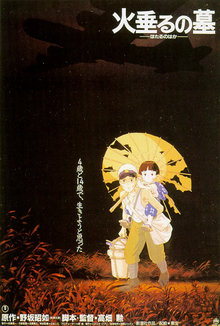
Grave_of_the_Fireflies_Japanese_poster.jpgAnime is very much a Japanese art form denoted by its style, the visuals, and even the depiction of its characters with wide eyes all the better to convey emotions. Oftentimes the images onscreen are a great deal more stagnant than the real-time action that American animators try and replicate with a greater frame rate.
Maybe American animation is more “realistic” but what the Japanese films have is an unrivaled beauty almost like watercolors or as if canvases of actual paintings are making up the backdrop for our characters to reside in. There’s even a line of inspiration that can undoubtedly be drawn from Japan’s own rich tradition of vibrant scroll and woodblock paintings.  Far from being derided as childish fare, cartoons are given a platform as art and they are executed as such.

Thus, it’s fitting that Grave of the Fireflies brought to us by renowned Ghibli Studios and the acclaimed director Isao Takahata would utilize this very Japanese style to tell a native story full of pain, suffering, chaos, and survival. His canvas includes exquisite landscapes that glorify the Japanese countryside but more often than not provide a muted even sobering lens to view the ashes and destitution that war sows. The wounds and the scars. The dead bodies left in the streets and the dirtiness that pervades daily life. It’s offensive to the eyes. All of this because American planes drop fire bombs to break the will of the enemy.

In western minds, it almost seems like an incongruity that a film can be both a stark war-torn drama and an animated picture but Grave of the Fireflies proves emphatically that this simply is not the case.

There are very few films brimming with so much emotion, so powerful and evocative and so fully invested in the human experience. There is an innate understanding of the pure destructiveness in the totality of war. It breeds very little that is good. Ripping families apart, causing children to grow up too fast, and subjecting mankind to excruciating loss and indignity.

But in my estimation, it remains far too simplistic to simply state that Grave of the Fireflies is an indictment of the carnage of war or that it is an anti-war picture because its scope is so much greater than that.

Notice what Takahata doesn’t do. He doesn’t make the Americans into dehumanized monsters or anything else. They are just absent, faceless individuals that we will never know. However, he does give us a front row seat to the events through the eyes of two other people.

I think it’s an especially uncomfortable and maybe an important perspective for Americans because instead of seeing ourselves front and center of this epic story of WWII amid both its victories and tragedies, we are only a distant force. This film causes us to take on the viewpoint of those on the other side of the Pacific. This wasn’t just an emblematic figure like Tojo or some crazed, inhuman killer that we were looking to take down.

It becomes clear from the outset that the people being displaced from their homes by firebombs and struggling with rationing and families getting split apart by conflict are not so unlike us.

Takahata brilliantly gears us up for a story that could not be more universal. It doesn’t take place on a battlefield. It doesn’t involve war rooms or army barracks. It’s about two siblings. An older brother Seita and his little baby sister Setsuko.

Together they provide the core of the film. Because Setsuko is one of those precocious little kids who undoubtedly does not comprehend the gravity of all the chaos that swirls around her. All she knows is that she wants to see her mother or that she’s hungry or that she wants her favorite Sakura fruit drops. And her brother provides for her and sticks to her closely with fortitude and faithfulness that makes their bond one of the most affecting connections between cinematic siblings.

I would be hardpressed to guess how old Seita is but there’s no doubt that he’s forced to act quite a lot older than should be necessary under normal circumstances. His father is gone in the navy. His mother is debilitated. He must be his sister’s keeper and everything else for her. Her friend, her playmate, and her protector from a traumatic world that she cannot begin to understand. Since they only have each other and as they skrimp by, as an audience we realize just how abhorrent their conditions are and how no child should ever have to know a life of malnutrition or obliteration.

It’s easy to marvel at the animation because whereas normally we would probably take care in depicting actions of great consequence, a picture such as this finds time to articulate the little things that feel so human. Fiddling with a piece of clothing, scratching an itchy mosquito bite, or simply frolicking along the shoreline for the sheer relish of the moment.

It’s these smaller interludes and touches that give even greater import to the larger ones. A childhood home burning down with a whole host of others so that an entire town looks drastically different. A brother and sister who are forced to live on their own thanks to the glacial welcome they receive from distant relatives. And ultimately the inevitable comes knocking: death.

But just as the titular fireflies fill young Setsuko with a certain awe and wide-eyed wonderment, even in death there seems to be some distant even elusive sense of hope. In a world that can hardly be fathomed, Seita and Setsuko are reunited; no longer plagued by their suffering, their path illuminated once more by nature’s shining beacons of light. While we might have slightly different views about the afterlife, there’s no doubt that we share a desire for such an outcome after death.

Where graves will be emptied. Death will be no more. Pain will have ended. War will be over. Families will be restored. Wounds will be healed and peace will be the final resounding note. Do not let your flame be extinguished by hate, burdens, or dissatisfaction but know that there is so much more to life. In their enduring innocence in the face of such devastation, Seita and Setsuko are a stirring reminder.

Because life is not simply upended by tragedy. It is also fortified by hope. That’s part of what makes it worth living. As Dylan Thomas once eulogized, “rage, rage against the dying of the light.” Do not let your youth be quelled. Do not let your optimism be forfeited. Do not give up your capacity for love. It’s well worth the fight.

5/5 Stars

Review: Back to the Future (1985)

back to the future 1.png

Back to the Future zooms at us as a lovely mishmash of sci-fi thrills and 50s nostalgia that feels like pure happenstance. The one purported flaw, the fact that Marty McFly has no right to be in his family, is partially understandable. As Michael J. Fox wasn’t even slated to appear in the film. He was a last-minute replacement that just happened to pan out. But what a bit of serendipity it was all the same.

Without question Back to the Future clocks in as one of the most enjoyable adventures of the 1980s for delivering unadulterated audience satisfaction. It has all the great hallmarks we yearn for starting with rewarding characters, inventiveness that makes up for any corny interludes, and a pulse on what’s fundamentally entertaining.

Our introduction to the story tells us as much about Doc Brown as it does the teen rolling in on his skateboard, if not more so. Marty, the plucky kid with a penchant for rock n roll, finds Doc’s workspace in complete disarray thanks to an extended period of neglect. More on that later.

For now, the iconically cool vibe of “The Power of Love” underscores Alan Silvestri’s own cinematic orchestration on the project providing a fitting anthem for everything that is Back to the Future. McFly coasts around town on his skateboard using each passing car as his own personal lift. Rock is his main passion while his girlfriend Jennifer remains his main distraction. Meanwhile, Mayor Goldie Wilson looks to get reelected a la Nashville (1975) and Marty is accosted by locals championing the “Save the Clock Tower” campaign.

In fact, Hill Valley is a bit of a mythical city. It’s part Middle America, part fantasy, where the local principal is out to get our hero, his closest friend is a mad scientist, and he must battle against the ultimate affront of all time that he might not amount to anything just like his old man. Those are the stakes and this is the world. The perfect place for time travel. Doc in all his scatterbrained kookiness makes an appearance to introduce a DeLorean time machine into the storyline as well as the main conflict. The rest is in Marty’s hands as he whizzes away into the past.

The fact that it paints this world as a caricature as well instead of reality, far from being a weakness, becomes one of its bolstering charms. Refrains of “Mister Sandman” play throughout town. The local marques boast the star power of Barbara Stanwyck and Ronald Reagan (wink wink) in Cattle Queen of Montana (1954). Further still, the local five and dime features the tunes of Nat King Cole, Pattie Page, and of course, Tennessee Ernie Ford. Everyone gets a plug to set the scene.

A few good-natured jabs at incumbent President Reagan are also in order. After all, who could ever believe that an actor could become a president? Of course, nothing is all too surprising in this day and age. Still, the 50s via the 1980s were in many ways both simpler times. Star Wars and Van Halen. Chuck Berry and Jackie Gleason. That was the life.

It devolves into a glorious unfolding of circumstances as worlds collide and Marty’s cause begins to unravel at two ends. First, he needs to get back to the future, hence the all-encompassing title but in his haste, he accidentally tampered with the natural order of things – namely the initial meet-cute of his mother and father. It subsequently instigates one of the most awkward cinematic mother-son relationships known to mankind.

Having done irreconcilable damage to their relationship, Marty must do all he can to get his parents back on track. The problems are innumerable. Namely his mother’s infatuation with him, the dreamy out-of-towner Calvin Klein, his father’s undeniable dorkiness, and of course the bullies to end all bullies Biff. In fact, he’s been a thorn in George’s side for 30 years.

Still, with Doc’s aid (the quintessential secondary helper), Marty looks to right all that is wrong. It proves difficult as he attempts to set his parents up to attend the Enchanted Under the Sea Dance together – the fateful dance where young love kindled. Yet Marty watches his life slowly disappearing moment by moment as his parent’s union seems a slight chance at best.

With a few riffs of “Johnny B. Goode” and an imminent date with Doc at the old clock tower in town, a happy conclusion seems possible if not for the Libyan Terrorists still waiting for Doc in the future. After all, Plutonium doesn’t grow on trees and there are consequences for swiping it. Thankfully he doesn’t necessarily listen to his own advice about altering the future and Marty returns to a world that is strikingly different to the one he used to know. It’s strangely rewarding even if it does feel all too perfect in this third world.

While it becomes one of the most obvious films to shamelessly set up and plug its sequels (ultimately two other offerings), there’s no doubt that Back to the Future makes each a rewarding prospect. Not only is it boosted by a winsome performance by Family Ties favorite Michael J. Fox in a now defining role but Christopher Lloyd’s turn is equally laudable even if it easily typecast him in future tech nerd projects. There are certainly worst places to be.

Furthermore, under the tutelage of executive producer Steven Spielberg, director Robert Zemeckis became one of the great successes of the 80s and 90s with Back to the Future being yet another reason why Spielberg remained at the forefront of popular entertainment throughout the decade.

For their part, whether they like it or not Michael J. Fox and Christopher Lloyd will remain pop culture gods in the hearts of nearly everyone. Bless them for that. Doc and Marty are as memorable now as they were back then and no doubt even years into the future. That’s right, a movie about a time-traveling DeLorean has staying power. There’s a bit of the magic of the movies for you.

4.5/5 Stars

I Was Born But… (1932)

800px-I_Was_Born,_But..._1932.jpg

What strikes me right away about Yasujiro Ozu’s silent classic is just how relatable it feels. Yes, this is a Japanese film and yes, it’s silent too but watching the scenarios play out on screen have an undoubted timelessness. This is decidedly fresh material that’s blessed with humor and grace like the best silent comedies.

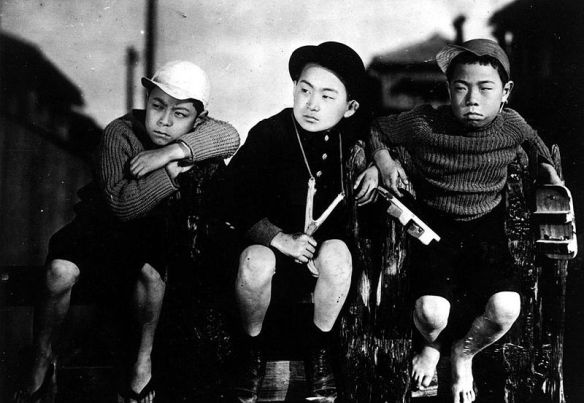
It’s a narrative about two young boys who have moved with their family to the Tokyo suburbs. As is usually the case it’s brought on by their father’s work and the whole family must get used to it. For the boys specifically, that means a new school and getting to know the neighborhood kids with their carefully enacted social hierarchy. Simply put, the biggest kid rules the roost and the new kid on the block is always bound to get the worst of it.

So obviously we witness the ensuing verbal skirmishes and a few fistfights where the clogs come off and are brandished as built-in weaponry. That’s all part of the rite of passage where the brothers must prove themselves. If we learn anything from this comedy, again, it’s the fact that many things have not changed all that much. Boys haven’t changed that much. At least not in the core important things that still hold weight.

Certainly, this is a less organized and less done up exploration compared to Ozu’s later endeavors but that’s part of the charm. The comedy at times is so pure and simple it gives the sensation of some of the early kid comedies like Our Gang or Chaplin’s The Kid (1921). Watching the posse of boys scamper every which way necessitates no understanding of language or culture. Watch and you understand.

Sparrow’s eggs preclude the pumice stones in Ohayo (1959) decades later as the boy’s favorite keepsake. In this particular hierarchy, it buys them a coveted place at the house of the richest kid whose parents are showing off their home movies. It’s a novel thing for all the boys and they look on with baited breath.

As it turns out, the Yoshi boys’ father is a real cut up, a real funny man, and they couldn’t be more ashamed, from the self-deprecating performance he gives for the bosses camera. This is far more than a few images that garner a few laughs. This is an affront to their father’s character and subsequently their family honor. But this hardly ever feels like a Japanese cultural issue, this is an issue that arises in the hearts and minds of proud, naive boys.

It’s the colliding viewpoints of children and adults and rather surprisingly the film is willing to look at the perspective of the kids. If Ozu’s initial work shares any similarity with Ohayo many years later, it’s at this juncture. The boys decide to protest their father by keeping silent and not acknowledging his presence since he has wounded them so egregiously. They’ve mastered the scowl to perfection as they glower in the front yard eating their mother’s onigiri. It seems like they’ll never be able to face the other kids again and they’ll never forgive their father.

Those very themes alone make this universal storytelling and it’s easy to forget for even a moment that this is a film brought to us from 1930s Japan. Because there is something going on here that feels so real. Every young boy wants to think of their father as a big deal, the king of the hill, a big success, and when we are met with anything that seems to contradict that vision we have, it does hurt us.

Still, what the story does well is to find a resolution where the boys can still be content in who their father is, beginning to comprehend a little bit the situation he is in. Even as they get a little help from the local paperboy to vanquish the local bullies, they ultimately gain a small dose of sympathy for their dad. If they don’t quite understand why he has to say good morning to his boss every day and treat him with such deference, as they grow older they might start to appreciate him more.

However, it does seem like something is lost in the translation of this title for American audiences but the subtitle does suggest more meaning. This is an “Adult’s Picture Book View” so we are looking at a child’s world from an adult perspective and though it’s inherently funny we gain a greater respect for both children and parents.

4.5/5 Stars

Review: A Place in the Sun (1951)

a place in the sun 1.png

George Stevens is only one among a plethora of filmmakers who came back from WWII changed. He had seen a great deal of the world’s ugliness — Dachau Concentration Camp for instance — and as a result, the films he made thereafter were more mature ruminations on humanity at-large. Adapted from Theodore Dreiser’s An American Tragedy and a subsequent play, A Place in the Sun is one of those pictures crafted in the wake of such historical change.

There’s no doubt that this is Hollywood melodrama backed by a raging score from Franz Waxman but this is no less, high powered high-class stuff. It’s augmented by gorgeous black and white imagery that reaches pitch-black tones and still manages to make Lake Tahoe into a scintillating getaway. Meanwhile, the camera captures the action with elegant movements, sashaying through space, at times nearly imperceptible to the eye. Though admittedly the film’s stature as a social commentary is less interesting now than it probably would have been in its day. Still, we can’t have everything now, can we?

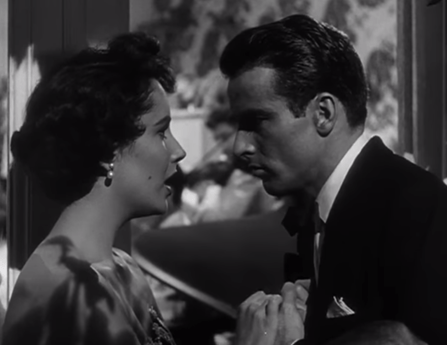
Montgomery Clift is often forgotten in the fray of powerhouse actors but the line can easily be traced from his intense performances to the work of Brando and Dean which would also sprout up in the 50s. Though that same intensity is there, it never feels like he’s trying to sell us a gimmick or a method. He’s simply trying to provide a lens to see a bit more clearly the intricacies of an individual, in this case, one George Eastman. It manages to be a profound and at times an agonizing performance.

Of course, Elizabeth Taylor is exquisite in every frame as always but her bright-eyed sincerity is equally arresting. She feels perfectly made for the role of Angela Vickers and seamlessly transitions into more adult fare with A Place in the Sun, standing tall alongside Clift, destined to make them one of the great romantic pairings of the 1950s. She supposedly said that she finally felt less like a puppet and more like an actress after this film. It shows.

Still, though given a thankless role at times, Shelley Winters is equally important because, in her simpler, humbler way, she reflects how quickly a man can change. She’s not a bad person at all, just a frail, even helpless one who feels like she has very few people in the world to hold onto. George proves to be a comparable companion until he unwittingly finds himself running in different circles and that’s where the tension begins.

I look at George Eastman and see the same drive for recognition, power, and wealth in many of us, those desires that oftentimes can be our undoing because they turn out to be meaningless. The irony is that his intentions never seem malicious but he is undermined by something. He quickly sinks into this double life. At first, he was simply happy to have a job and some companionship. His desires were simple. But slowly, as he found himself rising in the ranks of the Eastman company and getting more recognition, he couldn’t help but want more. Are these impulses bad? Not in the least, but they led him to some pretty rocky soil.

The scene that stands out in my mind could seem fairly mundane. But Stevens maintains a fairly long shot that’s peering through Eastman’s living room and we can see into the next room over as he is on the phone. It feels like minutes go by and Stevens fearlessly never cuts the sequence. The first call is from Alice which he takes.

But the second comes from Angela and at that point, we know that things have changed. It’s set up the dilemma. He genuinely loves Angela and wishes to be with her and to be a part of her life. Yet for that to come to fruition he must do something about the other girl. Alice won’t disappear. It’s funny how someone who you used to appreciate so dearly now feels like a burden. To her credit, we feel sorry for  Winters’ character without question.

In fact, the film succeeds along those lines. We pity her for the sorrowful position she is placed in — essentially abandoned by George. And even in her frivolity and opulence, there’s a candidness to Angela that makes us want to root for her and that allows us to simultaneously pity her because she has no idea of George’s other life. If there is anyone to lash out against it is George Eastman himself and still even in that regard, Montgomery Clift reveals the full gamut of this tortured man so even if we are hesitant to feel sorry for him, he does open us up even with a tinge of compassion.

But the muddled morality is complicated by the fact that Clift’s character has a sense of remorse. Surely he cannot be all bad based on what Vickers saw in him? His capacity to love and be tender is evident. Still, that is not enough to keep him from going on trial and the film’s final third takes place, for the majority, in a courtroom. The district attorney is played by Raymond Burr, who might well be in a dry run for Perry Mason and he comes at Eastman with all the fervor he can muster to convict him in his lies. Even in these moments, we must fall back on George’s inner conflict, his capability to love others, and his intentions for love.

If A Place in the Sun gets too preachy or succumbs too much to Hollywood’s stirringly romantic tendencies, it still might be one of the finest examples of such a film. Front and center are two phenomenal stars and Stevens films their euphoric romance with a meticulous eye, catching them in particular moments, with close-ups, and such angles that we are constantly aware of their intimacy.

As much as Eastman is looking for his place in the sun, and he could spend hours just sitting with Angela soaking in the sun’s rays (not many would blame him), it’s just as true that there is nothing new under the sun. That’s what we’re left with. Mankind is still distracted by many things. Oftentimes they are good things, but we make them ultimate things, and they wreak havoc on our lives. Meaningless, meaningless, everything is meaningless under the sun. But that doesn’t keep us from wanting to bathe in its tantalizing warmth any less. That’s part of the American Tragedy.

4.5/5 Stars

Review: Lost in Translation (2003)

lost in translation 1.png

30 minutes into Lost in Translation our two traveling misanthropes finally meet in the hotel lobby at the bar sharing a friendly exchange. They are two people who share one striking similarity — they are Americans in a foreign land — and they’re looking for a friend.

It’s a very pertinent film for places I’ve gone as an American who has traveled to Japan of my own volition but still as a bit of an outsider. Not because I am rejected or an outcast but for the very fact that there are obvious cultural and linguistic barriers in my way. I resonate with this film not so much because it takes on the point of view of the Japanese and empathizes with them but on the contrary, it focuses on those on the outside looking in. Like Bob & Charlotte and you and me in our manifold cultural illiteracies.

Bob is a big shot movie star. Probably not unlike Bill Murray. Big in the 70s and 80s but now his popularity is slowly waning as the years begin to catch up with him and he’s demoted to cameos. In fact, maybe Murray has fared better. Bob’s in Tokyo promoting Suntory Whiskey in their latest ad campaign. It’s good money but certainly not what he wants to be doing with his career.

He’s Suntory Time’s latest spokesperson. It’s the epitome of culture becoming completely muddled along language lines. My Japanese admittedly leaves much to be desired, but the Japanese director’s stage directions are full of passionate vision of what this scene will be, a shot out of Casablanca, full of emotion and heartache. The translation Bob gets is simply “He wants you to turn and look to the camera.” He feels like he’s missing something. Just as each reference that’s tossed haphazardly his way is never fully understood.

The Rat Pack, Bogart, Sinatra, Roger Moore, even Johnny Carson. Each of these names comes with so much more. But the context has been ripped away from them and appropriated and transplanted to different settings. It’s nothing to be up in arms about it’s simply the reality of our internationalized culture and it’s utterly befuddling to Bob. He can’t navigate it at all.

Charlotte (Scarlett Johannson) is a recently married philosophy graduate who looks hardly a day over 20. Friends back home seem too preoccupied to listen as she calls them up over the phone. Meanwhile, her dweeby husband with a particularly whiny voice (sorry Giovani Ribisi) is consumed with his own career as a photographer and distracted by old acquaintances ( namely Anna Faris). He says he loves his wife but he certainly doesn’t spend much time with Charlotte. Her loneliness shows. She’s even hit the bottom of the barrel listening to CDs to discover the purpose of her soul.

Bill Murray’s characteristic deadpan cheekiness feels entirely at odds with the culture that he is thrown into where you’re forced to cook your own food (Shabu Shabu) and he dwarfs the national average in terms of height. Bob is the prototypical American movie star making his press junket of Tokyo but at the same time, he’s also oblivious that he forgot his son’s birthday again until he receives a reminder.

In fact, Murray never feels like he could be anyone’s best friend because he’d either be a flake or he’d never open up to you because he’s too busy making jokes in lieu of actual conversation. Still, maybe there’s a grain of hope.

Bob and Charlotte are totally adrift in the city. Lost in the sea of Tokyo and it’s really no fault of the city despite its astronomical population and unfamiliar customs. It only serves to magnify the real problem — a small-scale parallel to what is going on in their lives. Their problem doesn’t start with Tokyo. It starts with the person who looks back at them in the mirror. Though they come from two very different stations of life, their current state of affairs is all but analogous. Bob and Charlotte are in the midst of personal crises — the biggest ones imaginable — what’s life really about?

That’s why when they break out in conversation it means something. Of course, he leads with an extended joke, “I‘m trying to organize a prison break. I’m looking for, like, an accomplice. We have to first get out of this bar, then the hotel, then the city, and then the country. Are you in or you out?”

Their meeting in the hotel lobby is a lifeline that they both willingly grab hold of and it leads them out into the world around them. They frequent the video game parlors, traverse Shibuya crosswalks, perform in late night Karaoke joints, and sit up talking with Japanese surfers as Tokyo’s bright lights illuminate the night air. Coppola even drops a nod to her significant other with Phoenix’s “Too Young” exemplifying the vibe around town.

The film hints at infidelity at times and Bob’s marriage is a flimsy one at best but the beauty of his relationship with Charlotte is that first and foremost it is a friendship and by the time they must part ways it’s heartbreaking. They’ve grown so close. But a hug can be as meaningful as any sexual relationship might have been. They genuinely care about each other. It turns out Bill Murray can be a good friend and one with wisdom and grace no less.

In its fleeting moments, Lost in Translation, captures just how horrible goodbyes can be. There’s so much you want to be able to say and nothing you can begin to say. In fact, Bob cannot leave it there and so he goes after her, tracks her down, and shares one final embrace and one last word. Both of them go their separate ways but there’s no doubt that Bob and Charlotte have grown and helped each other to a better place. It’s still a work in progress but that’s part of what life is about right? Living and growing alongside other people.

We can scour YouTube to come up with the latest and greatest, definitive enhanced audio video to tell us exactly what Bob leaves her with, although each one undoubtedly claims something different, or we can bask in that ambiguity which while so maddening in some way feels satisfying for the very same reason. Floating through Tokyo has never been so wistfully affecting.

4.5/5 Stars

lost in translation 1.png