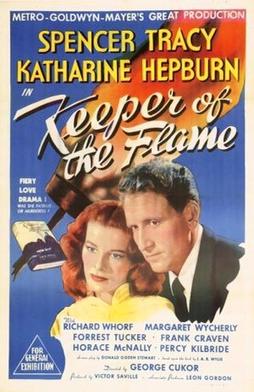
Keeper of The Flame (1942)

Keeper of The Flame strikes me as good ol’ fashioned Hollywood storytelling. It’s conveyed through a fatal opening car crash and a flashing montage of newspapers spelling the death of that great American institution, Robert Forrest. We’re hooked immediately as the story keeps on rolling.

The world itself in the formerly sleepy town has the definitive consciousness of Home Front America, full of interiors and then exterior-looking interiors, all on the studio lot. Moreover, there’s a frantic industry and a general chaos in the face of shortages, bringing out American know-how and good humor in the face of everyday adversity.

Namely, a bevy of journalists and well-wishers descending on the place not fit to handle such an overflow, especially during wartime. A harried Donald Meek monitors the telephone line and does his best to get the flood of people in front of him booked in any vacant rooms still available.

Steven O’Malley (Spencer Tracy) wanders in unannounced and mostly unseen. He pays respects to an old friend who barely recognizes him. It’s the eyes. He gives Janey (Audrey Christie) that quiet congenial Spencer Tracy look, and she asks quizzically if it hurt much when Hitler gave him the boot.

We glean he must have been a war correspondent, either based in a concentration camp or the Berlin press bureau. Their jokes are casual. You know they must do this in their line of work and in 1942, we can hazard a guess they don’t know the full extent of what they’re saying.

Christie has the whip smart repartee of a journalistic working woman a la Rosalind Russell. Since the house is packed, she coyly registers him as her “husband,” though there’s another colleague up for her affections (a young Stephen McNally).

O’Malley has an aspiration to get into the grieving Mrs. Forrest so he might share her husband’s story with the people. Riffing off of It Happened One Night, his pals quip that she’s the Queen of Jericho and he’s no Joshua. The walls of her castle won’t come down for just anybody. Though Tracy always had a certain dogged tenacity about him, and that’s what makes him a compelling, active hero.

Algonquin Round Table alum Donald Ogden Stewart builds out his screenplay in the opening act with all these intriguing nooks and crannies and characters who seem capable of existing of their own accord with intricate backstories.

Howard Da Silva is a guarded vet of the Argonne and de facto groundskeeper of the Forrest estate. A little boy (Darryl Hickman) grieving the wake of this great man from a lamppost; we learn he too has an intimate connection to the deceased.

There’s another relation to Mrs. Forrest who’s equally distrustful of the press and drinks his sorrows away with ginger ale. The dead man’s bespectacled press secretary (Richard Whorf) chooses a different approach: He’s highly elegiac and accommodating because his job requires levels of PR, though there’s plenty he’s not letting on about.

Beyond Christie, a personal favorite is the peculiar old cabbie (Percy Kilbride), laconic and chewing his cud while offering up homespun wisdom. He provides O’Malley transportation to and fro as the journalist pokes around for his story.

We know from a fair distance Keeper of The Flame is a kind of grade-A American propaganda piece, and it finally becomes most explicit when Tracy gives a little soft-spoken speech to Daryll Hickman about not letting the unseen enemy make them slaves and kick them around by putting chains on their minds and tongues.

In its defense, it’s mostly soft-pedaled moralizing because Tracy’s soapbox is small and he has a way of making the serum of slightly hokey words tolerable thanks to his usual candor.

However, the local doctor (Frank Craven) provides one of the most telling remarks after paying a house call to the imposing estate: “Ever since we’ve been falling out of touch with God, we’ve become pushovers for hero fever.” When he speaks of a young woman who was sent away, he surmises,  “You don’t fall in love with a god, you just worship him.” He’s a sympathetic fellow and in making his opinion of Forrest quite clear, it’s one of the first dubious signs we have to go on.

These ideas are thematically rich with potential, not to mention controversy. The movie becomes less so with the tinges of forested and thunderous gothic melodrama. Coincidentally, it’s not material I would immediately attribute to George Cukor although the 1940s were replete with such fare.

And it’s true there is a vague Citizen Kane-like bend to the story of a prominent man now dead. Although I also think of Welles’s other great figurehead Harry Lime for casting a shadow over the film, which is not too dissimilar to Hitchcock’s Rebecca, albeit gender swapped. These are mostly uncharitable comparisons and few can argue the point.

Katharine Hepburn might seem uncharacteristic in something so grim and restrained, but she proves her capacity for it. While I always am skeptical of her as a shy wallflower in a picture like Undercurrent, she handles this tormented role with a certain inscrutability. Although I don’t know if even she can manage keeping the story from getting out of hand.

There’s something in it on the tip of my tongue tying into almost John Fordesque mythmaking, whether it be Fort Apache or The Man Who Shot Liberty Valance. Sometimes you print the legend to protect people because the truth is too destructive to reveal. Except Tracy isn’t squeamish about giving the electorate a sober reality check.

In this regard, it feels like a daring sort of picture and you wonder if this was the saving grace, making it a draw for audiences beyond the conspicuous nature of the romance and brooding genre elements.

Still, the initial propaganda moments burn off only to come back like a raging conflagration. Hepburn brings them back again and she drops them right in our laps when she mentions fascism as embodied by her late husband. In one sense, it’s an impressive rallying cry and also an utter disappointment given the film’s best parts.

The finale of literal fire and water is all things histrionic and ham-fisted. Hardly the film’s finest achievement. All of this comes with a convenient ending, but I suppose in wartime you give the people what they want — assuming this was it.

Even with the underlying sentiment, Keeper of The Flame still has its moments that feel downright groundbreaking, and better yet, the wit of the supporting characters lives on in the mind’s eye. Alas, this was not meant to be.

Most of all, I regretted characters like Audrey Christie and Percy Kilbride fading away without consideration; I suppose they were sacrificed on the altar of a greater cause. I understand the sentiment and still, it feels like a waste of a stellar set-up for such conventional ends — even if it was for the sake of galvanizing wartime propaganda.

Perhaps this is all the more reason to want more out of the film. This is a good impulse because it means there are more than a few things worthy of praise.

I’ve only one final thought. In many ways the movie presages what Jacqueline Kennedy chose to do in the wake of her husband’s tragic death. More than once in the movie, an allusion is made to Abraham Lincoln, and Jackie made sure her husband had a funeral evoking that of the nation’s first slain president.

Then, at his final resting place in Arlington Cemetery, there burns an eternal flame. She was the keeper of that flame — solidifying his stature for generations of Americans. I won’t get into conjecture about her husband’s legacy, but it does play as an intriguing counterpoint to this film’s central figure.

3.5/5 Stars
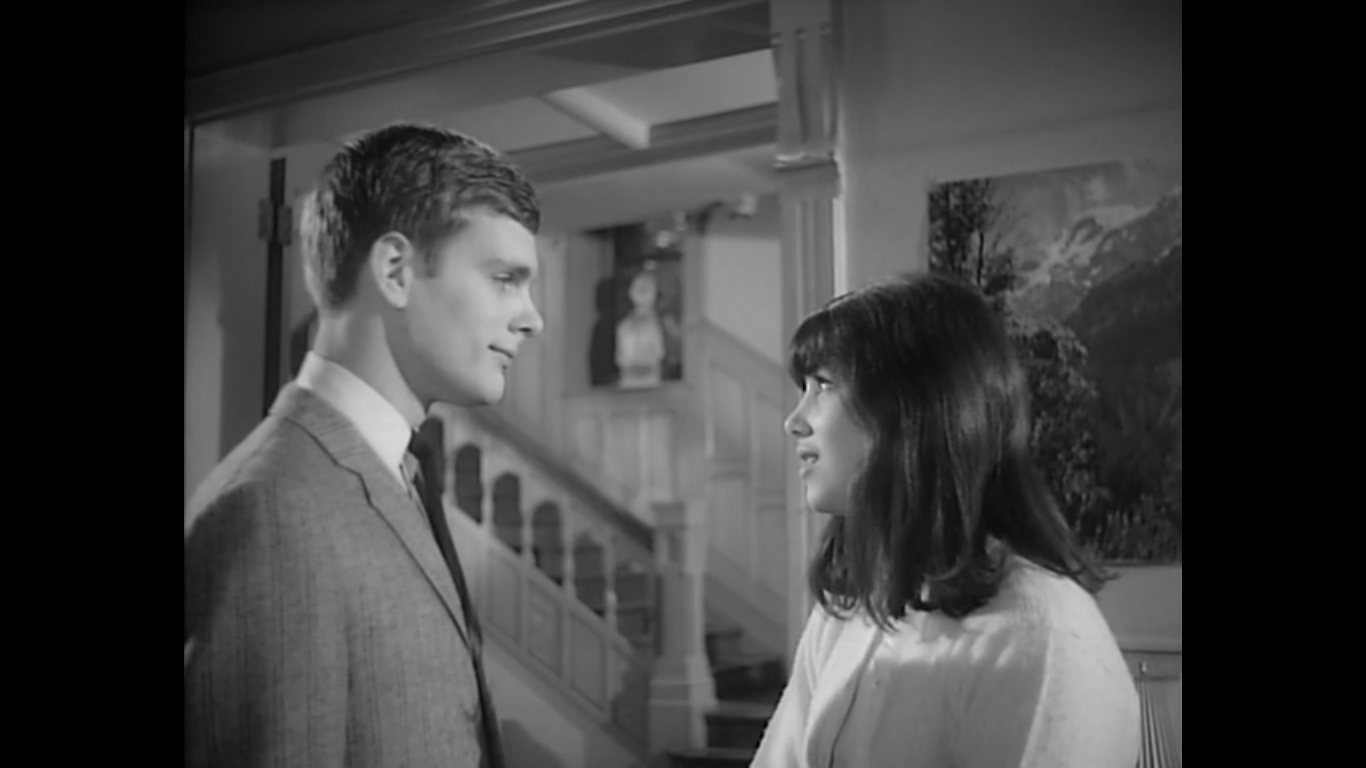
David & Lisa (1962)

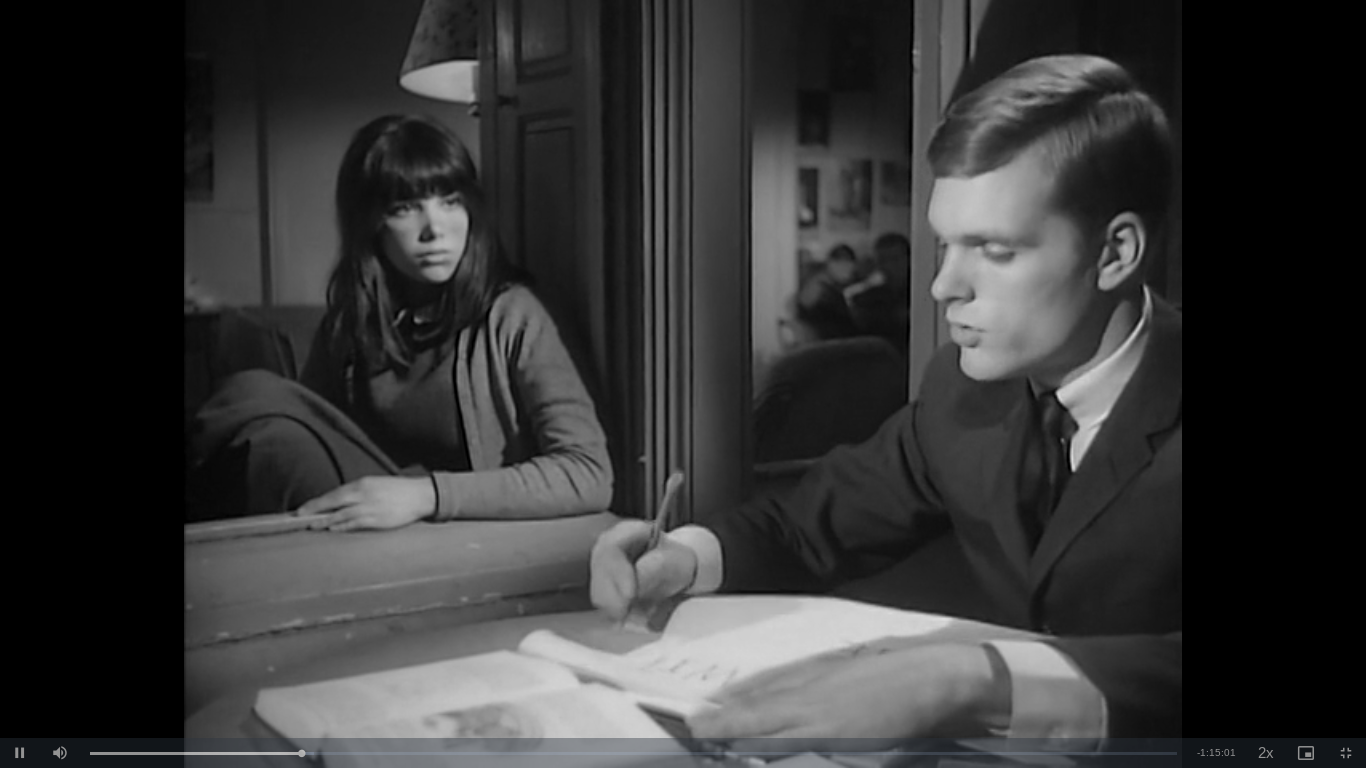
Keir Dullea is an actor who will always be most prominently remembered for Stanley Kubrick’s 2001: A Space Odyssey. He’s Dave of pod door fame. However, part of me wants to promote him as the lead in David and Lisa because this film from Frank Perry, in its quiet empathy and emerging relationships, feels more deeply like his film.

It relies heavily on his turn as a grim young man with OCD-like symptoms. As his mother drops him off at a psychiatric center for a brief stint, he immediately carries himself as a youth too smart for such an establishment. He’s an aloof loner with cold temples and the most severe eyes. Surely, this is a story about David’s transformation.

But the ampersand in the title reminds us that he only works in tandem with another life. Likewise, Dullea’s performance gains more meaning when he is put up next to Janet Margolin in her screen debut. She causes him to change and shift even as he elicits something out of Lisa.

Since I got my first introduction to Margolin in Take The Money and Run and became instantly smitten, it’s fabulous to see her in another role that plays so exquisitely off her inherent human charms. Lisa is a young teenager with a penchant for rhyme. If we want to diagnose her, she has schizophrenia, but the beauty of the film is watching people reach out to each other, instead of categorizing each other dismissively.

Even someone like Howard Da Silva is a pleasant surprise. In the old days, he mostly played conniving heavies in film noir; here he settles into the role of benevolent authority quite easily, and it’s a fine look for him. He wears it well. David is so quick to distrust him and what he stands for. Over time, the authenticity is so apparent that even he is won over. He comes to appreciate the place as home. It’s a space to belong.

However, if I’m honest, David and Lisa is the kind of film that feels like it might be frowned upon today if we know nothing about it. Still, there’s a tenderness in the love story that I can’t quite shake. It’s disarming and totally flies in the face of expectations.

I realized that whatever way you take it, there are these kinds of overt metaphors to the film. People who are different than the society around them somehow find solace in this shared sense of otherness. He meets her with rhyming and she meets him in a way by not reaching out with human touch. The things that ostracize them also have the inertia to draw them together.

If these are idiosyncrasies, then they respect them and respect each other enough to take their predilections seriously. Meanwhile, “normal” well-adjusted people at the local train station castigate them as weirdos better resigned to the funny farm.

But even when David makes a brief return home, the perceived distance at the dinner table and the manifold hangups of his own parents, make it apparent we do not live in a society of the well-balance and the imbalanced. Those in the former category either do a better job at hiding it or they have enough money to smooth it over. Success and status can cover a multitude of social sins, at least on the surface.

There’s one particularly crucial moment where I became mesmerized with Margolin watching her sway with the metronome although it precipitates a kind of demonstrative ending that doesn’t do the story much service. In one moment of annoyance, David lashes out at Lisa only to work tirelessly to win her back. Their chemistry is so fragile, held together by wisps of gossamer thread, but that makes it all the more vital to maintain.

When Dullea scampers up the Philadelphia steps, and they share a moment so much unspoken emotion is carried with them in the scene. It’s only the two of them. She no longer rhymes. She’s fully herself. “Me,” she says.

He reciprocates by doing the bravest most vulnerable thing he can, asking her to reach out and touch him. I remember a line of prose by C.S. Lewis about love being vulnerable and this lasting image is a testament to this truth. Here the pain and transparency brim with sympathy.

David and Lisa can be characterized as a romance, although it is one where the leads never kiss, never embrace and only touch in the final frame. Somehow it’s packed with more import than many other films claiming the same genre conventions. Because what some other films forget is that love and affection, romance, they all require so much more than physical touch. It’s about warmth and stillness. Willing to open yourself up and be hurt by other people even as you stretch yourself as a human being.

For a film about psychological disorders from so many years ago, there’s a gentle subtlety to David & Lisa; it’s quite extraordinary, and Dullea and Margolin make a wonderful pair together. It’s only a shame they were not both allotted even more high-profile vehicles commensurate with their talents.

3.5/5 Stars

The Underworld Story (1950): Cy Endfield and Dan Duryea

“You know what’s inside of ivy Mike? Little crawling things. You should feel right at home there.”

The Underworld Story is full of these wild narrative beats forming the foundation of a new normal. It’s like playing an unwieldy game of connect the dots. Take the opening scene. It’s straightforward enough. The district attorney and a gangster informer named Turk are injured on the steps of the hall of justice. They didn’t fall down. There’s a deliberate hit put out on them.

But this particular story has no special investment in apprehending these perpetrators with shotguns and a high-powered car. It plays like more of a misdirect than a primary plot point. Instead, the story slingshots to The Times Gazette‘s hard-bitten reporter Mike Rees who is on the chopping block for not withholding a story.

It’s this breaking news flash that got those same men killed. It’s all his fault, and he finds himself blackballed throughout the industry for breaking their unspoken code of conduct. He’s finished — a leper in the industry.

Dan Duryea is nothing if not a journeyman actor. He went through a number of phases even for the uninitiated. I can think of seeing him in things as diverse as The Little Foxes and The Pride of the Yankees (also as a journalist). Then, came the days of ill repute in everything from Scarlet Street to Too Late for Tears. These were his bread and butter, and he fit the mechanics and the malaise of the material like few others.

What’s marvelous in a picture like The Underworld Story is how he gets leading man status — he was an actor of that caliber surely — but he still plays a starring role as slick and unprincipled as ever.

It goes to show he can play either side of the spectrum — good or bad — and it still comes off mostly the same. There’s something in his delivery that makes it always sound like he’s sneering, disgusted with every human being he has the displeasure of running across. The feelings are mutual.

With nowhere else to go, he sets up shop in Lakeville. In an apt bit of exposition, we learn it is home not only to a church lane but also to a church street…and a graveyard. This is the world he’s walking into. He does his best to play the part of an honest-to-goodness, salt-of-the-earth American. He’ll do anything to survive.

In fact, he gets out of the big ocean so he can poison the water somewhere else. In a small pond where the water’s stagnant, all his rancid practices can fester and congeal into pond scum. The humble paper itself is run by Catherine Harris (Gail Storm) wet behind the ears and her faithful colleague Parky who is a veteran, but he’s used to a leisurely, benevolent sort of reporting. Harris wants none of Mike’s local news with a slant.

When the daughter of the local newspaper magnate (Herbert Marshall) is found murdered in the woods, they have no recourse to run the story. Reese is way ahead of it, prepared to nuke the news flash and blow up circulation all around town. It’s the kind of tactics that might easily get him back into the big leagues.

It also occurred to me right when we see the hustling, bustling frenzy around the murder scene, it plays a bit like a B-side to Billy Wilder’s Ace in the Hole (though it does sit on the right side of history having premiered a year earlier). We have some of that media circus going on here albeit in an alternate small-town setting.

The waves of swirling melodrama are the movie at its most overwrought and tiresome. None of this is original or attention-grabbing in the way a good news story might be. It also pushes the envelope on plausibility with these wonky near-nonsequiturs cropping up every which way.

As such, The Underworld Story proves to be a wildly uneven picture. At times there’s so much to latch on to and ruminate over. Other passages of the film feel downright tacky, whether it’s the dialogue or the rather fervent scoring providing a rampant array of dramatic underpinnings.

When it’s grounded in ideas of the press of what it stands for and how it can be used to manipulate and capitulate situations, that’s when the movie sings with something wielding a definite voice.

We watch Reese continually taking advantage of the situation. First, he’s rather comically running up the bargaining price for their exclusive to his liking by juggling two phone calls at once. He’s also prepared to use Molly Rankin. She’s the girl wanted as a suspect in the young woman’s murder.

The Sentinel vows to prop her up, but far from championing her as a symbol of prevailing justice in the town, it feels dangerously close to a trial, with free publicity attached for the paper. Of course, that’s because that’s exactly what it is. The Defense Fund becomes his latest scheme, which actually proves itself to be very successful in earning public support.

Alas, the public is fickle. The local paper starts sinking in quicksand as they meet a media juggernaut and watch Molly lose all credibility. The last thing to be done is to concede and plead guilty. However, Molly comes from a place of integrity — all she has are her personal convictions that she’s innocent and she won’t give it up — even if pleading guilty to manslaughter might actually allow her to keep living. To pragmatic, unscrupulous sorts, throwing in the towel makes logical sense. She, however, must abide by the truth.

Ultimately, Mike pleads with a newspaperman in his ivory tower — there’s actually some genuine concern there for once — but he also gets fingered by the jovial gangster who lays out threats with a smile. Howard da Silva makes an early appearance only to show up later and practically steal the show. It’s not simply about malice; it’s how he’s able to mask it with this kind of menacing conviviality. There’s a dissonance between the threat in each of his measured words and his outwardly cordial manner.

In the end, true to form, Duryea gets the crud beaten out of him, enough that he earns a date with an ambulance at the end of the picture. Even then when his girl steps in to ride off by his side, it’s hard not to consider their chemistry in the moment. They never felt like a couple, at least not to the degree such an action implied. Gail Storm, no fault of her own, is written to flit back and forth between indignation and admiration. She isn’t allowed to really stand on her own two feet.

It’s a final dagger in a movie that’s a bumpy excursion and still a calculated risk for Dan Duryea aficionados. The movie certainly isn’t averse to risks, taking on the theme of a black woman accused of murder and theft. It has a lot of potential, although the incisive edge is neutered by whitewashing the part and casting Mary Anderson in the role, no doubt to placate southern audiences. It’s a shame.

There’s only one last point that I feel compelled to bring up given the historical moment. The Underworld Story oozes Blacklist from the moment Duryea gets forced out of town and can’t win a favor, even from his friends. This is indicative of the story, but we can also consider all the personnel involved. Cy Endfield and Howard da Silva among them would wind up victims of HUAC destined for ex-communication from the Hollywood majority.

Mind you, these weren’t coincidences. People on both sides knew what they were doing. It proves that art really does have an impact on life. I would use the term art loosely with Endfield’s picture, though it does have a certain trashy allure around the corners — flaws and all.

3/5 Stars

They Live by Night (1948)

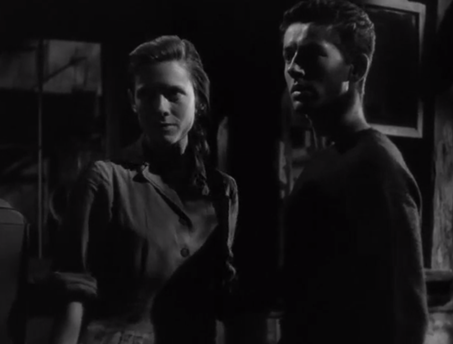
theyliveby4Regrettably, I have seen very little of Nicholas Ray, however from his debut in They Live by Night, I saw the same care spent on his youthful characters, which is also noticeable in Rebel Without a Cause. He does not treat “Keechie” and “Bowie” as cardboard cutouts or kids who are dumb and in love. They have value and feelings that are worth examining more closely.

The film opens with three thugs breaking out of the local prison. Two of the men Chicamaw (Howard Da Silva) and T-Dub (Jay C. Flippen) are weathered criminals. The third, Bowie is a baby-faced kid looking hardly a day over 20, but he went into the clink for a reason.

They find shelter at a nearby filling station where Chicamaw’s mangy older brother (Wil Wright) makes a living with his timid, no-nonsense daughter Katherine. They get a car and have enough money to get their feet off the ground before a big bank job in Kelton.

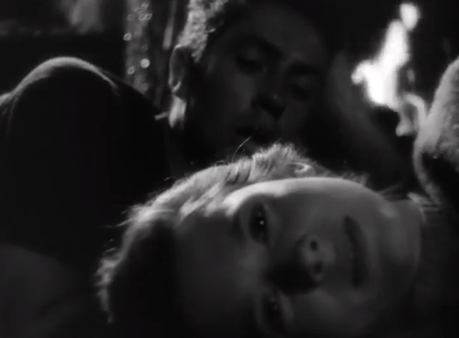
theyliveby2It goes off without a major hitch, but soon after Bowie gets in a car accident and Chicamaw takes him back to his brother’s to be cared for. Katharine is there and the two of them find companionship in each other because neither one has anyone else to turn to. They are young, naive, and in love. They’ve never had these types of feelings before.

Since Bowie needs to lay low, he takes “Keechie” with him and they make an adventure out of it. Ultimately, it results in a cheap $20 marriage and a lot of nice intimate nights spent together driving and cuddling. They’re living the lives of carefree newlyweds who need no one but each other. They find a simple cottage out in the backcountry owned by a homely proprietor (Byron Foulger), and it acts as a new home. A perfect oasis from the newspapers, the cops, and Bowie’s accomplices.

However, they do catch up with him eventually, and he and Katherine split fast after a tiff. They want a normal life, but Chicamaw and T-Dub won’t allow it because they need more money from another bank job. He won’t and in the subsequent attempt, his former partners eat it. The lookout is still hot for the boy as well.

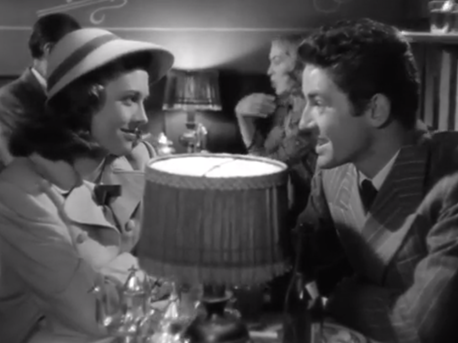
theyliveby1He seems so undeserving of hard justice, but it is bound to come after him anyways. For such relative newcomers, Farley Granger and Cathy O’Donnell (The Best Years of Our Lives) have such genuine chemistry opposite each other. Granger is more often than not gentle and kind. O’Donnell is pretty in a simple, unadorned type of way. They elicit so much more sympathy than Bonnie and Clyde or even the fugitives in Gun Crazy. Perhaps because they aren’t even outlaws, only young kids who are victims of their circumstances.

4/5 Stars