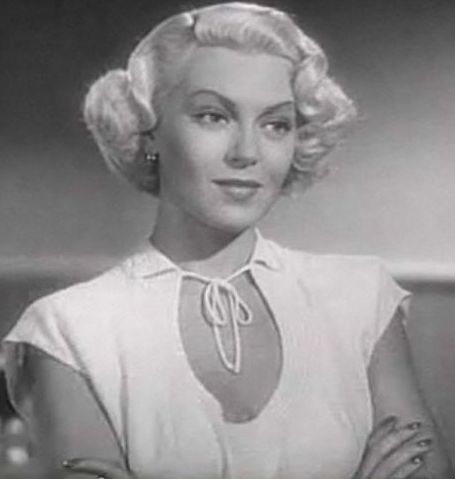
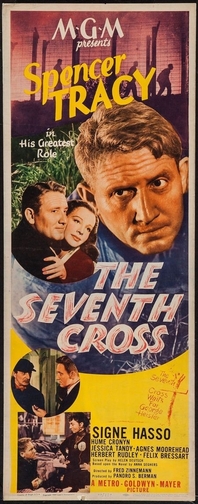
The Seventh Cross (1944)

Fred Zinnemann had one of his first Hollywood successes with the daring Seventh Cross. Since he was Austrian and lost family to the concentration camps, the personal nature of the material is unquestionable. He takes the novel by fellow Austrian emigre Anna Seghers and packs the story full with a wealth of European emigre actors and a few choice Americans as well. What it delivers is a stirring testament to humanity and the joining together of grit and determination in the face of oppressive evil.

I actually don’t mind Spencer Tracy playing the lead in the picture because it has the Hollywood bent of the studio system. Like casting James Stewart as a Hungarian in The Shop Around The Corner, there’s a collective understanding that Tracy’s attributes, as a kind of grounded everyman, are what matter most. It helps make this very specific and personal story a universal story for all men to see themselves in.

He is one of seven prisoners who make a nighttime escape from a Nazi concentration camp. As they all break off from one another and go their separate ways, we know the goal is the active pursuit of survival in a malevolent world. There’s nothing more fundamental, and we walk alongside George Heisler as he searches out any old friends and his former flame, who might be able to help him in his dire need.

Meanwhile, all the other prisoners are mercilessly rounded up and hung up on the crosses erected by the camp commandant; they are meant to be a warning sign to anyone else, but everyone knows the inherent metaphor. They are martyrs to the cause like the thief hung next to Christ. There is hope that they will one day see paradise.

The story utilizes a dead man’s voiceover before Billy Wilder took the device for Sunset Blvd. Here it feels a bit more like a crutch to distill Anna Seghers novel down; he lives as a ghostly subconscious entreating Heisler to remember the address 46 Morganstrasse…

At its best, the movie becomes a lyrical pilgrimage for this character as he’s privy to the kindness, passivity, and utter heartlessness of common people, each in turn. Because at your lowest, when you have nowhere to go and you rely solely on the good graces of others, this is where their true nature becomes evident.

I can see Classic Hollywood films, taking on Nazism, being derided in a modern context for going too soft, especially if you have a preconceived notion of what they might be. Certainly, these artists didn’t know every atrocity that had been perpetrated, but they were not stuck with their heads in the ground. In many cases, they knew far better than the general American public.

There’s immense consequence to everything within the frame, and Zinnemmann brings many searing evils to the screen, both seen and unseen. The aforementioned cross imagery is bleak iconography borrowed from Seghers. There are little boys with Nazi armbands rumbling around town to try and tattle and find fugitives.

One of the runaways, a formerly famed trapeze artist, must flee across the rooftops as locals gawk at the show and the Nazis hunt him down like cornered game. He takes one final curtain call after being mortally wounded and leaps forward in total serenity. It’s his final performance with his last breath. Heisler watches the scene, and before catching the ending, he disappears around the corner grimly.

His former flame Leni (Kaaren Verne) vowed to wait for him, but now she’s married and terrified to see him. The fear in her eyes manifests itself in brusque accusations. He has nothing but fondness for her; he’s requesting food and accommodation, and she will give him nothing. He stuffs a few crusts of bread in his pocket and disappears, feeling totally betrayed.

There’s another particularly unnerving scene. As the dragnet closes around George, he gets a tip about a doctor who might be sympathetic and can bandage him up for a wound. He pays a call on the man. Dr. Lowenstein (Steven Geray) states in accordance with the law that he must tell his patients before working on them that he is Jewish.

There might be other contemporary cinematic depictions of the Nuremberg laws or other anti-Jewish legislation like this, but the mundanity of this institutionalized prejudice is like ice in the veins. It’s right there in the open and in the face of this, the doctor still chooses to do an act of good.

Our hero is graced by another generous soul when he’s put up in a Hofbrau on his perilous road to freedom. By now, his name and likeness are all over the papers; Toni (Signe Hasso) the barmaid, could turn him, and yet she doesn’t. They share the kind of solitary love story that exists suspended in movies or those real-life moments where there is no time to stop and think before two ships pass on in the night.

George Macready even gets one of his first opportunities to play a conflicted, if ultimately sympathetic man caught in the crosshairs of the war and his own personal comforts. It takes all kinds for the sake of the cause.

Hume Cronyn shows up over halfway into the movie, and he is our respite. Paul Roeder might have the first genuine smile in the entire film with his domestic life alongside his wife, Liesel (Jessica Tandy), being a refuge from the hopeless world at large. He treats George well, symbolizing the growing tide toward human decency.

What he also represents is another viewpoint. The movie has the right to paint the Nazis as villains, and yet it does present a German character like Paul, who has been mostly shielded from the horrors.

What he sees is the economic prosperity and the help he’s received as he goes about providing for his wife and caring for his kids. The government has done good by him, and this is what he holds onto. George must help him see the other side and bet on the human proclivity toward good, even if we must forgive how easily Paul gets away from SS interrogation.

For being a film with so much grief and oppression — even if it’s fashioned on a Hollywood backlot — the movie does ring even more resolutely with this affirmation of human dignity. Instead of labeling it mere naivety, I prefer to see the optimism as represented by Paul and the little people.

Felix Bressart has the briefest cameo as the local delicatessen owner who brings George sustenance for the long journey ahead. Like his Shylock speech in To Be or Not To Be, he comes to signify the entire picture with his resolute encouragement. He doesn’t know the man, and yet he extends this generous hand; he’s just one of the faithful worker ants who will not let goodness die. Together, they can overcome.

What the film does well is distill these sentiments into individual human interactions we get to observe and imbibe as an audience. So although we are not completely inured to the state of the world, we are not blinded to it either, like Paul.

In 1944, there was still much of the war to be fought and won. Thus, The Seventh Cross does feel like a daring picture and one with immeasurable worth. I’m not sure if it was appreciated in its day, but looking back on it, there is much to admire in its incisive self-awareness.

3.5/5 Stars

Review: Shadow of a Doubt (1943)

Teresa_Wright_and_Joseph_Cotten_in_Shadow_of_a_Doubt_trailerIt is well documented that Shadow of a Doubt was Hitchcock’s personal favorite of his own films. That’s quite a telling statement when you do a quick scroll through some of the titles up for contention. Vertigo, Psycho, Rear Window, North by Northwest, Notorious, even The Birds. And yet the famed “Master of Suspense” chose the often glossed over Shadow of a Doubt.  If we take a slightly closer look it makes a great deal of sense as the film follows through with one of Hitch’s most prominent credos, “There is no terror in the bang, only in the anticipation of it.”

That’s, in fact, a great deal of what Shadow of a Doubt is. It’s the cringe-inducing anticipation for what is bound to happen. The inevitable that is plain as day, except not everyone sees it so clearly. But that’s enough ambiguity.

The story opens in a depressed urban city with Charles Oakley (Joseph Cotten) laid out pensively on his bed. Dollar bills are scattered haphazardly across his floor. Soon he learns two men want to talk with him, and he’s not about to get acquainted so he gives them the slip and heads to the one decent place he can think of. Santa Rosa, California, the peaceful abode of his older sister Emma and her family.

What we learn over time is that Charlie is known at large as the “Merry Widow Murderer,” because he has strangled three such women and taken their valuables. Hitchcock playfully alludes to the fact by opening his film with the “Merry Widow Waltz” and it will pop up throughout the entire story if you’re paying attention.

shadow-of-a-doubt-trainHis train comes barreling towards town with smoke spewing ominously. For now, his oblivious family is just happy to see his face, especially his oldest niece and namesake Charlie (Teresa Wright) who is ecstatic to have something to shake the family out of their funk of normalcy. At this point, there is little to be uneasy about, because Uncle Charlie is not about to do anything rash, but there are a few moments where he gets uneasy. Covering up a paper headline and doing his best to avoid two men taking photos for a national survey. Charlie doesn’t think much of it at first, and it feels just like old times with uncle giving gifts and receiving the royal treatment.
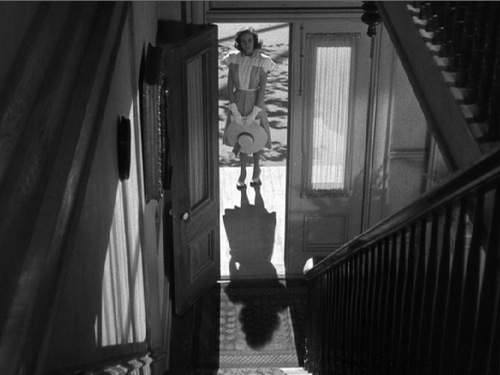
Except the ring he presents to Charlie is plundered jewelry with a mysterious pair of initials engraved on it. Of course, the men interviewing the Newton household are actually trailing Uncle Charlie, and Detective Graham fills Charlie in while also becoming fond of her. But it’s not the kind of news she’s willing to accept. How can she? It’s a late night visit to the local library that finally confirms all her deepest fears. Soon, the telltale signs become more apparent to the audacious girl, and Charlie simultaneously notices the changes in her as well.

This is where the film becomes fidget-inducing because it’s out in the open. Uncle Charlie knows that she knows, and still he remains in their home, in quiet little Santa Rosa, as if nothing has changed. For most of the family, nothing has, but Charlie’s demeanor is completely different. She just wants her uncle gone, away from her family, and then there’s the impending threat that her own life might be in danger. In truth, Uncle Charlie doesn’t want her around, even though it looks like he might get off scotch free.  His mind is already so twisted — so far gone — that he coolly attempts to get rid of Charlie, right under the very noses of their family.

It turns into a psychological mind game between uncle and niece, Charlie vs. Charlie. There’s no detective to save her now because he’s already left town and there’s no other direction to turn. She finally does succeed in getting dear uncle to leave town, and it looks like the living suburban nightmare is coming to a close. Then, in a final instant on the outbound train, Hitchcock’s lets off a BANG! The film’s culmination arrives and is just as quickly passed over. It’s done just like that, but it’s not really what was important. All that nerve-wracking build-up — the meat and potatoes of the drama was what was paramount.

Thus, Hitchcock delivers us a shocking nightmare of a film. It’s not anything like Psycho, existing in a far more mundane world. But Shadow of the Doubt brazenly suggests that murder can reach us even in our homes, even in the places that feel the safest. Hitch exhibits his wicked sense of humor with two characters who love to talk murder in Mr. Newton (Henry Travers) and the next door neighbor Herb (Hume Cronyn). They obsess over crime fiction and discussing ways to get away with murder. Little do they know that the man in their midst is trying to do just that.

Teresa Wright is certainly one of my favorite actresses and her role as Charlie is one of her bests highlighting her cordial charm, while also revealing her adeptness in the role of a tortured heroine. We want her to succeed more than anything, and as an audience, we worry for her well-being the entire film. Meanwhile, Joseph Cotten generally plays laconic types, but still, they usually have more goodness than baseness in their souls. Uncle Charlie is a fine role for him because he’s so sweetly cunning and at the same time sadistically twisted.

Shadow of a Doubt pic 3Unfortunately, the role of Detective Saunders feels rather shallow, but that’s hardly something to get stuck on. If that were the case, we could easily point to Charlie’s parents who seem way too old. But they are perfectly average, ordinary folks, as played by Henry Travers and Patricia Collinge. The script work of the preeminent Thorton Wilder (Our Town) and the on-location shooting in the Everytown of  Santa Rosa lend a universality to this thriller’s impending dread.

Dimitri Tiomkin heightens the film with his usually stirring, pulse-pounding approach to scoring. Hitchcock’s camera, while in black and white, is nevertheless noticeably dynamic. He always emphasizes the necessary focal points, and extreme close-ups and high angles only accentuate the drama. His use of the stairwells in the house is absolutely marvelous, implying both distance and foreboding in numerous shots. For every shot that Cotten looks menacing, there is an equal number highlighting the pure innocence of Wright. It’s the perfect juxtaposition of character, in a film that is really only your typical see-sawing struggle of good versus evil. Except it takes place in our own backyards.

5/5 Stars

People Will Talk (1951)

peoplewill1People Will Talk is in this weird gray area between genres. It has humor but it’s not screwy enough to be a screwball. It has drama, but it’s not intense enough to be a full-fledged melodrama. And underlining all this are issues that reflect such areas as the medical industry, the Korean War, and most definitely the witch hunts that were going on in the nation — bleeding into the Hollywood industry.

Written and directed by Joseph L. Mankiewicz, this is a minor classic about a doctor named Noah Praetorius (Cary Grant), who is under investigation from one of his by-the-book colleagues Dr. Elwell (Hume Cronyn), who dislikes the good doctor’s unorthodox and thoroughly effective approach to his trade. Praetorius by now is a preeminent physician who started his own clinic and also teaches classes at a local med school.

One of these individuals happens to be Mrs. Deborah Higgins (Jeanne Crain). She is not a student but sits in the lecture because her former partner was a medic. A date with a cadaver proves to be too much for her and she faints. Seems normal enough right? Wrong. After examining her, the Dr. tells her she’s pregnant. The truth comes out that she’s not really married and the father is dead. Her own father would be greatly distressed to learn about her condition, since he cannot provide for her.

That’s where Dr. Praetorious comes into the picture, and he takes great concern in Ms. Higgins condition. He attempts to allay her anxiety by saying she’s not really pregnant, and she runs away from his clinic out of embarrassment, since she is falling in love with him. He goes with his stoic friend Mr. Shunderson to the farm owned by Deborah’s uncle.

Deborah turns out to have a strange mix of aloofness and lovesickness, but when she realizes the Doctor’s true motive for being there (before he even does) she is wholly relieved. They share a passionate kiss and leave the farm behind to get married. Of course, the Doctor still hasn’t told her about the pregnancy.

Meanwhile, the whole storyline culminates with a concert conducted by Praetorious himself, but it just so happens that the hearing to analyze his conduct is happening simultaneously. Some mysterious truths about Mr. Shunderson are given in his own words, and stale Mr. Elwell’s case is dumped. Everything wraps up nicely as you expect with a happy marriage and Grant free to direct the symphony in one last glorious crescendo.

So you see if you really look at this film, there are these two main story arcs. One is a response to McCarthy’s witch hunts, the other an equally subversive love story about a doctor marrying a woman who had a pregnancy out of wedlock. When you put it that way this film seems chock full of controversy, and yet it is all veiled in a palatable comedy-romance. Walter Slezak is a welcomed addition to the cast as the nutty colleague and Hume Cronyn has taken on better roles, but nonetheless, he is always an enjoyable character actor. Obviously, this is a lesser Grant performance, but his pairing with Jeanne Crain is still a fun one.

4/5 Stars

Brute Force (1947)

BruteForceImage873Potentially one of the weaker Jules Dassin films noir, Brute Force is still a worthwhile film exploring the dynamics of a prison during the 1940s. The inspiration comes from the rebellion at Alcatraz in 1946 and this film was shocking at the time for the amount of violence it portrayed. It stars Burt Lancaster as the glowering leader of a group of prisoners in block K17. His main antagonist and the villain of the entire yard is the authoritarian Captain Munsey (Hume Cronyn in an especially icy role).

The story follows the inmates as they make due with prison life and bide their time waiting for parole. However, Joe Collins, who is fresh off a spell of solitary confinement, seems bent on escape. The prison warden is an older fellow struggling to keep tempers from boiling over. The likable but often inebriated doctor (Art Smith) can see the writing on the wall. Things are reaching the end of the line if Munsey continues to hike up his tactics that are making the men resent him more and more every day. It’s positively a powder keg and it’s not going to be a pretty sight if the pressures get to be too much.

The entirety of the film takes place within the confines of the prison except for a couple flashbacks as four men recall the women they left outside in the real world. They are played by Anita Colby, Ella Raines, Yvonne De Carlo and Ann Blyth respectively, reflecting the hope, memories, and loved ones who are pulling at these men and ultimately led them to get into trouble. Perhaps it’s a stretch, but you might even be able to call them the femme fatales in an otherwise very male-centric film.

One man hangs himself afterward from Munsey and another gets it for causing problems for Joe. Neither of these men is looking to stand down anytime soon as Joe cautiously begins enacting plans of escape with another prisoner named Gallagher (Charles Bickford). Munsey continues to hound prisoners for information while halting all privileges.

Ultimately, the finale turns into the most electrifying moment of the film, while simultaneously Munsey is made the new warden and Collins puts his plan in action. Guards are waiting for him and his crew, but Gallagher has plans of his own in the compound. It leads to a handful of explosions, endless mayhem, and more than a few deaths. This is what happens when you use brute force.

4/5 Stars

Review: The Postman Always Rings Twice (1946)

Lana_Turner_in_The_Postman_Always_Rings_TwiceThe first time I saw this gripping noir, my least favorite part of the film probably was the title, and it still is. That’s saying a lot, and the film is adapted from the James M. Cain crime novel anyways, with the title included free of charge. Otherwise, Postman is a wonderful example of the film noir canon, and yet it lacks the elements of your more typical private eye mystery.

It trades dark streets of crime for a small roadside burger joint owned by a shrewd man and his noticeably younger wife. Bring a drifter searching for a quick buck and you have everything set for the deadliest of love triangles. At the tips are John Garfield as the rambling man Frank who initially couldn’t care less for his boss’s pretty wife. Then there’s Cora, the alluring girl who seems out of place in her life. Then you have the money-grubbing Nick (Cecil Kellaway) who seems naively oblivious to the whole situation.

At first, nothing seems to be afoot, and Cora is adamant about not getting involved with the new hand. However, ultimately things evolve. That’s not necessarily the exciting part. We expect the rapid and lurid love affair that soon besets Frank and Cora.  We expect, more likely than not, that Nick will either catch them or they will knock him off first. They choose the latter and its far from preferable. Soon the district attorney is down their throats with his own suspicions about the forbidden couple. He’s pretty smart too.

Sackett plays Frank and Cora off of each other. They’re both scared. Neither one wants jail or worst the gas chamber. Nora ends up being the only one prosecuted, but her sly lawyer (Hume Cronyn) is able to call his opponents bluff and get Cora off with hardly a hitch. The only problem is that Frank and Cora hate each other guts now. They are positively poisoned to each other.

The story could end there and it would be ironic enough, but it doesn’t. It has yet another act where Frank and Cora make up following the illness of her mother, the flourishing of her establishment after the trial, and a bout with blackmail. All seems to be better than it ever was, but fate can have a cruel sense of humor.

On one out of the ordinary car ride, Frank crashes and in the aftermath, Cora is left dead with Frank on the fast track to the gas chamber. And that’s where the title comes in. The Postman Always Rings Twice. In other words, if you don’t pay for your crimes the first time around, you always end paying up one way or another. Cora was killed and Frank faced execution. Neither one got off in the end.

Putting aside the Hay’s Codes need for justice to be dealt, this is a wonderfully sardonic tale and ultimately sensual noir for the 1940s. Lana Turner was never better dancing with relative ease between amorous sweetness and acidic intentions. And the moment she first shows up on the screen is one of the most eye-catching entrances by a femme fatale period. Although not the greatest of leading men, John Garfield is surprisingly credible opposite, Turner. He plays the hard-working everyman incredibly well. Hume Cronyn, for his part, plays his wily prosecutor wonderfully with a sly smile all the while. I cannot quite put a finger on it, but I like him.

4.5/5 Stars

Lifeboat (1944) – Alfred Hitchcock

Directed by Alfred Hitchcock and starring Tallulah Bankhead, the film follows the passengers of a liner who escape in a lifeboat after the ship is sunk. Together they try and survive in order to make it back to civilization. Along the way they must make many difficult decisions. This includes saving the life of a German who sank their boat as well as amputating a man’s leg. Through it all there is ongoing conflict among the people who would normally be genial. However, their circumstances are by no means ordinary. By the end they are so desperate and crazed they seemingly turn against some and fall in love with others. This technical challenge of such a small setting did not disable Hitchcock’s storytelling ability. Written by John Steinbeck, the film’s story is an interesting view of humanity during World War II. This movie also includes Hitchcock’s most ingenious cameo of any of his films.

4/5 Stars