Me & Earl and the Dying Girl: Depth and Dying (2015)

meandearlandthedyinggirl1What struck me about Me & Earl this time around was not just the cinematic homage or the quirky indieness, but the fluid movement of the camera matched with the ever-evolving score of Brian Eno. It made me appreciate this film yet again because some people might say it’s weighed down by over-trod tropes, but it leaves those in the dust. Others might criticize it for playing up to all the cinephiles out there in order to garner respect. Which might be true.

But in essence, this film resonates on such a greater level. All the side characters are fun and interesting and I’m sure all the various parodies will open the floodgates for some enthusiastic young moviegoers to discover film’s roots. Those are all wonderful perks of this story. And yet again, Greg Gaines feels so relatable it’s almost scary at times. He’s so insecure on so many levels, drifting in and out of the school corridors, awkward around dying girls, and awkward around girls in general. Most of this I pointed to already in my initial review.

However, it’s the work of director Alfonso Gomez-Rejon along with cinematographer Chung-hoon Chung that contribute an added layer of depth to this film. The gracefully spiraling camera is at times reminiscent of Ophuls ascending a staircase. There are perfectly symmetrical shots popping with colors that Wes Anderson would most certainly approve of. But like the great minimalists out there, the camera is still when necessary. In poignant moments when Greg and Rachael have real, heartfelt, even hurtful conversations, there’s no need for flashiness. It’s in these moments where those behind the camera prove their skill because we can see them having fun with their artistic vision, but we also notice the great deal of care they have for these characters.

meandearl2It never feels flashy or superficial in these crucial moments. Any slick plot device or cinematic allusion falls away to get at the heart and soul of this film. It’s about coping with death and finding closure in that terrible event in life. Specifically for this one young man, but it is universally applicable to most every one of us. Especially when you’re young because as young, naive individuals, death can feel like such a foreign adversary. It’s so far removed from our sensibilities, and that’s what makes it so painfully unnatural when it strikes. In many ways, Greg is our surrogate. For all those who struggled to find themselves in high school, or college, or even life in general. And for all of those, who took risks on friendship in a world full of death and dying. Once more Me & Earl and the Dying Girl proved its worth, not by being a perfect film, but by being a heartfelt one.

4.5/5 Stars

Review: Short Term 12 (2013)

shortterm1In recent years Hollywood has been the land of superhero films, special effects extravaganzas, and star-studded drama. It all fits into the mold of this industry personified by sun-soaked beaches joined with excessive glitz and glam.Go down the California coast to San Diego and you find a slightly more humble, but still highly prevalent affluent beach culture. Look no further than La Jolla and that reality is extremely evident. That’s part of what makes Daniel Destin Cretton’s film so credible. It’s not like that. But it’s important to start from the beginning to understand why that is.

Cretton, who is originally from Hawaii, came to San Diego in order to attend Point Loma Nazarene, one of these pristine waterfront getaways that also doubles as a school. Afterwards, he went through film school at San Diego State. However, in between his two stints in school, he spent some time working as staff for a short-term home for teens. It proved to be a formative experience and the jumping off point for Short Term 12.

It began as a short film for Cretton’s Master’s thesis, but with the proper funding, he turned his modest work into a full-fledged feature project. However, this is far from your typical Hollywood production and it undercuts the typical San Diego persona. Instead, this story literally bleeds with humanity flooding out of its veins like no other.  In other words, it’s not your high-brow epic. It’s truthful, gritty, and inherently real. The facility pictured here feels like a more typical San Diego, depressed, humble, and full of people fighting against the currents of life.

shortterm4These characters are not caricatures, but reflections of people who could very easily be real. Headlining the modest cast is Brie Larson, who is on the rise with a few more mainstream roles on the horizon. With Grace, she channels a spirit that is so affecting in a raw, visceral way. She is the catalyst of the workers who are meant to be a stabilizing force on the kids in their care. Day in and day out they must deal with angry outbursts, insubordination, and sometimes worse. It’s a difficult job, to put it lightly, and yet Grace does the work dutifully with an unfaltering mix of tough love and compassion.

These kids often come from the worst of family background including abuse. Grace was one of those kids herself and now she helps others with a group of staff including her partner and best friend Mason. In essence, she is their friend and champion, but behind this facade lies a girl — timid and scared. Not ready to let others in after she so readily enters into the lives of others.

The kids are a big part of this story as they deal with their baggage, but first and foremost Short Term 12 is the story of Grace. The story of how she finally learns to open up her life, to confront the pain, and allow herself to be vulnerable with the one she loves.

In so many of these characters, there are a multitude of emotions that brew in isolation. So much is pent up inside and so much goes unspoken. It’s barely hidden under the surface but always written on faces and in averted gazes. This is not a pretty film and it should not be because life rarely is the perfect portrait that movies often seem to paint. Drama is not dazzling theatricality; it’s dirty and low, besmirching all that it touches.  There’s so much loneliness to be parsed through, in the adults and adolescents alike, before problems can be resolved. They are never made perfect, but the film leaves these people better than when they started.  Life goes on much as it had before, and a great deal of hope is unearthed beneath all the debris. So though it might not be pretty, it is unmistakably beautiful.

shortterm2The director’s unsteady handheld camera feels a little abrasive at times, but also brutally honest, spending a great deal of time on close-ups. Cretton’s script is relatively simple, still, it continually brims with harsh realities and little moments that feel terribly human. It might be Grace sitting solemnly in an abortion clinic, the brooding Marcus throwing down a heartfelt rap, or Jayden illustrating her pain through the story of an armless octopus. The minutiae work marvelously, collectively making these into people who we can truly feel for.

Many might vehemently disagree, but Short Term 12 seems to prove that all a film needs is a grain of truth mixed with some authentic humanity to be engaging. That is far more gratifying than any amount of special effects or explosions that Hollywood can manage to throw up on to the screen.  Unfortunately this is a criminally underseen film and hopefully, Netflix might help change that.  But if not it will take individuals championing lost clauses just like the workers in this story. They never gave up on these kids and they were willing to go the whole nine yards when everyone else had forgotten. Please do yourself a favor and do not forget Short Term 12. I certainly won’t be forgetting it anytime soon.

4/5 Stars

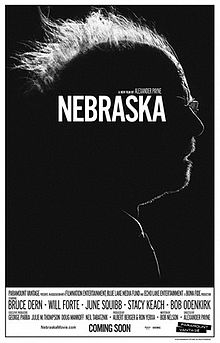
Nebraska (2013)

Nebraska_PosterDirector Alexander Payne tackles his native Nebraska in this character study that is part road trip movie, part father-son drama. Honestly, I never knew much about Bruce Dern, but at well over 70, I think it is safe to say he gave one of his great performances as Woody Grant. In this story, he is convinced that he has won a million dollars. It’s not a scam to buy magazine subscriptions like everyone seems to tell him. Including his weary, but good-natured son David (Will Forte). Woody’s ornery wife Kate is fed up with his behavior. He’s feeble, absent-minded, and not as sharp as he used to be. In fact, David and his older Ross (Bob Odenkirk) are thinking of putting their dad in an old person home sometime soon.

However, Woody is bent on getting that money, even if he has to walk all the way to Lincoln Nebraska, from Billings Montana where he lives. It’s utterly ludicrous and everyone knows it except Woody. But instead of fighting it, David sees it as a chance to spend some quality time with his dad away from his job in an electronics store. So the two of them set off to Nebraska to spend time with Woody’s family in his old stomping grounds.

Now Woody’s not much of a talker similar to his brothers (including Rance Howard), however, David and the audience soon come to realize that despite a rough exterior and alcohol problems, he really is a kind man. He’s a giver. That’s evident whether it was his family or his former partner, the opportunistic Ed Pegram (Stacy Keach). Because when all of these folks catch wind of the money, Woody becomes somewhat of a local celebrity and no one will believe that it’s not the case. They think it’s simply a dodge to avoid sharing the wealth.

Really most of the townspeople are petty, opportunistic, folks looking to gain from somebody else’s good fortune. However, it also revealed the shallowness of some, who were quick to ridicule when the money turned out not to be real. This film made me appreciate my own family in the Midwest and some of the more good-natured characters did strike a chord with me. There’s something so attractive about a community that remains so close-knit with each other over the years. I can never have the experiences of my grandparents. Even if I manage to be married for 50 or 60 years, I can never have that wonderful small town feel of returning to my roots and seeing all my classmates from bygone years. Although sometimes I suppose it can be a blessing and a curse because in small towns people will talk and that’s not always conducive to quality relationships.

That’s why when David lets his dad ride through town in front of all his old friends, it is such a poignant moment because he gifts his father one final moment of freedom to relish in front of his friends. All he got was a stupid hat that reads “Prize Winner,” but his son sold his car to allow his father to live out his dream one last time.

Because if you strip it down and take out all the white noise, this is a father and son film. It’s beautifully stark at moments with its modern black & white visuals. Yet it still has intimate scenes between father and son, that sometimes are incredibly sad, but also have a shard of hope attached to them. It took reading several other articles to latch onto the fact that this is seemingly Payne’s nod to the great Japanese director Ozu. Or at least he shares a lot of the same issues in this film and in some respects very similar pacing. It’s not some high-speed action flick, but it cares about deeper issues and reality. This is not California, but Nebraska and still relationships are universal. They look a shade or two different wherever you go, but never lose that personal meaning. It breaks through time and place, to speak to each of us on a personal level. Honor your father and mothers, because those relationships have great value even when they are a struggle.

4/5 Stars

Frances Ha (2012)

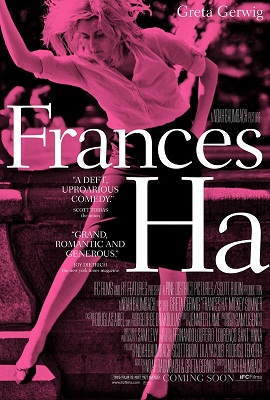
Frances_Ha_poster“You look older but a lot less grown up…” 

People as diverse as Buddy the Elf, Holly Golightly, and Annie Hall call New York their stomping ground and along with these iconic figures comes Frances Halladay. Her bubble does extend to France and California, but New York is really her home base. In Noah Baumbach’s film, we follow this enigma as her address constantly changes, and she strives to follow her dream of becoming a professional dancer. We are allowed time to examine and analyze her in all sorts of situations because plot usually gives way to various asides showcasing the free spirit who is Frances.

She worries about money, can’t pay rent, wants to play fight with her best friend, and is a self-proclaimed “undateable.” She acts like a five-year-old one moment and yet has an almost unknowing beauty about her.  In other words, she’s a real winner. We cannot help but fall in love with her since she wins us over with all her oddities from beginning to end. Her friend Sophie cannot stay mad at her forever either. It’s just not possible. They have to make up.

Frances settles down one final time, after trying her hand rather successfully at choreography and moving back to Washington Heights. There we get one last little nugget. We finally can chuckle knowingly about the title of this film. It’s so Frances and it’s the perfect cherry on top of the sundae.

In the tradition of New York films, Baumbach’s effort has a visual style that was meant to hearken back to the austere black & white of Woody Allen’s Manhattan (1979). In some sense, it acts as another character altogether. Whether he is pandering to us or not, there is no doubt that I am a sucker for the cinematography and it made things just a little bit more magical.

Thankfully Greta Gerwig helped craft this script and in her character, she found the perfect paradox. An individual so extremely quirky, but still somehow believable in the same instance. Her foibles and pratfalls only help to solidify her character in our mind. The fact is that each of us probably knows some variation of Frances. Those individuals who dance to a different drum and give every single day that they live on this earth a certain degree of pizzazz. I speak for all the cautious, rationally minded human beings out there. We need the Frances Has to make us laugh and to shake up our normality at least a little bit.

4/5 Stars

The Virgin Suicides (1999)

VirginSuicidesPosterIn her debut, Sofia Coppola fashions the 1970s with a washed out wistfulness that feels like a distant memory — lingering for a time — leaving a few far away remembrances to be eulogized and reminisced about.

Her film is really about two groups. There are the Lisbon girls who live with their militantly authoritarian parents and then the neighborhood boys who look on with awe. These girls are the unattainable prize that all of these young men are entranced by. They are not besmirched or dirtied by the ways of the world, stuck in the ivory tower of their parent’s home. It’s almost as if they come out of a dream, so pure and in the same way so provocative.

However, things get shaken up when the youngest daughter attempt to commit suicide and then in a free moment she jumps out of the window and meets death by the metal fence posts below. Red flags should be going up everywhere, but stubborn Mrs. Lisbon only becomes more stringent in her moralistic ways. She should be trusting her daughters, allowing them certain freedoms, but she only takes away more. And reluctant Mr. Lisbon does nothing to stop her. He just lets it be.

Only allowed to socialize at one dance under strict guidelines, the girls relish this opportunity and so do the boys. They finally get their chance with a different class of girl. But after the smitten Lux breaks curfew, all the sisters lose all contact with the outside world. The iron gates go down, and she never gets another moment with high school heartthrob Trip. On top of that, their mother makes her burn all her records in another strict turn.

Lux defies her passively in any way possible as she and her sisters try and maintain contact with the boys on the outside. But there is a point for any person where this type of confinement, this type of prison, gets to be too much. The girls reach the end of their rope and take the only way out they can see.

Oddly enough, most of the boys have little personality, but the focus is the Lisbons and specifically their daughters. The Virgin Suicides was partly intriguing because it never seemed to take on some dramatic tone and it never felt all that personal. I felt so far away. As Carol King mournfully sang, “Doesn’t anybody stay in one place anymore. It would be so fine to see your face at my door. Doesn’t help to know you’re so far away.” That’s exactly what this film does. It doesn’t allow us to get close and that aloofness lent itself to the intrigue we have in these girls. We’re pulled into their story along with all these young boys.

3.5/5 Stars

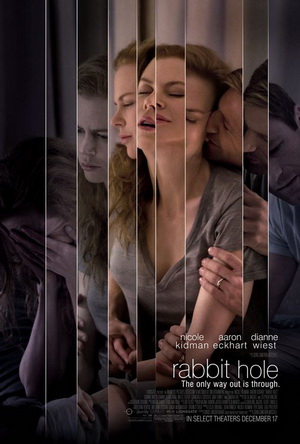
Rabbit Hole (2010)

Rabbit_Hole_PosterRabbit Hole is a modest film — a film based off of David Lindsay-Abaire’s original play that he adapted for the screen. However, that is not to discount the big performances that fill up the screen from Nicole Kidman and Aaron Eckhart to Miles Teller.

The film finds its drama in the story of a seemingly perfectly successful couple Becca and Howie, except the pair is still trying to get over the death of their four-year-old son. It’s been 8 months now, but Becca still seems far from ready to move on with her life.

She doesn’t want another kid. She can’t bear to see the dog that Danny was chasing into the street. She does not want to go to a support group, and she remains mostly aloof with her mother and sister, who hardly run in her same circles.

The moment the story takes a turn begins when Kidman’s character takes a great deal of interest in a boy. This is not some strange obsession or desire for a tryst. It’s nothing like that at all, but we begin to wonder why is she so interested in this seemingly ordinary high school student on the bus.

It might be clear to some right off the bat, but for others, it will take a few moments…Yes, that’s right. He was the one driving the car! He was there when it happened. That’s horrible. That’s awful. How are you even supposed to deal with that? How can you handle meeting face to face? Except Becca does meet with him in the park, and it may not seem like therapy, but it is just what both of them needed. They want things to be made right again, but they can never quite go back to the way they were before. They want someone to talk to and so they do, about whatever they want, whether it’s comic books, prom, or something else.

However, the news of their meetings finally becomes too much for Howie. The roles get switched as she becomes the cool and collected one while he seems to be losing it himself. It even gets to the edge of a precipice that almost drops into the chasm of an affair. But he doesn’t fall in. He and Becca slowly begin to patch things together, and their life slowly begins to fall in place.

Rabbit Hole is engaging because it speaks of how to cope with death and the kind of loss that tears your life apart. It considers what it is to mourn well and how we still must move on with our lives in a healthy way. The hard part is that there is hardly an easy progression, and sometimes it feels very subjective as to what a “healthy” way to grieve even entails.

Honestly, I watched this film out of curiosity in Miles Teller’s performance, thanks to Whiplash and especially The Spectacular Now, but I ended up being treated to two turns by Nicole Kidman and Aaron Eckhart that really commanded my attention.

3.5/5 Stars

Me & Earl & the Dying Girl (2015)

Me_&_Earl_&_the_Dying_Girl_(film)_POSTERI can say unflinchingly, without a single waver in my voice, that this is the best new release I’ve seen this year. Truth be told, I have not seen a whole lot of new films this year, but even if I had, Me and Earl and the Dying Girl would be the best by far.

The title in itself exudes a quirkiness that continues in a steady stream throughout the film. The same quirks can be found in our main protagonist, the self-proclaimed awkward, pale, rodent-faced high school senior Greg (Thomas Mann). He’s gone through high school with the mission of ingratiating himself to all and befriending no one. At this point in his high school career, the closest thing he has to a friend is Earl, who he simply considers his “co-worker,” since they develop homage short films together (ie. A Box of ‘Lips Wow). That’s another thing. Greg is obsessed with film: He eats up anything from Werner Herzog or The Archers thanks to the influence of his father (Nick Offerman). His other “friend” is the chill history teacher Mr. McCarty with an office that is the lunchtime oasis for Greg. But that’s about it.

That is until his doting mother (Connie Britton) forces him to go visit a girl who has been diagnosed with Leukemia. It’s a very forced scenario and both Greg and Rachel know it right from the get go. They haven’t even hardly talked since kindergarten. But, despite that, the two of them hit it off and Greg begins this doomed relationship with this dying girl.

The next 209 odd days or so Greg navigates this friendship and all that goes with it, while also developing a film for Rachel on the urging of the classmate that he is infatuated with. But do not get me wrong, this film does not fall into some contrived love triangle or sordid high school drama. It has a far broader more mature scope than that.

Yes, this is a high school teen film. Yes, it is a coming-of-age story, but it boasts so much more. It’s a film about films, a film about friendship, a film about regret, and most importantly a film about what it means to be alive. And yet, all the while, it tries to sidestep the normal tropes we expect.

Greg and Rachel have two very different perspectives. Two very different lots in life, but somewhere in between all of that, amidst the fear, laughter, and even anger, they find some special connections.

There is so much to appreciate about the film and for me, it starts with the character of Greg, because in some ways he was analogous to me in high school. I too was a nomad who traveled from group to group never being fully known. I found a passion for film and slowly began to learn about Kurosawa and Bergman among others. It was not until senior year where I finally began to feel comfortable in my own shoes and that was the perfect time for a new adventure in college. Thus, I resonate with Greg, because although he is certainly not me, he’s the most relevant high school character I have seen in a long while.

As for Connie Britton and Nick Offerman, both of them have some nice scenes that add a lot to this story. One as the over-involved mom who generally cares and the other as a free spirit of a dad who likes exotic food, bohemian garb, and art-house, not to mention the family feline Cat Stevens.

With great films, it is always difficult to pin them down, and the same can be said for this one. It has an awareness of film history that is unequivocally refreshing and unheard of for a genre potentially aimed at teenagers during the summer months. It has its own heartfelt crescendo that in some respects reminded me of Cinema Paradiso. In all other facets, it works beautifully as a teen dramedy and it does a better job in that niche than most. Miraculously, it couples humor and quirks with touching notes that are relevant to the here and now, while somehow still being universal. Also, do not get me started on the music, which is absolutely fantastic.

I look forward to seeing it again sometime soon!

4.5/5 Stars

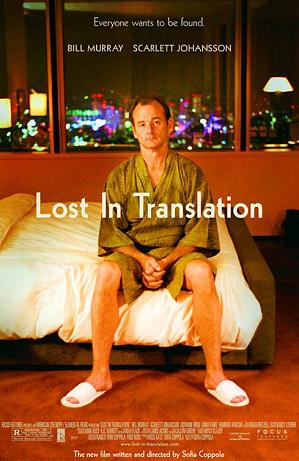
Lost In Translation (2003)

Lost_in_Translation_posterStarring Bill Murray and Scarlett Johannson with direction by Sofia Coppola, this film is set in the fast-paced, technological, and modern world of Tokyo, Japan. That is where Bob and Charlotte find themselves and they both are lost, simply going through the motions of life. He is a middle-aged, former movie star filming a whiskey commercial. She is a newly-married wife of a fashion photographer. Despite their age differences, they find out that they have a lot in common. Over the week they spend time together in Tokyo and become friends. When the time comes for Bob to leave neither one wants their time to end. They say goodbye but do not forget each other. This film was enjoyable because it portrayed two people who could be good friends without getting romantically attached, at least in the conventional sense.

I must say that this type of friendship intrigues me. It is understandable that if you go to a foreign country alone it would be nice to have someone you could at least converse with, without any barrier getting in the way. It might be at Narita airport for a moment, at a Hotel, or walking the streets of Shinjuku.  It would act as a comfort in a world like Tokyo that is so fast paced and high stress. These unusual circumstances could throw together two very different people, with little in common except the language they speak. That is something that does not happen every day.

Needless to say, after gaining the opportunity to visit Tokyo two years in a row it has given me some new insight. I can now wholly empathize with Bob and Charlotte because although I knew a few people, Tokyo is such a highly populated, fast-paced world that seems so easy to get lost and overwhelmed in. There is so much to see, so many lights, so many hurrying folks, so many subway lines, so many surgical masks, so much etiquette, and so much technology. True, some of my ancestors were Japanese but the language still baffles me, making it very easy to get “Lost in Translation.” Being in Tokyo it also helped me realize that it is not only tourists who get lost. It has been over 10 years since this film came out and a lot can happen in that time like more Starbucks and McDonalds on every corner.

Despite the westernization and technological advancement, Tokyo also has a time-worn aspect, and its people are often worn as well. They might not be lost because of a literal language barrier. However, they, like Bob and Charlotte, are often lost because they have difficulty getting close to their peers. Often they, like the two protagonists, seem to be searching for someone to talk to, but in their case manners keep others at arm’s length. Coppola’s film gained an even more personal note now that I have walked in these places and interacted with or at least walked alongside the Japanese people. They like anyone else can be “Lost in Translation,” it just might be a different type of “language” than what we struggle with. They too are humans who have their share of struggles, worries, joys, hopes, and dreams. Hopefully, this type of understanding will help us transcend any barriers so we no longer find ourselves “Lost in Translation.”

4.5/5 Stars

Whiplash (2014)

2b478-whiplash_posterIf ever there was the Devil’s incarnate, it isn’t Terrence Fletcher (J.K. Simmons), he’s probably meaner and harder to nail down. In the world of musicians, there is no school more prestigious than Shaffer Conservatory in New York and that’s where young drumming prodigy Andrew Neiman (Miles Teller) finds himself learning the ropes. Like most of the people there, music is his life and it’s what drives him. His dream is to be the next Buddy Rich. Most people don’t know who that is, but he does and that’s enough.

Nieman thinks he’s made the big time when he gets made the alternative drummer in the orchestra of conductor Terrence Fletcher, a man who seems strict, but still highly passionate about music. Andrew looks to prove himself and let his talent shine through.

He has no idea what he’s getting himself into. He watches with surprise as Fletcher tosses a member of his band out for being out of tune in a rehearsal of Whiplash. Except it was the other guy, but Fletcher feels it’s just as well since the guy didn’t know he wasn’t out of tune. Obviously, he was not a true musician.

Thus, Andrew gets a taste of this sadistic treatment all in the name of art and music. He gets a chair hurled at him. He gets repeatedly slapped for being off tempo. It becomes clear all too soon that Fletcher is a merciless two-faced monster who does everything in his power to improve HIS band at all costs. He never ceases berating, belittling, cursing like a sailor, name-calling, and inducing physical harm. He doesn’t care as long as it leads to results improving overall performance.

About this time Andrew awkwardly asks out the cute girl at the movie theater, and they share an awkward date at a 2nd rate pizza joint. It’s a cute beginning with some real promise. As far as family goes, his dad is a loving man, but Andrew has some real familial conflict with his relatives. They see his aspirations as small potatoes, and he, likewise, sees them as nobodies who are full of themselves. It’s mutual distaste.

Andrew’s education continues on an intense path when, by a fluke, he becomes core drummer. Fletcher also calls Andrew out saying he needs to practice harder, and it becomes a game of survival of the fittest. Kill or be killed. Dog eat dog. Fletcher has no sympathy or emotional attachment. All that matters is fielding the best band he can. He works his three drummers to the point of pure exhaustion, hands bleeding, drenched in sweat before Andrew finally gets the tempo right just to his liking.

He has his chance once more, but on the day of the big Jazz competition, Andrew runs into some roadblocks and since he is hardly capable of playing, Fletcher gives Andrew the boot. The enraged drummer tackles him to the floor. Days later he is expelled from Shaffer while a lawyer is also digging around about Fletcher’s conduct. Andrew reluctantly agrees to blow the whistle on him and he has to go from there.

By this point, the question must be asked. Who is truly insane here? Yes, Fletcher is a nightmare and a tyrant of epic proportions. But what drives someone to do what Andrew does? He drums until his fingers are so ripped up they bleed through bandages. He breaks up with his girlfriend Nicole, all in the name of progress in his career. Perhaps craziest of all, he continues to follow Fletcher until his expulsion. It got to the point that he was losing all touch with reality because drumming was everything. Completely blinded by obsession, spiraling further and further into the abyss that was consuming him.

In many ways, those two were made for each other, and one day they meet on the outside. Andrew no longer a student and Fletcher now fired from his position. Now they just want to play music for the sake of music. Fletcher needs a drummer for a jazz festival he is competing in and Andrew obliges because he cannot stay away from it forever. Of course, his nemesis pulls one last dirty trick, but it was out of this scheme that Andrew realizes himself as a true musical artist letting his hands lead him on an emotional Odyssey of snares and cymbals. For one instant he has Fletcher’s approval and the euphoria of the beats rushes over him. This is all he ever wanted.

Whiplash is a film that is squirm-inducing. Utterly painful and terrifying to watch, thanks in part to the performances of J.K. Simmons and Miles Teller. Teller is inherently likable and that’s what made his turn in the Spectacular Now (2013) so gratifying. His character Andrew is on the complete opposite side of the spectrum, however. He’s utterly friendless and singly-minded, geared towards one thing and one thing only. Teller proved that he could play this role, and it is purposely left ambiguous what happens next. He lost his girlfriend and he got expelled, but what are we supposed to feel for him? Pity, sadness or disapproval?

J.K. Simmons was just WOW… Director Damien Chazelle did a remarkable job and likewise the editing of Whiplash exquisitely fit the theme of drumming. It is completely on form with its frenetic fury to its merciless cutting. It will not give us a break or let us relax as an audience, underlying the generally insane tempo of this film. The name “Whiplash” from Hank Levy’s composition was perfect. Melodious but completely unnerving.

4.5/5 Stars

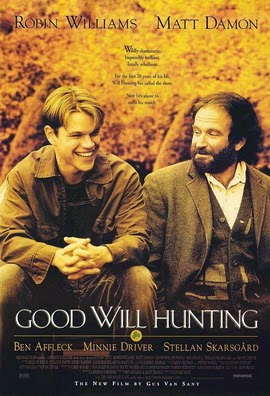
Good Will Hunting (1997)

9db12-good_will_hunting_theatrical_posterGood Will Hunting is an extraordinary story on multiple levels because it is about the little guy. The trajectory of a lowly janitor being propelled to MIT genius is moving no matter how often it gets copied or imitated. It just never gets old. Then, there is the story of two young unknowns named Matt Damon and Ben Affleck who shot to fame thanks to some big dreams and a few mentors. Now they are two of the top names in Hollywood over 15 years later and they continue to be (Gone Girl and Interstellar are proof).

However, back then they were a long shot with only a solid idea for a film. It worked wonderfully though because of its core themes. It’s about friendship. It’s about romance. It’s about fear and aspirations. It’s about vulnerability. It’s about long shots making the most of their lives. Admittedly, that could be almost any film so there’s a need to bring the microscope in a little closer.

At face value Will Hunting (Matt Damon) seems like a young thug from South Boston who loves his beer, buddies, broads, and brawls. He and his friends including Chuckie (Ben Affleck) spend their days trying to make ends meet and fill the rest of their time with the aforementioned. We get glimpses of a different Will, however, a brilliant young man holding a plethora of book knowledge and blessed with a photographic memory. He’s able to philosophize rings around conceited Harvard students catching the eyes of a cute British girl named Skylar (Minnie Driver). They are a sweet couple and it seems like it might add up to something good.

Then, comes the necessarily fateful day when Will solves the unsolvable equation on the MIT wall, following that feat with a brawl fight that lands him with a potential jail term hanging over his head. It’s a strange dichotomy and it deeply surprises Professor Gerald Lambeux who quickly realizes the unassuming genius that is Will Hunting. He’s fantastic, but in order to utilize his potential Lambeux agrees to have him meet weekly with a therapist.

What follows is an absurd string of therapy sessions where Will, who wants none of this analysis, makes a mockery of his psychologists. When Lambeux’s former roommate and last resort Sean Maguire (Robin Williams) is called in it looks like more of the same.  But he is different. He sees something more and Sean is not about to give up on the kid. Their sessions begin as a battle of wills until Will’s defenses finally break down. They construct something beautiful, something real,  and in many ways vulnerable.

It is then that Sean teaches Will about true love and living life with no regrets. He had a wife who passed away from cancer, and he is hardly a big name academic, but he wouldn’t trade his life for anything. That’s enough for him. All the while, in between sessions, Will must figure out his life whether he wishes to work in the stuffy world of academia with professor Lambeux, continue living with his chums in Southie, or move forward with Skylar who is off to Stanford soon.

Sean doesn’t force him into one decision or another but he gives him personal advice. As a young man, he met a pretty girl in a bar, the same day in 1975 that Carlton Fisk hit his famed home run. But Sean gave up his seat to spend that evening with a girl and it paid off. She would be his wife for all those happy years before she came down with cancer. In Will’s eyes, and perhaps even the eyes of the audience, he was utterly insane to pass that up, but for Sean, there were no regrets. That’s enough.

On the verge of turning 21, there are so many choices, thoughts, feelings, and fears swirling around. Not to mention Will’s ugly past as a foster kid full of abuse and a heavy rap sheet. It’s the steady and pragmatic consoling of Sean where he finds relief. Sean will not be quelled in reminding him, “It’s not his fault.” That’s simply the hand he was dealt.

In another beautiful scene that is oft cited, Chuckie tells his friend, in the most genuine way that he can, that he doesn’t want Will to stick around. Because, the reality is, Will has been given a ticket out of Boston, and it would be a knock to all of his friends if he stayed around. On the day Chuckie won’t need a note. He’ll have satisfaction enough that his friend will be gone. To this day, it still feels a tad corny, but it works within the film so I will go with it.

Down the line, Sean receives a sincere note in his mailbox and Chuckie walks up the steps to Will’s place and no one answers. No one needs to say anything because they all know Will has gone to follow his dreams. Go west young man after the girl you love and take a chance. No regrets. It is the perfect ending for this film and at the same time the most aggravating.

Robin Williams was an obvious standout in this film, and it saddens me to think that he is no longer with us. I think I appreciate him most in his dramatic roles because he is so genuinely funny it comes out organically. He is a great counter to Matt Damon. Without that dynamic, this would be a far less noteworthy film. Also, the script is full of quips and a great balance of intellectual and laymen terms making for a unique story. It takes time to acknowledge the idiosyncrasies and pain that are a reality of human existence.  That’s why it hits home. Hopefully, Will as well as all of us find what we are hunting for.

4/5 Stars