James Whale: The Old Dark House (1932) and The Invisible Man (1933)

The Old Dark House (1932)

The Old Dark House has a disarming levity that broadsided me at first. James Whale, the man who famously gave us Frankenstein, has all of his notable features with the tinges of horror on hand for another ghastly delight, and then he goes and pokes fun at the whole setup. Raymond Massey is instantly pegged as a slightly stuffy husband. His wife, dazzling Gloria Stuart, a young ingenue has signed up for more than she bargained for with the outrageous downpour dousing them in the dead of night.

Then, there’s old reliable Melvyn Douglas playing his quintessential character type, always good for a wisecrack, with his feet kicked up, and his pipe tucked in his mouth as they proceed to get hopelessly lost. And of course, he can’t help but whistle a few fractured bars of “Singing in the Rain” when their waterlogged buggy has no recourse but become semi-amphibious.

Oftentimes bathos is used as a kind of criticism — this idea of anticlimax or a break of the mood — because it’s too jokey and therefore undermines all the groundwork put down before it. However, Whale seems to be doing something different.

At any rate, it’s not an out-and-out drama and so while somehow deconstructing his tropes and suggesting to his audience he knows precisely what he’s doing, we reap the benefit of the humor and the chills in ample measure. This is the underlying success of the film in a nutshell. It carries off both and becomes invariably more intriguing in the process.

Because The Old Dark House fits seamlessly into the tradition of Cat and the Canary, Hold That Ghost, House on Haunted Hill et al. A dark and stormy night is a genre given, but the abode itself must bring with it the unnerving idiosyncrasies to make the audience ill at ease. Rest assured. It does.

The proprietors include a white-haired gentleman trembling with timidity and his eternally deaf and priggish sister who condemns all blasphemers en masse. Their valet (Boris Karloff) might as well be a grunting prototype for the wolf man. All of this doesn’t quite suggest a warm and amicable atmosphere. It screams something else. But that’s just the beginning of the festivities…

If I’m to be terribly honest, it seems like an utter waste of Karloff’s talents, especially because I was barely aware he was playing the part. He gets partially overshadowed by the more verbal characters. Charles Laughton, for one, comes tottering through the front door soaked through as gregarious Sir William accompanied by his playful and rather giddy companion (Lilian Bond). Her lithe spirit mirrors Douglas, and they gel nicely. The night quickly turns them into an item. In fact, all the guests hang together.

One could wager it comes out of necessity. It’s a ghoulish space filled with funhouse angles and other parlor tricks. Locked upstairs is a decrepit patriarch and behind another closed door is crazy Saul, who makes a cameo appearance spouting the story of King Saul and David. You know the one, where malevolence came over Saul and he proceeded to spear the other man to death.

He finds a knife and brandishes it with a kind of giddy insanity we don’t know how to respond to. He could do anything. Douglas, the picture of casual confidence and charm for most of the picture, finds his own veneer unseated filling in for David. It’s these kinds of digressions that we never expected, and somehow they make the picture by leaving the audience totally nonplussed.

By the time The Old Dark House is wrapped up, it feels like the gold standard of this brand of haunted house movie because it’s just as much about being a mood piece — finding humor in these outlandish scenarios — and Whale does all of the above with assured aplomb.

4/5 Stars
The Invisible Man (1933)

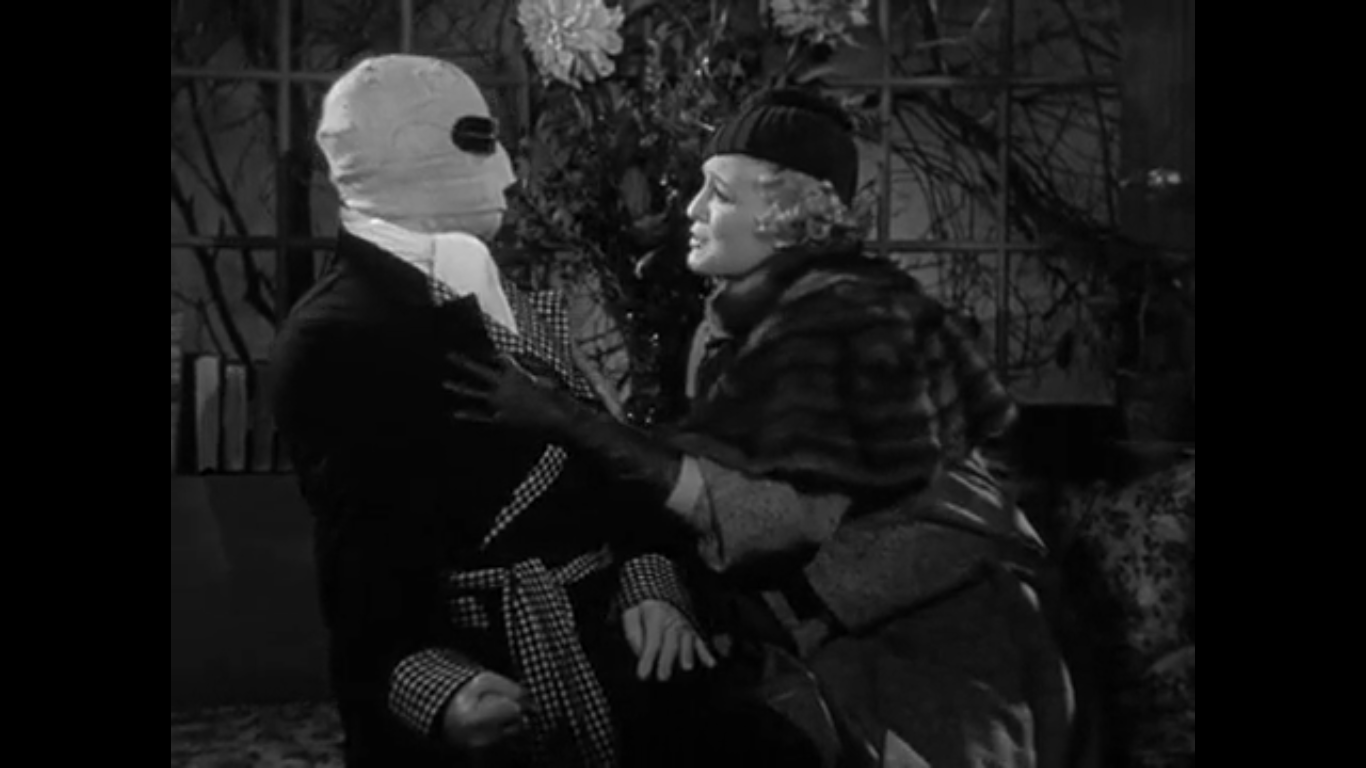
I always thought about The Invisible Man as a scientific marvel, but now I understand how he’s firmly planted in the realm of horror with added superhuman abilities. There’s something that feels somehow modern about Claude Rains’ portrayal of the eponymous character. It’s almost as if he’s the precursor to some enigmatic alien creature from Star Wars.

He’s unique and out of step with this more traditional setting of a bar and lowly establishment as local folks chew the fat and the incomparable Una O’Connor runs the place. One feels quintessentially British, albeit through the prism of the Hollywood dream factory. Rains is totally a movie machination born of smoke, mirrors, and special effects.

But it’s also as if this camouflage provided Rains the means to give one of his most ballistic and volatile performances. It’s not that he couldn’t play, wry, sly, or even bad-tempered, but his typical onscreen disposition was one of regality. He commands the room but in a very different way.

He’s seething one moment and then hysterical the next. The local constable rightly asserts, “He’s invisible. He gets those clothes off and we’ll never catch him for a thousand years!” It makes the stakes obvious. Soon thereafter the maniacal doctor commences a reign of terror making good on his threats by committing murders and diverting trains off their rails. He makes it clear he has the power to make the world grovel at his feet.

If it’s not obvious already, he’s taken on the mantle of a violent “Superman” cut out of the cloth of Dostoevsky’s Raskolnikov. What’s worse, there seems to be no one capable of stopping him.

What’s most fascinating is how the film builds the legitimacy of the Invisible Man. It’s not merely a sitcom-like trope where the invisible are given the freedom to pull practical jokes or take on a Groundhog Day-type disregard of worldly conventions. This is part of it, yes, until it becomes something more.

It turns into a story of fear and broader social implications broadcasted over the news and through every small town by word of mouth. He’s continually left unchecked and the drug he’s taking pumps him full of delusions of grandeur. It’s a drug and addiction of a different sort. Not even the affection of his former girlfriend (Gloria Stuart) can change his mind. He’s too far gone.

The special effects and the choreography get better and better as a crowd of bobbies forms a human dragnet to converge on him in the dead of night. He skips away with a policeman’s trousers sowing chaos and discord wherever he goes. But before anyone gets the idea The Invisible Man is a mere lark, we’re quickly shocked back to reality.

It has a jagged edge of vindictiveness which the production codes would make sure soon enough would never see the light of day (at least for a good many years). For now, it feels like a chilling, compact drama chock full of ideas, invention, and not a wasted minute of running time. It’s also without a doubt Rains’ finest entrance in a movie: It happens in the final frame.

4.5/5 Stars
Waterloo Bridge (1931): Pre-Code Edition

Screenshot 2020-01-11 at 82932 AM.png

Many might best remember Vivien Leigh and Robert Taylor in the 1940 version of Waterloo Bridge. It’s immediately obvious this movie has a very different flavor from the outset. It’s an earthier more boisterous version of Waterloo Bridge before the Production Codes took their axes to the original material.

James Whale’s camera pans across a gay gang of chorus girls on the stage — they are alive and bursting with perky energy — putting on a show for their patrons. Behind the curtains and after-hours, the girls maintain the buzz as they chat in their skimpy Pre-Code attire. One of their ilk is Myra Deaville (Mae Clarke).

It’s delightful how the camera takes such a shine to our heroine though it’s so obvious to see she might play second or third fiddle to the band of big wigs and aristocrats in the world at-large. She really does feel like a nobody far away from home. Still, there’s something to be said for her way of life.

As is, London has a lovely artificiality that we can breathe in and still enjoy as the characters amble along the streets with car horns and horse carts to go with the post boxes and street lamps.

Likewise, the beats feel raw and unkempt in a way the 1940 remake would never have dared or been capable of to begin with. Somehow it takes on a grander more chaotic scale in the hands of James Whale. And yet the characters and vernacular are more casual even familiar.

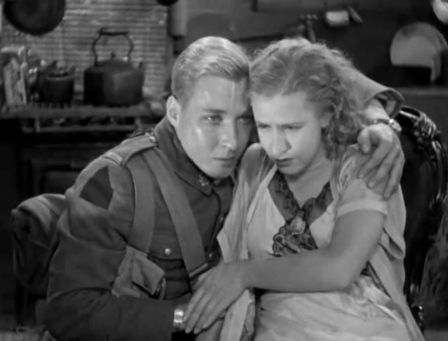
Douglass Montgomery feels like an honest-to-goodness callow soldier boy. He doesn’t have the slightest sense of what he’s gotten himself into and with anything he does, there’s a latent fallibility you don’t get with Robert Taylor. He never feels endangered in the same way.

Likewise, Mae Clark is affecting yet generally capable of exuding an everyday ordinariness. We hardly remember her star compared to the likes of Vivien Leigh, who headlined one of the most grandiose, decadent epics of all time. Their trajectories and legacies could not be more disparate This is just the film to raise her reputation above one crackerjack scene playing opposite James Cagney and a Lemon.

She’s no star (the film coincidentally features a young Bette Davis), and the story seems to like it that way. Because both Clarke and Montgomery, by today’s standards, are hardly highly touted figures, but somehow they fit so genuinely here within the provided context.

It’s a youthful dynamic with a 19-year-old doughboy and the dance hall performer who’s been around. She also carries the forlorn look rather well even as Montgomery’s face is fresh and boyish.

They meet helping an old lady pick her potatoes off of Waterloo Bridge. It’s the same air raid from the earlier film with a certain frenzied uncertainty of war in the atmosphere. The gas runs out in her shabby apartment, and they talk to each other about their lives, mouths crammed with food.

It also cultivates a different dimension of ex-pats away from home. Because both Roy and Myra are born and bred Americans, and so there’s this inherent otherness they engender. It’s the type of visible difference that makes it all the more believable they would gravitate toward one another.

Furthermore, the film is not just consigned to the urban cityscapes but finds its way out into the countryside far from the signs of tumult and war. Because whereas the later version had the reverie of dance and “Auld Lang Syne,” this version needs its own escape valve, a respite before the final act’s guttural finale.

Here Myra is thrown in with Roy’s mother and an avuncular old step-father, hard of hearing and loving a good whiskey and soda. He’s a puttering scene-stealer — mostly because Bette Davis has nothing of import to do as an amiable sister. Her time would come in due time.

Meanwhile, the drama goes on behind the scenes as Myra is a woman of such genuine conscience — she admits she picked Roy up on Waterloo Bridge — she is no chorus girl. Though she could marry him, she chooses not to. She understands the mores of society and is willing to abide by them, even when it hurts.

You can call it the hooker with the heart of gold archetype to be sure, but what it really brings out is a culture so quick to label people as pariahs and outcasts — dirty and sinful folks not fit to be seen with the rest of God-fearing humanity. Then, behind closed doors, there’s gossip and what-have-you in the guise of propriety.

In the end, between passionate kisses, a crowded truck of onlookers shipping out to the front, and zeppelins raining down incendiaries, there’s not a moment to breathe before the curtain falls. This might be very well by design. Still, this movie zips along with a raw vitality worthy of consideration.

3.5/5 Stars

Show Boat (1936)

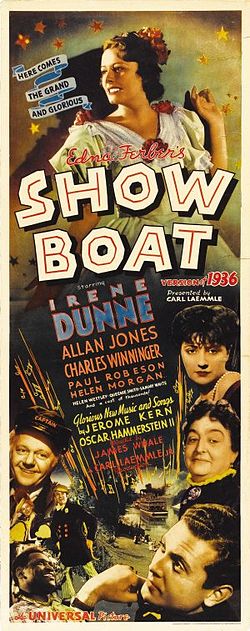
ShowboatposterMost of what I know about riverboats can be gleaned from Mark Twain, Davy Crockett and the River Pirates, and that ever beloved Snoopy incarnation The World Famous River Boat Gambler. The 1936 musical Show Boat falls into that very same rich tradition but some clarification is in order.

In truth, this is not the most remembered or even the first adaptation, for that matter, of the wildly popular stage hit of the 1920s. Those laurels go to the 1951 version starring Kathryn Grayson and Howard Keel and then the original partial-talkie released in 1927. But it’s easy to go out on a limb and reckon this is the best of the lot.

James Whale noted for such reputed monster movies as Frankenstein and The Invisible Man proves an equally compelling helmsman of musicals. Here his obvious attention to period authenticity is highlighted making the riverboat world of Missippi circa the 1880s incredibly atmospheric.

The story starts exactly where its title suggests with a Show Boat and the traveling crew of performers who turn up in every town to add a little gaiety and charm into every man, woman, and child’s life. The personable mastermind of it all Cap’n Andy Hawks promises big things to the general public who turn out in droves to get a chance on the entertainment.

But as is the case with any such narrative the true meat and potatoes is either on the stage with every song and dance or behind the curtains where people are living life and trying to get by the best they know how. Hawk’s wife is constantly nagging him and demanding that their daughter never become an actor. Instead, young Magnolia (Irene Dunne) is relegated to sit behind the piano.

Still, there is another plot thread with major implications on the contemporary constitution of race relations. I personally had no idea what was at the core of Edna Ferber’s Show Boat. I assumed it was only a musical perhaps bred in the rather sorry tradition of Gone with the Wind and other such pictures when it comes to depictions of African-Americans.

It’s true that there are some of those stereotypes present but this is a surprisingly forward-thinking narrative at first because at its core is miscegenation–in simpler terms the marriage of a white man with a woman of color. The two tragic lovers are actually depicted in a sensitive light while at the same time giving Magnolia her break with their sudden ignominious departure in the midst of the public scandal.

Still, in this small way,  it’s not unlike Ferber’s later work Giant in how it begins to dissect the hypocrisy in society. For his part, singing giant and future blacklist casualty Paul Robeson’s epic rendition of Old Man River is one of the true capstones of the film imbuing the story with even more meaning and power. For another minor instant, it seems like the point of view of the downtrodden and marginalized is, at the very least, being acknowledged and given a place of significance. as if to say even for a split second that there are dignity and worth there.

Of course, it loses all the credibility it could have in one regrettable stage number where the happy notes make the blackface feel even more abhorrent. Though I have no major qualms enjoying this movie on a whole, any discussion must come with a substantial caveat.

In its second half, Show Boat does admittedly succumb to some pacing problems hitting its peak early on and slowly dropping off from its frenzied and energetic openings to more wistful conclusions that are understandingly less diverting even purely from a tonal perspective. It seems to even acknowledge its own weaknesses by condensing decades for the sake of time and the audience’s attention span.

It all began with lively commotion, spirited passion, and young love. In the end, it settles for a sentimental reunion of two lovers torn apart by destitution and time itself. It’s a lovely feel-good conclusion but it’s not nearly as satisfying as it could have been if Show Boat had kept its steam from the starting gates.

Though this is far from being Irene Dunne’s greatest role, she still gives a winning performance that memorably showcases her vocal training opposite her romantic co-star the rich-toned tenor Allan Jones.  As a side note, she also exhibits the most unique churning dance you’ve seen rather like a caterpillar in a dress–only surpassed by Lauren Bacall’s shoulder shimmy in To Have and Have Not.

Still, Paul Robeson stands as one of the titans of this film. I hope he got the respect that he deserved for this role and if nothing else time seems to have honored him as “Old Man River” still remains one of the great musical numbers out there.

4/5 Stars