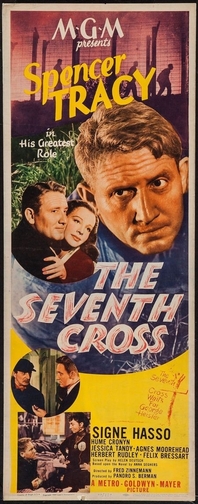
 Fred Zinnemann had one of his first Hollywood successes with the daring Seventh Cross. Since he was Austrian and lost family to the concentration camps, the personal nature of the material is unquestionable. He takes the novel by fellow Austrian emigre Anna Seghers and packs the story full with a wealth of European emigre actors and a few choice Americans as well. What it delivers is a stirring testament to humanity and the joining together of grit and determination in the face of oppressive evil.
I actually don’t mind Spencer Tracy playing the lead in the picture because it has the Hollywood bent of the studio system. Like casting James Stewart as a Hungarian in The Shop Around The Corner, there’s a collective understanding that Tracy’s attributes, as a kind of grounded everyman, are what matter most. It helps make this very specific and personal story a universal story for all men to see themselves in.
He is one of seven prisoners who make a nighttime escape from a Nazi concentration camp. As they all break off from one another and go their separate ways, we know the goal is the active pursuit of survival in a malevolent world. There’s nothing more fundamental, and we walk alongside George Heisler as he searches out any old friends and his former flame, who might be able to help him in his dire need.
Meanwhile, all the other prisoners are mercilessly rounded up and hung up on the crosses erected by the camp commandant; they are meant to be a warning sign to anyone else, but everyone knows the inherent metaphor. They are martyrs to the cause like the thief hung next to Christ. There is hope that they will one day see paradise.
The story utilizes a dead man’s voiceover before Billy Wilder took the device for Sunset Blvd. Here it feels a bit more like a crutch to distill Anna Seghers novel down; he lives as a ghostly subconscious entreating Heisler to remember the address 46 Morganstrasse…
At its best, the movie becomes a lyrical pilgrimage for this character as he’s privy to the kindness, passivity, and utter heartlessness of common people, each in turn. Because at your lowest, when you have nowhere to go and you rely solely on the good graces of others, this is where their true nature becomes evident.
I can see Classic Hollywood films, taking on Nazism, being derided in a modern context for going too soft, especially if you have a preconceived notion of what they might be. Certainly, these artists didn’t know every atrocity that had been perpetrated, but they were not stuck with their heads in the ground. In many cases, they knew far better than the general American public.
There’s immense consequence to everything within the frame, and Zinnemmann brings many searing evils to the screen, both seen and unseen. The aforementioned cross imagery is bleak iconography borrowed from Seghers. There are little boys with Nazi armbands rumbling around town to try and tattle and find fugitives.
One of the runaways, a formerly famed trapeze artist, must flee across the rooftops as locals gawk at the show and the Nazis hunt him down like cornered game. He takes one final curtain call after being mortally wounded and leaps forward in total serenity. It’s his final performance with his last breath. Heisler watches the scene, and before catching the ending, he disappears around the corner grimly.
His former flame Leni (Kaaren Verne) vowed to wait for him, but now she’s married and terrified to see him. The fear in her eyes manifests itself in brusque accusations. He has nothing but fondness for her; he’s requesting food and accommodation, and she will give him nothing. He stuffs a few crusts of bread in his pocket and disappears, feeling totally betrayed.
There’s another particularly unnerving scene. As the dragnet closes around George, he gets a tip about a doctor who might be sympathetic and can bandage him up for a wound. He pays a call on the man. Dr. Lowenstein (Steven Geray) states in accordance with the law that he must tell his patients before working on them that he is Jewish.
There might be other contemporary cinematic depictions of the Nuremberg laws or other anti-Jewish legislation like this, but the mundanity of this institutionalized prejudice is like ice in the veins. It’s right there in the open and in the face of this, the doctor still chooses to do an act of good.
Our hero is graced by another generous soul when he’s put up in a Hofbrau on his perilous road to freedom. By now, his name and likeness are all over the papers; Toni (Signe Hasso) the barmaid, could turn him, and yet she doesn’t. They share the kind of solitary love story that exists suspended in movies or those real-life moments where there is no time to stop and think before two ships pass on in the night.
George Macready even gets one of his first opportunities to play a conflicted, if ultimately sympathetic man caught in the crosshairs of the war and his own personal comforts. It takes all kinds for the sake of the cause.
Hume Cronyn shows up over halfway into the movie, and he is our respite. Paul Roeder might have the first genuine smile in the entire film with his domestic life alongside his wife, Liesel (Jessica Tandy), being a refuge from the hopeless world at large. He treats George well, symbolizing the growing tide toward human decency.
What he also represents is another viewpoint. The movie has the right to paint the Nazis as villains, and yet it does present a German character like Paul, who has been mostly shielded from the horrors.
What he sees is the economic prosperity and the help he’s received as he goes about providing for his wife and caring for his kids. The government has done good by him, and this is what he holds onto. George must help him see the other side and bet on the human proclivity toward good, even if we must forgive how easily Paul gets away from SS interrogation.
For being a film with so much grief and oppression — even if it’s fashioned on a Hollywood backlot — the movie does ring even more resolutely with this affirmation of human dignity. Instead of labeling it mere naivety, I prefer to see the optimism as represented by Paul and the little people.
Felix Bressart has the briefest cameo as the local delicatessen owner who brings George sustenance for the long journey ahead. Like his Shylock speech in To Be or Not To Be, he comes to signify the entire picture with his resolute encouragement. He doesn’t know the man, and yet he extends this generous hand; he’s just one of the faithful worker ants who will not let goodness die. Together, they can overcome.
What the film does well is distill these sentiments into individual human interactions we get to observe and imbibe as an audience. So although we are not completely inured to the state of the world, we are not blinded to it either, like Paul.
In 1944, there was still much of the war to be fought and won. Thus, The Seventh Cross does feel like a daring picture and one with immeasurable worth. I’m not sure if it was appreciated in its day, but looking back on it, there is much to admire in its incisive self-awareness.
3.5/5 Stars
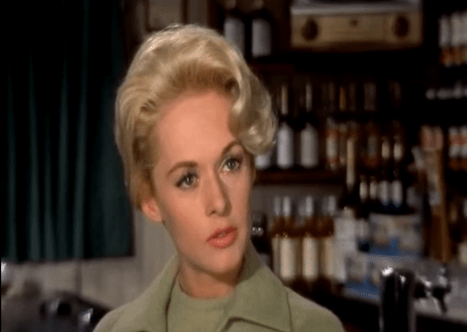 The Birds is about all sort of birds. The ones we are acquainted with initially are actually a pair of humans. Lovebirds you might call them. Except they don’t know it quite yet, but the moment Melanie Daniels (Tippi Hedren) and Mitch Brenner (Rod Taylor) meet in a pet shop, the sparks are already flying — the birds too.
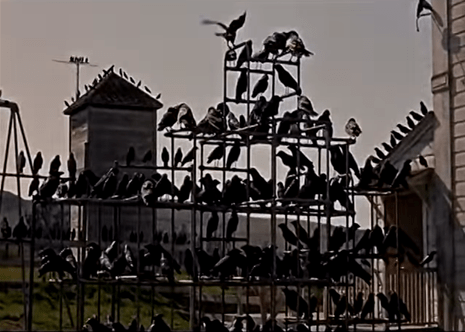 Most assuredly, the film benefits from long stretches of wordless action. The most striking example involves a murder of crows gathering on a jungle gym near the schoolhouse. Never before was the name of their posse more applicable. And while the narrative lacks a true score, the unnerving screeches from the birds is sound enough to send chills down the spine of any audience.
 4 Star Films