Shield For Murder (1954): Edmond O’Brien Gone Bad

In a movie like 711 Ocean Drive, Edmond O’Brien proved himself capable of being a cad over the course of his performance. With Shield for Murder, there’s no buildup or pretense. He establishes himself as a stone-cold killer right from the outset before we even get a peek at the credits. It’s a tough, uncompromising introduction and to his credit, he sells out to make his role of Barney Nolan one of his most memorable.

Having seen a decent number of his performances, I consider this a compliment because more often than not, he turned in spirited even gamely performances. Whether starring in B-grade features or supporting in A-listers, he had a knack of bringing something enviable to his parts — something you don’t soon forget.

In Shield for Murder, he’s a veteran cop with 16 years on the payroll. One of his colleagues (John Agar) is the first to the crime scene, and he gives Barney the benefit of the doubt because he owes the man his life. In truth, he idolizes him, and for very good reason. Barney’s the man who picked him off the street as a boy and straightened him out. You can’t just overwrite that history in a matter of minutes.

For the time being Barney is in the clear. After all, he’s on the side of law and order. At the police precinct, Emile Meyer brings a level-headed, no-nonsense stability to the role of the police chief. An in-office journalist provides a worm’s eye view of life inside the station’s walls. Being a veteran on the beat, he holds a jaundiced eye and remains skeptical of the crooked cop when everyone else believes in his integrity.

If noirish pictures require corruption and duplicitous activity in the shadow hours, then there also seems to be a prerequisite for female counterparts. The way the camera lingers over a scantily-clad Marla English looking herself over in the mirror almost feels indecent. It’s like another leering face.

What it does do so effectively is create a kind of instant juxtaposition. Because Patty Winters is the picture of innocence. English who was only 19 at the time, has such a warm face and this moment suggests a hint of insecurity more than any amount of vanity.

When we find out that she’s Barney’s girl, suddenly, their attraction fits together, and we can understand how they gravitate toward one another. They both hold something that the other does not. Even as her jealous beau orders her to give up her spot as a cigarette girl, he whisks her away to a model home.

Barney shows it to her proudly. It’s pre-furnished and the kitchen is full of all the latest appliances for modern living. They go to the master bedroom. It’s almost scandalous again, but they are so genuine and happy. This is the very evocation of the 1950s American Dream in suburbia. While he’s not rich, he’s a proud man. The money he acquires and buries on the premises are so he can take care of her. Never mind how he got it.

And yet that’s just it. If the pre-credits are like a violent sock to the gut, providing a first impression of this man, then all the humanizing events that follow cannot totally redeem his character. Surely there is a sliver of good in him. He hasn’t always been this way, but there’s also a sense it cannot make up for his sins.

First, it’s the bookmaker he shoots in the back. Then, it’s the deaf and mute witness left for dead on the stairs. These moments punctuate the story, and they act as staves between Barney and his friends. He’s driven away from them — holding secrets from them out of necessity.

In one memorable extended scene that feels a bit like an aside, Barney sits at the bar downing drinks. There’s a platinum blonde sitting nearby, who doesn’t speak for a moment. Carolyn Jones plays the woman, and she’s an effective foil for Patty — an alternative for the moment. They share a Spaghetti dinner, except Barney isn’t hungry. Instead, he pummels the two tails a local kingpin has set loose on him and leaves the family joint in a shambles.

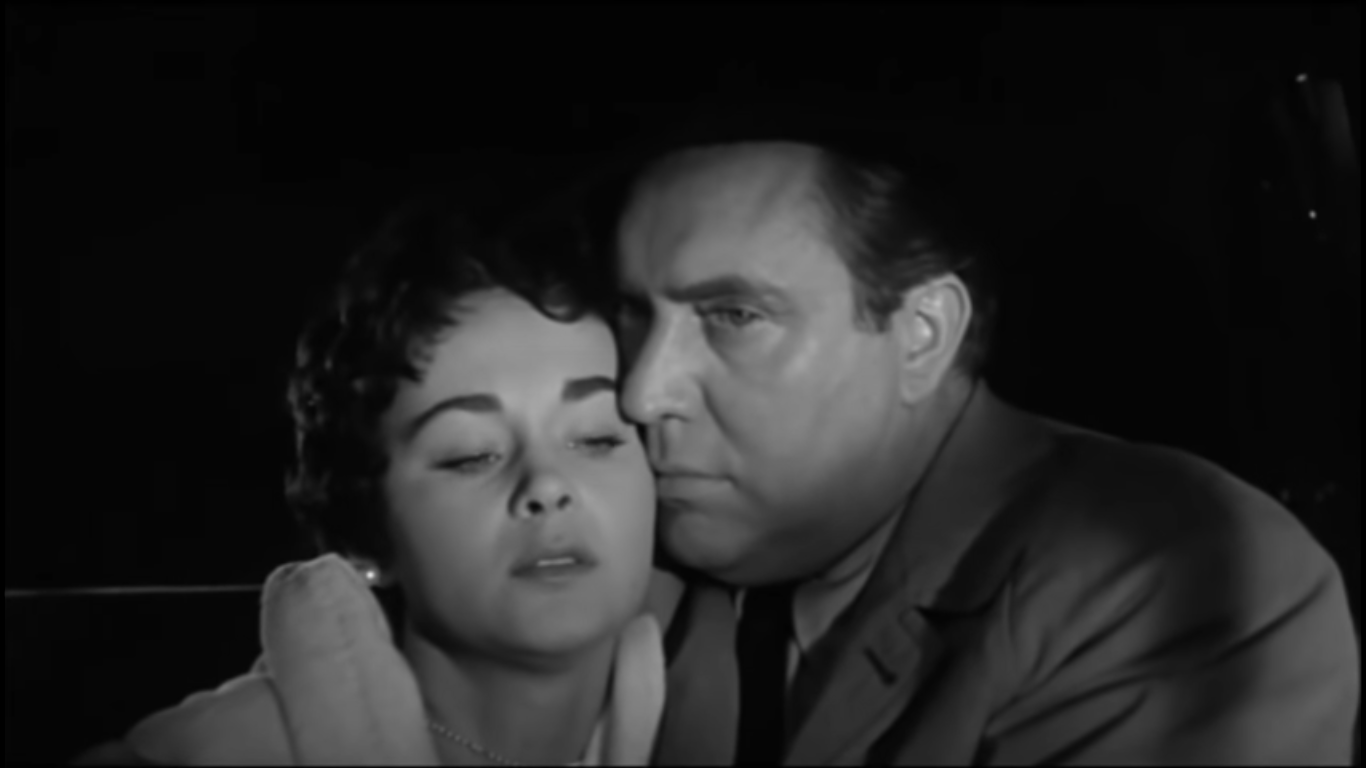
The final act can only go one direction, and it’s the road of devastation. He becomes a wanted man on the run from his own colleagues, and the man leading the investigation is his best friend; no matter how uncomfortable the current situation , it cannot be any other way. It’s too late. Out of desperation and fear Barney wants to take Patty away. She doesn’t recognize the gravity of the situation. She becomes emotionally traumatized as he flees the scene.

Everything choice going forward only buys him more time. He dons his old policeman duds as a disguise. He seeks refuge with Richard Deacon, who’s hardly the criminal type. He’s busy poring over his academic textbooks as the desperate cop looks to broker a trip out of the country.

I’m pleased to say the finale actually works a bit better than the crescendo of 711 Ocean Drive, if only for the fact it localizes the action and makes it more accessible to all of us. We are able to understand the threat of the gunfight in such an intimate and ordinary setting. He has it out with a gunman at the Union Heights indoor swimming pool in a sea of shrieking bystanders.

But he must make it to his money at all costs. These final solitary moments we have with him totally crush any idealistic notions of the great American dream in post-war society. It blasts a hole right through the entire thing.

While Shield for Murder is blunt in its symbolism, there’s something rather poetic, even fitting, in how it chooses to wrap up the tragic trajectory of a cop who’s gone sour. He’s the good man — formerly a straight arrow — who watched his dream crumble around him. We see it firsthand. It’s brought on by his own aberrant desires.

However, thanks to O’Brien, it has everything you expect, nay demand, in a gritty crime picture totally immersed in murder and corruption. When the end titles come, they feel earned like the movie has delivered on the fatalism we want. There’s little that pretty or polished about it, and in the annals of noir that’s more than a good thing.

The star makes it more than worth the price of admission (especially in the 1950s). There’s probably not a sweatier protagonist, and in a noir film that plays like yet another compliment. He makes us feel his anxiety as well as his deceitfulness.

3.5/5 Stars
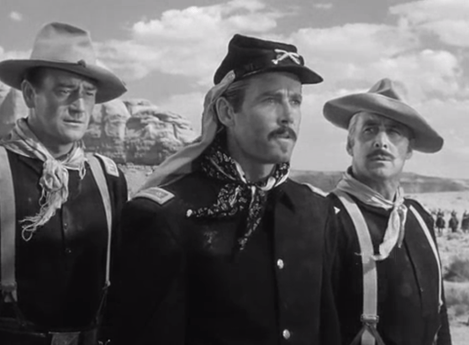
Fort Apache (1948)

fort apache 1.png

Fort Apache gives me the opportunity to consider one of John Ford’s most unlikely long-term collaborations with film critic turned screenwriter Frank S. Nugent. As with all Ford partnerships, it was oftentimes prickly but there’s no repudiating the impact. However, even the writer realized how improbable it was he would have such a hand in mythologizing the West alongside one of the great American masters. Nugent noted the following:

“I have often wondered why Ford chose me to write his cavalry films. I had been on a horse but once—and to our mutual humiliation. I had never seen an Indian. My knowledge of the Civil War extended only slightly beyond the fact that there was a North and a South, with West vulnerable and East dealing. I did know a Remington from a Winchester—Remington was the painter. In view of all this, I can only surmise that Ford picked me for Fort Apache as a challenge.”

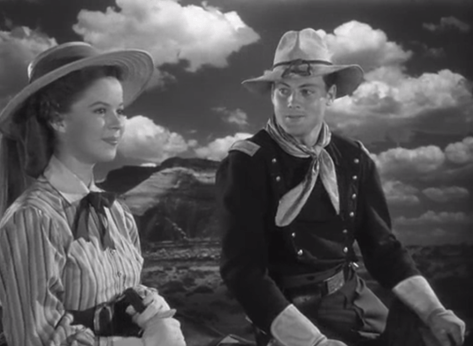
The picture opens with a particularly acerbic and icy Henry Fonda as Owen Thursday, newly assigned to the cavalry outpost at Fort Apache. One could make a wager each of Fonda’s characterizations in everything from You Only Live Once to The Ox-Bow Incident and even My Darling Clementine all culminate right here. Though he’s dismissive of the assignment, Thursday is nevertheless intent on upholding his duty. He rides along the bumpy roadways with his teenage daughter Philadelphia (an effervescent Shirley Temple) who is simply glad to be by her father’s side.

To understand the picture, it’s useful to know Nugent developed extensive bios for every character to flesh out who they were exactly. We have John Agar in his screen debut starring opposite his new wife in real life (Temple) and playing the newest commissioned officer to the fort, Second Lieutenant Michael O’Rourke.

fort apache 3.png

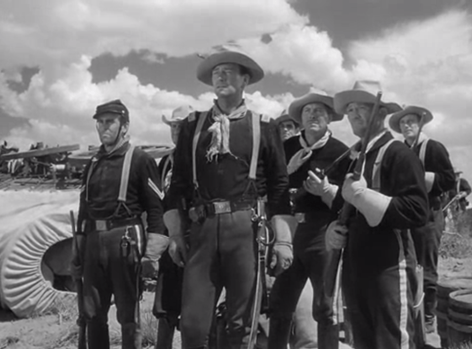
Life as a cavalryman proves to be a family affair and one clan has an especially substantial presence in the camp. The Lieutenant’s father (Ward Bond) is stationed there too with his mother, the older man serving as a Sergeant Major. Meanwhile, many of the veteran soldiers provide a close-knit community including Sergeant Festus Mulcahy (Victor McLaglen) who has been a lifelong friend to the O’Rourkes. Here we see Irish-American blood flowing through the picture as Ford heralds his own ancestors part in this historical landscape not only during the Civil War but long afterward. The pride in this shared culture is undeniable.

For most of its run, Fort Apache is the epitome of character-driven drama. Nugent’s meticulous character development overlaid by Ford’s own distaste for expositional dialogue provides the groundwork for yet another story operating in vignettes more than anything else. At any rate, the dialogue comes off clunkily at times while the romance between Philadelphia and Michael O’Rourke begins to blossom.

However, with her father adamant against such a union and astringent in all manners of his command, it causes an instant riff in the camp. One of his finest lines comes with inspecting his officers and noting, “The uniform is not a subject for individual whimsical expression.” He expects everyone to abide by the letter of the law and his unswerving personality is glacial on all accounts.

Meanwhile, the old reliable guard has fun with the new recruits. Among their ranks, rather unbelievably, is the veteran character actor Hank Worden. Then, the community of wives and sweethearts led by Mrs. Collingwood (Anna Lee) and Mrs. O’Rourke (Irene Rich) look to help Philadelphia make a home for herself. John Wayne is in the picture as well though he takes a decidedly secondary role as Captain Kirby York, striving to work under Thursday’s guidance with as much obedience as he can muster. However, the final act is Wayne’s as much as it is Fonda’s however.

It hardly needs to be said at this point but Monument Valley is awesome. Watching horses streak across the plains ferociously kicking up storms of dust never grows old. Nor do images of Wayne and Pedro Armendariz perched on a towering rock formation taking in the view. You can’t make this stuff up. The beauty is majestic as only natural topography can be without input by human hands or CGI — the way it was probably meant to be photographed.

There’s the impending threat of Indians making their way south. Telegraph lines are down again. So a visit is paid to the scruffy horse trader who is quite conveniently liaison between the American Indians and the government within the territory. Despite his contempt for Meacham, Thursday will not do anything about him nor does he attempt any diplomacy with the belligerent Cochise. He decides instead on the executive decision to make an all-out charge on the Native Americans forces who are waiting, guns cocked and ready.

fort apache 2.png

In the waning moments, Fort Apache becomes a more fully-realized, even emphatic indictment of recalcitrant and bluntly antagonistic leadership. Thursday holds a very entitled station — whatever he says, he says on behalf of the United States government — and no one else can say anything otherwise. What they do protest he backs up with regulations, honors, and code of conducts that might as well bury everyone.

Instead of addressing any area of compromise as minor as it might be, there is a straight and decisive path cut through any issue. They ride toward their inevitable deaths. The final bugle sounds for charge and yet it’s hardly a battle, target practice is more like it, and the horrifying thing is most everyone knows it going in. But when a man such as Colonel Thursday holds the reins you reluctantly cave to his demands lest you be clapped in irons for insubordination — even when the decisions are near lunacy. York is the one man brave enough to stand against and lives to fight another day. Many others are not so lucky

If Custer’s Last Stand was anything like this, it makes complete sense and simultaneously becomes an even more terrifying piece of history. In what might be called an early precursor to the glorification of a hero’s legend in The Man Who Shot Liberty Valance (1961), much the same treatment is provided here for the far more dubious Owen Thursday. Once more Ford’s picture is able to get at this obvious discrepancy by pulling away and looking at the story from those folks who canonize history for all posterity. It’s oftentimes the newspaper men who are afforded that privilege. Whether their effusive praises are in order is another matter entirely and by the end, Ford Apache is a sobering portrait. It comes so far from seemingly homely even jovial roots within the compound.

So many lives were needlessly sacrificed so one man could be heralded a legend. The frightening thing is that Thursday was not a mere glory seeker; he fervently believed what he was doing was in the right. That kind of dogged methodology proved itself highly pernicious when no thought was given to discretion of any kind. It’s simply blind execution of duty. Whether it evokes Kant or not, I cannot help but think of one of the most famous examples of this in Adolf Eichmann, acting as a lowly Holocaust architect, who nevertheless proved the consequences of such a philosophy.

The dark horse of the Ford pictures, Fort Apache begins as one beast and comes out quite a different animal by the end. It so easily gets sidetracked, distracted, and lulled into different scenarios and there never is a true sense of urgency to keep the picture moving toward an obvious conclusion. Still, in the end, we get the finale and it’s unnerving as both a commentary and another projection of the mythical West. Somehow Ford stitches it together as a two-edged sword of both indictment and a moving paean to those passed.

4/5 Stars