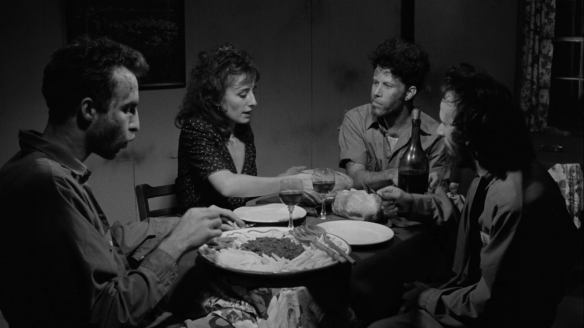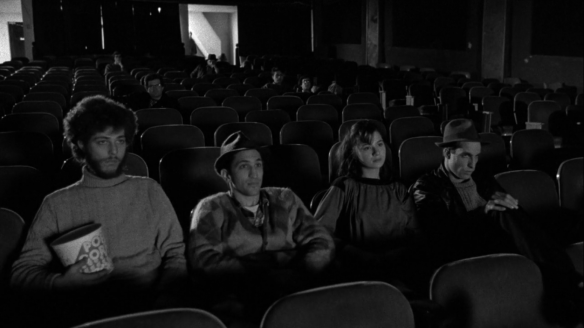
Mystery Train (1989)

I hold an immediate affinity for the images at the core of Mystery Train: A Japanese couple (Youki Kudo and Masatoshi Nagase) riding a train. This is the ’80s so they’ve got a walkman with an audiocassette tape, and it’s blaring Elvis! It becomes apparent they are making a pilgrimage to Graceland so famously immortalized by Paul Simon. The song “Mystery Train” becomes an apropos and uncanny way to enter the story while paying homage to the King.

Jim Jarmusch always strikes me as such an open-minded and curious filmmaker. Modern society speaks in terms of diversity and inclusion, but the beauty of watching a Jarmusch picture, it’s the fact he’s not looking for these things in order to meet some quota. He seems generally interested by the stories and perspectives a whole host of characters can provide him, and his films benefit greatly from this enduring proclivity.

Regardless of where the funding came from, who else would consider making a film about two Japanese youth in search of Elvis Presley in the 1980s? They spend the first several minutes speaking a language that the primary audience probably does not understand. They likewise are bewildered by a upbeat yet motormouthed docent at Sun Records. Still, somehow shared passions for Carl Perkins, Jerry Lee Lewis, Roy Orbison et al., draw them together in inextricable ways.

There’s something perfectly fated about the whole thing with Screaming Jay Hawkins as a rather flamboyant hotel clerk aided by a youthful bellhop (Cinque Lee). I don’t know how to describe it but Hawkins has a command or a sway over the picture rather like Wolfman Jack in American Graffiti. His presence is felt and becomes so indelible in accentuating an aura. He comes to represent a certain era and a place in human form.

Jarmusch’s characters of choice often feel like sojourners, strangers in a strange land and Memphis is such a place. It is a film that features degradation — cracked pavements, garish neon lights, and portions of the world that are not perfectly manicured. What a concept. It’s almost like Jarmusch is giving us the real world albeit composed through his own cinematic lens. It’s no coincidence it has this kind of baked-in glow of Paris, Texas another film of geographical Americana captured so exquisitely by Robby Muller

It’s only a personal observation but my level enjoyment slightly decreased with each descending story. As someone who journeyed in Japan and went to one of the greatest concerts of my life in Yokohama, I feel this kind of kinship with these Japanese youths in their pilgrimage to Elvis and Carl Perkins. Also, on another level, this is a point of view we just don’t often see in movies of the 1980s or even today. Jarmusch is not using them as some kind of stereotypical punchline. He’s genuinely interested in their story and allowing it to play out in front of us.

Then, there’s Nicoletta Braschi in part two. She’s told a ghost story by a dubious stranger and gives him a tip to be left alone. She too seeks asylum for the night at the same hotel and gains a chatty roommate (Elizabeth Bracco) who is linked to our final vignette.

This last interlude with Steve Buscemi feels like it exists in the time capsule moment of a certain era where Tarrantino, the Coens, and others were making these stylized, often grotesque comedies. Elvis (Joe Strummer) gained his nickname inexplicably, but he’s also started to become unhinged because his girlfriend went up and left him. The cocktail of booze and firearms make his buddies Charlie (Buscemi) and Will Robinson (Rick Aviles) uneasy. Although it feels more like an absurd episode of The Twilight Zone than Lost in Space.

Regardless of my own preferences, Jarmusch still gives his world a sense of purposefulness. Again, it’s this serendipitous quality reminiscent of Jacques Demy’s fated films where lives cross paths and intersect in deeply poignant ways.

There’s something somehow elegant about the structure. It’s certainly premeditated and Jarmusch purportedly was inspired by classical literary styles in constructing his triptych, but it’s also a genuine pleasure to watch it unfurl.

The movie revolves on the axis of a few shared moments and places: A hotel, a radio DJ (Tom Waits) playing “Blue Moon,” and a gunshot. But it’s not like they’re all building to some kind of collective crescendo; it’s more so just a passing indication of how lives, whether they mean to be or not, are often interrelated.

Characters orbit each other and interact in these preordained ways that reflect the mind of the maker, in this case, Jarmusch. There’s something oddly compelling and comic about it, but there’s simultaneously a sense of comfort. We have order and a kind of narrative symmetry leading back out from whence we came.

Jarmusch is calling on the poetry of the ages and so in a movie that seems to have a free and laissez-faire attitude, there’s still a very clear order behind it, three distinct threads end-to-end and yet still interwoven into a tapestry that we can appreciate. Mystery Train represents the best in cinematic storytelling — with purposeful composition and aesthetics — but also a sense of aura and inscrutability.

It’s funny and yet when it’s over there’s also satisfaction and a hint of wistfulness. I wish there were more of its ilk today. The movie that’s come the closest is Paterson — another modern jewel from Jim Jarmusch. I see that film in a new light as a much older, wiser, and more forthcoming Masatoshi Nagase sits down on a bench with Adam Driver.

Again, it is a story about the human journey, how we are all travelers in some sense, and what a beautiful thing it is to relish the road because it can lead us to so many beguiling places if we take the time.

4/5 Stars
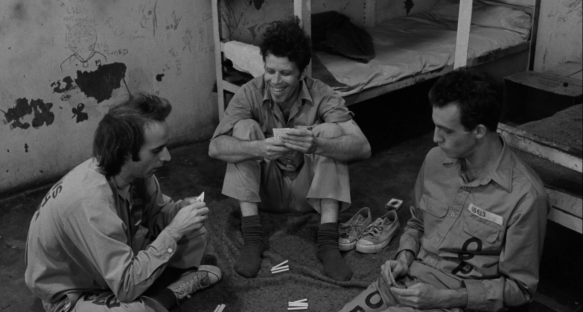
Down By Law (1986): An Offbeat Jarmusch Noir

Screenshot 2020-02-26 at 65844 PM

A raspy vocal emanates from the screen verging on spoken word as it sings to a mambo-infused rhythm. Casual tracking shots lead us by the local architecture at the pace of a car ambling along on a Sunday afternoon. I only confirmed after the fact this is Tom Waits singing his tune “Jockey Full of Bourbon” from an earlier album.

These are the streets of Louisana, and the man helping to capture these glorious, sweeping shots is none other than Robby Muller (probably most famous for his work with Wim Wenders). His partnership with Jim Jarmusch was just being established and it would continue well into the ’90s.

This is the opening prelude of Down by Law if you will. Because the real intimate stretches of humanity — at least the ones dwelling in this story — can be found in the dirty, dilapidated interiors and on the sketchy street corners. It’s these bombed-out, grungy aesthetics giving the film its layers of instant character.

Muller’s cinematography is an immediate asset and no matter the subject matter within the frame, he makes it feel captivating and strikingly beautiful, whether it’s a street corner, a jail cell, or a boggy bayou. We’re drawn to keep watching and relishing his images.

John Lurie is a pimp who feels like a nobody. He tries to act big only to get sucked into the shadiest of business deals. Tom Waits isn’t much better off as a disgraced disc jockey. His girl walks out of him in a fit of rage, and he proceeds to go drown his sorrows.

However, first, he must gather up his shoes from the street below where they have been unceremoniously tossed. The inhumanity of Gene Pitney’s record (I think that’s him) cast out into the street says it all — both the mood and the crispness of the photography.

I’m not sure if Tom Waits is an actor as much as he’s an enigmatic personality exuding something we can latch onto as an audience. Lurie’s not altogether intriguing to me, but with Waits there’s something different — something we want to find out more about.

The manner of this off-beat noir is now fully established because the mood is the key when plot feels almost secondary even tertiary in importance. The dialogue is laughable, but somehow it fits into this world gladly mixing both style and sendup of the past. And yet it’s only the most affectionate homage to bygone years with its chiaroscuro, smoky street corners, and fedoras to fill out a modern underworld.

It’s the kind of movie where a guy will just walk up to you on a deserted street corner and offer you keys to a Jaguar and a wad of Franklins to do his dirty work for him. Sometimes the dirty work has strings attached.

Pretty soon Zack’s in the can and Jack’s with him. What a sorry pair they turn out to be. But there is eventually a saving grace. Enter Bob. Aside from being another tribute to Jarmusch’s wildly diverse casting tendencies, Roberto Benigni holds the film together with his charming personality.

He single-handedly redefines the tone of the movie making it into a kind of reluctant buddy movie. Because his instant good nature, loquaciousness, and limitations with the English language give him the powers to add something radically different to the film’s cocktail.

If he’s ever the butt of the jokes as the foreigner, more often he’s the movie’s champion, a force of joy and goodwill bringing together two bunkmates of the most cynical and standoffish sort. When they start their giddy tirade — yelling at the top of their lungs — You scream, we scream, we all scream for ice cream, it feels like “Moses Suposes” antics taking over the jailhouse.

Even with the introduction of Benigni, there is this sense Jarmusch is once more working in these near-stagnant scenes involving shooting the bull or playing cards much like Stranger Than Paradise. It’s once more observational and altogether content in the idiosyncratic. The elliptical sense of filling the spaces in between is also surprisingly prevalent. The biggest example being, of course, the prison escape.

Tarantino would choose to not show the heist 6 years later in Reservoir Dogs. To some degree, Jarmusch beat him to the punch as far as genre deconstruction with a jailbreak movie missing its most crucial lynchpin. But for what he’s going for, it works wonders. It works far better by throwing away convention because he never rested on it, to begin with.

Soon they are fleeing through the bayou, then canoeing, then getting left adrift without any inclination where they are going. Thankfully, they find a bunkhouse in which to recalibrate (though it looks eerily similar to their cell). However, the real prize is when they happen upon Luigi’s Tin Top. In its own way, the restaurant is an oasis.

Screenshot 2020-02-26 at 8.03.43 PM

We had been through so much already, it completely slipped my mind that this moment was coming. It feels like a slice of serendipity. Here we have Roberto Benigni playing opposite Nicoletta Braschi as two Italians madly in love in the middle of nowhere. Again, they somehow operate outside the pervasive tone — the underlying stench — of the movie and its other characters.

However, what makes it feel fortuitous comes with context. They would wind up getting married 5 years later and remain so to this day as far as I know. Over a decade later, they would star in their most renowned foray Life is Beautiful, which pretty much bottled up everything disarming and magical about Benigni and enchanted the world over with its abundant good cheer and tenderness.

For now, they dance cheek to cheek in a lonely restaurant out in the boonies. It’s inauspicious while signifying something so much more. We leave them knowing they have a rewarding life ahead.

In the final moments as Lurie and Waits walk down the path, trees on either side, I couldn’t help but think of one of the greatest, most atmospheric noirs: The Third Man. Except as Jack and Zack split off at the fork in the road to forge their own paths, we can’t help but be reminded of Robert Frost.

Because Jim Jarmusch might as well be summed up as such. A noir aficionado with the sentiments of a poet. Down By Law is not quite bombastic pop culture pulp in the mode of Tarantino. There’s a distinct artfulness there that still never quite loses its idiosyncratic yearnings and inclinations.

4/5 Stars

Stranger Than Paradise (1984) and Jim Jarmusch

Screenshot 2020-02-17 at 3.40.27 PM

One of the most revelatory aspects about becoming more familiar with Jim Jarmusch is how international his films are. At the very least, there’s this sense of them putting a lens to a broader cross-section of society.

He is unequivocally American, but whether it’s because he’s a cineaste or driven to a global perspective through music or other interests, he paints with a canvass broader than simply the American experience. He also seems to understand the American experience is framed and colored by those who come to us. In fact, we are a melting pot, as Alexis de Tocqueville once noted, made up of all nations.

As a storyteller, Jarmusch seems drawn to what I’ve heard termed the “mearcstapa” — the border walkers — people on the outskirts. They could be expatriates, foreigners, or people who simply conceive of the world in a different manner than you and me. Although the term is recontextualized from its Medieval connotations, it does take on renewed meaning. In the case of Stranger Than Paradise, it’s a visitor from Hungary.

But if any of this dialogue runs the risk of making the story sound too rarified, rest assured, it is far from that. It’s a picture content in the simplest of moments. The plot as it were is born out of a statement. Eddie (John Lurie) has a cousin arriving and visiting him from Hungary. That’s it right there.

He feels put upon having her stay with him. He doesn’t show her the town. He doesn’t give her food. He’s the most inhospitable person in the world. But then again look at his life. He subsists off TV dinners and beer.

His only friend is Eddie, a shifty-eyed, flighty fellow who’s half-witted in a lovable kind of way. They spend time watching football, playing cards, drinking beer, or going to the races. That’s just about all they ever do. And it hardly changes with the addition of Eva.

Still, what the movie exudes resolutely is a style and an aesthetic, forming something more substantial than the sum of its modest parts. Because it’s certainly humble, and the antithesis of flamboyant production values, and yet it manages to supersede the simple nature of what is happening onscreen.

Take, for instance, the sequence where Eva is walking down the streets with her suitcases in hand to the tune of “I Put a Spell on You.” Screamin’ Jay Hawkins rumbles across the pavement, and it’s oddly mesmerizing.

Pairing this with the black and white cinematography, dominating the film with a dreary, dilapidatedness leaves a startling impression. It’s both the prevailing sense of the world and somehow complementary to the budget and resources he’s working with.

I am reminded of the early films of Rainer Werner Fassbinder because there is the sense of almost two-dimensional space in many of the scenes — simple but purposefully done. In the case of Jarmusch, there are hardly any cuts, with the shots put end-to-end and void of any other type of true editing. It’s the simplest form, really, cut together by way of black inserted between the sequences.

You could point out Jarmusch is making a kind of glorified short film, and that’s how the narrative began sticking the footage together in three segments. But the black in-between the visuals also function as a kind of ellipsis.

Because pretty soon Willie and Eddy get up and go from Brooklyn and road trip it out to Cleveland. Why? Because Eva’s there. She is a fellow sojourner, and so they take to the road in order to catch up with her. In one of his typically dorky observations, Eddie tells his buddy, “Before I met your cousin, I didn’t know you were from Hungary or Budapest or any of those places. I thought you were an American.”

Pretty soon they’re staying with the Aunt and back to watching TV and playing card games. Shooting the bull and chewing the fat like they always do wherever they go. Even miles away in the icy tundra of the Midwest they realize, “You come someplace new and everything looks the same.” Restless for some meaningful experience, they head off to sun-soaked Florida to seek something else.

Finally, there’s some action, albeit off-screen and pretty much only alluded to. The boys lose all their dough at the dog races. In her own absurd turn of events, Eva winds up with a mother lode in drugs. That could be a whole rabbit hole all to its own. Instead, they take a trip to the airport to set up another adventure…undoubtedly just as absurd as the last.

It might not seem like much, but that’s the entire charm of Jarmusch’s movie; he’s so very comfortable bending away from Hollywood convention. Where location shooting becomes more of an in-joke than of a particular commodity and characters and story are more likely conduits of style. In fact, to this day, he’s made a career out of it.

Now, Stranger Than Paradise feels a bit like Richard Linklater’s Slacker. They played as important catalysts for subsequent generations of filmmakers because they were unique and of their own time with their own vision. And part of their merit is having done it first — using the world at their disposal and creating something that stays with us however mundane and unadorned.

Part of the paradoxical charm of Stranger Than Paradise is how you could conceivably make a movie like it, and yet you couldn’t ever match its essence because Jim Jarmusch made it just so — distinctly individual and measured to his own personal liking. That’s what it has going for it even to this day. It’s unmistakably him.

3.5/5 Stars