Enter The Dragon (1973)

Turner Classic Movies came out with a podcast to give Pam Grier her plaudits and bring her out of the shadows so she might regain her rightful place as one of the unsung icons of the 1970s.

It occurs to me Bruce Lee occupies a similar cultural place. Because among his devoted fanbase, he’s revered and there is a cult following around him. Still, it’s hard to know if he’s totally understood beyond a superficial appreciation as a martial artist and thrilling symbol of Asian masculinity.

Both stars were either relegated to the periphery of mainstream entertainment or given the lead in the kind of potboilers that would never garner any critical acclaim. And still over the years, they have maintained a steady audience. What they have in common is a kind of “It Factor” born of charisma and an incomparable presence on screen.

Bruce Lee, for one, became the image of the Asian to the broader world with his prowess in martial arts and hint of religious mysticism. This is no fault of his own but rather indicative of a culture that did not totally allow for the proliferation of Asian talents in the ’60s and onward.

He became one of the token archetypes of Asianhood and although the vehicles he was given were not always the best, somehow, like Grier, he seemed capable of wholly transcending the form. It’s easy to be transfixed by his every move.

Previously I didn’t have the vocabulary to recognize how similar Enter The Dragon is to the concurrent Blaxploitation movement of the ’70s. In giving the cinema screen a broader cross-section of society for a new type of action hero, the films nevertheless lean into all the accepted stereotypes one could imagine.

What’s evident is how the movie coalesced as a cauldron of martial arts movies, James Bond influences, and Blaxploitation. It relies on a plot that’s an obvious Bond movie knockoff as Lee is sent to take part in a prestigious martial arts competition on a remote island as a pretense to snoop around the base of a man named Han.

The only other things you need are shoddy dialogue, obvious dubbing, and pretty girls with a lot of punching, kicking, and general brutality. Enter The Dragon has them all. Some of it gets especially gruesome as the story progresses and the stakes rise. The score cycles between Bond-like guitar riffs, blaxploitation funk, and the stringed twangs of “orientalism.”

Lee is not the only man who is invited to the prestigious affair. It might feel like token casting, but it also makes the ride a lot more engrossing. Jim Kelly with his afro and imposing build showcases a prowess in martial arts as an emblem of what black power can look like on the screen. Cool, disaffected, and a ready-made hero.

Former matinee idol John Saxon does well in a role that feels made to evoke a B-grade Burt Reynolds or Sean Connery. He brings some wry good humor to the movie to go with his many appetites and preeminent abilities in the ring. He also loves to gamble on anything. While he might be mercenary, he’s not entirely heartless.

They all make the ferry ride across to Han’s private stronghold. He’s a martial artist in his own right and the perilous embodiment of Fu Manchu villainy replete with a claw for a hand and courts full of all the exotic Asian diversions one might imagine. He’s flanked by a row of shuriken-throwing maidens and a ready-made army including the hulking O’Hara. Han even strokes his cats with the self-assured menace of Blowfeld.

Now that we have the pretense for their introduction, it’s a joy to get down to business watching Bruce Lee take on the whole island after he surreptitiously climbs around the base looking for answers. The scenery and the sets seem totally disposable but that makes it all the better for beating up baddies and tossing them every which way.

To the very last sequence, as he’s bare-chested and sliced up, Lee’s still ready to vanquish his enemy whatever it takes. The production does well to pinch Lady from Shanghai‘s stylish hall of mirrors sequence for some easy atmosphere and a kaleidoscopic showdown.

I had the pleasure of seeing the film in a packed house in celebration of 50 years of the film. Enter The Dragon is clunkier than I remember around the edges. People in front of me looked a bit befuddled with the dubbing, then laughed at some of the primal screams from the heat of battle.

But the whole theater erupted with every showing of Lee’s inimitable dominance. If anyone entered that theater looking only for a cheap action flick, I think they came out appreciating one of the great action heroes of the 20th century.

Given the limited resources at his disposal, it’s still amazing to consider the headway Lee made in the cultural consciousness. I’m not from Hong Kong (he was actually born in California too), but I am quick to claim Bruce Lee as a star who changed the perceptions of what Asians could be.

4/5 Stars

The Reluctant Debutante (1958): Rex Harrison and Kay Kendall Together

If Royal Wedding started off the decade with the auspicious coronation of Queen Elizabeth II, then The Reluctant Debutante depicts another cultural milestone in its own right: the last “Season” before the newly-instated Queen decided to officially disband the social tradition.

There’s hardly anything pointed about either of these pictures and so historical events serve as only a twee and oh-so-mild evocation of a totally bygone era. It’s a bit refreshing to have them back again even for an hour or so.

Front and center, we must acknowledge Rex Harrison. Harrison comes off as a generally innocuous figure from my childhood with his monologue songs in Doctor Doolittle and My Fair Lady (in that order). He’s mostly amicable if a bit dry and witty.

Personally, his biography is a bit more complicated. When he was a younger man, he was famously attached to blonde bombshell Carole Landis whose career was ended tragically by an untimely death. Harrison’s part in her final days remains mostly obscured. I won’t pretend to know the details.

Then, after their comedic foray in The Constant Husband, Harrison and Kay Kendall got married and made The Reluctant Debutante together portraying husband and wife onscreen. It would be their only film together while they were married and Kendall’s last film, period. She would die at age 32 of Leukemia.

It’s another shocking tragedy and so only some solace can be gained from the frothy goofiness making up Vincente Minnelli’s picture. Because it feels totally antithetical to this entire biography laid out thus far. This is cinema at its most dorky and feel-good.

We must also take a moment to acknowledge Sandra Dee: she was America’s quintessential ingenue for a generation thanks to pictures like this and Gidget. Her persona falls quite easily into a story like this as we are dropped in London, circa 1958 during “The Season.”

There’s a delightfully playful jauntiness to The Reluctant Debutante from the outset, and it comes down to the character types bouncing off one another to great effect. All that’s left to do is watch where they lead us.

Husband and wife rush off to the airport to pick up their daughter. It’s easy enough to explain away the relationship between Jim Broadbent (Harrison) and Jane (Dee) rather quickly with a mention of her American mother back in the States. Kendall is the well-meaning, if a bit ditzy, stepmother, Sheila, and we’re off.

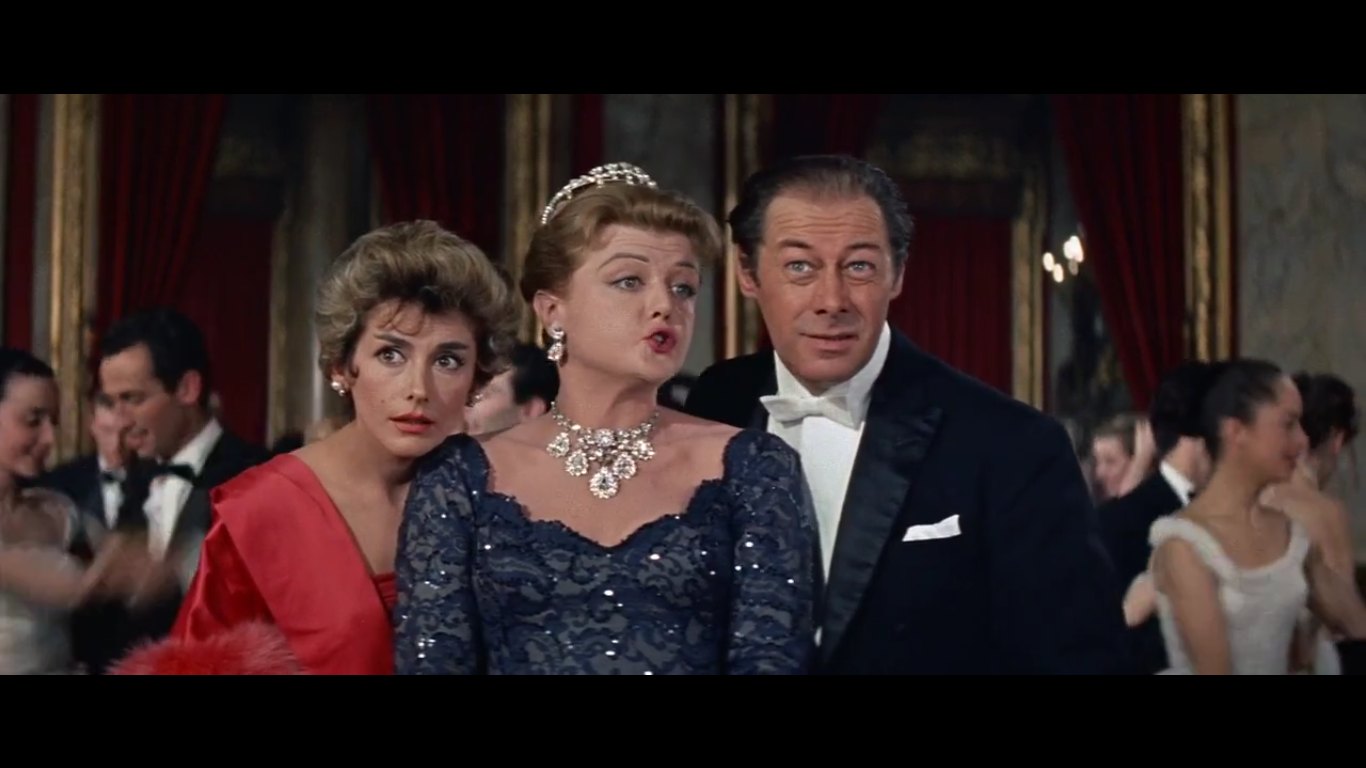
Soon they’re crammed into a taxi with chattering Mabel (Angela Lansbury). She and Kendall form the film’s most antagonistic relationship as dueling mothers trying to set their young daughters up with the finest prospects in well-to-do society.

Because a debutante’s “coming out” is of grave social importance — at least to mothers — it’s not just like breaking a bottle over a ship; this will launch them into the social elite! Sheila’s intent on creating an extravagant charade out of Jane’s coming out ball because she must keep up appearances and outdo Mabel at all costs. This is war and wars require stratagems, if not slings and arrows to do battle with.

Father and daughter couldn’t care less. Sheila’s not interested in any of the prospects, and Mr. Broadbent seems far more interested in the buffet. In fact, it’s the mothers going gaga over the same distinguished young man, David Henner (Peter Meyers). He’s a royal guardsman with quite the handle on diction and London geography.

Kendall whisks Harrison away from the bar and his sardines and potato salad to win an introduction with the fellow. He’s a dutiful husband, but it’s little more. In comparison, he has the most delightful time sharing a moment with the drummer playing with the band; it used to be an aspiration of his as a young man.

This turns out to be a bit of an unexpected but serendipitous rapport because the young Italian-American, David Parkson (John Saxon), will soon be catching his daughter’s eye. For the time, their instrumental rendition of “Rock Around the Clock” has a buoyant joy all but epitomizing the picture at its best. We’re in for some good fun.

The story starts to sing as we get comfortable with the movie’s rhythms with all the pieces in place. Harrison the walking ulcer in evening dress. Lansbury diabolically switches wires with them — giving her “friend” the number of the wrong David on “accident.” Wink, wink.

Harrison and Kendall form the perfectly in-sync comedy duo; they play wonderfully off one another. They’re flying around the ballroom, heads on a swivel going every which way in their evening duds, keeping tabs on Jane’s perfectly innocent activities. It matters to them very deeply which David she fraternizes with. But only one David matters to her.

If it’s not obvious already, Kay Kendall should be lauded as an unsung comedienne because there are unimaginable pleasures in watching her tug everyone around like a dizzying hurricane all out of a place of good-natured maternity. Harrison gets on by pleasing his wife and feigning convention and doing his best to love his daughter in spite of it all.

Heaven forbid Jane go out to the nightclub with the wrong David because she looks all but destined to. It has Sheila in a tizzy. When they finally arrive home, husband and wife hang around trying to spy on them and figure out what they’re doing, but the adults are not very adept at faking a search for lost earrings or fiddling with hot water bottles right within earshot. One can only imagine the obligatory kissing scene. It’s as awkward as one might expect, but also sweet.

It’s in these ways we can see the similarities between Father of the Bride, The Courtship of Eddie’s Father, and The Reluctant Debutante. There’s no denying the full-blown comedic elements, and yet Minnelli never lets these totally envelope the interpersonal relationships at the core of his movies. This is to their benefit. We genuinely care about Spencer Tracy & Liz Taylor, Glenn Ford & Ronny Howard, etc.

I might easily attribute it to a quirky mood or a generous spirit, but The Reluctant Debutante caught me on the right day. Minnelli’s forays in comedy usually have a dash of goodwill, but this one struck a chord immediately. Harrison still had some of his most prominent performances ahead as did Sandra Dee. You might come for one of them, but stay for Kay Kendall. We lost her impeccable talents far too soon.

4/5 Stars