Review: All About Eve (1950)

EveEveMargotCasswellWitt“Fasten your seatbelts. It’s going to be a bumpy night” ~ Margo Channing

It’s cliche, I do admit, but they simply do not make films like this anymore. Stories about people talking where the actors take center stage. In this case, the story from Joseph L. Mankiewicz is about the Broadway stage and all that happens behind the curtains, in the dressing rooms, and behind the closed doors of the royalty of that profession.There is so much that could be dissected, antagonized over, or acknowledged so I will move through it the best way I know how.

A moment must be spent acknowledging that this is the film that revitalized the career of Bette Davis. She was the tops during the 30s and early 40s, but the role of the histrionic stage icon Margo Channing was her comeback and it thoroughly suited Davis. I have actually never been a fan of hers because I always found her rather arrogant and she scares me visually. However, All About Eve plays on my personal sentiments wonderfully. When we’re first introduced to Margo, she’s everything we expect in a Bette Davis character, and truth be told I don’t really like her. But interestingly enough that changes. That’s where Eve and the rest of the cast come in.

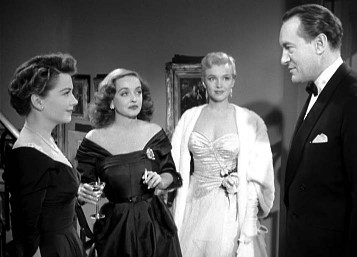
The film is book-ended by the wonderfully wry and snooty commentary of theater critic Addison DeWitt (George Sanders). He makes it his mission to rake every new play over the coals, and he can be merciless. But he also is a great ally and he proves so for young Eve Harrington (Anne Baxter). Because, after all, this film is her story, we just don’t quite understand why at the beginning.

Eve came from humble roots and was the most devoted young fan of Margo Channing. She would attend every one of her performances and wait outside her dressing room timidly, just to get a glimpse of the star. One of Margo’s best friends Karen Richards (Celeste Holm) was accustomed to seeing the girl and in a kindly gesture she invited Eve up to the dressing room. And just like that Eve had her backstage pass into this world rounded out by Margo Channing, Karen, her husband the playwright Lloyd Richards (Hugh Marlowe), and the young director Bill Simpson (Gary Merrill) who also happens to be Margo’s suitor.

She begins unassuming enough on the outskirts of their little group. Always seen, not heard. Always thoughtful and ready to be of service. Eve takes on the role of Margo’s personal assistant just like that and an ego like Channing doesn’t mind. In fact, everyone seems to like having her around except the skeptical Birdie (embodied by the always spunky Thelma Ritter).

As time marches on, Eve loses her charm. More and more it feels as if she’s analyzing Margo. Watching her every move. Monitoring her success and slowly moving in. She plants the idea that she can be the next understudy and so it is. One fateful night Karen agrees to stall Margo and Eve gets her big chance as an understudy. She of course politely invites all the major critics to see the performance. It was the conscientious thing to do after all. Ironically, it’s at this point where things turn. Margo becomes the victim and in her great vulnerability, while sharing with Karen, we begin to sympathize with this woman hiding behind the facade of Margo Channing. Meanwhile, Eve continues her ascent using whatever means possible. She alienates Margo and begins driving a wedge between the always amiable working relationship of Lloyd and Bill. Eve even resorts to blackmail and home wrecking sharing her master plot with Addison.

She’s used everybody else and so he seems like the next logical target. However, he’s too much like her. He’s too cynical to fall for her act, and he points out a few chinks in her armor. So like that we end up back at the award ceremony where Eve is about to win her big award. Now we know all the clawing and backstabbing it took for her to get there. Now all that is veiled under her perfectly demure features and charming voice. But we see it on the faces of all the ones who sit there knowingly. Each one knows all too well the damage that this girl has done. She came out of the woodwork, used and abused them because everything was about Eve. Nothing else mattered to her.

But the beauty of the film’s ending is that the cycle continues. Margo is fading away yes, and Eve is taking her place, but that means that there are more Eves where she came from. Young girls obsessed with stardom, fame, and success. It’s a frightening evolution and it proves to be a sharp indictment of the industry as a whole.

The five leads are solid and their performances shift as the Margo-Eve dynamic fluctuates. However, George Sanders is possibly the most enjoyable character, because, despite his cruel wit, he’s the one who is outside of Eve’s influence, or at least he catches her in her charade. There’s something utterly satisfying in that. Also, he has some memorable moments alongside the aspiring Ms. Casswell (none other than the show-stopping Marilyn Monroe in an early role). So really this is a film about the performances and they are well worth it because they suggest that in such a cultured world, so many things lurk under the surface. It might be insecurity, fear, suppressed desire, or savagery. Humanity is most definitely messy, you just have to look behind the curtain sometimes.

5/5 Stars

People Will Talk (1951)

peoplewill1People Will Talk is in this weird gray area between genres. It has humor but it’s not screwy enough to be a screwball. It has drama, but it’s not intense enough to be a full-fledged melodrama. And underlining all this are issues that reflect such areas as the medical industry, the Korean War, and most definitely the witch hunts that were going on in the nation — bleeding into the Hollywood industry.

Written and directed by Joseph L. Mankiewicz, this is a minor classic about a doctor named Noah Praetorius (Cary Grant), who is under investigation from one of his by-the-book colleagues Dr. Elwell (Hume Cronyn), who dislikes the good doctor’s unorthodox and thoroughly effective approach to his trade. Praetorius by now is a preeminent physician who started his own clinic and also teaches classes at a local med school.

One of these individuals happens to be Mrs. Deborah Higgins (Jeanne Crain). She is not a student but sits in the lecture because her former partner was a medic. A date with a cadaver proves to be too much for her and she faints. Seems normal enough right? Wrong. After examining her, the Dr. tells her she’s pregnant. The truth comes out that she’s not really married and the father is dead. Her own father would be greatly distressed to learn about her condition, since he cannot provide for her.

That’s where Dr. Praetorious comes into the picture, and he takes great concern in Ms. Higgins condition. He attempts to allay her anxiety by saying she’s not really pregnant, and she runs away from his clinic out of embarrassment, since she is falling in love with him. He goes with his stoic friend Mr. Shunderson to the farm owned by Deborah’s uncle.

Deborah turns out to have a strange mix of aloofness and lovesickness, but when she realizes the Doctor’s true motive for being there (before he even does) she is wholly relieved. They share a passionate kiss and leave the farm behind to get married. Of course, the Doctor still hasn’t told her about the pregnancy.

Meanwhile, the whole storyline culminates with a concert conducted by Praetorious himself, but it just so happens that the hearing to analyze his conduct is happening simultaneously. Some mysterious truths about Mr. Shunderson are given in his own words, and stale Mr. Elwell’s case is dumped. Everything wraps up nicely as you expect with a happy marriage and Grant free to direct the symphony in one last glorious crescendo.

So you see if you really look at this film, there are these two main story arcs. One is a response to McCarthy’s witch hunts, the other an equally subversive love story about a doctor marrying a woman who had a pregnancy out of wedlock. When you put it that way this film seems chock full of controversy, and yet it is all veiled in a palatable comedy-romance. Walter Slezak is a welcomed addition to the cast as the nutty colleague and Hume Cronyn has taken on better roles, but nonetheless, he is always an enjoyable character actor. Obviously, this is a lesser Grant performance, but his pairing with Jeanne Crain is still a fun one.

4/5 Stars

A Letter to Three Wives (1949)

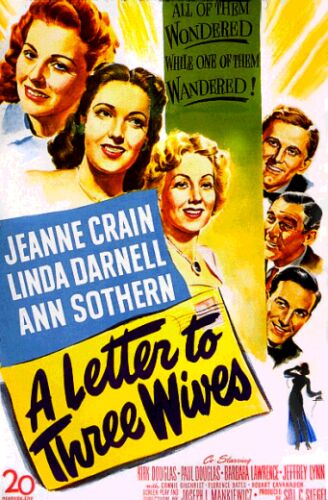
A_letter_to_three_wives_movie_posterHere is a story about three wives, the three husbands that go with them, and the one woman who got in the middle of them all. The main plot device is simply this: This woman named Addie Grace, who we never see but who is always being referred to, has left town and she also left a letter addressed to the three wives. The women get it as they board a boat for an afternoon out at sea with some underprivileged children. When they read what it says their afternoon takes a major turn. The one and only Addie Ross has run off with one of their husbands and yet she does not say who it is.

The rest of their time is spent thinking back on their marriages and each recollection is framed as a long flashback. First, comes Deborah Bishop (Jeanne Crain), a farm girl who met her husband during the war. Now with his friends back home she wishes to make a good impression, but she feels like she can never measure up with such elite society. To make matters worse, she learns that before the war it was thought that Brad would marry Addie Grace because they grew up together.

Next, comes Rita Phipps (Ann Sothern), who puts on an extra special dinner for her bosses from the radio station she writes for. The night includes a forgotten birthday, sappy radio programs, and all the while Rita is constantly trying to please and appease her bosses. They enjoy the evening but her husband George is upset that she constantly caves to them. To make matters worse, as a school teacher, it is difficult for him, as the man of the house, to have her bring in a great deal of their income.

Last but not least is Lora Mae Hollingsway (Linda Darnell) who grew up in a poor household near the train tracks with her mother and younger sister. She focuses her attention on Porter Hollingsway (her future husband), an older divorced man who also happens to own a chain of department stores. After a great deal of back and forth, they get married but underlying their marriage is this assumption that she only went after him for his money. Their relationship hardly seems to involve true love.

All three women return to their lives. Rita is grateful to find George sitting in the living room. Porter, who Lora Mae half expected to be gone, has come into the house exhausted after a long day of work. Deborah is seemingly not so lucky. All of them get ready for the dance that evening with their spirits all at different levels. However, after Porter shares a revelation the evening gets a whole lot better.

This Joseph L. Mankiewicz precursor to All About Eve is a remarkable drama in its own right thanks to its primary narrative device and fine performances from the cast. Thelma Ritter was as entertaining as ever and Celeste Holme was tantalizing as the unseen voice of Addie. It is interesting how all the stories of the film interconnect characters, making us come to understand each and every one of them a little better. The ending was slightly abrupt but still clever. All in all, A Letter to Three Wives was an interesting concept that paid off beautifully.

4.5/5 Stars

The Ghost and Mrs. Muir (1947)

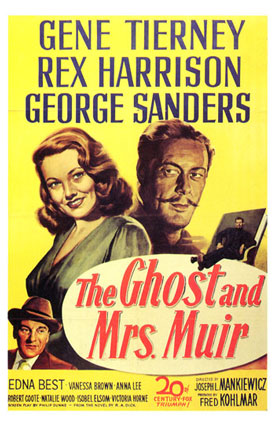
f5ab0-the-ghost-and-mrs-muir-postersStarring Gene Tierney, Rex Harrison, and George Sanders, the film is about a widowed mother who moves with her daughter to a supposedly haunted house. She and the ghost have some altercations but she will not be intimidated and she has fallen in love with the unique home. Soon Mrs. Muir and the Ghost bond as he dictates his life story for her book. However, once it is done, they realize the problems with their relationship. Mrs. Muir falls for a human man and when it gets serious Michael decides to leave her life, causing her not to remember him. Soon the years pass and the unmarried Mrs. Muir is getting older with her daughter growing up. Finally Mrs. Muir passes away peacefully and now she is reunited with the one she forgot and they can be happy for eternity. This is a very nice film and Tierney and Harrison are both wonderful in their roles. Although the plot is simple it is unique and enjoyable all the same.

4/5 Stars