
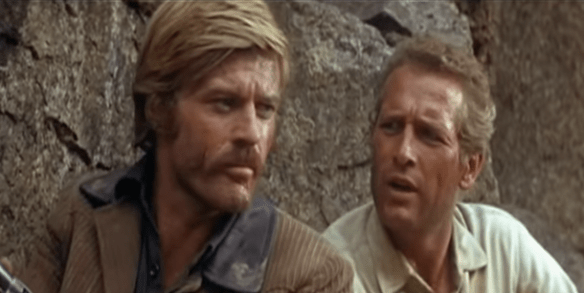
Despite my general reluctance to say that the Western in its classical form was on the way out, it’s hard not to make such an assertion looking at the landscape of the late 1960s. The Wild Bunch is a common marker of the seismic shift leading to the complete obliteration of the classic western mythology, but there are some related themes strewn throughout Butch Cassidy that make it equally representative of an era or so one could argue.
The times were changing historically speaking and that plays out cinematically in Butch Cassidy and the Sundance Kid. Bicycles are the future, destined to replace the old reliable horse. And the western hero as we knew him has long since gone, replaced instead by vengeful tough guys and in this case a pair of bank robbing antiheroes. Bonnie and Clyde were the new standards and out of that trend, we saw more like them.
So it’s not just the fact that the film takes place at the tail end of the Old West, slowly evolving into the modern, or New West, but simultaneously the genre would never be the same. There’s a bit of a wistfulness to it all. The legend is fun. The mythology is something to be thoroughly embellished, but it too comes to an end. It’s only a wisp of a memory made of sepia tones and silent newsreels. But Butch Cassidy and Sundance will be remembered fondly by the audience just as the West is. Maybe that is enough.
Unfortunately, Butch Cassidy as a film does have its shortcoming which became more apparent with time. It’s possible to be a dated period piece as this film is (although it’s hard not to love “Raindrops Keep Falling on My Head). Still, it can be plodding and some would argue it’s about nothing substantial, nothing meaningful at all. Still, it manages to be one of the greatest western comedies of all time only eclipsed by its own heavy dose of cynicism.
It’s funny watching Butch and Sundance go through their motions. Butch (Paul Newman) is the brains who bemoans the fact that banks are getting upgrades and shipments are being made by trains. After all, they are constantly on the move and it becomes a constant guessing game. He’s given more grief by his gang that looks to overthrow him led by the hulking thug Harvey (Ted Cassidy).
And on top of that every lawman wants him dead. In such moments, being the idea man that he is he entertains thoughts of joining the army for the Spanish-American War or even going to a far off land like Bolivia. Content with his gunplay and letting Butch do the thinking, Sundance rides by his side, certainly his own man but also part of this comic duo.
William Goldman’s script is brimming with wry wit that’s almost inexhaustible. But Paul Newman and Robert Redford loom even larger as the titular stars in this epic buddy comedy. In the age where winning charm and star power still seemed like a genuine box office draw. You came to see actors and in 1969 there were few actors as commanding as Newman and Redford. They had looks and charm. Cool and comedy. Charisma goes a long way. For those very reasons it’s an impressive film and enduringly entertaining. If we cannot watch a film and enjoy it as pure entertainment at least on some level, it really is a shame because that’s one of the many joys of the cinema.
But there’s also something admittedly depressing in how their story evolves. It can no longer be about snide repartee and living the good life robbing banks, continuously augmenting their legendary notoriety. It’s light and funny for a time before slowly spiraling into a deadly cycle.
Perhaps my faith in Butch and Sundance wavered slightly but I will go on resolutely and maintain my immense affection for them that began as a boy. This is still a wonderful film. Outlaws do not have to be one-dimensional. They can be just as funny as they are depressing. That is their right and the legend of the Hole in the Wall Gang is exactly that type of story. We don’t have to see them die. Instead, we get the satisfaction to leave them in one last shining moment of triumph. One final triumph of the West as we once knew it.
5/5 Stars
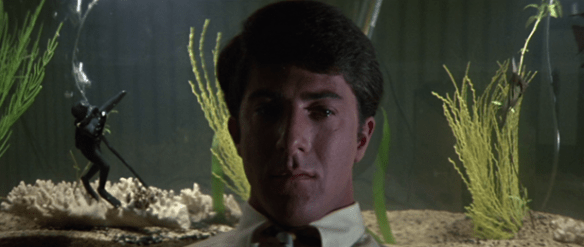 “You’re living at home. Is that right?
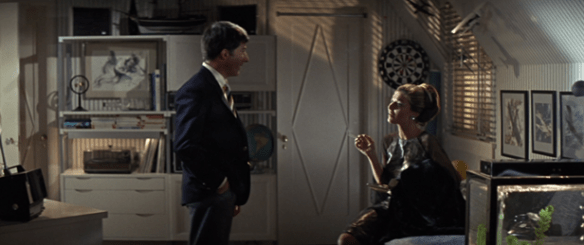 Then Mrs. Robinson coolly enters his life. It’s perhaps best signified when she tosses him the keys. They end up in the fish tank almost as if on purpose and after that she has him reeling for good. Soon he’s walking into the lion’s den (or lioness’s) as she expertly manipulates and elicits the precise response from him. In these moments the film is elevated by the awkward, huffing and puffing, and nervous chattering of Hoffman. We often forget the second part of his famed line, “Mrs. Robinson you’re trying to seduce me. Aren’t you?” His general naivete and hesitancy say it all.
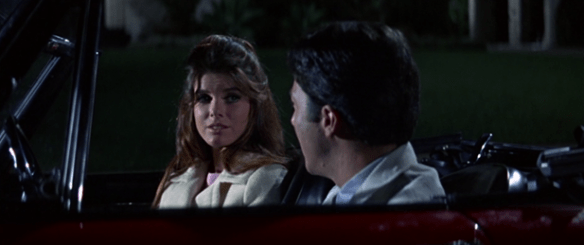 But when he meets Elaine Robinson and finally begins to connect with her on a peer-to-peer level, it’s something so profound to him. Having someone his own age that he can relate to, who feels the same unnamed apprehension and angst that strains on him. It’s what makes Ben become so mixed up. He has true feelings for her, while his affair with Mrs. Robinson only serves to poison all that could be good. And his illogical, unhealthy pursuit of Elaine continues to Berkeley where she is attending school. Still, Mrs. Robinson and her now estranged husband look to send their precious daughter far away from Benjamin Braddock.
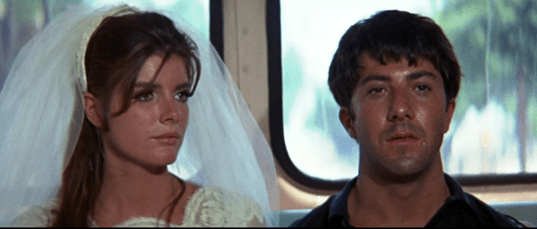 That’s what makes his final Herculean effort all the more climactic. He bursts in on her marriage to another man and whisks her off to another life altogether. A life that seems exciting at first, because, oh how great it is to be young and in love. But once they climb aboard that bus in their tattered garments, have a chance to sit down and really think about what they are embarking on, you see something else in their eyes. The laughter slowly dissipates and as they look around nervously, they begin to somber up. True, Ben is no longer alone in an airport terminal, he has a fellow traveler, but that does not make the future any less unpredictable or scary for that matter.
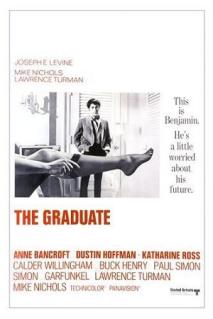 may see this film as a comedy drama that is not in the category of great movies. However I feel if nothing else, The Graduate is culturally significant because it ushered in an age in the late 1960s where films focused on trying to attract younger audiences. Along with its good writing this film was one of the forerunners in using popular music in its soundtrack.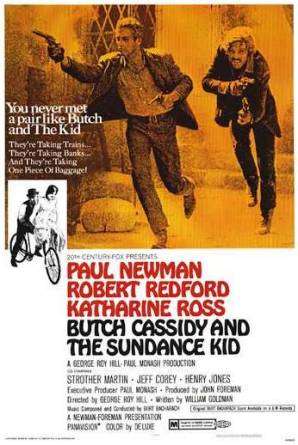
 4 Star Films