

Like Stormy Weather, it’s a slightly unnerving form of mimesis as Cabin in The Sky sets about depicting the lifestyle of Blacks. There’s not a white folk to be seen, and yet there’s no doubt they have been integral in developing this musical fantasy out of a Faustian-like folk tale.
It’s telling that two of the only other mainstream films with prominent onscreen representation of Blacks were the religiously-tinged musicals Hallelujah and Green Pastures. Whether real or imagined, there was this perceived sense that Blacks were only identified with these limiting salient features. This was their only utility onscreen and thus, Hollywood kept on representing them in a narrowly defined manner.
It’s not like this is simply a modern observation with renewed enlightenment of the 21st century. First-time director Vincente Minnelli noted it too in a later interview, “If there were any reservations about the film, they revolved around the story, which reinforced the naive, childlike stereotype of blacks…If I was going to make a picture about such people, I would approach it with great affection rather than condescension.”
The eponymous Cabin in the Sky number is a perfect example of how Minnelli subtly develops the cinematic space, in this case expanding the intimate moment of his leads into a much broader chorus of singers. At least pictorially, the director seems to have his performers’ interests in mind.
In the opening moments, a booming minster calls upon two of his local parishioners: the devout housewife Petunia (Ethel Waters) and her backsliding husband Little Joe (Eddie Anderson), a hapless man prone to worldly vices like gambling. He wrestles with the devil on the daily while his bright-eyed wife prays ardently for the Lord to look with disfavor on his gambling and sure enough, he never wins a plugged nickel.
Be it box office repeatability or plain ignorance, there is no contest. Blacks had very few outlets in movies. But the talents are undeniable. It’s intriguing to think that while Jack Benny was performing in a Nazi satire like To Be or Not to Be, Rochester was finally getting out of his shadow, albeit playing a role that pretty much stayed true to his usual characterization. In both cases, it might be difficult to teach old actors new tricks, harder still is getting an audience to accept them as such.
In its day, the NAACP lauded the film. Most of the performances have a jaunty affability; it’s not about a lot of bells and whistles, the wall of orchestral sound notwithstanding, but it’s an agreeable diversion. One cannot help but see Ethel Waters as emblematic of the film: all smiles while she belts out “Taking a Chance on Love.” She brims with pious candor even as the actress looked to punch up her rather thankless role and give it more substance (and religious morality).
Somewhere between Hellzapoppin’ and Stormy Weather, we have a Faustian struggle done up with the musical trimmings and the stereotypical religious leanings of the time. The film can be considered using the same paradigms as a film like Here Comes Mr. Jordan or even A Matter of Life and Death, in this case, exemplified by a chorus of Black angels and Black demons doing a bit of spiritual jousting.
Little Joe is a simple fellow. His only aspiration, when he’s not lounging in a hammock, is to become a hotel elevator operator much to his wife’s delight (The picture makes a constant punchline out of his illiteracy).
At his wife’s behest he’s busy with the process of “getting saved,” and he has an appointment with repentance, but some of his gambling partners show up on the steps of the church ready to collect their outstanding debts.

God’s General and Lucifer Jr. (Rex Ingram in a particularly gleeful performance) use Little Joe as a spiritual battleground. I’ve known it for some time but haven’t had a reason to acknowledge Rex Ingram of late. It’s a pleasure watching him because he seems in on the joke more than he is a victim of the scenario like so many Black performers.
His Idea Men in Hotel Hades include none other than Louis Armstrong and two of the most troubling figures in 20th-century representation of African-Americans: the googly-eyed Mantan Moreland and bubble-headed Willie Best. They deserve more care and nuance than I can provide, so for the time being I’ll defer to others.
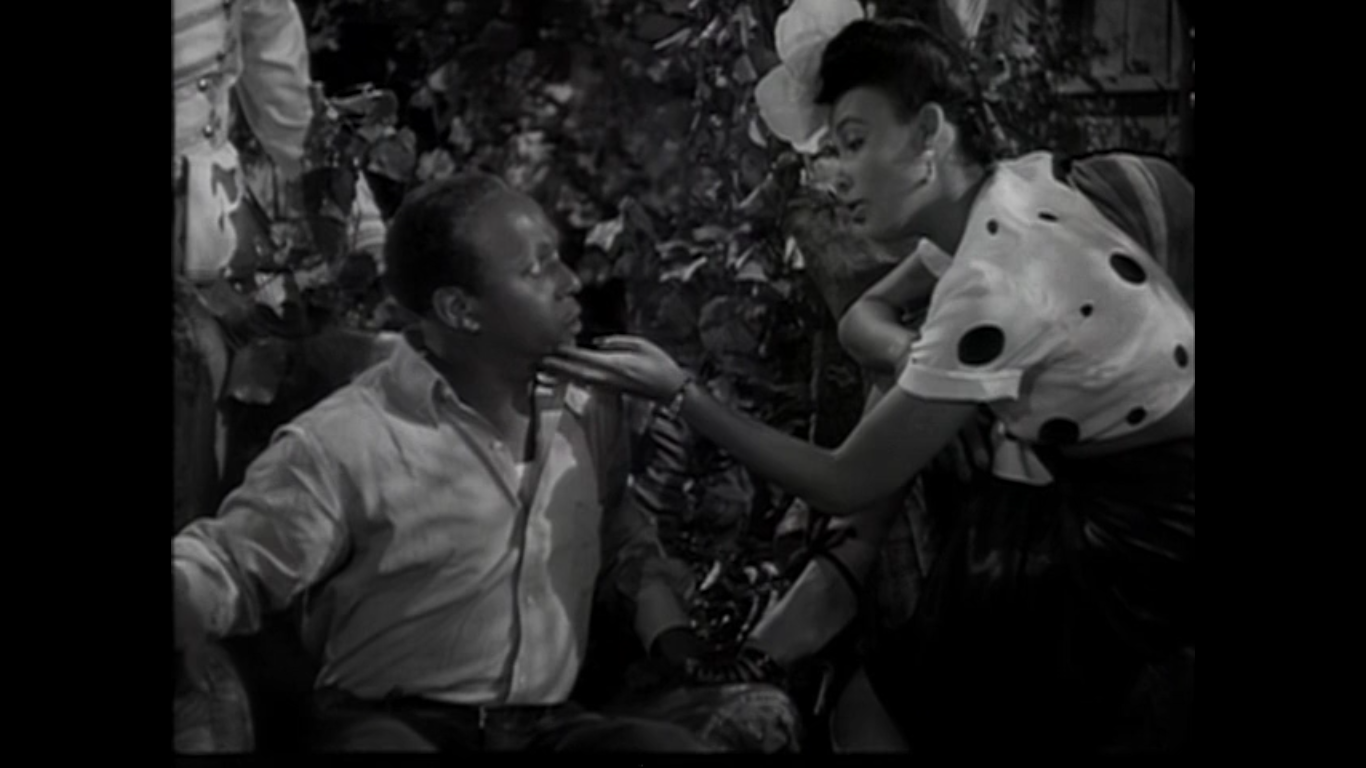
While there scenes in the hellacious office are talky and promote more dubious theology, they spin a couple of webs to entangle Little Joe. First, there’s sweet Georgia Brown. Lena Horne dons her best perfume and polka dots to knock his socks off.
She’s introduced with a sultry jazz motif, moseying along as Ingram plays the serpent kicked back on her bed, whispering little intimations into her ear as if by chance. Horne positively melts the celluloid as she coaxes Rochester toward the path of vice in “Life is Full of Consequence.” It becomes a marvelous dueling duet between the two performers forming one of the core conflicts of the film as Little Joe yowls, “I’ve been burnt more than twice.”
It hardly matters that a bubble bath scene deemed too racy for the era was totally excised. Horne leaves her mark, and it’s a memorable role. However, she deserved better in her career going forward.
Lucifer Jr. is surprised by the human’s steadfast fidelity to his wife and so Louis Armstrong dreams up a new scheme (“Give a man money. Watch him act funny”). An Irish Sweepstakes engenders consequences and misunderstood intentions of its own. It seems secular society has won out as represented by the blasphemous (and ridiculously fun-looking) halls of Jim Henry’s. It’s a hangout full of exuberant snapping, swinging, and Duke Ellington himself.
The overwhelming, overflowing of the moment is a joy to be a part of highlighted by the dapper dancing extraordinaire John Bubbles (John William Sublett). In his hat and cane tap dancing ensemble, ostensibly, it’s hard not to see echoes of Fred Astaire and in truth, in the early days the famed white hoofer was taught and no doubt patterned his style after his Black contemporary.
When Bubbles and Horne get these glorious close-ups to sum up a couple of their numbers, it feels deserved like a resounding show of recognition of careers that were never going to garner the plaudits of their white counterparts.
While not everyone will likely appreciate jazz being equated with worldly debauchery, it serves as a convenient metaphor. In contrast, religion seems regressive and prudish, anti-fun, with a God who is a cosmic killjoy.
The musical’s catastrophic ending is some humdinger. It doesn’t seem like typical Minnelli until we’re met with the aftermath, and we see how wonderfully conceived this smoke-filled, jagged-edge pile of rumble is as a newfound visual labyrinth.
Again, it’s not to be taken too seriously, but Little Joe’s life is reflected as a mission to balance the books in order to get through the pearly gates. After all, the heavenly ledger must be rectified. It’s mostly Hollywood hokum.
Instead, I feel compelled to end with something that moves me. Rock and Roll pioneer Sister Rosetta Tharpe sang the gospel spiritual “Journey to The Sky,” which conjures up a similar metaphor and begins like so:
When I reach that heavenly land
To see my Jesus in His glory
As I go from land to land
When I reach that heavenly land
And I know, I know we shall see Him
In that sweet, oh My Lord, peaceful rest
3.5/5 Stars
 4 Star Films