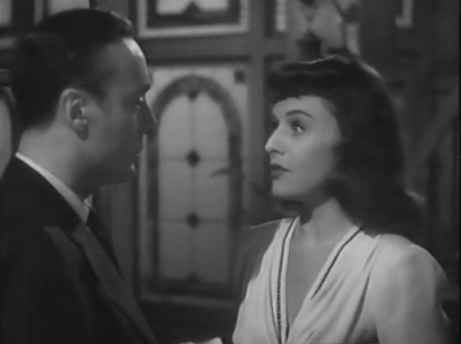
Sabrina (1954) – A Lovely Fairy Tale

sabrina1Sabrina, Sabrina where have you been all my life?  ~ William Holden as David Larabee

I never understood that incessantly observable trope that permeates all forms of media where the blonde is far superior to the brunette. Aside from being highly superficial, it’s simply not the case. If anything, Audrey Hepburn is the blatant exception to that rule. She turns any such presumption on its head because simply put, she is absolutely stunning. There’s a reason why she is one of the most photographed and iconic figures of all time. Her style is different than a Marilyn Monroe, a Sophia Loren or an Elizabeth Taylor because it exudes a certain demure quality. She’s glamorous in spite of a certain unassuming humility. And she’s what makes Sabrina work because she embodies Sabrina Fairchild.

The film begins with a bit of narration that feels like it’s setting up a modern fairy tale, and it really is. Sabrina recounts the life of a young girl who lives above the garages where her father is a chauffeur. He faithfully serves the well-to-do Larabee family,  and he’s content in his life. But his daughter is hardly so lucky. From an early age, she has carried a girlish crush on the younger Larabee brother David (William Holden), a womanizing, ogling playboy who seems like the unattainable dream for young Sabrina. He sees her as a child, and she worships the ground he treads on. Nor can she stand any of his female companions. Ironically, none of his conquests are good enough for him, in her estimation. But unrequited love, even young love, is a bitter pill to swallow and Sabrina hardly takes it well. The ode to Maurice Chevalier’s “Isn’t It Romantic” is the ultimate irony at this point in our storyline.

Then comes the fateful day that her father sends her off to learn the skills to become a world-class French chef like her late mother. Sabrina is unhappy in her work, cracking eggs, making souffles, and so on. But over time, David is less of a weight on her heart. She still thinks of him, but she also begins to grow into her life and truly flourish.

She left a girl and she comes back as Audrey Hepburn, immaculately radiant in a wardrobe crafted by her lifelong designer Hubert de Givenchy. David and the audience cannot help but marvel at this vision standing at the train station with her prized pooch, who by no small coincidence is also named David.

When all the pieces fall into place, the love-struck man is bowled away to find out that this is young Sabrina, the girl he never gave a second thought to. He’s ready to wine and dine her, to present her with the fantasy romance that she has always wanted and only he can offer. The dreams she always wished for in her youth are coming true before her very eyes.

But it’s David’s stuffy brother Linus (Humphrey Bogart) who steps in at this point, stage right. He’s the respectable and pragmatic one. He runs the family company and oversees their business. His latest project is a merger which will prove mutually beneficial but to help proceedings along he’s looking to marry off David to the daughter of his prospective business partner.

Sabrina stands in the way of his plans and as a proper businessman, he deals accordingly. David is holed up with injuries sustained sitting on champagne glasses, so Linus swoops in. He doesn’t seem like the wining and dining type, but he does it all in the name of sending Sabrina off to Paris again. He wants to get rid of her to salvage his merger, but he too falls under her spell. That sweetly serene personality matched with those pair of doe eyes melt any man’s heart. Still, duty calls and he admits to Ms. Fairchild just how much of a cad he has been. But now he’s a cad who truly has feelings for her. There’s no denying it. David sees it. The audience sees it. Now only Linus must acknowledge it himself. However, now we have a love triangle with time running out, and that’s when drastic action is necessary. After all, you cannot let a girl like Sabrina Fairchild, aka Audrey Hepburn, slip through your fingers.

In truth, Sabrina is easily overshadowed by Hepburn’s shining entrance in Roman Holiday and not as well remembered as her iconic personas in Breakfast at Tiffany’s or say My Fair Lady, but it is hardly a lesser film. It brings together some of the best talents you could hope for from one of the most preeminent of Hollywood directors.

Certainly, you can make a very strong case that the casting of the male leads was questionable. Bill Holden fits the playboy role well enough, but Bogart was perhaps not quite stuffy enough and far too old to be playing Hepburn’s love interest. In fact, the part was initially to go to Cary Grant. However, we got Bogey, and he’s worth a watch whatever the film and so it is with Sabrina, allowing him to reveal a little bit of his softer side. Furthermore, Billy Wilder will always and forever be the master of weaving stories together. His skill as a scriptwriter extends perfectly into his self-assured direction that gives us a thoroughly delightful comedy. Romance wins out over any dose of cynicism, and it all fits together nicely–a lovely fairy tale.

4/5 Stars

The Blue Angel (1930)

blueangel1The Blue Angel is the name of a nightclub and it turns out to be a very fateful nightclub indeed. It just takes us a while to figure out why. Although Josef Von Sternberg’s film is known, rightly so, for making a star out of Marlene Dietrich — in the first of their 6 collaborations — this early German sound film is nevertheless about the decline and fall of Emil Janning’s character. Immanuel Rath begins as a professor at the local college, and although his pupils are unruly, he commands the utmost respect. He sees it as his prerogative, and he is quick to bring order and discipline to these young lads. But boys will be boys and they become corrupted by the beautiful cabaret singer Lola-Lola (Marlene Dietrich). One evening the professor drops into the seedy joint to look out for some of his troublemakers and talk with the proprietor. Of course, he unwittingly ends up meeting the gorgeous girl backstage and returns the following evening with a seemingly very flimsy excuse.

Ironically, his boys are not the only one who take a liking to her. The once restrained and reserved man of learning begins to change. He becomes a man obsessed and infatuated beyond the point of logic. But what does he care? He enjoys being in Lola’s company and the idea of a marriage proposal makes complete sense in the reverie that he is swimming in. So they do get married. The professor leaves all the common sense behind and goes on the road traveling with his wife and their promoter.

blueangel2But by this point, he is a sorry figure, so pitiful and bedraggled in every way. He reluctantly parades himself in front of audiences as a clown just to make some money for him and his wife. It is, of course, inevitable that he return back to his old stomping ground, and it does eventually happen. He reluctantly goes onstage and it is difficult to watch this final chapter. Lola is no longer his. He’s completely ruined. Completely destroyed. Oh how far the man has fallen, as he winds up keeled over on top of his former desk in the gymnasium.

I think I enjoyed Emil Janning’s in The Last Laugh more and yet to its credit The Blue Angel does not cop out in the end. It has a tragic trajectory that in some ways feels like a precursor to such noir as Scarlet Street and Nightmare Alley. It’s understandable how Dietrich became a star because stars have the capability of drawing your attention. Janning’s gives a wonderful performance certainly, but the allure of Dietrich is too much to discount. She steals the show just like she steals the Professor’s heart. We’re just “Falling in Love Again and we Can’t Help It.”

4/5 Stars

Review: Shane (1953)

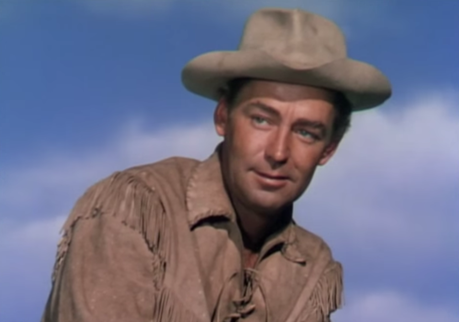
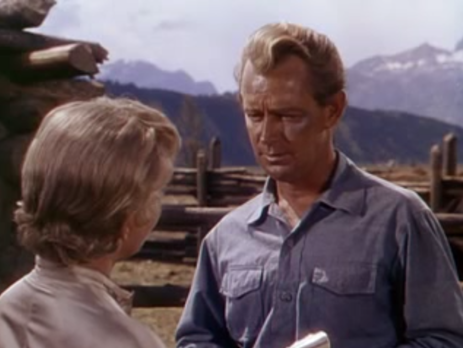
shane1Jackson Hole, Wyoming and the looming Tetons lend the same iconic majesty to this western that Monument Valley does for many of Ford’s best pictures. But then again, George Stevens was another master and he too was changed by the war, coming back with a different tone and an “American Trilogy” that included some of his best work. Shot in Technicolor, this picture boasts more than wide open spaces and raw Midwestern imagery. Stevens has some wonderfully constructed sequences and there are a number of great characters to inhabit them.

Shane is the eponymous gunman who is content to linger in the background while others become the focal point. Namely, Joe Starrett (Van Heflin), a man who came to the untamed land due to the Homestead Act and won’t let the rancher Stryker muscle them off the land that he believes is rightfully theirs. Despite this being her final film — and a favor to her previous collaborator Stevens — Jean Arthur is as wonderful as ever. The character Marian is brimming with goodness and a sensitivity that is hard to discount. It’s a part very different than her earlier work and yet she plays it so wonderfully. As for newcomer Brandon De Wilde, he’s an astute little actor and we really see this world through his eyes, so he does wonders to hold the story together.

Grafton’s general store and saloon become a wonderful arena of conflict within the film because it is rather like Ryker’s stomping ground since he and his men can always be found lounging around there when they aren’t terrorizing some poor sodbuster. After he agrees to work for Starrett, Shane goes into town for new duds, leaving his gun behind, and he quickly learns what he’s in for. It’s in such a scene that we learn who this man really is. He’s not a hot-head and he initially takes the abuse of Stryker’s guns, who call him out for purchasing soda pop. It’s for the boy Joey, but he doesn’t have to say that, because he needs not prove himself, at least not yet. Also, the relationship between Shane and Marian might be troubling to some — will they fall for each other — but when Ryker makes insinuations about Starrett’s wife, Shane is quick to shut him up. He’s not that kind of man. When Shane does return to the store, he’s prepared this time for retaliation and although it might not have been the smartest thing, it sure is gratifying for him and for the audience. He and Starrett make a killer team, after all, beaten and bruised as they end up.

shane2What follows is retribution from Stryker as he tries to buy out, threaten, and continually lean on the sodbusters, but Starrett remains resolute in keeping his friends together. In fact, there’s still time to share a wonderful Fourth of July dance with all the neighbors and it shows signs of a brighter, happier time that could be possible. With neighbors joining together in simple community and sharing life together. Shane feels somewhat out of place in this type of environment, and maybe deep down he knows it too, but he seems oddly content.

This happy time is juxtaposed with the funeral of ornery “Stonewall” (Elisha Cook Jr.), who was gunned down near the saloon by hired gun Jack Wilson (Jack Palance). His death is making some of the others jumpy, but once again Starrett keeps his group together, by first giving their former friend a proper burial and banding together once more. But by this point, they’re barely hanging on. Stryker’s got them on the run and Joe knows he needs to have it out with his arch-nemesis once and for all if things are ever going to return to the status quo. His dreams of ending this whole thing are ludicrous because there is no way he can get out alive. His wife knows it. He knows it, but it doesn’t stop him and his American Dream.

shane3It’s interesting how Shane at first does not try to stop him, but then he gets tipped off to what awaits Joe, and he decides to go in his place. This is his arena after all. The gun we all fawn over is finally getting put to use as Shane rides into town for the final showdown to have it out with the men in the saloon. However, although the shootout is intense it ends very quickly. Thus, what is really interesting are the moments beforehand where friend is literally fighting friend. Both doing what they think is right. However, since Joey only thinks in absolutes, when he sees Shane hit his father over the back of the head, he initially reacts with hatred towards his fallen hero. He doesn’t understand why all this is necessary. But as time goes on and he sees events unfold, he gets it.

As Shane rides off into the night, Joey yells after him to come back, he cannot bear for this idolized man to ride off. It makes me wonder if young Joey grew up with the image of Shane, the hero of his childhood. The doer of good and the ultimate champion of the oppressed.

The cast was rounded out nicely by some solid supporting players like Palance, Ben Johnson, Edgar Buchanan, Elisha Cook Jr., and down to Ellen Corby and even Nancy Kulp. It’s astounding to think that this film could have starred Monty Clift and William Holden potentially with Katharine Hepburn as well. Because, after all, the casting of Shane feels just right. Clift would have brought depth and emotional chops to the role, as a wonderfully impassioned actor. Just look at George Stevens’ A Place in the Sun (1951) for proof of that. However, what Alan Ladd has is a serenity and simple goodness that still somehow suggests something under the surface. It begs the question, how can someone so upright make a living packing a six-shooter? No doubt I like Holden better as an actor, but Heflin has the scruffy outdoors-man look, while still reflecting high ideals. Hepburn just does not seem to fit a western. This is one of the instances when all the pieces seemed to fit into place and we were blessed by a western classic that never seems to lose its luster. In a sense, we become boys again like Joey, completely in awe of Shane. Let us revel in that feeling, that moment of innocence once more.

5/5 Stars

The Strange Love of Martha Ivers (1946)

strangelove1“I don’t like anybody pushing me around. I don’t like anybody pushing you around. I don’t like anybody getting pushed around.”  Van Heflin as Sam Masterson

Lewis Milestone never quite eclipsed the heights of All Quiet on the Western Front. Still, The Strange Love of Martha Ivers is brimming with some engaging performances. Although it is, at times, more of a  melodrama than noir, there is still merit in Robert Rossen’s script. When it does not falter with didacticism, the film has a certain twisted, deep-seated emotion that runs through it. Barbara Stanwyck is the one at the center of it all, as the title suggests.

The film begins in 1928 with three children. The assumption is that these three individuals will become of greater importance later on. After that fateful evening, one would be left without any family, one would leave for good, and one would be left in the perfect position to rise up the ranks. These opening moments boasts spiraling staircases, thunder, the pounding orchestration of Miklos Rozsa, and a complete gothic set-up.

strangelove317 or 18  years later a full-grown Sam Masterson (Van Heflin) decides to return to his old stomping grounds, Iverstown, on a whim. He’s surprised to learn that the “little scared boy on Sycamore street” is now District Attorney (Kirk Douglas). And he’s now married to Martha Ivers (Stanwyck). She and Sam had something going long ago, but he’s all but forgotten it by now. He’s made a living as a gambler who has a pretty handy dandy coin trick, but really Heflin’s character could be anything.
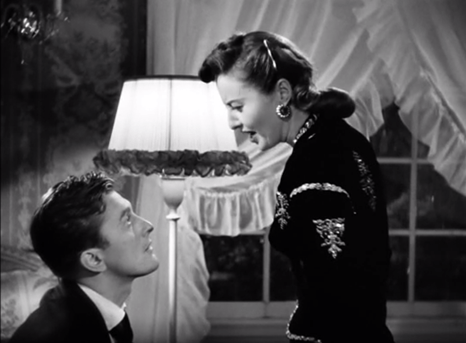
He meets a sultry, smoky-voiced Lizabeth Scott with the pouting face. For those unfamiliar, I would liken her to a Lauren Bacall-type, although she was less well-known and ultimately got typecast in noir roles. Here Scott’s “Toni” Marachek is an often despondent woman who just got out on probation.

strangelove2We don’t actually see Barbara Stanwyck’s face until 30 minutes into the film, but it doesn’t matter. She as well as Kirk Douglas (in his screen debut), leave an impression right off the bat. They are a married couple alright, but she seems to hold the keys to the kingdom, so to speak. All her power is propping him up as he makes his political rise. Perhaps there’s more going on here, however.

From its outset, Martha Ivers looks to be a tale with two threads that slowly begin to intertwine, bringing together some old pals and acquainting some new ones. When Sam wanders into the lives of Martha and Walter O’Neil, it’s putting it lightly that they’re taken aback. The district attorney is good at putting on a face for an old boyhood chum. His wife, on the other hand, is not about to hide her excitement in seeing her old flame.

However, they both think he has an agenda, misreading the twinkle in his eye as intent to blackmail, for a payoff after what he saw all those years ago. But that’s just it. Only we know that he didn’t see anything. Martha Ivers slips up, caught between love, hate, and a suffocating life. She has so much power and yet so little. So much affection and yet so much bitterness.

strangelove5Honestly, although Stanwyck is our leading lady, it’s quite difficult to decide whose film this really is. Van Heflin and Barbara Stanwyck are at its core, but then again, Scott and Douglas do a fine job trying to upstage them. There’s a polarity in the main players, meaning Stanwyck and Heflin have the power, and the other two are the subservient man and woman respectively. However, the film really becomes a constant tug-of-war. Douglas is not just a spineless alcoholic. There’s an edge to him. Scott seems like a softy and yet there’s an incongruity between her persona and that prison rap that hangs over her. Heflin seems like the one relatively straight arrow because as we find out, Stanwyck is fairly disturbed. She’s no Phyllis Dietrichson and that becomes evident in yet another climatic conflict involving a gun. But she’s still demented, just in a different way.

3.5/5 Stars

Review: The Lady Eve (1941)

theladyeve3“You have the darndest way of bouncing a fellow down and bumping him up again” ~ Henry Fonda as Charles Pike

The story goes that screenwriting wunderkind Preston Sturges penned The Lady Eve with Barabara Stanwyck in mind. He promised her a great picture and he most certainly delivered a stellar screwball like only he could. It plays off the archetypal biblical temptress with comic effect, and it finds the greatest of comic couples in Stanwyck and Henry Fonda. They both are iconic stars, but the narrative works so well, due to that, but also the fact that the film constantly undermines the typical plotting. As the title suggests the woman is really the focal point of the film — she’s the one in control.

In this instance, Stanwyck is shady trickster Jean Harrington, who joins forces with her equally conniving father (Charles Coburn) to take people to the cleaners in any way possible. They’re real smooth operators with cards and any other type of con you could think of. A luxury ocean liner seems like the perfect place to set up their business. Out of all the many high profile passengers, one man stands a head above the rest. His name is Charles Pike (Henry Fonda). He keeps his nose buried behind a book, tries to avoid the gazes of all the pretty girls, and has a penchant for reptilian wildlife after getting back from a long expedition. He also just happens to be the heir to a gargantuan Ale fortune. That’s what catches everyone eye, including the beautifully sly Stanwyck.

theladyeve2In fact, we have a brilliant introduction to her as she narrates the scene unfolding in front of her with the aid of her compact mirror. She trips up the bumbling bachelor and their introduction is the first exclamation point in a bumpy relationship. She’s ready to play him and marry rich and famous, because he’s a pretty naive fellow, and stiff around the ladies. Fonda’s nervous charm proves the perfect recipe for success as he is constantly being overwhelmed by Stanwyck’s frenetic barrage. His defenses are down and he hasn’t the foggiest what has hit him. Either he was really that uncomfortable or otherwise, he does a superb job of faking it since there’s never another moment where he’s not being fondled or manipulated.
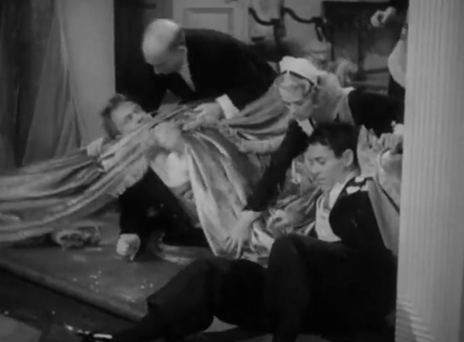
Jean is very quick to get cozy with “Hopsy” (after alcohol and not a rabbit), but something strange begins to happen. For some strange, ludicrous reason she begins to fall for her mark — this goofy guy with loads of cash. That certainly was not in her cards, yet she doesn’t seem to mind. What follows are some wonderful card playing antics between Charles Coburn and Barbara Stanwyck as she tries to stave off her father from pulling one over on her new beau. But of course, just as Pike is getting his sea legs he catches wind of the whole charade quite by chance, and he’s quick to turn off Harrington for the fraud he thinks she is.

theladyeve4The story could end there, but Sturges has set his story up perfectly for a killer second act. Jean plans a perfectly sneaky revenge plan to get back at “Hopsy” by posing as the British niece of another con man (Eric Blore). He uses his own wily charm and influence to get them an invitation to the Pike household for dinner. There we see several other great character actors in action including Horace Pike (Eugene Pallette), and the perennial sourpuss Muggsy (William Demarest). Jean shows up now as the Lady Eve and successfully convinces her “Hopsy” that she is a completely different individual. The film works wonderfully on this axle of ludicrousness because  young Pike is completely befuddled and awestruck again. He goes thudding, clanking, and crashing all evening long, a true victim of love. Pike thought he lost one girl for good and here’s another even better prospect. A whirlwind romance follows and everything is falling into place beautifully. There’s a frantic montage in preparation for the big day and then it happens. They get hitched. Afterwards, it’s all done and the two lovebirds are on a train barreling down the tracks interspersed with the long laundry list of all Eve’s beaus from Angus, to Herman, and Cecil and so on. It’s Charles’ worst nightmare, and he hopes to get out of it as quickly as possible.

But then by chance, he runs into the first girl, who is, of course, Stanwyck as well. He’s genuinely happy to see her, and they embrace like nobody’s business. Being the honorable man that he is, Pike acknowledges that he is, in fact, married now, but the joke’s on him. She is too! It’s an entirely irregular ending, but that’s screwball comedy for you.

theladyeve1What makes Sturges’ film so wonderful is all the parts making up the whole. His script is perfectly contrived mayhem. He sprinkles it with his typical slapstick, his loudmouthed stock company lends an added layer, and his typically lightning-quick repartee is brought to life by his leads. Stanwyck was the quintessential leading lady of the 1940s and in 1941 she was in fine form (Balls of Fire and Meet John Doe). She can dance so effortlessly between dynamic comedy to heartfelt drama that is positively palpable.  She overshadows Fonda in a sense, but they still work together, because he is her perfect foil, the precise innocent fool to fall into her web of feminine wiles. She can muss up his hair, manhandle him, and completely manipulate his feelings. Yet we still like both of them in spite of it. They are a hilarious match, and there’s space for some passionate canoodling as well. It’s probably one of the most perfectly wonderful, utterly dysfunctional relationships we could ever hope to see put on screen.  By continually whipping out punch line after punch line to the very last quip, Sturges makes this comedy look positively effortless.

4.5/5 Stars

Review: Vertigo (1958)

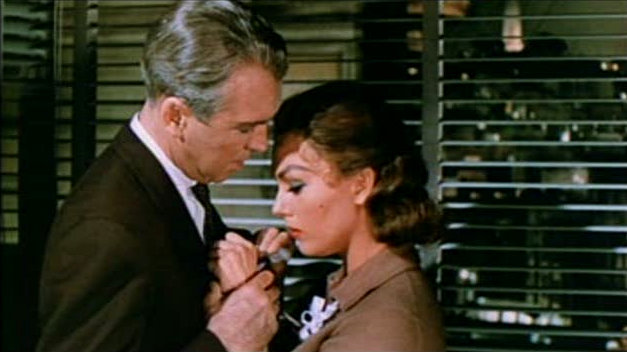
Vertigo_1958_trailer_embrace“The Greatest Film of All Time.” It certainly seems like an arbitrary title, but if nothing else it gives film aficionados something to discuss. And that’s what Alfred Hitchcock’s Vertigo is now being called for many reasons. Rather than join the debate, I wish to take a few moments to acknowledge what makes the film itself special.

On the surface, shall we say the first viewing, Vertigo is thoroughly enjoyable as a psychological thriller and mystery. The title sequence is haunting with an eye staring back at us from behind the credits and as an audience we are quickly thrown into the action, watching the opening chase scene unfold. In only a few moments one man is dead and the other John “Scottie” Ferguson (James Stewart) now has debilitating vertigo that takes him off the police force. We never learn why they were chasing a man on the rooftops. It doesn’t really matter. It’s a time later with his friend Midge (Barbara Bel Geddes) that we first see Scottie after the harrowing events. She obviously cares deeply for him, and he sees her simply as a good friend so we can undoubtedly expect her to be in the film more.

Then, rather mysteriously, an old school acquaintance named Elster (Tom Helmore) calls up Ferguson, hoping to get him to shadow his wife. It has nothing to do with infidelity, but fear, because the worried husband believes that something is wrong with his wife Madeleine. She disappears for hours at a time and is barely conscious half the time. He would describe her as possessed and Scottie is noticeably skeptical. But he relents and agrees to tail her sending himself spinning headlong into a mystery that will become his obsession.

Vertigo_1958_trailer_NovakHe gets to know Madeleine by following her, all throughout the streets of San Francisco, and much like Rear Window, this part of the film becomes a repetition of scenes followed by the reactions of Stewart. Hitchcock’s background in silents is seemingly at work here as he lets the images and score of Bernard Hermann take center stage along with Stewart’s expressions. We end up all over, from a flower stand to a cemetery, an art museum, and an old hotel. Madeleine goes from place to place like a solemn specter and we watch in expectation. Something must happen.

In an instant, she leaps into the water near the Golden Gate to commit suicide and that’s when Scottie swoops in to rescue her. He can’t lose her now because by this point he’s entranced by the icy blond who he only knows from a distance. And so their relationship progresses if you can call it that. They wander together and Madeleine shares her nightmares with Scottie.

The two of them head to San Juan Bautista and that’s when the nightmares become a reality for both of them. It’s devastating to Scottie, and the second phase of the film begins. He’s inconsolable and madly in love with this girl he cannot have. She’s hardly real. But then wandering the streets listlessly he spies Judy Barton, who coincidentally looks strikingly like Madeleine.

So he does the only thing that he can think of, meet her and try to turn into the girl he so desires. His obsessions are the only things that drive him, that and the haunting memories. Finally, he figures out the mystery, but the swirling cycle continues as he goes back to San Juan Bautista. A cruel twist of deja vu rears it’s ugly head once more.

Vertigo_1958_trailer_Kim_Novak_at_Golden_Gate_Bridge_Fort_PointHitchcock always was one for visual showmanship and it reveals itself whether it’s the parallel symbolism that Scottie notes in the painting of Carlotta Valdes or the out-of-body dream sequence that he suffers through. There’s also the dizzying zoom creating the so-called Vertigo Effect whenever Stewart looks down from a great height. These are obvious visual flourishes, but it’s almost more interesting to watch our main characters walk the streets of San Francisco, especially since there are so many real landmarks to work with (ie. Golden Gate, Mission San Juan Bautista, Muir Woods National Monument, and the Coit Tower among others). There’s something mesmerizing and trance-like about all these scenes that’s difficult to discount. It pulls us in as an audience. We want to see more. Bernard Hermann’s score is, of course, noteworthy and at its core, there is a constant disconcerting quality. It is strangely majestic and beautiful, but it pounds away menacingly. And it spirals in and out with the same sounds, the same crescendos. You think you would get sick of it, but strangely enough, you don’t. It enraptures us.

Vertigo_1958_trailer_embrace_2Then there are the players. Kim Novak has the dual role as Madeleine and Judy. She carries out both with the needed precision. Elster’s wife is elegantly beautiful, aloof and ethereal in a way that makes her the obvious fantasy of Stewart’s character. When she casts a sidelong glance or stares up at Stewart there is a faraway quality in her eyes. The clothes. The hair. How she talks. Even how she carries herself. She is spellbinding, otherworldly, and almost unattainable in all ways. Then there’s Judy, the epitome of a Midwestern girl. Pretty but not elegant. Smart but not cultured. But she falls for Ferguson as he falls for an impossible ideal.

Vertigo_1958_trailer_Stewart_on_a_laddderJames Stewart is an important piece in this film because it’s his character’s obsession that drives the plot. His instabilities, his desires, his anguish, his vertigo. It has been said that Stewart himself is a stand-in for Hitchcock and the own inner workings of the director’s being. His obsession and lusts. That may be true but something else that could be inferred is that Stewart is really a stand-in for all of us. After all, there was no greater every man than him, but there also is a universal quality to the baggage weighing on his being. Stewart’s every man is certainly being subverted, or could it be he is becoming a more accurate depiction of everyone? It’s a scary thought but what is buried inside of us? What are our own fantasies, obsessions, and lusts that lurk under the surface? Let me put it a different way.

For Stewart, he has three prominent women in his life. There’s the fantasy in Madeleine, the perfect ideal, who will ultimately ruin his life because intimacy with her is impossible. There’s Judy who has a passionate love for him, but it seems complicated in so many ways. She’s trying to measure up to his standards. The ideals and fantasies he has created poison what they could have. Then, there’s Midge who is practical, funny, and also completely devoted to Scottie. If his head were on straight he would go right to her because he would undoubtedly find the most satisfaction in that relationship, but his obsessions have undermined that.

There was an alternate ending of the film which showed Scottie with Midge once more, listening on the radio about Elster’s capture. The ending that was kept is more powerful, not because Elster got away scotch free, but because we don’t see Midge again. She all but disappears by the end of the film and with her goes all that could have been decent and good about reality for Scottie. He gets so caught up in fantasy and that tears his life apart. He’s literally spiraling in a web of never-ending hellish obsession.  Who knows what becomes of him? We can only guess.

5/5 Stars

Easy Living (1937)

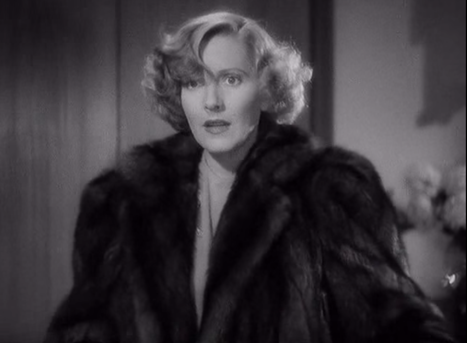
easyliving1Easy Living is a sizzling screwball comedy propelled by a Preston Sturges script and the direction of Mitchel Leisen (a former costume designer). It finds humor in the stratified 1930s society and the so-called easy livings of the affluent. But it also has it’s fair share of rip-roaring slapstick. Really the whole plot revolves around a rogue fur coat.

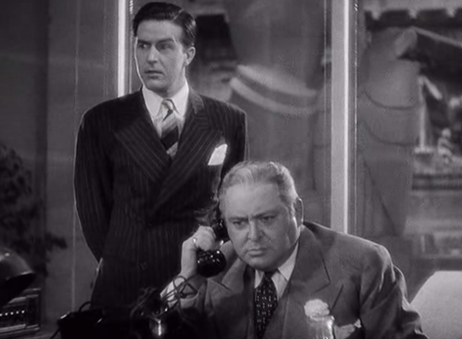
J.B. Ball (Edward Arnold) is the third most prominent banker in New York. His wife has a penchant for fur coats and his son John Jr. (Ray Milland) is fed up with his father’s constant criticism. He’s ready to leave the luxury and make a go of it on his own. Fed up with his wife and not all that pleased with his son, Mr. Ball tosses one of his wife’s sables off their balcony. Mary Smith (Jean Arthur) is the unsuspecting recipient of the coat as she rides by on a passing bus. By chance, she and Mr. Ball strike up a conversation and they hit it off after he resolves to buy her a new hat, in lieu of the one that was ruined. Of course, the clerk gets the wrong idea about their little friendship and it has major repercussions.

Many folks want to get on her good side since they’ve heard through the grapevine that she’s connected to Mr. Ball. This includes the befuddled hotel owner Louis Louis, who offers Mary one of his finest suites and she has no idea what she ever did to deserve it. Of course, Mary crosses paths with John Jr. who is smitten with her right off the bat. But she has no idea who his father is.

A joke from him, relayed by Mary, ends up having overwhelming consequences on the stock market and it ends up spelling major trouble for Mr. Ball. But of course, father and son and Mary all wind up in J.B.’s office together as the comedy of errors finally synchronizes. Son finally proves his acumen to father and gets the job he desperately needs.  Mary has her guy now and Mr. Ball’s marriage is all intact.

easyliving3Edward Arnold is an absolute riot and at his pushy best as the affluent banker. Jean Arthur has always been one of my favorite comediennes. She has such a great voice for delivering quips; there’s a certain lilt to it that is always invariably funny. She’s also the perfect independent working woman like a Barbara Stanwyck or Rosalind Russell. She’s no pushover. I knew Ray Milland for later films like The Lost Weekend or Dial M for Murder, but I saw here firsthand that he has some comedic chops. I also learned what an automat was and at the same time got treated with some top-notch slapstick. Thank you, Preston Sturges.

4/5 Stars

Hold Back the Dawn (1941)

holdbackthedawn boyer de havilland 5Hold Back the Dawn was written by the winning combination of Billy Wilder and Charles Brackett, but the director was actually Mitchell Leisen. That was the last time Wilder would let someone else take hold of his work. It’s actually rather meta, a film within a film. We see our director and a film being made (Complete with Veronica Lake), but that is only a pretense for this story to be told.

Georges Iscoveu (Charles Boyer) wanders into the studio hoping to tell his story to somebody who might help him. The tale goes something like this. Much like many other hopeful emigrants, he heads to Mexico in an attempt to try and get into the states, but he’s told that he’ll have to wait and so Iscoveu holes up at the Esperanza Hotel with all the other masses. Time passes and he is getting nowhere fast, but he does bump into an old partner in crime named Anita (Paulette Goddard). Undoubtedly using her feminine charms, she wrangled herself a husband in order to secure herself citizenship. Then she swiftly got a divorce to close the deal. She’s a real peach and she plants the idea in Georges because he is desperate after all.

The gears are turning and he sets his sights on the pretty young schoolteacher, who is in Mexico with some of her students. Their car is in the shop, and after swiping a sprocket, Georges goes into action.

With soaring rhetoric, he wins Miss Emmy Brown over and he puts a ring on it, a borrowed ring from Anita to be exact. He’s a real cad, but it is a Charles Boyer leading man.

To her credit, Olivia De Havilland plays this ingenue and small-town teacher with bright eyes and idealism. We cannot help but feel for her because this is a woman who is swept off her feet and she exhibits true affection. She’s naive, but as Georges acknowledges, she’s swell. Anita has plans for them to meet up once the marriage is terminated because she thinks that she and Georges can run in the same circles once more. But all the time he has spent with Emmy has not left him unchanged. Car rides and travels through Mexico becomes intimate and sweet. So somewhere there is a turning point in the psyche of Iscoveu. It no longer becomes a con game with Anita, but a true romance with Emmy.

However, the trouble comes when the inspector named Hammock (Walter Abel) comes sniffing around because the marriage of Emmy and Georges seems obviously fishy to him. But Ms. Brown does the noble thing and defends Georges not out of ignorance, but charity. She knows she was living a dream and is about to go back to reality, making the drive back to her home in Azusa, California.

Georgholdbackthedawn6es has what he had initially set out to get, but the story cannot be over. When he hears of a deadly car accident, he rushes across the border without heed of the law so that he can be with the love of his life. It’s a gushy conclusion that looks like it might end badly. After all, Iscoveu broke some major laws, but Hammock gives him some grace showing he’s a softy at heart. Even Anita gets what she’s always wanted.

The film is a treat because we not only get an A-grade performance from De Havilland, there’s a conniving Paulette Goddard, and even a brief cameo by everybody’s favorite Peekaboo girl Veronica Lake. Curt Bois (the pickpocket from Casablanca) also makes a spirited performance in one of the minor plots.

Hold Back the Dawn certainly begs the question whether Wilder’s own experiences are infused into this story since he often told anecdotes about his emigration into the U.S. which ultimately led him to success in Hollywood. Also, this film suggests that Mitchell Leisen is not so much a great director or a maker of masterpieces, but he is in his element with romances. However, I wonder if part of his success was having the likes of Billy Wilder and Preston Sturges writing scripts for some of his most prominent films (including Easy Living, Midnight, and Remember the Night).

4/5 Stars

Review: Sullivan’s Travels (1941)

Veronica_Lake_and_Joel_McCrea_in_Sullivan's_TravelsIf Preston Sturges was a comic wordsmith then Sullivan’s Travels was his magnum opus. It has so many pieces worth talking about, despite it only running a meager 90 minutes. It is the kind of comedy that director John L. Sullivan (Joel McCrea) would want to make, and it’s a message movie against message movies. It’s a film about filmmaking (including mentions of Capra and Lubitsch). There’s even a scene where an ecstatic actress goes racing around the studio lot, completely disregarding the period piece she is acting in. The script has the undeniable frenetic poetry of Sturges and even takes time to wax philosophical at times. Sullivan opens the film with some very grandiose vision of what film can mean for the everyday filmgoer (I want this picture to be a commentary on modern conditions. Stark realism. The problems that confront the average man!).

Sturges’ film is scatterbrained and insane in its pacing at times. Take the opening speeding sequence as a newly bedraggled Sullivan tries to shake his caravan so he can really get a feel for the common man’s plight. It almost gives you a heart attack as they blitz down the road, people and everything imaginable flying every which way. It’s faster than most modern action sequences could achieve.

However, although Sturges is undoubtedly known for the strength of his scripts, it’s important to note that Sullivan’s Travels has some wonderful visual sequences. Many of them lack his typical lightning dialogue and instead rely on music and images to develop scenes. Sometimes it’s the plight of the homeless on the road as Sullivan and his companion make their way across country. I would have never thought of this comparison before, but sometimes his heroes elicit the same type of empathy that would be given to Charlie Chaplin or the Gamine (Paulette Goddard) in Modern Times. In that same way, this film so beautifully fluctuates between comedy and heartfelt drama.

Another beautiful thing about Sullivan’s Travels is the cast. Our star is Joel McCrea, who is sometimes known as the poor man’s Gary Cooper, but that is rather unfair because he’s a compelling actor in his own right. Just look at this film to prove his case. Also, he and Veronica Lake (Ms. Peekaboo Haircut herself) have a fun relationship going from the beginning when they first meet in a diner. You might say the shoe’s on the other foot since she thinks she’s doing a good deed for this down on his luck nobody. She has no idea that her “big boy” is actually a big shot movie director. However, it makes no difference, because in some ways she feels responsible for him, and so she takes part in his noble experiment even afterward. That’s where we build respect for them, and she, in turn, falls for him. It’s what we want as an audience. And we finally get it when Sullivan beats his death and a chain gain to return to civilization. His nagging wife has married some other boob, so Sullivan gets his girl.

Sometimes I feel like a broken record, but it definitely seems like they don’t make character actors like they used to. It helps that Sturges has a stock company of sorts and the studio system probably helped in propagating certain actors. However, there’s no doubt that players like William Demarest and Porter Hall are so memorable. Their voices. Their look. There’s no escaping them and there are numerous other faces that you get deja vu with. We’ve seen them before somewhere and just cannot place it.

Within this whole story of comedy, romance, and a heroes journey, there is, of course, a moral. However, I don’t mind Sturges and his simple didacticism. Because he ditches high rhetoric or sickening idealism for a simple conclusion (There’s a lot to be said for making people laugh). A Pluto cartoon short that brings a few giggles can be just as impactful in this world of ours compared to the next big Oscar drama. That’s what Sullivan’s Travels led to. A change in perspective through a hilarious itinerary.

5/5 Stars

Union Station (1950)

unionstation1Although it features the pairing of William Holden and Nancy Olsen, Union Station certainly is no Sunset Boulevard, but it doesn’t need to be. It’s a modest procedural of 80 minutes, but it has a gritty realism that is rather reminiscent of Pickup on South Street (1953) or The Naked City (1947). This is ironic since it’s hardly believable and yet it still ropes us in. The story goes something like this.

A young woman  (Olsen) says goodbye to a blind friend and later after she boards a train, she sees two suspicious men board the same car as her. At the final destination of Union Station, she goes to lead cop Willie Calhoun (Holden) who uses his network of plainclothesman to investigate and tail the men. As it turns out, the blind girl has been kidnapped and a ransom is put up for her at $100,000. Her father is understandably desperate to get her back and does whatever he is relayed to do. He remains in contact with Calhoun and the Inspector named Donnelly (Barry Fitzgerald) who resolve to get his daughter back and apprehend the perpetrator.

However, the man they are dealing with has been around the block a few times, and he is well acquainted with Union Station. Thus, the station becomes the main point of interest in the film evolving from less of a game of cat and mouse to a chess match. Men are tailed aboard trains, in terminals and everywhere else. When one man leaves another takes his place, eyes are always watching and the beauty of it all is you can never tell who is a policeman and who is not in the veritable mass of humanity. But it goes the other way too.

The ransom is ultimately set to go down at Union Station and just in the nick of time, Calhoun catches a break. All that’s left is to chase down the mastermind, but it’s not so easy as he also has the blind girl Lorna stashed away. Calhoun must race to apprehend the culprit while also getting to Lorna first. It’s a photo finish.

Did I say already that Union Station employs a gritty realism? Well, it does, and it is full of slimy criminal types pitted against no-nonsense cops who are not opposed to using rough methods if necessary. Willie Calhoun is the number one tough guy and he’s relentless in his job as the intense finale suggest. Donnelly is a character blessed with the voice of a Leprechaun thanks to Fitzgerald and believe me that’s a compliment. He’s a personable, mentoring type who is a nice compliment to Holden. Inquisitive Joyce Willecombe is necessary to get the plot rolling and also as the love interests, but Nancy Olsen gives an appeal that reaches farther than that.

Enough said, now take a trip down memory lane to Union Station where you are sure to be lost with the masses in this engaging procedural.

3.5/5 Stars