
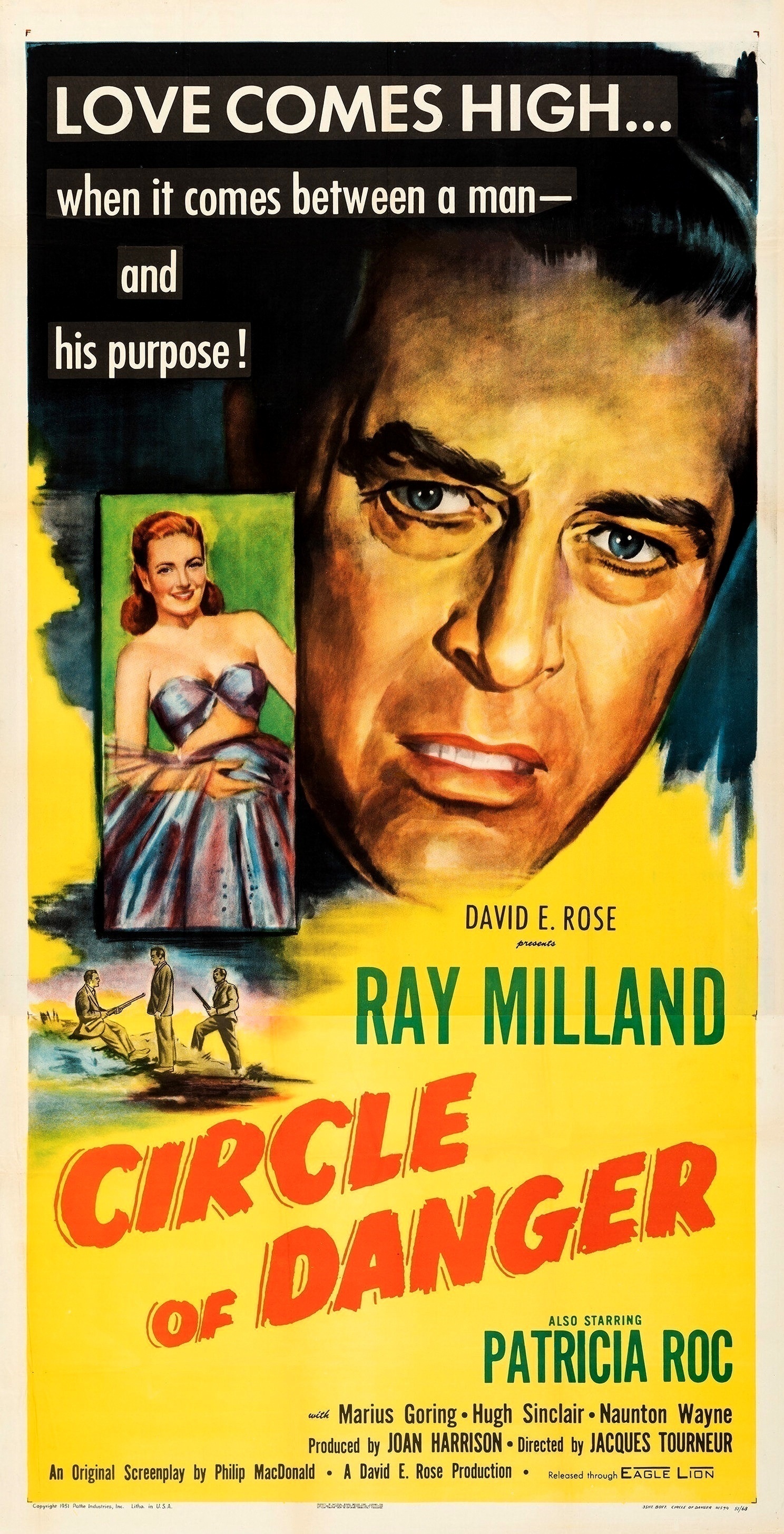
 Circle of Danger introduces us to our hero, Clay Douglas (Ray Milland), off the coast of Florida. He’s part of a team of salvagers culling the depths.
For others, it’s a moneymaking proposition. For him, it’s solely mercenary. The first sign of real dough, and he parlays it into a trip to England. It seems ludicrous, but it also shows how determined Clay is to get there. The question remains, why?
With this one jump across the Atlantic, it might be possible to call Circle of Danger a globetrotting thriller, though it’s one on a budget, and the story becomes localized to the British Isles.
Jacques Tourneur seems far more comfortable dealing with the environs of this picture than something All-American like Easy Living. He might not be British, but the sensibilities of the movie are closer to his European roots.
Joan Harrison feels like another crucial figure. Not only was she a pioneering producer, but she came through the ranks under the tutelage of Hitchcock, learning her trade on projects like The Lady Vanishes and Foreign Correspondent. It’s easy to see this lineage being continued with Circle of Danger.
It’s fascinating to dig into the picture because it straddles the line between British-American mimesis as only Classic Hollywood can. Harrison feels like a major part of this connective tissue, but also our lead actor, Ray Milland, was born in Wales, yet he plays the American.
When he has to pay the cab fare, he’s as nonplussed as any of us Americans might be by shillings, pence, bobs, and crowns. A young woman he meets, named Elspeth (Patricia Roc), shows him a beautiful panorama of the Scottish Highlands on her walk home, overlooking a lake. She recites the name in Gaelic, and he asks the meaning. It’s a fantastic world for him as it is for us. Florida feels like a distant memory.
Former Gainsborough girl Patricia Bloc has a vivacity to go along with a pertinacious nature, which works well in a more contemporary role. She’s determined to resolve a friendly quibble over Mary Queen of Scots, and he’s only interested in getting to know her more as he continues his search.
The movie itself feels relatively vague about it, though the reason Clay met her at all was in service of his fact-finding tour. You see, his younger brother fought with the British during the war and was killed in action. He’s not satisfied and suspects some foul play.
A man named Hamish McArran (Hugh Sinclair) led the mission. He and Elspeth have been close for quite a long time. Beyond jealousy, he also seems quite hesitant to help Douglas with the list of names from the raid. Feigning any reason to get out of it. While he hardly plays the villain, there is a kind of British stiffness about him. He wants to let sleeping dogs lie, as it were.
While you would never confuse it with an Archers Film, there is some similarity in the romantic milieu going places Hollywood would rarely occasion, aside from How Green Was My Valley or National Velvet. The inclusion of Marius Goring also helps in this regard, since he played such an integral part in some of Powell and Pressburger’s finest works.
He makes an appearance as a successful choreographer named Sholto, though he’s hardly very accommodating when it comes to divulging information about the war years. Still, Clay weaves his way all around, meeting the remaining veterans for any possibility of a lead. The premise is simple, with Milland being our primary searcher, and yet, as with many of the director’s pictures, it’s the full breadth of the world Tourneur builds around him, making it feel like a proper story.
Clay’s new girl quite understandably gets a bit frosty about being stood up on two subsequent evenings. After being stymied in his initial efforts, a bit of a frenzy takes over him as he meets a car salesman and a final eyewitness who seems to recall what happened to the brother. He saw it from a distance, and his memory’s foggy after so many years. Also, he expects some quid pro quo; the man’s a car salesman after all.
There’s an elegance to the crime’s eureka moment reminiscent of a Fritz Lang picture, like M, or the early Hitchcock thrillers like The 39 Steps. This momentum builds into a confrontation of sorts, though it subverts the typical bombast for something that fits the world and its circumstances rather well.
The only sequence with guns somehow imbues them with an inordinate amount of power. While Clay and Hamish get into the latter’s gun rack and ostensibly go out for a leisurely afternoon of “hunting,” our minds and their expressions suggest it might be something far more sinister. Or is it only a false alarm?
Clay seems to be ganged up on by another accomplice in the crime. Has he met his executioner in such a desolate place? But the movie gives us a final twist that puts the entire story in a new light.
Perhaps it’s too easy, but it feels like a supremely British ending. Instead of brutality and violence, it burns off and leaves us with a final subversion of our expectations. Tensions over the past are left to simmer as our hero rushes off to a Hollywood ending with his girl.
No one talks about this picture, but it plays as a lovely heir apparent to the Hitchcock thrillers as shepherded by Tourneur and Harrison or even Milland’s nail-biting foray with Fritz Lang: Ministry of Fear. At its very best, it conjures a modicum of the magic from all of their best movies by bringing darkness into the most idyllic and mundane spaces.
It’s easy to laugh at the triviality of the romance, but the movie needs Patricia Roc just as it needs the rest of the British cast to function in conjunction with Tourneur’s mise en scene. Because they collectively give the story something more than a perfunctory chase or murder plot. They provide the heart and personality that’s distinctly British.
3.5/5 Stars
 4 Star Films