
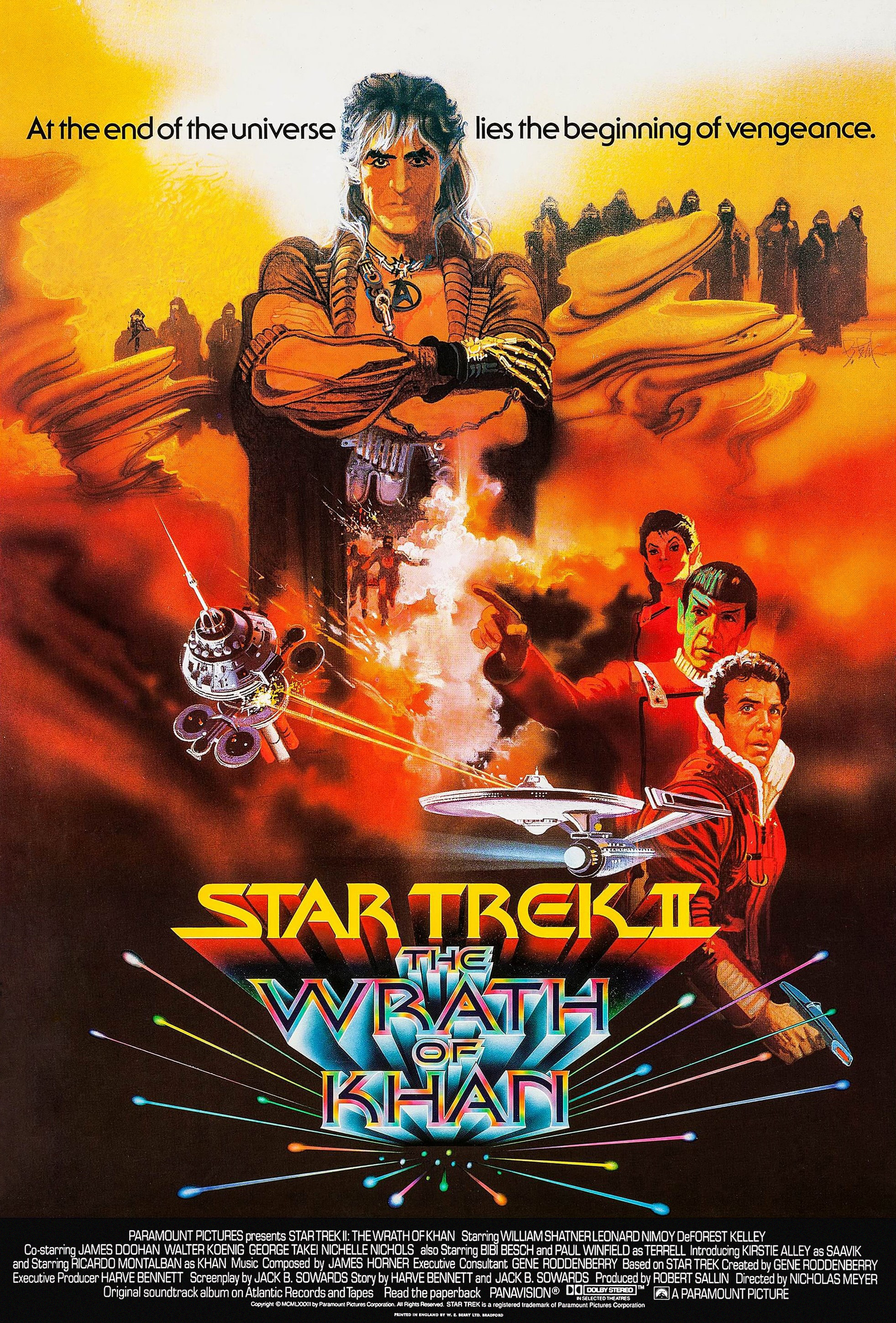
Star Trek II: The Wrath of Khan (1982)

If I had to take a stab at the age-old distinction, I would differentiate Star Trek and Star Wars like so.  Star Wars was a sci-fi Fairy tale and became something more. Star Trek began as a sci-fi allegory on TV and became something more. In a word: beloved.

The Wrath of Khan opens with a scenario involving the usual suspects on the USS Enterprise, except standing in for Kirk is a  Vulcan named Saavik; they must rescue the crew of the Kobayashi Maru, and it all goes terribly wrong.

Moments later we learn that the entire escapade was a simulation.  Kirk (William Shatner), now an admiral, was watching from the wings. It turns out the Kobayashi Maru is a “No-win scenario” elucidating the character of the ship’s commander. You can probably imagine how Kirk handled it in his day, very unconventionally.

Bones (DeForest Kelley) chides his friend to get back out there. He’s not made for a desk job; he’s meant out there on the edges of the galaxy with his crew and wits about him tackling the universe’s most pressing problems. The pull of the movie means he has no choice in the matter.

Captain Clark Terrell (Paul Winfield) and Chekhov (Walter Koenig) lead the crew of the USS Reliant to an uninhabited world; it’s part of an interdisciplinary project to use the newly devised Genesis technology’s immense power to revitalize desolate planets.

There’s something ominous about it after they beam down, and it’s true they are not alone getting ambushed by the vengeful Khan (Ricardo Montalban) who still holds a vendetta for Captain Kirk leaving him to die (see “Space Seed”).

Among his entourage of scavengers he keeps some burrowing creatures as pets and they make his two hostages highly compliant. Khan’s quick to commandeer the ship, and we know what his aims are before he’s put them into action.

A trap gets set to lure Kirk. The USS Enterprise is alerted and comes face to face with The USS Reliant. Their purported friends have treacherous intentions looking to blow them out of space from close range.

There’s a robust theatricality to Montalban’s villain that feels large and provocatively cunning as he holds onto a grudge going back to Star Trek‘s TV days. It’s an inspired piece of work not only in building out the story, but in having the actor back for another installment because he already has a built-in history.

It turns it in a fine chess match and a space opera with Kirk and Khan crossing wits and playing out their old grievances in outer space. It takes this scope and the unfamiliar if appreciated world of space ships, phasers, and light speed, distilling them down into something so intimate and human.

If you’re a cynic, you could say the action mostly involves the two foes talking to each other over video screens. If memory holds, they never actually share the same frame. Still, regardless of what you think of the special effects or the sheer eightiesness of the film’s sets and wardrobe, the story is grounded in a conflict that feels so primal and compelling.

And if that is what gives us a movie, then we must also consider the other relationships. Kirk once had a romantic relationship with one of the head technicians of the Genesis project Carol Marcus (Bibi Besch); her grown son has followed in her footsteps and has a major chip on his shoulder when it comes to Kirk. His notoriety certainly precedes him.

The film is at its best when its heroes are put under duress. Echoing the film’s opening, Kirk and Spock look to rescue them from an untenable situation as they fight back against Khan’s unreasonable demands and Scottie tries to salvage what’s left of the Enterprise in the obliterated engine room. Radioactivity is contained, but with a busted engine, prospects are grim.

Like the second installment in the Star Wars franchise, Empire Strikes Back, Khan is a film about the ultimate sacrifice for the ones you love. If Han Solo did just that in the prior film, Spock does it here. It’s hard to think of two more beloved characters to watch suffer and giving them up hurts.

It’s fitting that the movie references A Tale of Two Cities with Kirk quoting Sidney Carton in the closing moments, “It is a far, far better thing that I do, than I have ever done; it is a far, far better rest that I go to than I have ever known.” This injection of classic Dickens reinforces how Star Trek is always grounded in traditional human history even if it’s pushed onward into future centuries.

Our hero is laid to rest with Scottie’s bagpipes. It always feels a bit anachronistic and then we hear the refrains of “Amazing Grace” in deep space suggesting it can touch even the far reaches of the galaxy.

Kirk eulogizes his buddy saying, “Of my friend, I can only say this: of all the souls I have encountered in my travels, his was the most… human.” That is the profound paradox of this friendship.

Spock’s a fundamentally rational character, and yet all these human impulses are pleased to dwell inside of him. It’s part of what makes him compelling because if we required a manual to read and comprehend him, it would be seem straightforward.

Kirk is the live wire, the unconventional one, who hates to lose — most of all he hates to lose his crew and the people he cares about. Yet in their camaraderie, we see something so formative, and Spock to the end is a noble, loyal friend.

It’s true he does bear the most human of traits and that’s why we hold him so dear because he knows what it is to love and care about other people. He has a heart to go along with his head, continually surprising us with the depth of his humanity despite his stoic countenance.

Like all the great adventure films, Khan has drama grounded in deep relationships, including the primary villain. In such a pressure cooker, every minute of action feels pregnant with real meaning and consequence. It also helps when characters we love and respect are at stake caught up in the middle of it all.

4/5 Stars


Sidney Poitier: For Love of Ivy, Lost Man, Brother John

In honor of the inimitable Sidney Poitier, I spent some time revisiting a bevy of his finest films and also some underrated ones that were new to me. Because he was a prominent archetype for a black movie star, when he was often the only one, it’s fascinating to see the roles he chose at different junctures in his career and how they evolved and played with his well-remembered screen image.

He will be dearly missed, but he left a sterling career behind well worth our consideration. Here are three films you may not have seen before:

For Love of Ivy (1968)

As best as I can describe it, For Love of Ivy, features Poitier and Abbey Lincoln in their version of a Doris Day and Rock Hudson rom-com. It starts out a bit cringy. Lincoln is the maid of the most hopelessly oblivious white family. Mom and Dad are completely blindsided when she says she wants to quit so she can actually have a life with prospects.

Instead of listening to her, the two teen kids ( a hippy Bea Bridges and bodacious Lauri Peters) scheme to set her up with an eligible black man. They know so few, but Tim Austin (Bridges) settles on Jack Parks, a trucking executive because he conveniently has some leverage to get Jack to give Ivy a night on the town. Some awkward matchmaking (and blackmail) ensues to bring our couple together.

Hence how Lincoln and Poitier become an item. But even this dynamic has some unprecedented delights. They eat Japanese food together and visit a club that positively scintillates with ’60s vibes as seen through Hollywood’s eyes. It’s the age-old ploy where the transactional relationship morphs into real love until the truth threatens to ruin the romance. Again, it’s not exactly new hat from Robert Alan Arthur.

Still, with a happy ending and equilibrium restored, Poitier, who helped develop the story, is trusting his audience can read between the lines of all the dorky craziness. For what it is, the movie plays as a great showcase for Poitier and Lincoln. Since there are so very few movies like this with black leads, it feels like a cultural curio. If the mood strikes you, some might even find a great deal more agreeable than Guess Who’s Coming to Dinner because it doesn’t take its own social importance too seriously. It’s mostly wacky fun.

3.5/5 Stars

The Lost Man (1969)

The Lost Man features an edgier more militant Poitier because there’s no doubt the world around him had changed since he first got to Hollywood in the ’50s. He’s cool, hidden behind his shades, and observing the very same world with tacit interest. It’s a world ruled by social unrest as his black brothers and sisters picket and protest the racial injustices around them only to be forcibly removed by the authorities.

Robert Alan Arthur’s film shows a brief focused snapshot of the social anxieties of the age. It becomes more convoluted when Jason and some other members of the organization rob a local bank. Their motives are in some ways philanthropic as they hope to use the funds to get some of their friends out of prison and support their families on the outside. But it’s also an overt act of insurrection in their battle against a broken system.

It also puts lives in jeopardy, culminating in a frantic murder as the police hunt for the perpetrators in the botched aftermath. Jason flinches in a crucial moment and must spend the rest of the movie as a fugitive nursing a bullet wound. These all feel like typical consequences in a crime picture circa 1969.

However, one of the most crucial and fascinating relationships in the movie is between Joanna Shimkus, who is a social worker, and Poitier. We don’t get too much context with them, but it’s an onscreen romance that would predate their marriage in real-life. Their rapport complicates the story because she is a white woman who is so invested in this community like few people are, and she effectively brings out a gentler more intimate side of him.

Although it’s not necessarily pushed on us, their interracial romance puts them both in jeopardy because it’s not the way the world normally operates. The ending somehow gave me brief flashbacks to Odd Man Out, but Poitier’s marriage with Shimkus would last well over 40 years! It’s the best denouement this movie could ever hope to have.

3/5 Stars

Brother John (1971)

Brother John feels like one of those characters who is a cinematic creation. He joins James Stewart’s Elwood P. Dowd and anyone else who was ever sprinkled with something special that enchants the world around them, whether they’re angelic or extra-terrestrial. But Brother John is a different version for a different generation, and he’s played by none other than Sidney Poitier.

He provides a quiet catharsis for a black audience as a cipher of a man that no one can get a read on. The film itself has a no-frills TV movie aesthetic that somehow still gels with its ambitions.

John comes back to town when he gets news of his sister’s death. The last time he came back was when there was another death in the family. The local doctor (Will Geer), who brought John into the world, is curious about where he comes from and where he goes, but no one takes the old man too seriously.

Still, the police manage to hound him because they’re suspicious of someone they cannot easily intimidate and put in a box. The doctor’s self-promoting son (Bradford Dillman) also needles him in his attempt to gain local prominence. The town’s leaders are looking to quell a factory from unionizing. All of this feels rather mundane in detail. John seems to have nothing to do with any of it.

They remain uncomfortable with him because he’s so inscrutable, well-traveled, knows a myriad of languages, and finds no need to divulge all the shades of his character. He’s contented this way, spending time with family and even calling on a pretty schoolteacher (Beverly Todd) who asks for his company. He won’t play by their preordained script.

There’s one painfully excruciating scene where some cops pay a house call on a black family. The man of the house is left so powerless as he’s subjugated and persecuted in his own home in front of his kids. John is at the table too. Quiet at first. Almost emotionless. Is he just going to sit there or spur himself into action?

In this uncanny moment, he goes down to the basement with one of the officers and proceeds to whoop the tyrant wordlessly with a bevy of skills the backwater lawmen could never dream of. It’s the kind of power exerted over malevolent authority that one could only imagine in your wildest dreams.

As such, Brother John fits in somewhere analogous to the Blaxploitation space but as only Poitier could do it. He wasn’t the same bombastic militant cool dude a generation craved for and received in Shaft or Superfly. He still has his measured exterior, and yet he equally makes quick work of any antagonists: racists, malcontents, white, black, or otherwise. It’s a bit of a boyish fantasy watching a hero vanquish all evildoers quite spectacularly. But, after all, this is what movies are for.

3/5 Stars