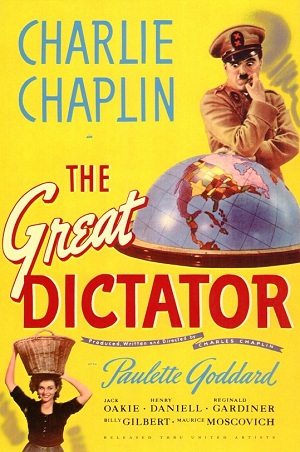
 Starring Charlie Chaplin with Paulette Goddard, this satire blatantly critiques Hitler and the Nazis. The film opens during WWI where a little solider (Chaplin) saves an important military man. However, as a result he lands in a hospital with amnesia. All the while the power hungry dictator of Tomania, Adenoid Hynkel (also Chaplin) is on the rise. The man with amnesia returns to his barber shop in the Jewish ghetto and there he catches the eye of a beautiful girl Hannah. However, as Jews they are not safe, and even when things start improving, quickly Hynkel puts down his iron fist. The barber and another dissident are imprisoned, Hannah is in trouble, and Hynkel is ironing out his differences with Benzino Napaloni. However, after a gutsy escape, the barber poses as Hynkel and makes an impassioned plea to the people.
I see this film as a drama full of pathos. It is important to realize that is is not trying to make light of the situation but it is in fact condemning what Hitler was doing at the time. I think that is part of the brilliance and universality of Chaplin’s films. He could balance drama and comedy so aptly, making it possible for him to tackle this controversial topic head on. Furthermore, even though this was his first true talkie he still kept one foot in the silent age in his portrayal of the barber (very similar to the Tramp), and yet he also acknowledged the very present danger of Hitler. This film has some wonderful moments, but I think the two that really stick out are the opening speech by Hynkel which blatantly derides Hitler’s mannerisms and rhetoric. Then, in a complete 360, Chaplin gives his powerful speech aimed to rally mankind. Overall, it is a stellar duel performance from Chaplin and Goddard is as radiant as ever. That mustache certainly did not hurt the film either!
5/5 Stars

 4 Star Films