It Should Happen to You (1954)

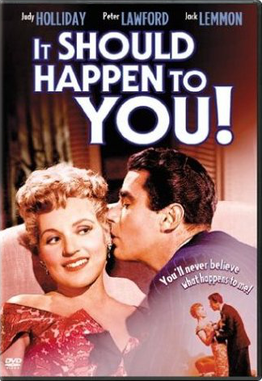
It Should Happen to You was the brainchild of screenwriter Garson Kanin and director George Cukor with Judy Holliday as their lead. As such it’s easy to cast the movie in the same lineage of Adam’s Rib (1949) and Born Yesterday (1950). Except in this movie, there’s also a featured newcomer, a young man named Jack Lemmon.

The movie opens as any respectable New York movie does in Central Park. In the outdoor reverie of men at their chess boards and kids running around, Gladys Glover causes a hullabaloo for feeding pigeons. One man takes particular umbrage at having her try to pick him up while he was minding his own business, listening to the horse races.

In the aftermath, she meets a documentarian, Pete Sheppard (Lemmon), who has his camera at the ready and an eye for people (Think a precursor to Humans of New York). He’s fascinated by this barefoot woman, and strikes up a conversation before they go their separate ways.

There’s an ethereal, fated tone I can’t quite put my finger on, but we know they will meet again and something is bound to happen. Judy Holliday perfectly exemplifies this airy bubbliness. I would never condescend to exhibit her as a dumb blonde archetype because there is far more going on here.

Gladys Glover sees an open billboard and resolves to buy up the prominent real estate on Columbus Circle. For what purpose we can’t be sure exactly. She says its personal. But she goes through the paces, speaks to the proprietor, and forks out the money that’s normally attributed to marketing corporations, not individual citizens.

Soon the words GLADYS GLOVER appear up on a street corner in lettering that looks like high rises. It’s an extravagant decision and Gladys beams with pride seeing her name like it’s never been before. But that’s not the end of it.

The rest of the movie is about the cascading effects it has since movies are meant to feed off delights of serendipity. It Should Happen to You is that kind of movie.

Peter Lawford plays a disgruntled marketing exec miffed to find out someone else has shouldered in on the billboard that has always been theirs in the past; it was an unspoken agreement between them. When he finds out about Gladys he wants to strike a deal with her. Surely a lady can be bought.

It must be said an angry Jack Lemmon is not always becoming and after moving in down the hall from Gladys, he seems to think more and more that he owns her. A more charitable reading of it is that he’s the only person who actually cares for her well-being beyond her growing reputation as a minor celebrity; he’s also falling in love.

Meanwhile Gladys strikes up an agreement to get her name put up on signage all over the city. When she’s shopping with Pete, a saleswoman helps them only for her demeanor to change instantly when she realizes who she’s helping. It’s like being queen for a day as a crowd forms around Gladys soliciting autographs from the local phenomenon.

She has effectively given them something — a nice souvenir to take with them in their day — and in this way it’s hard not to compare her to Elwood P. Dowd of Harvey. In the movie world they’re able to break into the everyday and give people some common decency and kindness.

However, we also watch from a distance as Gladys gets carried away by the mechanisms and machinery of television. She’s paraded out in front of America without much consideration of who she is as a human being. In one segment she’s even featured on a prim and proper panel show with the likes of Constance Bennett and Wendy Barrie. It feels twee by today’s standards, but the point is made.

Soon she finds herself caught between the indignant protectiveness of Lemmon and the business conferences of Peter Lawford including some extracurricular activities. His company has transformed the typical ethos marketing appeal into the Gladys Glover everywoman appeal for the average American girl. It’s a smashing success.

It Should Happen to You doesn’t feel like a groundbreaking story and part of this might be the fact we’ve seen so many analogous film’s in its wake. There’s this tension between celebrity and success and the kind of down-to-earth humanity that keeps one grounded.

I must say I was taken with the ending where Lemmon says goodbye to his girl using a film, and yet again it presages many of the meta qualities of a film within a film that have enamored writers and directors for decades.

In this particular instance, it’s in service of a romance. The happy ending is that he actually receives a reply. Gladys writes it in the sky for him with letters as big as her billboard. She hasn’t lost her knack for the spectacular, but she simultaneously recognizes someone who has her best interest in mind.

If you said you were going to make a romantic comedy with Judy Holliday and Jack Lemmon, it wouldn’t immediately strike me. Still, if you have two likable performers and put them together, the results speak for themselves, even if the returns are mostly modest.

3.5/5 Stars
Cluny Brown (1946): Nuts to The Squirrels

cluny brown

The title card introduces our time and place. It’s a lazy Sunday afternoon in England. The year: 1938. Nothing particularly important is going on except a cocktail party and that’s only important to the host, one Mr. Hilary Ames (Reginald Gardiner).

You wouldn’t call this much of a dramatic situation aside from the minor detail: his stopped sink is about to put a catastrophic wrench into his fast-approaching party. The guests will be coming soon! What will they say?

If this feels like an inane dilemma, then you already have a heart and pulse for what Ernst Lubitsch will be doing over the next hour and a half. Because this is his brand of continental comedy of manners, taking particular aim at the British classes.

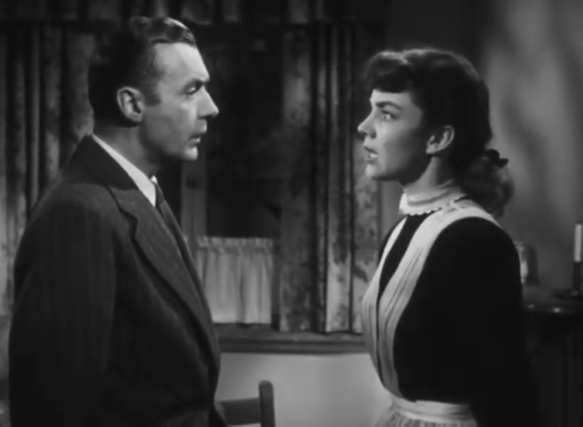
However, he’s in need of some conduits and they arrive at Mr. Ames’s door in the form of Adam Belinski (Charles Boyer) and Cluny Brown (Jennifer Jones). They couldn’t be more disparate figures.

He is an esteemed professor wanted by Hitler for some abstruse reason that’s never explained. Nevertheless, all the social elites pay him the highest amount of deference. Cluny is one of the lower classes — a chipper young lass — with an affinity for plumbing. Fixing pipes that is. She comes to repair the sink of Mr. Ames on behalf of her surly uncle. Although a crisis is averted, the bubbly girl is soon sent off to the country to be a housemaid — a position of propriety for a girl as herself.

Meanwhile, the party finally commences, and it’s what we expect, full of pretentious, huffy party guests. A trio of stultified mischief seekers, Peter Lawford, Helen Walker, and Michael Dyne are on the hunt for something to bring them out of the doldrums. They finally happen upon something arcane enough to pique their interests — a man sleeping on a bed tucked away in a back room.

What’s hilarious about Boyer is how he’s quite literally an anti-scandal maker. Lawford recognizes him as the esteemed thinker and immediately extends him the highest degree of repute. He’s falling over backward to take him wherever he needs to go and shoveling out pound notes to support his cause against the miserable Nazis.

Boyer doesn’t take advantage of these good graces as he meekly deflects most and then folds to a few. The biggest offer is a place to stay at Andrew’s parents — a lovely estate out in the countryside: Friars Carmel Manor. The very same place our plumbing prodigy is taking up residence.

However, the vivacious Cluny starts off her first day on the job on a dubious foot. She actually makes small-talk with the Lord and Mistress of the manor going so far as to drink tea and eat crumpets in their company! This will never do as far as the other staff is concerned. Her catchphrase of choice, “nuts to the squirrels” is tantamount to public indecency.

The key observation is how she never intends to bawdy; she never is. Her spirit simply sparkles brighter than any of them dare to. Because there is an intrinsic bounce in her step and a winsome demeanor burgeoning with innocence and goodwill. It feels totally at odds with the world she’s gone and got herself immersed in. But she makes a bright-eyed go of it all the same. She knows no other way to tackle life.

It’s easy to view this as a riff off the upstairs-downstairs dramas of Jean Renoir — Diary of a Chambermaid for instance — though this does have a Lubitsch twist. He, like the eminent Frenchmen, is readily poking a wry bit of fun at the lunacy of rigid class structures.

In other words, once it becomes evident who you are, people start treating you with respect or lack thereof. The good professor gets royal treatment. Cluny Brown receives the cold shoulder. And of course, they are the most crucial figures as two people totally out of place in the prim and proper hierarchy of the English countryside.

On her day off, Cluny goes prancing off to the chemist, swinging her purse, and wearing a garden on her head. She shares tea with the punctilious Mr. Wilson (Richard Haydn) and his grunting mother, then treated to harmonium music as the man of the house proudly acknowledges his position in the volunteer fire brigade. A walk in the countryside afterward sounds more rewarding. Mostly because they bump into Mr. Belinski; his candor can more than break up the turgidness of the bespectacled chemist.

On another evening, it’s the birthday celebration for Mrs. Wilson, which becomes a telling proofing ground for why this romance of opposites was destined for failure. As the candles are lit and snooty-voiced Mr. Wilson pontificates once more, the plumbing goes haywire. Cluny Brown does what comes naturally to her; she jumps into action, banging away at the pipes right then and there! It’s immaterial whether she succeeds or not. She has trampled over what is considered sacrosanct in these circles. A female plumber! It just isn’t done, and the party dissolves unceremoniously.

Thankfully, there is more to the story. The movie is blessed by these immaculately arranged character parts placed throughout for the likes of Reginald Gardiner, C. Aubrey Smith, Una O’Connor, and still others.

But the most sublime of the surprises, aside from Jones’s sheer ebullience, is how Boyer constantly feints away from his dashing leading man persona. I’m not sure if other moviegoers assumed the same, but one cannot help think that Boyer hearkens back to Maurice Chevalier in all those saucy operettas from the 20s and 30s. For many, Boyer was heir apparent as the only other cinematic Frenchmen they might have known and a dashing one at that.

In other words, we think he’ll do something — act the rapscallion in such a prim society — but this is never his flaw (or his charm). Instead, he takes a genuine interest in others. He feels more like a matchmaker and a fix-it-man making his way through the story with a perceptive eye. And yet Lubitsch is good enough to give him a moment of romance for the sake of the audience since he sees the light in Cluny no one else appreciates.

Likewise, I don’t think I’ve ever appreciated him a role so much, for the very reason he was allowed to be far more than the stereotypical reputation that proceeds him. This extends to him a power — a new kind of novel flexibility — to be something he was rarely granted the opportunity to be before.

He and Cluny make a fine pair of kindred spirits and resident outsiders. In fact, they take to English society like squirrels take to nuts — a bit baffled but good-willed — adding a strain of much-needed gaiety to otherwise stuffy lives. Bless them.

3.5/5 Stars

Easter Parade (1948): Judy & Fred Together At Last

easter parade 2.png

There’s a slight disclaimer that must go with Easter Parade. It has very little to do with Resurrection Sunday. More so, it’s a premium excuse for a lavish musical. At least in this regard, it thoroughly accommodates its audience.

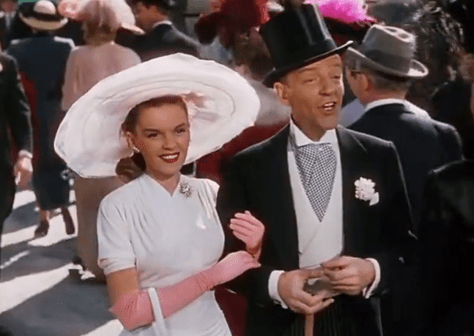
The show starts off gloriously, not with dialogue, but with song, reminiscent of the great operettas of old or the future works of Jacques Demy where the film is buoyed by a range of voices imitating the joyous chorus of life. Here we have the seemingly ageless Fred Astaire strutting down the street greeting folks, doing some window shopping, picking out a hat as models file by and everyone chimes in with “Happy Easter!”

What becomes immediately apparent, even as we are thrust right into song, is the immaculately colored world, bright and cheery, personifying the holiday festivities and simultaneously satiating audiences who come to expect such glorious decadence from Technicolor movie musicals of the age. It rarely disappoints in terms of pure opulent set design.

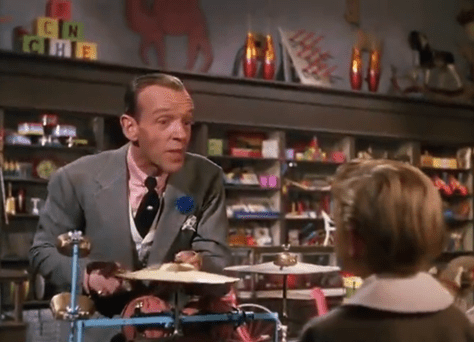
When Astaire spies a bunny in a toy store window, it inspires his finest number in the picture, a worthy precursor in fact to his shoeshine number in The Band Wagon (1953). Because what sets it apart is how alive, lithe, and playful it is. Gene Kelly was imbued with this ability too, but you have to witness it to completely understand the magic when environment and inspiration coalesce.

They could animate the world around them by taking lifeless objects and turning them into tools to personify emotion. Like all the preeminent performers, they take the tirelessly rehearsed and make it feel like the epitome of the organic, in a way that suggests we are discovering something precisely at the same moment they are. We are part of the magic born out of the moment.

Astaire banging on drums and xylophones. Twirling sticks and tossing toys like, well, a kid in a toy store. The story hasn’t even started yet, and he’s already made Easter Parade into something special. It’s when you’re reminded that these lavish musicals were at their best when they momentarily lost their plotlines through acts of artistry and inspiration that still managed to somehow advance the narrative.

easter parade 1.png

At some point, the exposition must arrive and with it a plot. It comes in the form of Don’s ravishing and vain dance partner. Nadine (Ann Miller) is intent on striking out on her own and commanding a larger audience. In fact, she’s already made up her mind and signed a contract with Ziegfeld, leaving Don to start from scratch with a new partner. Regardless, there’s no denying the chemistry they had together. Astaire and Miller absolutely light it up in “It Only Happens When I Dance With You.”

However, now feeling betrayed and saddled with a bit of a Pygmalion complex, he convinces himself that he can turn any second-rate performer into his costar, and he just happens to pick Hannah Brown (Judy Garland). The unassuming starlet splits her time as a waitress at a local bar while struggling to differentiate her left foot from her right. She looks like a hopeless case. Not so!

Fresh off his quality success in MGMs Good News (1947) from the year prior, Peter Lawford is inserted in the storyline as the close friend of Don and Nadine, caught in the middle of their personal and professional squabble. When he meets Hannah in the rain, it only makes things more complicated. One could wager that the handsome and youthful Lawford is partially miscast, but he has a good-natured charm that makes us disregard any of that. We like him as much as we’re supposed to.

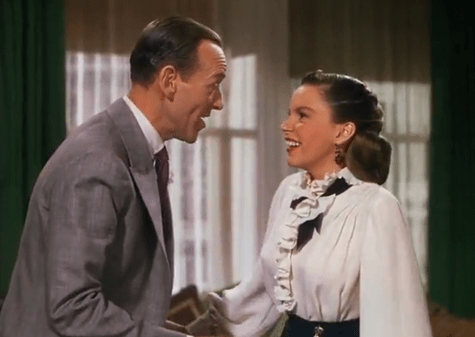
From their initial encounter, the Astaire and Garland relationship is front and center, evolving into the film’s most important dynamic. So far the movie is coming through on its promises. Again, we’re not all that interested in their acting per se, unless I’m just speaking for myself.

What actually strikes my curiosity is seeing them perform in tandem because they were consummate professionals who knew the Hollywood circuit like the back of their hand by now. Astaire, though still looking so spry, had years already logged with Ginger Rogers and others, not to mention stints on Vaudeville and the stage. Garland of course, though still quite young, had, since adolescence, been trained up and groomed in the ways of Hollywood. The shining examples early on, of course, being The Wizard of Oz and then her onscreen partnership with Mickey Rooney.

“Couple of Swells” endears itself as a delightfully corny number with our stars ruefully ditching the fine attire for artful dodger, tramp-like garb. Buying into their affectionate relationship by this point is no difficult task. They’ve made us believe in it.

easter parade.png

In truth, Garland had never met Astaire before their teaming though she had purportedly wanted to work with him for many years because he was the tops — the best of the best.

The rest of the production’s background is tumultuous, and the actual details sketchy at best. Scriptwriters Frances Goodrich and Albert Hackett were initially called upon only to have their draft touched up by Sidney Shelton. Vicente Minnelli was removed as director at the behest of Garland’s psychiatrist, deeming it better for her to work without her husband.

We might also call it an odd chance of serendipity as Gene Kelly (Garland’s co-star in many MGM musicals) was also slated for this project until he broke his ankle playing volleyball (right before production commenced).

Who was coaxed out of retirement to take on the role instead? Only the best: Fred Astaire. And Astaire would retire numerous other times thereafter, but you just cannot keep a man who was born to dance like he was away from the floor. Thank goodness he would come back for numerous more efforts. His successes in the 50s are too innumerable to count.

Simply put, he makes every movie he’s in worth watching for the mere chance that you will glimpse something spectacular. Paired with Garland, a world-class performer in her own right, there’s no missing, even if both have more iconic pictures. That’s probably more a testament to their iconic careers than the merits of Easter Parade. Because it all but delivers on everything you come to expect from the two names written above the title.  There’s a good chance you’ll be left with a broad smile on your face.

4/5 Stars

Good News (1947)

good news 1.png

The title Good News means next to nothing to me but it does suggest a certain sunny disposition we tend to equate with MGM musicals of the period. That assumption is fairly well-founded. Furthermore, I am well aware of Adolph Green and Betty Comden, that screenplay dream team, an integral part of Arthur Freed’s unit that had so many quality pictures to their name.

Most obvious inclusions include Singin in the Rain (1952), On the Town (1949), and The Band Wagon (1953). And here they are working in the realm of retro nostalgia pieces, their forte, a light comedy scattered with quips and a substantive lineup of tunes. But the important differentiation here is that this was the first one. This is where it all began, in theory at least, making them into a screenwriting mainstay. While the picture has long since been overshadowed by its successors and was never a huge box office success, there’s no doubting the unassuming charms still present in Good News.

Like Singin in the Rain (1952), the year is 1927 but instead of film sets in a Hollywood back lot, we are met with the world of Flappers and Sheiks — the names for boys and girls on college campuses across Middle America. On this particular campus, good ol’ Tait University, the boys are batty about football and girls and the girls are batty about boys — at least on a very basic level. So nothing is all that different.

And yet for anyone born in the latter half of the 20th-century, you can’t help and look at the depictions and think that everything is different.  Whether its styles of clothing, social rituals, colloquialisms, practically everything. Granted this is a musical.

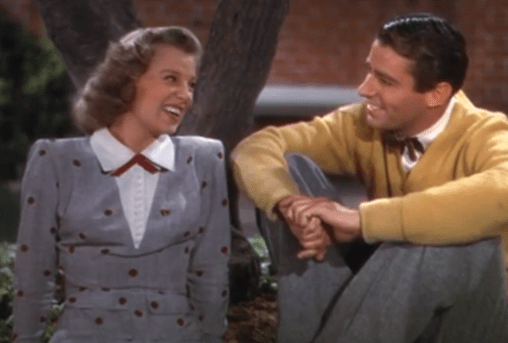
Still, the school’s All-American running back Tommy Marlowe (Peter Lawford) shimmies, shakes, struts, and sings with his buddies about the necessity of being a ladies’ man on campus. Because when they’re not on the field the subject of utmost importance is girls. Obviously. Thus, when a new girl fresh off of finishing school brings her refined manners, stuffy French vocabulary, and flamboyant dress, all the boys heads start turning including Tommy’s.

But as is often the case, not everyone is so infatuated or completely distracted by the opposite sex. For instance, we meet Connie Lane (June Allyson) as she calls for a wrench to remedy a leaky sink and she’s dressed to the nines. She’s a good student and pays her way through school at the local library. Boys are not her main concern though that’s not to say that romance doesn’t tickle her fancy.

So the film is a frolicking and invariably cheesy examination of the mating rituals of college kids. It’s crazy stuff sometimes but be assured we are in for a light and breezy good time — a squeaky-clean version of what college life is if you will.  It’s also short on plot but what is there proves to be a springboard for song and dance. For the most part, that’s promise enough.

A highlight is the familiar velvety fog of crooner Mel Torme as well as the rather dorky but endearing wiles of Joan McCracken who feels much in the same vein to parts Betty Garret would ultimately play. Of course, this is really the Lawford and Allyson show as they must come to know each other, show genuine feelings, get confused about it all, and fall back together again. That’s the way the story has been told since the dawn of time. This one is little different.

A formative number comes off as a musical French lesson as Tommy goes under the tutelage of Ms. Lane to land the new girl in town who is giving him the cold shoulder. Meanwhile, Allyson imparts her knowledge and delivers a warm rendition of the tune, “All The Best Things in Life Are Free.”

“Pass the Peace Pipe” at the local soda fountain — a song that feels doubly archaic coming from the 1920s through the 1940s to the present day — is no less a lively foot-tapping number to be sure. But be relieved that the football scrimmage is not turned into a giant musical number of its own. Football is football and dance is dance. Each gets its own arena and there are plenty of theatrics in both. The cherry on top is a stellar large-scale dance number, “Varsity Drag,” to sum it all up in a rousing fashion much as it began.

3.5/5 Stars

Little Women (1949)

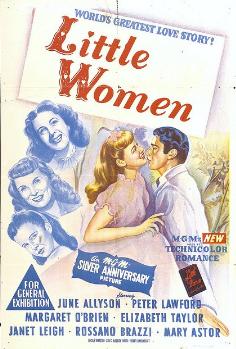
Littlewomen1949movieposter.jpgIn the recent days, I gained a new appreciation of June Allyson as a screen talent and in her own way she pulls off Jo March quite well though it’s needlessly difficult to begin comparing her with Katharine Hepburn or Winona Ryder.

Meanwhile, Mervyn LeRoy was a capable director of many quality films and it’s difficult to say anything damaging about this one because no matter the amount of mawkishness, it’s all heart to the very last frame.

If possible to imagine, this cast is even more star-studded than the 1933 adaptation and yet still somehow the casting just doesn’t seem quite right. In the Katharine Hepburn anchored cast every character was almost perfectly wrought and they felt like an impeccable ensemble.

Somehow here you have the varying personalities rubbing up against each other and it doesn’t feel like this is the March Family as much as this is June Allyson, this is Elizabeth Taylor, this is Janet Leigh, and Margaret O’Brien. Their beloved Marmee being played by none other than Mary Astor. They’re all fine actresses with esteemed Hollywood careers in their own rights but as a family, the dynamic is slightly off.

Of all the names attached, Elizabeth Taylor feels the most at odds with the material, not that she couldn’t play these types of sincere characters — she did it in Jane Eyre (1943) and National Velvet (1944) — but she’s nearly past that stage of being cute and now simply comes off as a bit of a snob. If I know anything about the character Amy (which I may not) she’s hardly that.

This is also far from Janet Leigh’s best role as she all but disappears into the background because there’s this underlining sense that Jo is the oldest sister here (due to Allyson’s obvious age advantage over Leigh) and so with that subtext Meg loses a great deal of her quiet strength as the perceived eldest sister. Because that means she’s hardly the one that the others look up to due to her age. She’s just the noble one while Jo is the free spirit hurtling over fences and throwing snowballs. Thus, the order of sisters really does matter for the full integrity of the narrative.

Come to think of it, the other obvious departure in the film is the development of Beth as the youngest March girl which gave Margaret O’Brien the opportunity to play her and she does a fine job at stirring the heartstrings with her timid solemnity but another dynamic gets altered in the process. I also wasn’t sure what I would have to say about Peter Lawford as Laurie and yet he does a commendable job as does the stately mustachioed C. Aubrey Smith.

It’s fascinating how the same story with at times almost verbatim dialogue can give you a completely different sense of the characters. Because it’s true that this version borrowed much as far as dialogue from the 1933 version. Thus, the scenes are all but the same with slight alterations to the opening and such, but the results are starkly different.

The same goes for the setting or rather the tones of the sets. Though the colored pictorials are glorious and lend a real jovial nature to everything also helping to make this Little Women adaptation a shoe-in for annual yuletide viewing, some stories just are not made for that treatment. It’s no detriment to this film whatsoever but there’s something about the original black and white that evokes the nostalgic aura of tintypes and antebellum photography in a way that this one simply cannot. Little Women seems like such a story.

Of course, that’s only my opinion and it could very easily be the case that someone else’s conception of the March family is very different than my own. That’s part of the fascination with novels and their adaptations. Despite our best efforts, or maybe because of them, they all turn out vastly different. It’s probably for the best.

3.5/5 Stars