Repulsion (1965)

f483d-repulsion
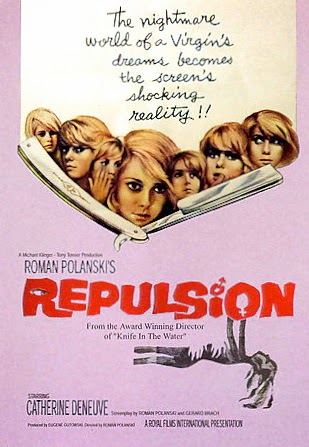
Directed by Roman Polanski and starring Catherine Deneuve, this British Psychological thriller is in the same vain as Psycho. Carol is a manicurist who is often absent-minded at work and she returns home to an apartment that she shares with her older sister. She passively resists the advances of an infatuated young man and at home she must live through her sister and a boyfriend in the next room. 

*May Contain Spoilers
Then, they leave and an attached Carol cannot bear her sister to leave her alone. The next days and weeks she sinks into a unstable state and slowly loses her sanity while losing track of reality at the same time. She is sent home from work, becomes even more preoccupied, and then begins hallucinating back in her home. When Colin comes to speak with her she is still unresponsive and she unexpectedly bludgeons him to death. Then, later on the annoyed landlord comes by for his money, and then makes advances on her, only to be killed by a frightened Carol. Helen and her boyfriend return to find the apartment in disarray and Carol out of sorts and concerned neighbors come to spectate. The camera closes in on a family photo and a young Carol’s perturbing face. 

This low budget documentary grade black and white film still packs a powerful punch and the best word to describe it is probably disconcerting. Unfortunately, I had never heard of the cinematographer Gilbert Taylor, but he had several wonderful films in his catalog including Dr. Strangelove, A Hard Day’s Night, Star Wars, and of course Repulsion.
 
4/5 Stars

Spellbound (1945) – Alfred Hitchcock

Directed by Alfred Hitchcock and starring Gregory Peck and Ingrid Bergman, the film follows the complicated story of an intelligent lady doctor skilled in psychoanalysis. Bergman’s character is very focused on her work and often withdrawn. That soon changes when she meets the new doctor (Peck) whom she falls for. However, soon Bergman realizes he is not the real doctor and further uncovers his state of amnesia used to forget his past. Trying to keep him out of the hands of the police, she takes Peck to her former colleague and they try to delve into his dreams. When Bergman finally seems to have all the answers unexpected complications arise. Now she must save her patient and lover before it is too late. Hitchcock’s directing, a great score, collaboration with Salvidor Dali, and good acting make this film worth seeing. Michael Chekhov is certainly good for a laugh or two as well.

4/5 Stars

One Flew Over the Cuckoo’s Nest (1975)

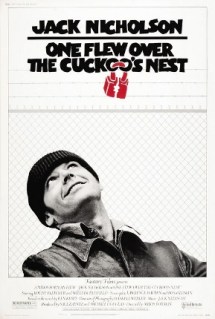
This is a powerful film from the 70s that has such an intriguing conflict between Jack Nicholson and Louise Fletcher. There have been many chilling villains in the annals of cinema, but Nurse Ratched was arguably the coldest and yet understated of them all. She makes this a true battle for supremacy. Nicholson is supported very nicely by the rest of the cast who he helps to rile up.
*May Contain Spoilers

Originally adapted from the novel by Ken Kesey, the film tells the story of a criminal interned in a mental hospital, because he thinks it will be “life on easy street” with a bunch of crazies. Jack Nicholson plays this Randle McMurphy, who goes in ready to live easy and challenge authority whenever he can.

Meanwhile, the doctors observe him seeing if Randle really belongs. As he grows accustomed to the institution, he becomes the instigator of the other patients. Whether they are playing cards, talking with the group, taking medication, getting their exercise, or taking a fishing trip, he always looks to get his way and have the other patients rally around him. However, he must deal with Nurse Ratched, a cold and iron-fisted woman, who keeps everyone at bay believing it is for their own personal well-being.

In fact, she chooses not to send McMurphy away because he is their problem and Ratched is ready to deal with him in the way she sees fit. Not even McMurphy seems able to prevail over Ratched and her tactics in the end. He starts a riot in the ward after they are not allowed to watch the World Series, and as the final straw, he holds a wild Christmas party with girls and alcohol. He plans to get away in the aftermath with his new-found friend “Chief,” only to wake up in the morning to a very displeased Ratched. Her pressure causes one unstable young man to commit suicide, and with the opportunity to escape right in front of him, an enraged McMurphy strangles the nurse, only to be subdued. Things quiet down and the patients revert back to their old ways with “Mac” nowhere to be seen.

One night he is returned and in a Deja Vu moment, the Chief goes to talk to Randle, only to see a blank look on his face. Ratched’s methods have seemingly won. However, Chief is able to use Randle’s plan to escape and keep the hope alive. Nicholson was backed by a stellar cast including Louise Fletcher, Danny Devito, Christopher Lloyd, Brad Dourif, Will Sampson, Sydney Lassick, and William Redfield.

Although this film is rougher around the edges, it reminds me of the earlier dramatic classic 12 Angry Men, because both films have wonderful casts that are able to create such tension through their collaborative performances. Much like Henry Fonda, Nicholson is the undisputed star, but all the other players make this movie truly extraordinary. Early on there are some definite comedic moments, but the film begins to get darker as the story progresses, and Ratched gets more and more strict.

Furthermore, this film is shot in a realistic almost bleak documentary-like style that really adds to the film. It is almost difficult to watch the scene where Randle chokes Ratched because it is up-in-your-face and graphic. Despite, the fact that the ending is depressing, there is still a hint of hope. It is one of the things that makes One Flew Over the Cuckoo’s Nest so riveting. Much like many of the patients that inhabit the facility,  the mood constantly swings like a pendulum from humorous, to calm, to bleakness, and finally hopefulness.

5/5 Stars


The Woman in the Window (1944) – Film-Noir

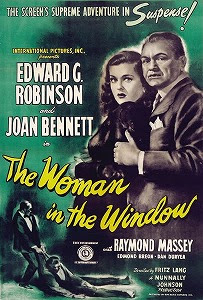
Starring Edward G. Robinson and Joan Bennett, this film-noir involves an ordinary psychology professor and a beautiful woman. The story begins at the club where the professor and his friends begin to discuss an enchanting portrait of a woman in a store window. He stays behind for a while longer and before he leaves he takes one last look at the painting. And there he meets the woman herself who then invites him over for a drink. However, her angry boyfriend comes by and he is left dead after a scuffle. Now the two perpetrators must cover up their murder and dispose of the body. That task goes to the professor and he naively dumps it out in the country leaving behind numerous clues. One of the professor’s friends is the district attorney and so he finds himself invited back to the scene of the crime. The professor is not suspected but the woman is blackmailed by a low life ex-cop who threatens to expose them if he doesn’t get his money. Much to the woman’s relief the blackmailer is killed but it comes too late for the professor. Or does it? This noir directed by Fritz Lang focuses on a mysterious woman and psychology. It also has one of the most abrupt, out of the blue endings. Every movie should not be resolved this way but I rather liked it one time around.

4/5 Stars