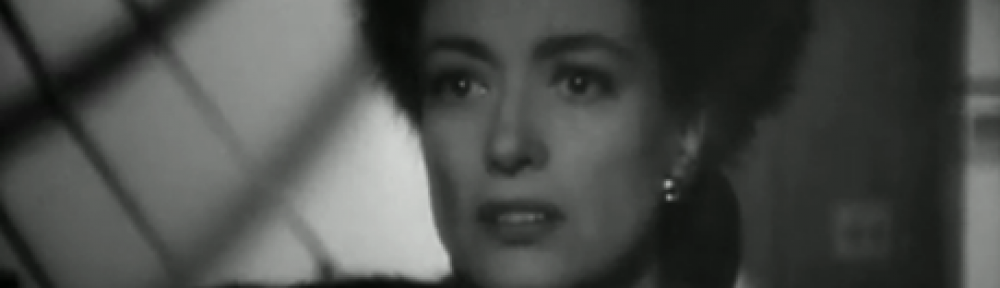
The Clay Pigeon (1949) and The Japanese-American Experience

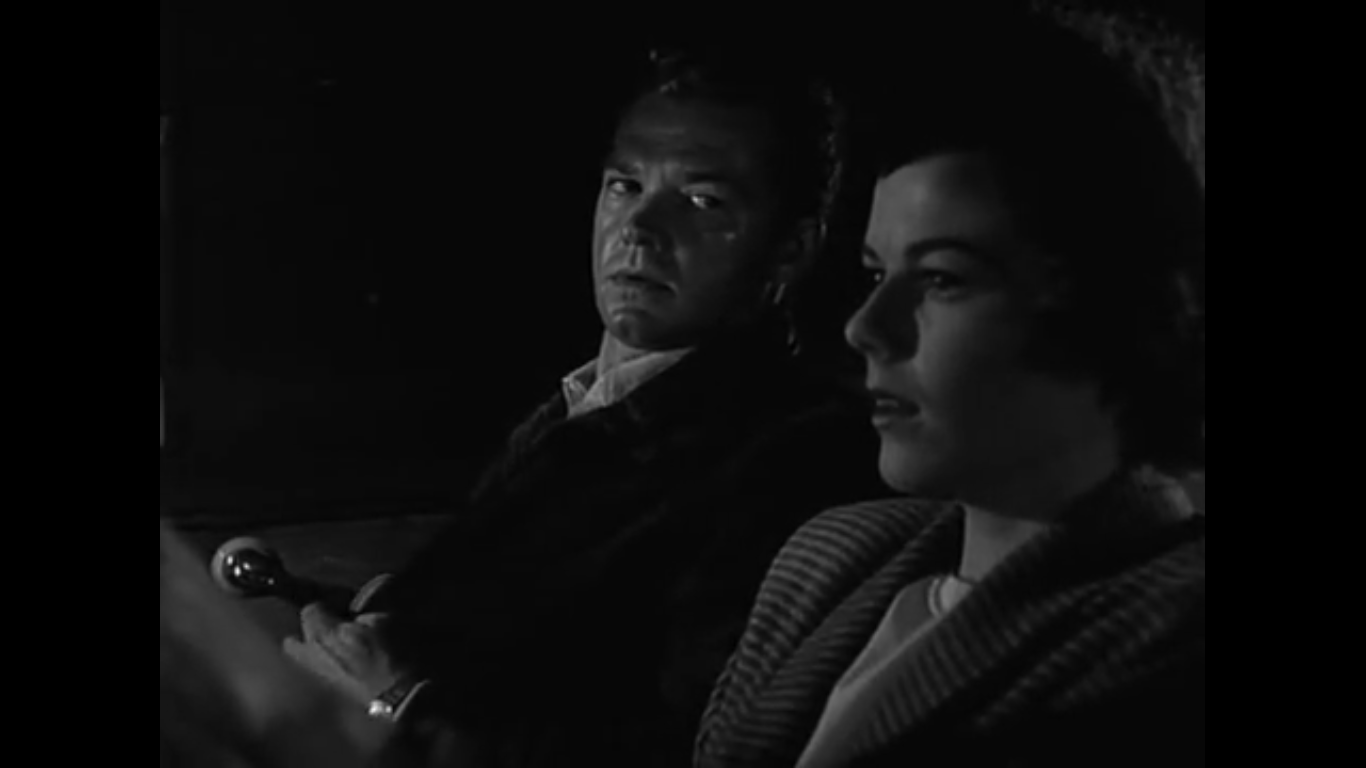
The Clay Pigeon is a film that I have spent several years trying to track down, and I’ve finally been able to see it. From the outside, it feels like fairly run-of-the-mill post-war noir fare. It’s directed by an up-and-coming workhorse in Richard Fleischer and stars real-life couple Barbara Hale and Bill Williams.

It’s one of those amnesia plots steeped in the residual post-traumatic stress of WWII reminiscent of Somewhere in The Night, Act of Violence or even a later entry like Time Limit. It’s this kind of narrative device that injects instant ambiguity into our story since G.I. Jim Fletcher (Williams) doesn’t know why he is currently in a hospital, and he seems to be implicated in some far more dubious crimes. Richard Quine also turns up, and he still has a couple years to go before his prolific career behind the camera.

Williams feels like a bit of an innocuous leading man without the gravelly charisma of a Van Heflin though he works in a pinch. Barbara Hale is a fond friend from Perry Mason so it’s easy enough to take her even if she transforms fairly quickly from victimized hostage to loyal female companion.

Because during the war her deceased husband was compatriots with Williams and Quine in a notorious Japanese prisoner of war camp. This clouded mystery of how their buddy was snitched on drives the movie with dubious implications in their own backyard.

Screenwriter Carl Foreman (known for High Noon) spins a swift tale that incorporates some real-life history that’s too farfetched to be fiction. It came out of an incident where a former POW walked into a department store only to see the unmistakable face of his former tormentor, a notorious prison guard nicknamed “The Meatball.” What a nightmare scenario.

Tomoya Kawaita was an American-born Japanese, going to Japan for university, but he got stuck overseas as the war heated up and ultimately became a notorious prison guard who would speak to his captors in English. After the war, he returned to States to attend USC. He was ultimately tried for treason and eventually got deported, spending the remainder of his days in Japan living in obscurity.

We usually think of the idyllic serenity of returning home from war albeit with growing pains. Warzones and  home are mutually exclusive spaces. But here these scenes collide. The movie ties all of these details into a widespread conspiracy with broader implications and still it pales in comparison to the facts.

Richard Loo becomes “The Weasel” and the fateful encounter happens at a Chinese restaurant called “The White Lotus.” It’s possible that the movie conflates the Japanese and Chinese cultures, but regardless, it’s rather striking to even have this space acknowledged at all.

Loo purportedly relished the opportunity to put the Japanese in such a bad light, and he was often called upon to play such demented roles for WWII propaganda. The Clay Pigeon was no different in how it called on his wartime persona. It’s a bit of a holdover of the earlier sentiments.

However, there is one obvious difference. The movie does actually provide some nuance or at least an alternate depiction of the Japanese. This is the other reason I’ve searched so earnestly for this otherwise unassuming movie.

During a chase where Fletcher’s trying to flee his pursuers and clear his name with the Naval authorities, he rushes into an open door seeking asylum. The woman (Marya Marco) calmly doing her laundry looks him over and allows him to hide as she answers the door.

Once the danger passes, they share another moment. It’s an interaction that the tiny film, barely over an hour long, didn’t require, but whether it was screenwriter Carl Foreman or someone else, he takes time to honor this lady and her people. You see she has a young son, but also her husband was a Nisei who died during the war. His commendation and photo are displayed proudly for all to see.

When Fletcher sees it, it changes his whole demeanor because the 442nd carries a certain cachet. They paid for it with their lives and through their bravery. That’s something that anyone fighting in the armed forces can accept. It’s a badge of honor.

The movie rumbles to its inevitable conclusion, and it’s a nice bit of meta narrative to watch Hale and Williams embrace right outside the doors with all the loose ends wrapped up neat and tidy and our hero vindicated.

But for me, I already got what I came for with this one solitary interaction as an emblematic remembrance memorialized for all time. In the face of so much discrimination and wartime paranoia, the Japanese-Americans proved themselves to be fearless, fiercely loyal, and just as profoundly American as anyone else.

3/5 Stars
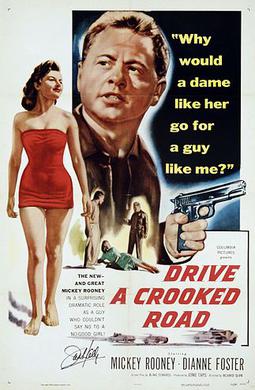
Drive a Crooked Road (1954): A Malibu Sunshine Noir

Drive_a_crooked_road

“On a clear day, you can see Catalina.”

Drive a Crooked Road might best be labeled as a So-Cal sunshine noir, and it easily has a place at the counter next to Shack Out on 101 and equally grubby fare.

Because under the right circumstances, it’s easy to see how Mickey Rooney could make a darn good noir protagonist. Like one of the genre stalwarts — Elisha Cook Jr. — he’s small in stature. Visually, he’s a bit of a pipsqueak and if you strip away his typical magnetism, the confidence, and charisma of a lifelong entertainer, there’s something quite fragile and forlorn there.

Rooney, for all his successes and the serpentine nature of his career, does himself credit here, reinventing his image once more. Eddie Shannon is the kind of guy who gets stepped on his entire life and takes it. He’s a lowly mechanic with far-off dreams of racing a European job at Le Mans. His other prominent feature is the scar on his forehead as if to mark him as a kind of social outcast.

Admittedly, his life is nothing more than fixing cars by day and going back home at night to a mantle lined with childhood trophies. It’s as if they’re compensation, a way of telling himself he is a big deal after all as he kicks back on his bed.

I won’t make any claims that the actor-turned-director Richard Quine is a virtuoso hand, but I do enjoy a handful of his films with varying themes. What draws together some of the better ones are his collaborators. Kim Novak made a startling debut in another sordid noir of the same year Pushover. Then, he had a good many collaborations with both Bill Holden and Jack Lemmon, just to name a few.

What Drive The Crooked Road shows off is his substantial collaborations with future mainstream directing giant Blake Edwards. Rooney, a fellow youth actor, was a holdover from their days together working on the screen as some of the industry’s promising talent. The greatest joy is how it shuns the prevailing song-and-dance, happy-go-lucky entertainment they normally stuck their name to and gladly takes a divergent path.

As good a place as any to start is with a femme fatale (Dianne Foster). She comes by the repair shop one day to get her car fixed up. That could be the end of it, but she has other plans. So Eddie pays the good-looking dame Matthews a house call.

It’s immediately apparent she’s shamelessly flaunting herself. First, on the lawn then, hanging over the side of her convertible, and finally, right next to him as he digs under the hood. Barbara makes her presence known, as it were, and she has total command of the scene.

This perceptible dynamic is so crucial as is Rooney’s diffident performance if the story’s to come off. How visibly uncomfortable he feels being around her — making eye contact with her flirtations — as she chats him up on the way to sunbathing above Malibu. It implicitly coaxes him out to the water’s edge.

Because even as his whole existence is uncomfortable in her very presence, he desperately wants someone as beautiful as her to give him the time of day. The fact she actually paid him notice gives him hope.

If it’s not obvious already, this bit of come-hither interplay devolves into a not so unfamiliar ploy used most definitively in Scarlet Street. Edward G. Robinson’s Christopher Cross was a suffocating nobody as well with nothing but his art. Kitty (Joan Bennet) exploits him for all he’s worth on the behest of her boyfriend (Dan Duryea).

In Barbara Matthews’s case, she’s operating on behalf of her major love interest, the dashing and charismatic, if generally despicable cad, Steve Norris (Kevin McCarthy). He and his smart-aleck buddy (Jack Kelly), don’t immediately strike one as a criminal types. And yet their high-living, bon vivant ways, and impatience with the normal tenets of capitalism cause them to buck the system.

They’re looking to rob a bank, a handy joint they scoped out while spending their summer vacation in Palm Springs. You could say the crime fits the criminals. The only problem is a driver. They need someone to navigate the windy backroads from Palm Springs to San Diego. Someone with handles who can help them make a quick getaway since time is of the essence. That’s why they called on Barbara to reel Eddie in.

However, she’s the only one to realize what is really happening. They label him like all the rest as an ugly little guy, a lonesome little animal; and it’s true by the world’s prognostications. But Matthews sees more being around him. There’s an earnestness, a candor in how he interacts with her.

She calls it devotion, a terrible kind of worship because he’s fallen for her irrevocably hook, line, and sinker. It’s pretty much instantaneous since the first moment she ever gave him the time of day. He’s not a normal mark; he’s completely given himself over to him, totally vulnerable. One can only imagine what he might do if he finds out he’s just a sucker.

Of course, her conspirators fail to heed her warnings. After all, what could a born loser do to them? So Eddie comes aboard, brought into their confidence, initially hesitant until Barbara leverages everything so he thinks he’s doing this for her. 15,000 smackers could do a lot for them. He studies their home movies religiously in an effort to gain a lay of the land in preparation for game day. Once more, he’s devoted because he thinks she wants this. It’s not for himself but to earn her affections.

Again, Barbara is overcome by misgivings about the entire operation. In her own way, she tries to give him a way out — knowing where they are headed listening to Eddie’s big talk about driving better than he ever has, doing the job so he can get the money she wants. He couldn’t see he’s being played unless he was hit in the head with it. That’s what it takes.

One of the greatest investments of the film really comes with Foster’s performance. Because at first, she feels like a prototypical noir vamp, merciless in how she uses her feminine wiles, and yet, if we can coin the phrase, she is a tender femme fatale.

Take, for instance, one scene where Eddie makes an impromptu house call to see her. They’re supposed to stay apart for the good of the mission and still, he cannot bear to be away from her. She comes out into the living room, closing the bedroom door to meet him.

At first, I thought she closed her door behind her to cover up something — maybe a male visitor lurking behind. But it’s simpler than that, even more innocent. Finally, Eddie leaves and she goes into her bedroom and cries. Whereas Kitty’s laughter was mistaken for tears in Scarlet Street, here the tears are real, there’s this conflicted tenderness present.

But of course, all this must be put on hold as the day of the bank robbery arrives. They make their best-laid plans, intercepting the route of the usual bank employee. In another quality creative decision a la Gun Crazy, we are forced to wait out the job from the getaway car with Eddie and Steve. It comes off without a hitch because it’s not primarily a heist film at all.

If that were the case, everything would need to go awry at this point. The question remains, Why do we hold off? Because the true pearl in the oyster is how the story is not solely about the tension of the bank robbery and whether they will succeed, though that becomes of great interest. Encompassing all of these genre elements is really the underlying character piece.

What will Eddie do? What will happen to him at the end of said crooked road when reality sets in and he finds out he’s been used. Because it’s not a question of if but when it will happen; eventually it does.

There’s the confrontation, the reveal, the turn of events. You’ll have to witness them for yourself. The images resonate most deeply with me. A car overturned on the beach, the tide lapping up against the shore in the background. There’s not a more fitting summation of the film’s juxtaposition of elements — that is sun-soaked, Malibu beachfront noir.

The final interludes bring to mind another paranoia piece of the atomic age, Kiss Me Deadly, and far from jumping off the deep end, Quine’s picture has its own misanthropic edge. Where the beach, shrouded in shadows, provides the perfect landscape for a devastating capitulation. It’s a testament to his core players, Rooney and Foster in particular. I’ll never look at Mickey Rooney the same way again.

3.5/5 Stars