
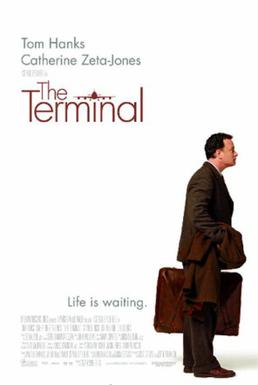
 “Do you ever feel like you’re living in an airport?” – The Man shaving next to Viktor
I’ve been fascinated by transitory spaces like train stations and airports as physical manifestations of the in-between, bridging places, cultures, and all sorts of people.
I just recently returned from a trip myself. Airports are never a favorite — they feel like a necessary evil on the way to the destination. But they’re very much suspended in time as you hurry and then wait and wait some more. Still, in these moments you often have space to people-watch and observe the world around you. It’s a small joy of airports — how many folks are thrown together and you can only imagine their lives and experiences.
If we can come to The Terminal with any kind of high-minded perspective, this might be it. Steven Spielberg’s subsequent film with Tom Hanks after Saving Private Ryan and Catch Me If You Can is a very different animal.
It’s inspired by the real-life existence of one Mehran Karimi Nasseri, a man who actually lived in the departure lounge of Charles De Gaulle Airport for years, as someone caught in between. He was not allowed to legally enter the country but couldn’t ship back home either. He was stuck in a perpetual state of limbo or, if you want to get more philosophical, purgatory. Even when he was finally offered stays in several countries, he chose to remain in the airport. One can imagine the reasons for this, but the most obvious one is familiarity.
This is much of what happens the longer we sit with the movie; its characters and the world grow in familiarity. At first I was wondering how they could sustain such a story for over 2 hours. Surely the premise would run dry about an hour in.
Tom Hanks is much like Jimmy Stewart for subsequent generations. Still, sometimes when I see him I see the beloved Tom Hanks and not a character. It works best when the part calls for his attributes as an everyman hero. Here he is an Eastern European man, named Viktor Navorski, who has fallen through a similar bureaucratic crack.
He can barely even string a sentence together in English for the first half of the film. It doesn’t help that one can easily draw comparisons to the works of Jacques Tati, like his expansive visual comedy Playtime, featuring Monsieur Hulot, a beloved film for many. Spielberg himself cited it as an inspiration, and ironically he was forced to build a full-fledged airport set because no location was willing to let him film there. In this way, the films have a genuine scope.
Still, if we think of Viktor in the world of the likes of Forrest Gump or Elwood P. Dowd in Harvey, we’re in business. Because he’s a kind of fated, sainted movie character. There’s also a bit of Elf in the movie, not so much because of the characterization but the environments of the “real” city and the camaraderie it builds among the forgotten ranks of humanity. It is a love letter to such people. Men like Viktor (or Buddy) can become unwitting totems and folk heroes for us all. We want to celebrate them.
The Terminal is another time capsule. It’s a post-9/11 world, so we’re not as naive and nostalgic as the 90s, and yet we can still hold onto mores of an earlier time. Whether it’s the TV adverts, the cost of Burger King, the sound of pagers, or the fact that Borders still exists. It takes us back somewhere that no longer exists, even if it’s only on videotape or in our memories.
Acting Commissioner Frank Dixon (Stanley Tucci) oversees the airport’s daily operations, and he’s the one who initially strands Viktor. Before the power goes to his head, the part comes off quite well thanks to Tucci’s inherent charm. We appreciate what he’s trying to accomplish within a system where Viktor has all the markings of a loose end who won’t go away. Loose ends can come back to get you.
Catherine Zeta-Jones plays the aptly named airline stewardess Amelia, who drifts in and out of the movie, crossing paths with Viktor in the terminal. Her life mirrors his in some ways but is also vastly different. He’s constantly stranded, she’s constantly on the move, and they always meet in the middle. Still, everybody’s waiting…just for different things.
Although she represents the continental and high-flying lifestyle, because of her candor — these starry-eyed movie moments — there’s some element of a You’ve Got Mail romanticism about her. We feel it the most when she and Hanks meet in one of their serendipitous encounters and wind up talking about Napoleon in Borders. It’s the kind of interaction that has a tinge of romance but, more so, lights us up because it is a meaningful connection made between two people.
The movie also has some wonderful supporting roles. These include Diego Luna long before he blew up, Zoe Saldana as an immigration officer/Trekkie, and Kumar Pallana, most well-remembered for featuring in Wes Anderson’s films. They are all part of the inner workings of the airport, and eventually, after he’s been there long enough, Viktor builds a rapport and becomes integrated into the behind-the-scenes network that keeps the place running. The movie is at its best when Hanks has joined the fraternity of workers at the airport like a budding found family.
They’re all culturally different and still united. One of their shared points of interest is helping Viktor get to know Amelia by putting together a private dinner for them, with all their lovable faux pas on display. But it’s an act of gratitude because Viktor helped his friend in his own romantic endeavors. He even joins them in their poker nights over unclaimed belongings.
The core of the whole movie — the film’s Rosebud, if you will — comes in the peanut can Viktor clutches to his chest. Without getting too detailed, we learn of Viktor’s connection to the famed jazz portrait A Great Day in Harlem, and it’s a stirring reminder of how music has the capacity to traverse cultures and move us with emotion like few things. There’s nothing more evident in my own life. I know it to be true, and an appearance by Benny Golson of the Jazz Messengers is such a satisfying evocation.
In the end, the movie is probably too long, or more specifically, it goes to too many places and takes too many swings when something pithy might have sufficed. There is the prolonged wait for the war back home to end. Vitkor aims to finally set foot in New York to keep a promise. What will happen to him and Amelia? Then, Dixon becomes more megalomaniacal. It’s a lot. But there are so many ideas and moments to love here. The fact they’re given to us by Tom Hanks and Steven Spielberg is no less remarkable.
Humanity is not usually good at waiting, but we are destined for it, and it becomes imperative what we do with the time. Elwood P. Dowd, Viktor, Buddy the Elf, even Mr. Hulot — these are characters to acknowledge. People are drawn to them for very good reasons, and in their quiet, solitary moments, they often bring beauty into the world. Viktor goes so far as to plaster deteriorating walls and later craft a magnificent fountain.
I look at a character like him and recognize he is not like us, and yet in another way there’s something true in him. Sometimes we feel like we live in an airport — we don’t know where we belong, we don’t have a home — and we must figure out where we fit, whether it’s a different place or a different world altogether. Sometimes we must aim to make a home out of the here and now until that day comes.
3.5/5 Stars

