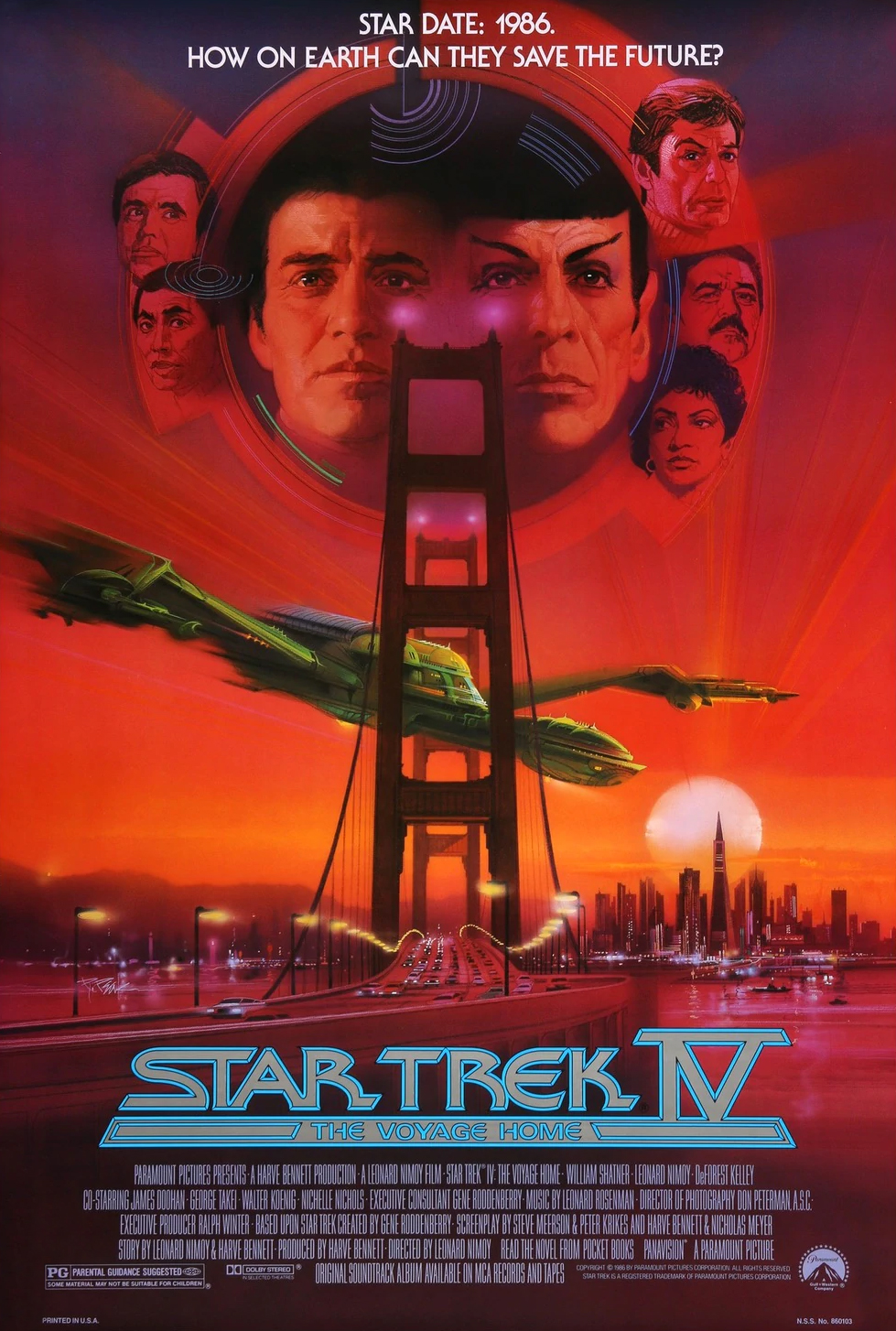
Star Trek IV: The Voyage Home (1986)

“The Cast and Crew of Star Trek wish to dedicate this film to the men and women of the spaceship Challenger whose courageous spirit shall live to the 23rd century and beyond…”

The opening remarks of The Voyage Home honoring the “courageous spirit” of those lost on The Challenger is a perfect encapsulation of the ethos of Star Trek.

Because it was always very much a franchise that was a social allegory for our world and by taking place in a sci-fi future, it was able to champion all that was good and valorous of people living through a space age even as they tried to reconcile with living with one another on earth with fraternity.

As a kid, Voyage Home was always my favorite Star Trek movie, and probably still remains so now. I’m not quite sure what it was exactly, though I do have some ideas. It’s important to acknowledge it right out front. Voyage Home has a wild and wonky premise full of a certain incredulity, but it’s also a good deal of fun.

Spock is back after Star Trek III, but now there is a new problem: Not only is Kirk a wanted man, but a frequency of humpback whale calls is causing chaos to reverberate all throughout the galaxy. Yes, you heard that right.

Kirk leads his fugitive compatriots on a Klingon ship with cloaking capabilities to time travel to the past — that is, the contemporary moment the film came out — 1986. The wheels start turning.

I’m no Star Trek savant, but it didn’t evade me that this is a subtle twist on the notable “City On The Edge of Forever” episode that sent Kirk and Spock (with his ear-concealing bandana) back in time to the soup lines of the Great Depression.

Voyage Home mines most of its comedy from your typical fish out of water premise, in this case pitting the Enterprise Crew of highly intelligent and advanced space cadets against a world that feels so analog and decidedly archaic to their sensibilities. Meanwhile, to the average guy on the street they look like helpless weirdoes.

A particularly memorable vignette involves a spiky-haired punk rocker on the bus with his blaring boombox. He does look rather like an alien to anyone left unawares from a different century. A little Vulcan nerve pinch gets the whole bus clapping with appreciation for curbing the noise.

Pairing Bones and McCoy off together is a pleasure in its own right, though it need not be expounded upon in depth here. The rest of the crew is entrusted to build a tank to carry the whales across the galaxy and also locate a nuclear reactor to help power their ship home.

Spock’s coming up to speed with the modern vernacular offers its own hilarity as does his commune with the whales in their enclosure at a Sausalito aquarium. It’s in plain view of everyone and another breach of societal norms. This just isn’t done in the 20th century. Spock has greater concerns as Kirk tries to guide him through this strange world like a blind man leading a blind Vulcan.

The resident biologist Dr. Gillian Taylor (Catherine Hicks) is incensed. She cares about these animals’ well-being deeply. Later, she offers a ride our two lovable nut jobs up in her pickup because she has a penchant for hard-luck cases.

The addition of Hicks in a fairly substantial role begins as a screwball comedy with her skeptical incredulousness around Kirk and Spock. It then builds into a kind of swelling romantic comedy served with a side of pizza pie. Somehow it plays as the less tragic inverse to Joan Collins turn in “City on The Edge of Forever.”

Because they push the boundaries of her belief and still, if she doesn’t quite have faith in their clear-eyed tall tales, she recognizes their shared mission to protect the whales. If it’s not quite faith, then her trust in them is rewarded in an extraordinary way as an unimaginable world of the 23rd century opens up before her eyes.

She always feels a bit out of step with the world around her, and then she finds these like-minded people, a little eccentric, and yet they suggest to her that she was made for so much more. It’s an extraordinary development.

Chekhov gets captured in a restricted area and is shipped off to a hospital in the city after he suffers an injury. Kirk and Bones lead a search and rescue mission masquerading in scrubs, then Gillian finds out the whales were shipped off early. They have to intercept them en route if they ever hope to save the whales and thereby the galaxy. No big deal.

Hanging out with the crew of the Enterprise in San Francisco sounds like a good time, and it’s a pleasure to assure everyone that it is. For such gargantuan stakes, Voyage Home feels surprisingly lightweight, lithe, and generally fun because we rarely feel burdened by them. It’s not bogged down by a lot of self-importance and this is to its credit. So it worked then, in my childhood, and it still holds up now eliciting the same kind of stirring reactions.

3.5/5 Stars

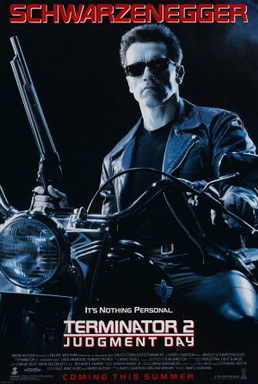
Terminator 2: Judgment Day (1991)

Terminator2posterBack in 1984 a strange life form came to earth in search of Sarah Connor and ultimately left a trail of destruction. It’s the same terminator (Arnold Schwarzenegger) who now shows up in the year 1991 intent on getting the right clothes, transport, weaponry, and cool shades to aid in the completion of his new mission. It’s the same terminator, except not really because he has been reprogrammed to protect young John Connor who will be the future savior of civilization as we know it. Right now he is a 10-year-old juvenile delinquent living with foster parents. His mother, the aforementioned Sarah Connor, is locked up tight in a mental institution after the events in the previous film.

But there also is a second more highly advanced terminator that Skynet has sent to assassinate Connor, and it becomes obvious that he is in grave danger. Both cyborgs converge on his location, and he flees with the help of his new found guardian. The terminator is programmed to listen to him and over time they form a bond with John teaching him slang (ie. the famed “hasta la vista baby”) and perhaps more importantly that he cannot kill everyone he sees.

They go to rescue Sarah from captivity on John’s bidding, but the other terminator has the same idea. The resourceful mother has plans of her own that are disrupted by witnessing her former executioner with her son close in toe. It’s all very confusing as they must alert her to the real danger and escape the present dangers.

Sarah leads them out of the city to the home base of a loyal friend who can give them resources and, above all, weapons. She sets her sights on Miles Dyson, the man who unwittingly developed the technology that would end in “Judgment Day.” In a fit of vigilantism, she mercilessly goes after the innocent man, for his work which would cause millions of future deaths. It takes the arrival of John and the Terminator to get her to calm down.

With Dyson’s help, they head to his office to destroy the prototypes for good, but they get a little company and it turns into a firework show complete with pyrotechnics and blockbuster explosions.

Yet again the shift-shaping, poly-alloy terminator pursues the trio and this time they are trapped inside of a steelworks. It’s a fitting locale for a desperate showdown with a wounded Sarah, a battered Terminator, and a thoroughly frightened John. Some last-ditch heroics finish off the futuristic assassin, but that is hardly the end of the story. John must say goodbye to his friend and probably the best male role model he’s ever had. He was a faithful companion to John, and he, in turn, came to understand why humans cry. There are just some things that cannot be expressed through words, protocol, or any type of rationale. The future is still to come, but at least for the present is safe.

I am unabashed to call Terminator 2 thoroughly enjoyable, because it embraces the fundamentals of a great sci-fi blockbuster, while never quite losing its human component. Perhaps we could have used more character development and less action, but the characters played by Linda Hamilton, Edward Furlong, and Arnold Schwarzenegger have enough depth to make them work proficiently. In fact, they are icons by now and I can understand why. James Cameron certainly knows how to develop thematic spectacle to the nth degree and this installment is no different. This sequel is bigger and better than the original 1984 film, which is a testament to not only the special effects but the story and characterizations. Hasta la vista Baby. Until next time anyway.

“If a machine, can learn the value of human life, maybe we can too” ~ Sarah Connor

4.5/5 Stars

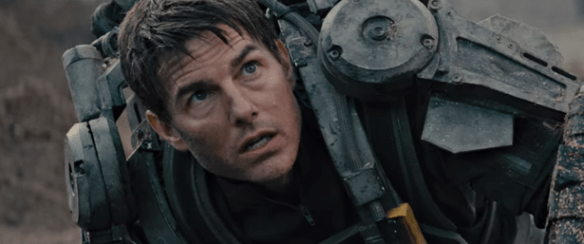
Edge of Tomorrow (2014)

24f4a-edgeoftomorrow1

Time loops are fun. Scratch that. They’re fun to think about and to watch as an audience in the comfort of an armchair, but they get old real fast for movie characters. Just ask public affairs officer-turned-time looper William Cage (Tom Cruise).

He’s an indolent former advertising agent who wants no part of the actual fighting that is taking place in Europe with a mysterious alien army of so-called Mimics. In his attempts to avoid combat, he ends up handcuffed, stripped of his rank of Major, and shipped off to a base at Heathrow. His worst nightmare is becoming reality as he is quickly thrown into the front lines where he is headed to face the enemy without any training. He is an absolute pitiful mess and his platoon mates spare him no mercy. After all, he’s a sniveling complainer.

He’s just as incompetent on the battlefield, and it becomes obvious he’s not going to last long (There’s potential for a very short movie). But before he gets killed by one of the aliens, its blood covers him. Did you get that? Although seemingly insignificant the whole film soon hinges on this fact.

Where does he wake up? No not hell or heaven, but back at Heathrow airport, handcuffs and all, with a superior yelling at him yet again. He’s back in this nightmare once more and it continues for the rest of the film.

Honestly, Edge of Tomorrow is an awful name for this film. The tagline Live. Die. Repeat. is a little closer. At least it gets at the heart of what this sci-fi tale is about. In a similar vein as Phil Connors in Groundhog Day, Cage first gets acclimated to his new ability to experience a moment in time. He learns how to manipulate and navigate it to help himself, but as would be expected it gets tiresome and monotonous. With great power comes great responsibility, difficulty, and fatigue.

Live. Die. Repeat. Live. Die. Repeat. Slowly but surely Cage makes it farther and father against the mimics joining forces with famed soldier Rita Vrataski who is the poster girl for this noble war (Emily Blunt). Her early advice, “Come find me when you wake up,” is the strangest of greetings, but it starts the ball rolling. In a world where humanity is continually walking into an ambush, they are the only two who comprehend what is happening. Vrataski knows because she used to have Cage’s ability but lost it, so he is the new hope. Live. Die. Repeat. Live. Die. Repeat. She shapes him into a more efficient fighter over numerous time loops and gives him more insight into their enemy. He’s getting sick and tired of getting killed too. Live. Die. Repeat. etc.

He starts seeing visions of the Omega (the nucleus of the mimic), but they soon realize that the mimic is leading them on. Live. Die. Repeat. By this point, Cage has gone through so much with Vrataski and he cannot bear to see her continually dying. They finally locate the whereabouts of the Omega but after numerous failures, they finally run out of second chances. Cage loses his ability to loop, like Vrataski before him, needing a blood transfusion to pull through. Live or Die. No repeat this time.

Thus, begins their descent into the throes of their foe towards the Louvre where the Omega is. However, this time Cage convinces his squad to help and they prove their worth. An alpha comes after Cage and Vrataski as he blows up the Omega with a pack of grenades. There’s an instant of doubt, an uneasy feeling. Live. Die. Repeat…

Except now Major William Cage is back on the helicopter. No stripping of rank, no orders to the front lines, and with a newly weakened enemy. The nightmare is over so it seems and Cage is twice the man he was before. Only one thing matters. You guessed it. He goes looking for Sergeant Vrataski and sure enough there she is where he always found her before. She greets him with the same curtness as he smiles knowingly and most definitely with relief. For the last time or the first, depending on how you see it.

Quick cut to credits and “Love Me Again” by John Newman and it’s all over. It’s an ending that we hate as an audience, but it is the right one. As far as modern sci-fi films go, this one reminded me a bit of Source Code and Looper. Similarly, once you bought into the premise and invested in the setup, it proved to be a smart and entertaining ride.

Tom Cruise proved he can still do action movies and Emily Blunt carried the film with a toughness that would have made Ellen Ripley proud. This may be summer blockbuster material, but it’s also a worthwhile trip that takes us for a loop. Awful pun intended.

4/5 Stars

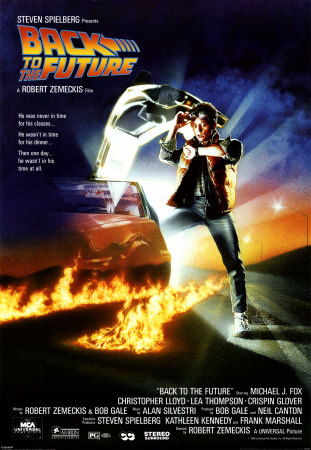
Back to the Future (1985)

Starring Michael J. Fox and Christopher Lloyd, the movie follows Marty McFly as he befriends the quirky Doc Brown. McFly witnesses the assassination of his friend by terrorists and unwittingly finds himself leaving his peculiar family and pretty girlfriend. He takes Doc’s DeLorean time machine back to 1955 and finds himself in a practically different world . Soon Marty is caught up in his own history when he messes with the first meeting between his teenage mom and dad. On the advice of a much younger Doc Brown, Marty tries to repair their relationship while the Doc gets ready to send Marty Back to the Future. Although he alters the past, Marty finds life even better back in 1985. The Doc turns out okay and his family is drastically different, in a good way. This film is great fun, full of sci-fi adventure, entertaining sequences, and enjoyable characters. If you ever want to catch the stars in some great TV shows watch Taxi and Family Ties.

4.5/5 Stars