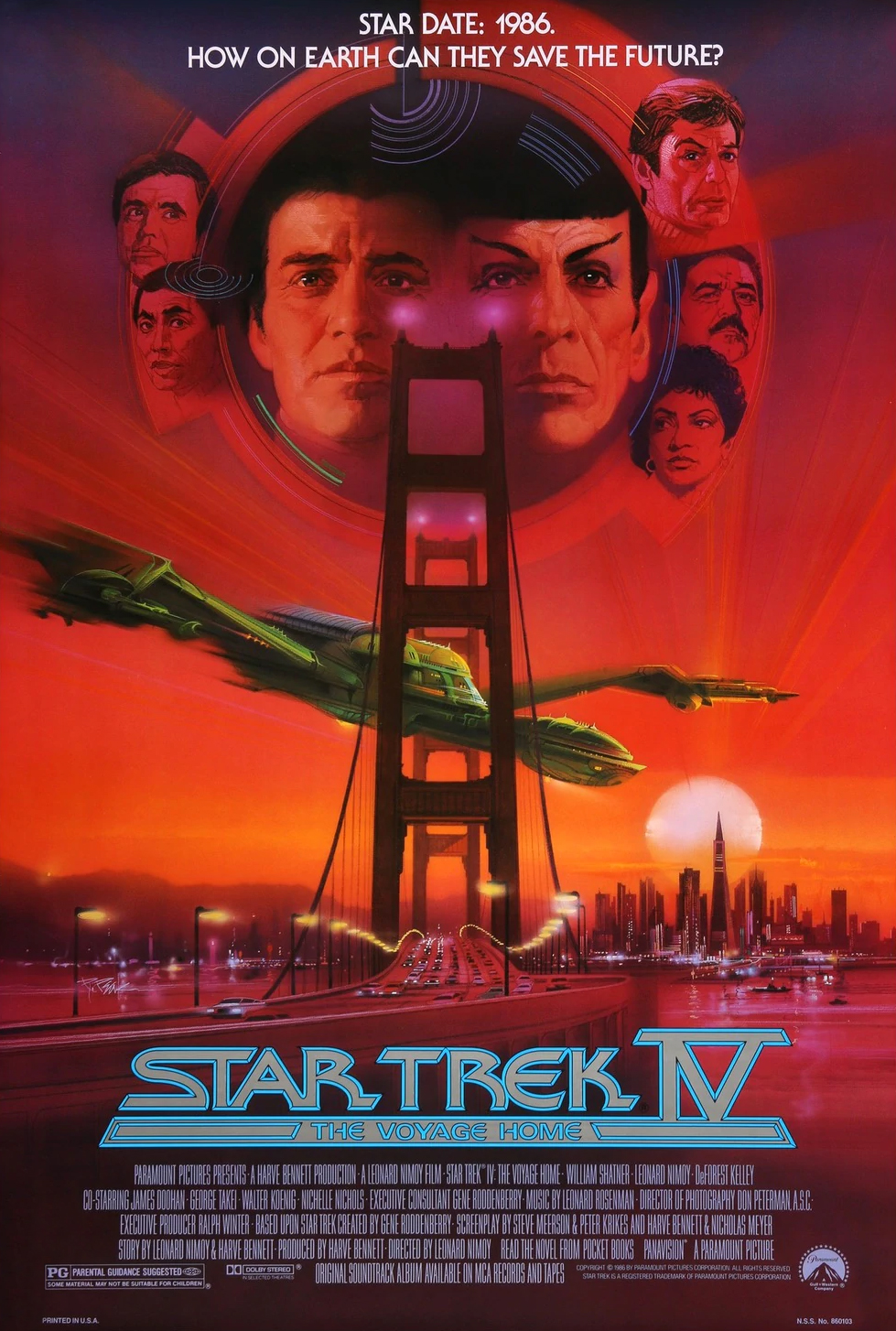
Star Trek IV: The Voyage Home (1986)

“The Cast and Crew of Star Trek wish to dedicate this film to the men and women of the spaceship Challenger whose courageous spirit shall live to the 23rd century and beyond…”

The opening remarks of The Voyage Home honoring the “courageous spirit” of those lost on The Challenger is a perfect encapsulation of the ethos of Star Trek.

Because it was always very much a franchise that was a social allegory for our world and by taking place in a sci-fi future, it was able to champion all that was good and valorous of people living through a space age even as they tried to reconcile with living with one another on earth with fraternity.

As a kid, Voyage Home was always my favorite Star Trek movie, and probably still remains so now. I’m not quite sure what it was exactly, though I do have some ideas. It’s important to acknowledge it right out front. Voyage Home has a wild and wonky premise full of a certain incredulity, but it’s also a good deal of fun.

Spock is back after Star Trek III, but now there is a new problem: Not only is Kirk a wanted man, but a frequency of humpback whale calls is causing chaos to reverberate all throughout the galaxy. Yes, you heard that right.

Kirk leads his fugitive compatriots on a Klingon ship with cloaking capabilities to time travel to the past — that is, the contemporary moment the film came out — 1986. The wheels start turning.

I’m no Star Trek savant, but it didn’t evade me that this is a subtle twist on the notable “City On The Edge of Forever” episode that sent Kirk and Spock (with his ear-concealing bandana) back in time to the soup lines of the Great Depression.

Voyage Home mines most of its comedy from your typical fish out of water premise, in this case pitting the Enterprise Crew of highly intelligent and advanced space cadets against a world that feels so analog and decidedly archaic to their sensibilities. Meanwhile, to the average guy on the street they look like helpless weirdoes.

A particularly memorable vignette involves a spiky-haired punk rocker on the bus with his blaring boombox. He does look rather like an alien to anyone left unawares from a different century. A little Vulcan nerve pinch gets the whole bus clapping with appreciation for curbing the noise.

Pairing Bones and McCoy off together is a pleasure in its own right, though it need not be expounded upon in depth here. The rest of the crew is entrusted to build a tank to carry the whales across the galaxy and also locate a nuclear reactor to help power their ship home.

Spock’s coming up to speed with the modern vernacular offers its own hilarity as does his commune with the whales in their enclosure at a Sausalito aquarium. It’s in plain view of everyone and another breach of societal norms. This just isn’t done in the 20th century. Spock has greater concerns as Kirk tries to guide him through this strange world like a blind man leading a blind Vulcan.

The resident biologist Dr. Gillian Taylor (Catherine Hicks) is incensed. She cares about these animals’ well-being deeply. Later, she offers a ride our two lovable nut jobs up in her pickup because she has a penchant for hard-luck cases.

The addition of Hicks in a fairly substantial role begins as a screwball comedy with her skeptical incredulousness around Kirk and Spock. It then builds into a kind of swelling romantic comedy served with a side of pizza pie. Somehow it plays as the less tragic inverse to Joan Collins turn in “City on The Edge of Forever.”

Because they push the boundaries of her belief and still, if she doesn’t quite have faith in their clear-eyed tall tales, she recognizes their shared mission to protect the whales. If it’s not quite faith, then her trust in them is rewarded in an extraordinary way as an unimaginable world of the 23rd century opens up before her eyes.

She always feels a bit out of step with the world around her, and then she finds these like-minded people, a little eccentric, and yet they suggest to her that she was made for so much more. It’s an extraordinary development.

Chekhov gets captured in a restricted area and is shipped off to a hospital in the city after he suffers an injury. Kirk and Bones lead a search and rescue mission masquerading in scrubs, then Gillian finds out the whales were shipped off early. They have to intercept them en route if they ever hope to save the whales and thereby the galaxy. No big deal.

Hanging out with the crew of the Enterprise in San Francisco sounds like a good time, and it’s a pleasure to assure everyone that it is. For such gargantuan stakes, Voyage Home feels surprisingly lightweight, lithe, and generally fun because we rarely feel burdened by them. It’s not bogged down by a lot of self-importance and this is to its credit. So it worked then, in my childhood, and it still holds up now eliciting the same kind of stirring reactions.

3.5/5 Stars
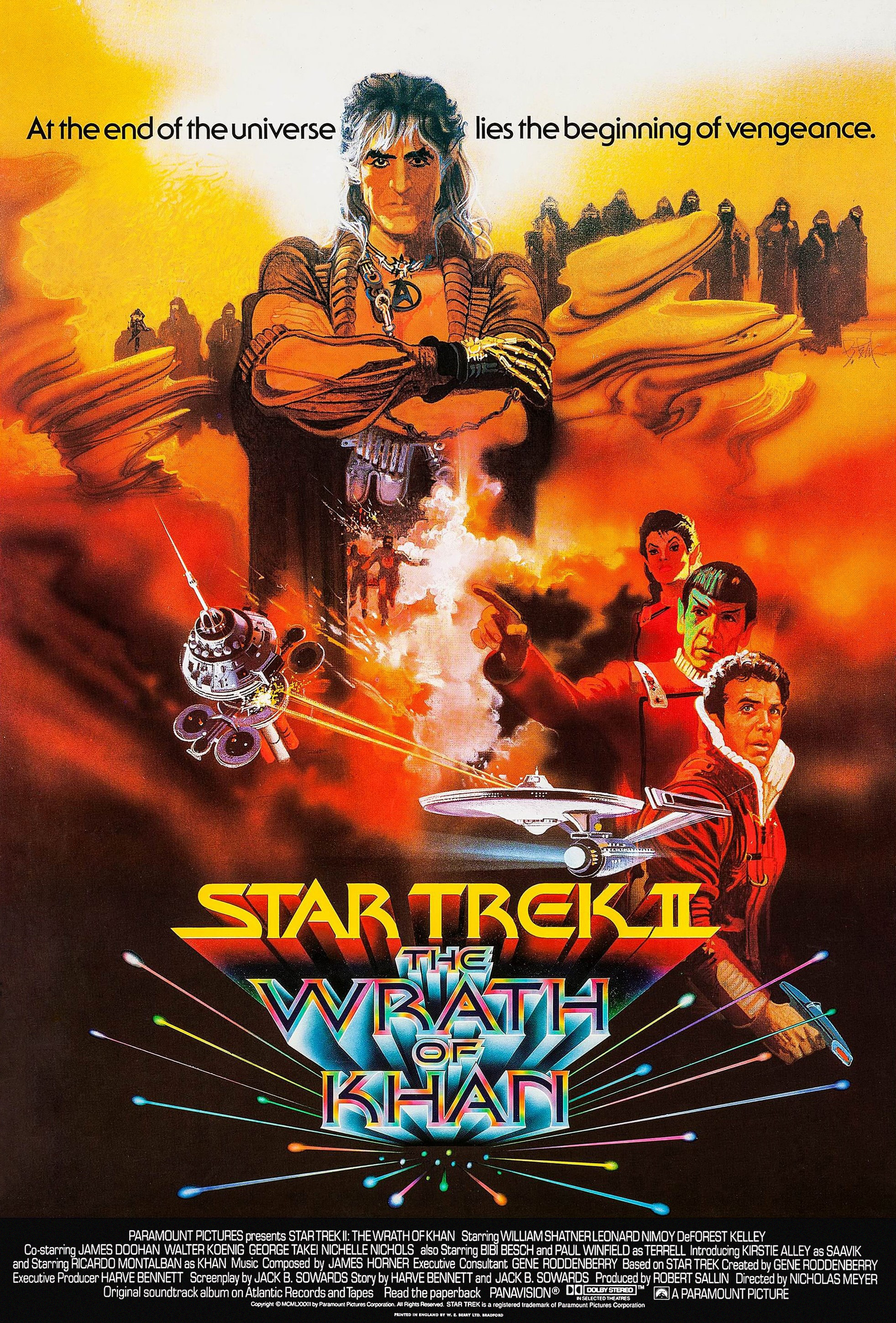
Star Trek II: The Wrath of Khan (1982)

If I had to take a stab at the age-old distinction, I would differentiate Star Trek and Star Wars like so.  Star Wars was a sci-fi Fairy tale and became something more. Star Trek began as a sci-fi allegory on TV and became something more. In a word: beloved.

The Wrath of Khan opens with a scenario involving the usual suspects on the USS Enterprise, except standing in for Kirk is a  Vulcan named Saavik; they must rescue the crew of the Kobayashi Maru, and it all goes terribly wrong.

Moments later we learn that the entire escapade was a simulation.  Kirk (William Shatner), now an admiral, was watching from the wings. It turns out the Kobayashi Maru is a “No-win scenario” elucidating the character of the ship’s commander. You can probably imagine how Kirk handled it in his day, very unconventionally.

Bones (DeForest Kelley) chides his friend to get back out there. He’s not made for a desk job; he’s meant out there on the edges of the galaxy with his crew and wits about him tackling the universe’s most pressing problems. The pull of the movie means he has no choice in the matter.

Captain Clark Terrell (Paul Winfield) and Chekhov (Walter Koenig) lead the crew of the USS Reliant to an uninhabited world; it’s part of an interdisciplinary project to use the newly devised Genesis technology’s immense power to revitalize desolate planets.

There’s something ominous about it after they beam down, and it’s true they are not alone getting ambushed by the vengeful Khan (Ricardo Montalban) who still holds a vendetta for Captain Kirk leaving him to die (see “Space Seed”).

Among his entourage of scavengers he keeps some burrowing creatures as pets and they make his two hostages highly compliant. Khan’s quick to commandeer the ship, and we know what his aims are before he’s put them into action.

A trap gets set to lure Kirk. The USS Enterprise is alerted and comes face to face with The USS Reliant. Their purported friends have treacherous intentions looking to blow them out of space from close range.

There’s a robust theatricality to Montalban’s villain that feels large and provocatively cunning as he holds onto a grudge going back to Star Trek‘s TV days. It’s an inspired piece of work not only in building out the story, but in having the actor back for another installment because he already has a built-in history.

It turns it in a fine chess match and a space opera with Kirk and Khan crossing wits and playing out their old grievances in outer space. It takes this scope and the unfamiliar if appreciated world of space ships, phasers, and light speed, distilling them down into something so intimate and human.

If you’re a cynic, you could say the action mostly involves the two foes talking to each other over video screens. If memory holds, they never actually share the same frame. Still, regardless of what you think of the special effects or the sheer eightiesness of the film’s sets and wardrobe, the story is grounded in a conflict that feels so primal and compelling.

And if that is what gives us a movie, then we must also consider the other relationships. Kirk once had a romantic relationship with one of the head technicians of the Genesis project Carol Marcus (Bibi Besch); her grown son has followed in her footsteps and has a major chip on his shoulder when it comes to Kirk. His notoriety certainly precedes him.

The film is at its best when its heroes are put under duress. Echoing the film’s opening, Kirk and Spock look to rescue them from an untenable situation as they fight back against Khan’s unreasonable demands and Scottie tries to salvage what’s left of the Enterprise in the obliterated engine room. Radioactivity is contained, but with a busted engine, prospects are grim.

Like the second installment in the Star Wars franchise, Empire Strikes Back, Khan is a film about the ultimate sacrifice for the ones you love. If Han Solo did just that in the prior film, Spock does it here. It’s hard to think of two more beloved characters to watch suffer and giving them up hurts.

It’s fitting that the movie references A Tale of Two Cities with Kirk quoting Sidney Carton in the closing moments, “It is a far, far better thing that I do, than I have ever done; it is a far, far better rest that I go to than I have ever known.” This injection of classic Dickens reinforces how Star Trek is always grounded in traditional human history even if it’s pushed onward into future centuries.

Our hero is laid to rest with Scottie’s bagpipes. It always feels a bit anachronistic and then we hear the refrains of “Amazing Grace” in deep space suggesting it can touch even the far reaches of the galaxy.

Kirk eulogizes his buddy saying, “Of my friend, I can only say this: of all the souls I have encountered in my travels, his was the most… human.” That is the profound paradox of this friendship.

Spock’s a fundamentally rational character, and yet all these human impulses are pleased to dwell inside of him. It’s part of what makes him compelling because if we required a manual to read and comprehend him, it would be seem straightforward.

Kirk is the live wire, the unconventional one, who hates to lose — most of all he hates to lose his crew and the people he cares about. Yet in their camaraderie, we see something so formative, and Spock to the end is a noble, loyal friend.

It’s true he does bear the most human of traits and that’s why we hold him so dear because he knows what it is to love and care about other people. He has a heart to go along with his head, continually surprising us with the depth of his humanity despite his stoic countenance.

Like all the great adventure films, Khan has drama grounded in deep relationships, including the primary villain. In such a pressure cooker, every minute of action feels pregnant with real meaning and consequence. It also helps when characters we love and respect are at stake caught up in the middle of it all.

4/5 Stars


The Intruder (1962)

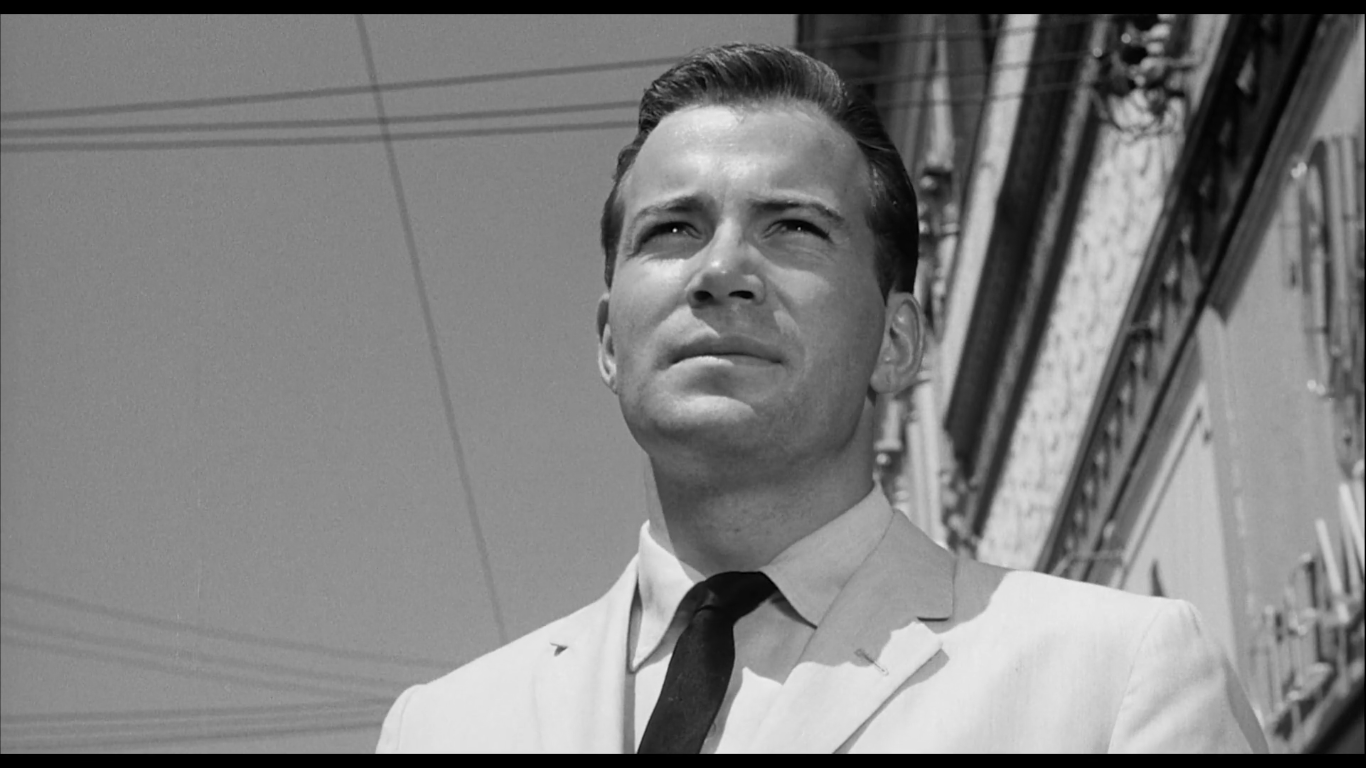
Before he became a caricature of his former self, even before the days of Captain Kirk and pop culture canonization, The Intruder is a reminder of something else in William Shatner. He still feels ripe and almost dangerous with a charisma that has yet to be calcified or even corroded by time.

The same could be said of Roger Corman at least if you only have a perfunctory understanding of his career like me. He is the master of fast and cheap entertainment turned out for profit at a rapid rate. Surely, The Intruder doesn’t fit into the patchwork of his career.

Before we blandly christen him the “King of Schlock,” a more nuanced observation seems to be in order, considering both his talents and his ambitions. Others must speak to this more knowledgeably. All I can say is that this specific film totally obliterates any preconceived notions of what we are getting.

Shatner stars as Adam Cramer, a self-described social reformer with a skeevy look in his eye to go with a cool disposition. He’s headed out on the latest bus to help the locals fight the government implementation of integration in the town’s high school. Under the guise of the freedom-loving Patrick Henry Society, he’s ready to stir up some action. Give me Liberty or Give me Death (though mostly death). In other words, a real creep.

He sets up shop at the local hotel — it bleeds with crusty southern hospitality — feeling like a stronghold for a racist status quo. He’s put up by a sweet ol’ lady while his next-door neighbors, a gregarious salesman (Leo Penn), and his flirtatious wife (Jeanne Cooper) don’t leave much to the imagination. We know what they’re doing and they don’t much care who knows it. It’s a good thing because the walls are especially thin in a place such as this.

Although the film is primarily white-centric, for a white audience, there are some black characters playing crucial roles on the periphery. One is the local minister, a man of faith who takes his calling seriously. He exhorts the youngest members of his congregation in meekness and prays over these 10 lambs from his flock. He’s well aware they are about to enter the valley of the shadow, a space no young person should have to be subjected to. Still, the letter of the law in some ways falls on their side in the face of threat and injury.

One evening on a grand old southern estate Cramer holds a rally to rile up the townspeople, spewing all sorts of epithets, and appealing to their spirit of discontentment.  The NAACP is a communist front, headed by a Jew. It’s all a sham. The government can’t be trusted and The Patrick Henry Society is tasked with preaching the truth — at least his version of it.

As we watch the masses be swayed and he skillfully plays them like a marionette with public opinion in his palm, the deviousness comes into full color. He’s a Lonesome Rhodes-type figure who uses his own magnetism to get what he wants.

When the whites, armed with their newfound ammunition, take to the streets ready to victimize a black family driving home the movie becomes too real. It’s almost like the film was overly cognizant of its time with an incisiveness toward the hot-button issues of the age. Even today it feels gutting to watch whether fiction or not. The images strike too close.

Shatner riding in a hooded caravan with a gang toting a cross through the black community is horrifying. There’s a faceless dynamiting of a church with the faithful minister left for dead. The only other time I recall something comparable in mainstream Hollywood was the mobbish vitriol in Phenix City Story a few years earlier. To Kill a Mockingbird is wistfully nostalgic in comparison. Right or wrong, The Intruder has no such illusions.

Cramer is a man who happily takes a prison sentence telling a wealthy backer (Robert Emhardt) to never underestimate a jail sentence — remember Socrates, Lenin, Hitler… How you can conflate all these men says so much about you. And of course, there’s no mention of Dr. King. This is not the kind of man to dignify a fellow reformer on the other team with an acknowledgment.

The most curious figure (aside from Cramer) is Tom McDaniel (Frank Maxwell). He’s a southern man. He’s been inculcated with the prevailing sentiments of the South, but he also seems to have a higher standard. It’s partially because he’s the herald of the local news — he has journalistic standards — but there’s something else we have to spend time with him to figure out. His wife disagrees. Grandpa wants to disown him. His daughter (Beverly Lunsford) is probably still trying to make sense of it all. Regardless, he believes the law must be carried out.

I don’t know if we ever get a clear indication of why. Although he’s not the only one we can say this about. I’m not sure if we ever get a precise reason for Cramer’s actions either. He’s not a Southerner and there’s never a clear indication he’s truly aligned with the white community, at least not when it gets right down to it. He’s not a Southerner. But he knows he can manipulate them for his purposes.

My fear is that the film is still too much the pipe dream of well-meaning moviemakers where southern guilt all of sudden turns a few solitary individuals into men and women of conscience. Maybe this is historically true. I don’t know, but for all the stories that ended like this with a life saved and a wolf in sheep’s clothing defrocked, we know that history was not always so forgiving. It is strewn with the names of men and women who were degraded, intimidated, and often killed.

That’s why part of me rumbles with a deep sentiment that must be acknowledged. It wants to cry out and warn folks not to see this movie. The inclination begins when they threaten to flip a black family’s car and reverberates again when a young white woman gets coerced into crying rape against a fellow black student named Joey (Charles Barnes).

There’s almost something indecent and profane about it as it echoes things that really came to pass. It’s this fine line I don’t know quite how to reconcile. Because I’ve rarely seen a movie this fierce and unflinching for the era, and yet in the same breath is this what is required then or now? It’s an open-ended rhetorical question. I don’t know the answer.

If the box office receipts are testament enough, the movie didn’t make much of a dent but for entirely different reasons. Roger Corman seems to have made his own implicit response. He never made another such picture again instead relegating his talents to Vincent Price Poe dramas and other such fare blessing the film world in another way. Yes, it was cheap entertainment, but also a breeding ground for some of the up-and-coming stars of the New Hollywood generation.

He did in fact make his own diagnosis of the film’s lack of success, which might be telling if not altogether definitive:

“I think it failed for two reasons. One: the audience at that time, the early sixties, simply didn’t want to see a picture about racial integration. Two: it was more of a lecture. From that moment on I thought my films should be entertainment on the surface and I should deliver any theme or idea or concept beneath the surface.”

Still, with a man’s face buried in the grass, a man fallen from grace head first, The Intruder totally reframes my perceptions of the now chubby anachronism of Shatner’s persona. I won’t say it redeems it so much as it augments it with a kind of duplicitous venom. It’s a new astounding contour to his career.

I’m still not sure if that’s a hearty recommendation or not. This is a very triggering film and a deeply onerous watch. The discerning viewer should make their own judgments. Because for some this kind of burden might be necessary. For others, it might be too heavy to bear.

4/5 Stars


Note: This review was written before Roger Corman’s passing on May 9, 2024