 “I would never want to belong to any club that would have someone like me for a member. That’s the key joke of my adult life, in terms of my relationships with women.”
So begins Annie Hall a film that Woody Allen, also known as Alvy Singer, begins with an opening monologue borrowing a quip from Groucho Marx. It acts as a lead into his life story, romantic and otherwise.
He had a childhood characterized as being morose, depressed, and so on, because as he noted early on “the universe is expanding.” He grew up living under a roller coaster and having fun with the local bumper cars. He grew up to be a comic with the same despondent outlook on life. In one memorable long shot of a sidewalk, we listen to Alvy talking to his friend about people making jokes about him being a Jew and his assertions seem uncalled for.
When Alvy was dating Annie, they went to Ingmar Bergman films and The Sorrow and the Pity was a personal favorite of Alvy. A favorite film with a perfect title and subject for the pessimistic fellow. However, what really vexes him are puffed up know-it-alls who pontificate on and on like they are God’s gift to the universe. It seems necessary at this point to break the fourth wall.
As Alvy recalls his early childhood and first relationship which began at an Adlai Stevenson rally, it is rather funny that he remains unchanged the whole time. Physically Woody Allen is playing Alvy as a young man and an old man without any change.
Then there is the fiasco with the lobsters and the memories of his first meeting with Annie over tennis. That was when he met the girl who came out of the Norman Rockwell painting. Seemingly the antithesis of Alvy himself.
Their relationship is examined with all its quirks from a trivial conversation about art, with underlying subtitles that reflect their real thoughts, to Annie’s stint as a nightclub singer. They have a comical time people watching, and Alvy recalls his second wife and the one who was a Rolling Stone reporter. His relationship with Annie also has its share of arguments, over spiders at 3 in the morning and adult education. Through it all Alvy still views Annie as a cartoon version of the Wicked Queen from “Snow White,” who he secretly loves.
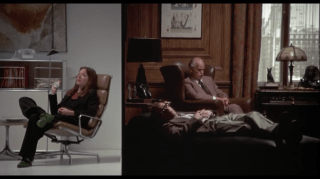 It is during a famous split screen sequence (actually a split room) where the stark differences, not only between the pair, but the genders are pointed out. Things are changing. They take a trip out to sunny California and Alvy cannot help but hate it compared to pleasantly gray New York. They have laugh tracks, wheat germ killers, and trash which is subsequently made into T.V. shows. Annie loves it all.
The inevitable comes and Annie breaks up only to have Alvy soon revisit California to propose marriage. Needless to say, it does not happen. He returns to New York and makes his first play about their last conversation verbatim, with one small revision. Alvy sees Annie one last time when she returns to New York, and they share some laughs while highlights role across the screen.
Allen’s stand-in Alvy sums it all up with one final joke about a guy who has a brother who thinks he a chicken, but he fails to do anything about it because he needs the eggs. That’s how he feels about relationships. “They’re totally irrational, and crazy, and absurd,” but you keep on because you need the eggs. Another philosophical gem from Alvy Singer.
The irony of Annie Hall is that many a person has gone on to pontificate on and on about it, but if we actually pulled an Alvy Singer and dragged Woody Allen from out behind a movie poster, I’m sure he could set us straight. Annie Hall is chock full of humor, a far from typical type of romance, and people trying to find their way in life. Take away discussion about psychoanalysis, modernism, antisemitism, and what you are left with are people just talking. Some of what they say is about such philosophical topics, but sometimes it’s not. It’s about memories, simple observations of life, and the little things that happen along the way.
There are clashing worldviews that come up against each other like New York and California (brought to us by the cinematography of Gordon Willis). There are different sorts of people like Alvy Singer and Annie Hall. Yet we still go through relationships “because we need the eggs” so to speak. We are searching for that type of intimacy and closeness, and very often we keep looking and looking. It is painful, seemingly necessary, and all the same, it can feel pointless. It’s part of being human I suppose.
Annie Hall works for me because of the quirks that give a fresh face to the typical romantic comedy and it will be the measuring stick for other such films that are being released for years to come. I am not usually a major fan of Woody Allen films, but this one is his undisputed masterpiece. It exemplifies his general philosophy and approach to comedy. Not to mention his typical players in Diane Keaton and Tony Roberts.
4.5/5 Stars
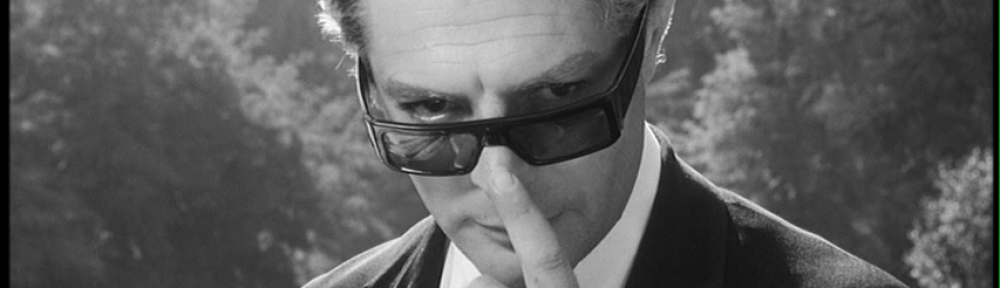
 Although he is not present you can hear and see the undeniable hand of Woody Allen behind this romance set in Barcelona. In a film that at times feels like a precursor to the more interesting Midnight in Paris, Allen takes on romance in another elegant city with two young Americans who have been transplanted there from their everyday lives.


 4 Star Films