Destination Tokyo (1943) and There’s No Place Like Home

destination tokyo.png

“This is sort of a blind date. We’ll just have to wait and see what happens.” – Cary Grant as Captain Cassidy

No pretense can be made to suggest Destination Tokyo functions as an original entry of a “men on a mission movie” from a couple decades later. For one thing, Cary Grant doesn’t strike one as the soldiering type. He’s not Lee Marvin or Charles Bronson.

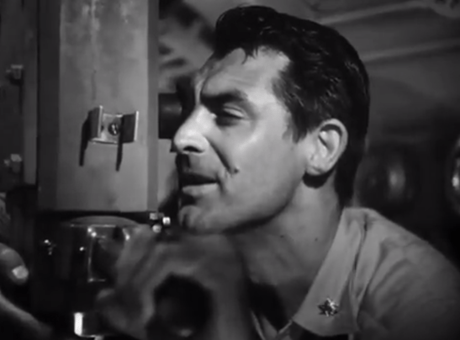
However, it must have worked on at least one kid. Years later Tony Curtis would recount how he saw the picture in theaters and the images of Grant looking through the periscope inspired him to enlist (and maybe become an actor).

He ultimately realized both aspirations — even starring with his hero in the Blake Edward’s comedy Operation Petticoat, which ironically, is set aboard a submarine! In Destination Tokyo, Grant is more business but an amiable skipper nonetheless, with a family waiting for him back home. Still, he’s more than prepared to face the task at hand.

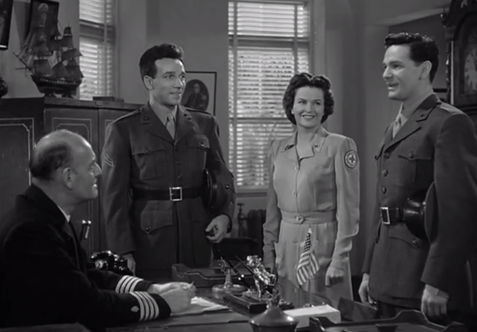
Although they are not much of a secret, thanks to the built-in spoiler in the title, Captain Cassady (Grant) waits the designated 24 hours into their excursion before opening their orders. Obviously, they’re headed to Tokyo. They are also required to pick up a package en route: a meteorologist named Raymond (John Ridgely).

What the film does well is creating an ecosystem for characters to be empathized with because once we have the framework of the task at hand, we can readily spend our time getting to know the men onboard.

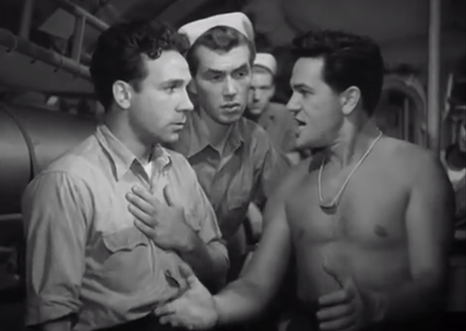
There always must be the callow recruit and this story is no different with Tommy Adams (Robert Hutton) stepping into the role. Meanwhile, John Garfield has a fine time hamming it up as the spirited Wolf enthralling the stir-crazy crew with his exploits with the fairer sex. His active imagination fuels their own hopes and dreams about sweethearts all across the sea, whether they exist or not.

Dane Clark readily complies to the rank and file with his own average G.I. Joe, “Tin Can,” an equally spirited Greek-American intent on getting his chance to make the “Japs” pay. Alan Hale, always counted on for comic relief, is little different here as the bubbly chef Cookie doing his best not to clang pans when they’re diving deep to evade the enemy.

Otherwise, he’s a handy fill in for Santa Claus for a Christmas spent 20,000 leagues under the sea, metaphorically speaking, of course. For someone like Adams, this is his first Christmas away from his family and the accordion accompanied quartet singing out “O Little Town of Bethlehem,” and a few other yuletide favorites is a much-appreciated touch of home.
destination tokyo 2.png

The crew begins to truly feel the weight of circumstance when a pair of Japanese zeroes come upon them on the seas. They let ’em have it with their anti-aircraft deck guns firing into the sky.

One curious stylistic choice is to actually show the enemy pilots raining hell down on them. It hardly feels like an empathetic turn, however, and more of an easy way to label them. If you see someone like this, know they’re the ones doing injustices against us. We’ve got to stick it to them whatever the cost. It becomes more blatantly clear only minutes later. They’re backstabbers.

In a film with an understandable but generally misguided sense of Japanese culture, it does become an intriguing task to begin to unwrap the ideologies being promoted. One cannot quickly forget this is propaganda meant to mobilize mom, dad, and everyone else back at home.  It makes it easier to comprehend how ignorance and general misconceptions can be so widely propagated.

Delmer Daves would soon become well-versed in these kinds of wartime tales from The Very Thought of You to Hollywood Canteen and The Pride of The Marines. One can note actors like John Garfield, Dane Clark, and John Ridgely readily being recycled throughout. However, to its credit, instead of merely painting all Japanese people as terrors, it frames them as victims of a broken system of government.

The token metaphor alighted on are roller skates — those vehicles of carefree child-like recreation — we need more rollerskates in this world including the next generation of Japanese kids. Because it’s a far better alternative than more international conflict.

In the most harrowing interludes, the crew of the USS Copperfin surreptitiously sneak into the minefield of Tokyo Bay under the cloak of an oblivious enemy cruiser. They squeak past the enemy netting and hold their breath as they move into the heart of enemy terrain. Their covert mission continues with three men, including Wolf, going ashore to undertake reconnaissance. It feels somewhat eery for the very reasons two years later nearby locales would be absolutely obliterated by Big Boy and Fat Man.

The balance of the human drama with wartime objectives remains the film’s greatest strength. It’s not all pulse-pounding action necessarily, but it maintains interest through the investment in its characters over the long haul.

An unexpected complication involves an impromptu appendicitis operation. A former pharmacist student, not formally trained as a surgeon, is given the unpleasant task of removing the burst organ based on the written procedures in a textbook. Meanwhile, on land, Tokyo Rose jeers the Allies only for our protagonists to send vital weather reports over the radio to waiting Allied receivers. This entire operation is purportedly under the nose of oblivious Japanese operatives.

The most laughable reaction comes from an incredulous Garfield, “If the Japs pick it up, they’ll think it’s one of their own guys.” He didn’t take into account how stifled John Ridgely’s pronunciation sounds. My Japanese is abysmal, but it doesn’t take a linguistic genius to know he’s probably never spoken a lick of Japanese in his life. But I digress.

The return trip is fraught with bombardment from above as the Japanese get wise and in the ensuing pursuit, the sub gets hammered. The situation is dire with the interior leaking and filling up with water. It’s all hands on deck just to bail them out.

However, when the proverbial fog clears, miraculously, they’ve got off scot-free. The next prominent landmark they see is the Golden Gate Bridge, and it triggers all their fluffy feelings of Americana. After being in foreign waters, the relief of being back home in the good ol’ U.S.A is too great to pass up. As an American who has lived for an extensive period of time in Tokyo, somehow I can relate, though for very different reasons. There’s no place like home.

3.5/5 Stars
Air Force (1943): Howard Hawks Takes on WWII

air force 1.png

At times, Air Force functions like a staged documentary. It feels both instructive and informed by Howard Hawks’ own passion for aviation. It has the simple task of making sure the folks at home can empathize with their boys up in the air. In fact, it falls short of being a mere instructional manual because its highest purpose is to be a stirring propaganda piece.

Certainly, the War meant all hands on deck, even when it came to filmmaking. You had John Ford famously capturing The Battle of Midway. Frank Capra oversaw the series Why We Fight, as a member of the Army Signal Corps. George Stevens notably took footage of Dachau Concentration Camp after it was liberated. This is Hawks’ contribution to the same effort, mobilizing the American public behind the war, in part, by harnessing their emotions. In this regard alone, Air Force is generally a success.

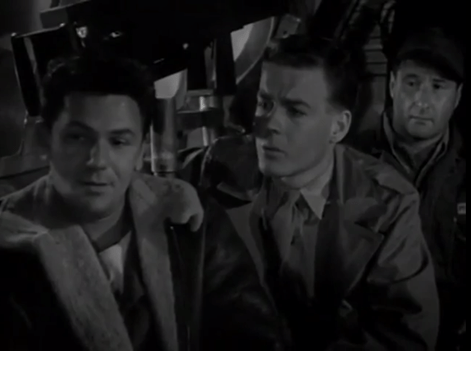
Although some of its players have been generally forgotten in the modern movie pantheon, Air Force features a surprisingly robust cast of actors. Their leader is pilot “Irish” Quincannon (John Ridgely), who has been charged with leading the crew of the Mary-Ann, a much-beloved B-17 Flying Fortress. Its caretaker is a crusty veteran (Harry Carey) whose own boy is currently stationed in the Philippines.

The rest of them feel like fine red-blooded Americans, from co-pilot Gig Young, navigator Charles Drake, and a youthful Arthur Kennedy as their bombardier. George Tobias adds his humor while John Garfield ably plays the outsider with a chip on his shoulder.

They are a perfect menagerie for Hawks to impose his always cognizant sense of male camaraderie because what more galvanizing situation is there than the throes of war? Very little.  It’s this link — a kind of communal gravitational pull — that helps them weather thick and thin, as the enemy hounds them at every turn. Without it, the picture wouldn’t have much pathos. These relationships are experienced vicariously by the audience.

Their assumedly routine mission is humanized through sendoffs from loving mothers and wives. Later on, they pay a visit to a sister stationed as a nurse on an island hospital. All these touches are very purposeful, implying how each life is interconnected with a web of loved ones and sweethearts. This could be any of us if we grew up in wartime America.

Against these waves of systematic sentimentality, the bad boy cynicism of John Garfield fits like a glove, and he peddles his usual pessimism with ease. For a time, that’s all the conflict we have.

Then, they pick up Japanese radio chatter — it’s odd — they don’t understand what could be happening until they see it for themselves. It is, of course, December 7th, 1941, and they’re right in the thick of the attack on Pearl Harbor. When they finally get a chance to inspect the situation on the ground, the aftermath is understandably grim.

In the moment, creating a broad conspiracy involving fifth column dirty treachery on Hickman Field is an effective paranoia tactic. However, in hindsight, there are a few pernicious details used to paint the scenario, namely, a band of rogue vegetable trucks used to clip the wings of planes on the ground. As if the enemy had ground forces orchestrating sabotage to coincide with the aerial attack. This, in fact, (considering the Munson Report) never occurred.

Regardless, the crew is ordered to get on the move again before any other trouble arrives. Their next leg is Wake Island en route to the Philippines. Along the way, they strike up a playful competition with a pursuit pilot, allowing our men to reconcile their differences. Even a dog christened “Tripoli” conveniently doesn’t like Japs (ie. Mr. Moto)

The ensuing dog fights in the skies feel atmospheric and like a dead ringer for George Lucas’s original Tie Fighter-Millenium Falcon duel, with turret guns blasting away. In this chaos, their one solitary flying fortress becomes an emblematic symbol in itself, representative of the American spirit, grit in the face of adversity, and a never say die mentality.

Battered and broken as it is, their sole purpose becomes putting it back together again, to fight another day, and it’s fitting because that’s very much what America was forced to do after Pearl Harbor. A victory at The Battle of Midway would have meant little if we didn’t get to that point. Air Force seems to suggest, with men as tough of these, we got there and ultimately we prevailed. It’s an easy narrative to swallow about the “greatest generation,” and there is a certain amount of truth in it. However, it’s certainly not a nuanced picture. We know its intentions full well.

The final minutes are all but a foregone conclusion, necessary for closing out the dramatic arc. There’s quite a large deal of bombs bursting, planes crashing, guns blasting — all key elements of the fog of war. Even in their archaic simplicity, there are some thrilling moments. However, most of what’s of interest still remains up in that airplane – – the men we’ve gotten to know along this arduous journey.

Of course, in 1943 the journey wasn’t done yet. Thus, there was the need for this picture in all of its patriotic fervor. In this realm, it’s fairly effective, amassing the third-highest box office pull in its day. There’s no doubt it spoke into a particular cultural moment. For those admiring of Howard Hawks, it’s a less-heralded but still intermittently gripping adventure in the skies, awash with jingoism though it may be.

3.5/5 Stars

Pride of The Marines (1945): John Garfield Plays Al Schmid

pride of the marines.png

During WWII there’s no question John Garfield was integral to the war effort despite having never served in the military. He did yeoman’s work when it came to morale, through his pictures at Warner Bros, originating the famed Hollywood Canteen with Bette Davis, and going on war bond tours with the likes of John Basilone.

No question he was a devoted champion of the Allied cause and so when he learned of the true-life heroism of marine Al Schmid, flipping through the pages of Life magazine one day, he started the wheels turning in Hollywood. Schmid was a Philadelphia native who was deployed in the deadly warzone of Guadalcanal in 1942. He and two mates held onto their gunnery outpost against hundreds of enemy soldiers. Their valor was not without sacrifice.

There are certain stories you could hardly write better for the cinema screen and The Pride of The Marines is one of them. As such, Schmid’s story fits fluidly into three distinct segments. It begins as a bit of a hometown romance. In the opening voiceover Garfield, in character as Al, explains how Philly and the Liberty Bell is all he’s known and although this is his life, it could have just as easily been someone else’s. There’s no missing that Delmer Daves’ film is a universal flag-waver for the whole country to get behind.

Like any red-blooded American, Al’s a confirmed bachelor, though he loves the company of his landlords, the genial Merchant clan. Jim (John Ridgely) is always good-naturedly tinkering on everything with varied success. His wife Ella May (Ann Doran) is just about the warmest beacon of hospitality one could ever meet. And if they are both benevolent spirits, their bubbly daughter Loretta (Anne E. Todd) is equally so. Al is affectionate toward them all, even as he remains fiercely independent. No girl the resident matchmaker tries to set him up with will make him think otherwise.

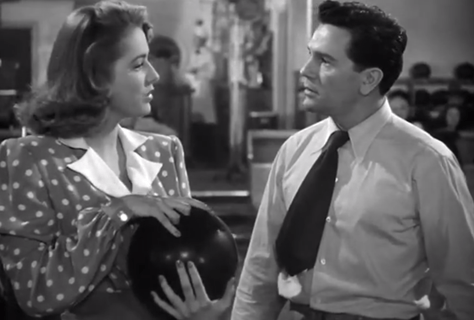
It’s much the same when he finds a quivering Ruth Hadley (Eleanor Parker) at the front door in the dark. A fuse is blown. The lights are out. The family scurries around as a brusque Garfield lets her in. He’s prepared to tear her apart as she confirms all his assumptions about the typical girl-next-door.

This is the rockiest of meet-cutes but I must say, I like it because there is this instantaneous conflict. No disrespect to Dennis Morgan in The Very Thought of You, but Garfield brings his brand of tougher authenticity that’s far more compelling. The beauty of Parker is not simply being an attractive face — on par with any of the Hollywood starlets of the 1940s — there is an earnestness and a feistiness present in her very being.

It comes out over a miserable bowling date tacked onto their already awful evening. She’s been continually humiliated, and she retaliates with her bowling ball and a forceful march out the front doors, which receives whoops and hollers from all the patrons. This is when we realize we have a story and with it a true love affair.

pride of the marines 2.png

At first, it’s tentative. The second stint begins as Al prepares to ship out after Pearl Harbor. Nothing has been agreed upon between them. He’s noncommittal. She’s not one to beg and plead, though she has her own private desires. Their hours together are dwindling and in one final burst of emotion, he asks for a promise: to wait for him and he provides a token of his faithfulness. They’re tied together now like we always knew they would be. There were too many sparks for it to be any other way.

The war can really be summed up in one extended scene played out within the morass of war. Enemy “Japs” wade across the divide toward their waiting machine gun encampment, mowed down in the mayhem. They taunt them throughout the night, coming relentlessly, hour after hour, only to be stopped dead in their tracks, piling up everywhere.

I couldn’t help feeling some amount of conflict in witnessing all this. I am an American and I love John Garfield as much as the next fellow but this senseless killing — even in a fairly chaste old Hollywood movie — still feels like too much. The problem is it featuring war at its most intimate.

“Don’t shoot until you see the whites of their eyes” is a practical axiom, but it also makes hand-to-hand combat far too personal. The film tries, but you cannot keep the enemy completely at arm’s length. Watching something like Fire on The Plains (1959) and we get an idea of what their side of the story might be. In this case, a stir-crazy Schmid holds them off in a gutsy stand that, nevertheless, leaves him without the use of his sight.

Phase three is arguably the most significant yet. He must start to grapple with this new reality, even as he’s rehabilitated in an army hospital in San Diego with some of his wounded buddies. He’s lying to himself, believing an operation will give him back his vision. The letter he dictates to be sent to a concerned Ruth paints much the same tale. Unfortunately, it doesn’t work that way.

The best shot comes in the moment of truth when the bandages are off in the darkness and as a flashlight is about to be brought up to his face, the camera focuses on his jet black hair and goes black as the voices keep talking. The image says enough already. We know the outcome without seeing anything or, precisely, because we don’t see anything…

Still, Al’s not ready to come to terms with reality nor is he prepared to tell Ruth. He wants to disappear so she’s not burdened with his disability; he’s even more dismayed to learn the presentation of his Navy Cross will take place back home. Because a “Marine doesn’t lean on nobody.”

pride of the marines 3.png

The old conundrum is not a foreign one. Each one of us wants to be loved, but what if you come back and we are not the same person — disabled or maimed in some way — that our significant other fell in love with? Will they still take you back or loathe the very sight of you? The answer is not always obvious.

Ultimately, it is his solicitous caretaker Virginia (Rosemary DeCamp) and the moral support of his buddies, including Lee (Dane Clark), pushing him forward. In one private phone call, the nurse confirms her suspicions. Ruth fits into the unconditional love category. She’s not going down without a fight, even if it’s a battle over the heart and soul of her disconsolate husband.

We need not dwell on what happens next. The imagination can all but fill it in. A bit of deception, the warmest of welcomes home, and the long haul ahead, forged by two people together as one. Al Schmid would die in 1982 and receive burial in Arlington Cemetery, while his beloved wife would follow him there in 2002.

Predating the likes of Best Years of Our Lives and The Men, The Pride of The Marines digs into the trials of soldiers coming home from war. Garfield is the most capable man I can think of to bear the brunt of this trauma. He battles the demons with his usual grit.

When he’s not at the center of the drama, it falters a bit into the typical didacticism. All the boys with honest, real-life problems, nevertheless, feel like they’re being used to preach to the audience about the plight of the G.I. It’s real, but the heavy-handed roundtable instigated by Daves gets in the way of everything of interest.

The starry-eyed adulation Loretta showers upon him about his exploits in Guadalcanal is also peculiar to me. “You killed 200 Japs, didn’t you Al?” She sounds breathlessly incredulous at this gargantuan feat; it’s like a trophy. I couldn’t help feeling a bit queasy about the statistics in this domestic context. It just goes to show my conflicted nature as a Japanese-American (who lived a stint in Japan) trying to parse through the complexities of World War II.

What’s not difficult to comprehend is just how brilliant Garfield and Parker are as a couple and if they do a fine job, then their real-life counterparts are even more extraordinary. Because they weren’t picking up a salary from Warner Bros. They were out in the trenches in the real world, living life, and facing everything together.

3.5/5 Stars

Classic Hollywood Baseball Movies

Gary Cooper and Babe Ruth

Given its hallowed place as American’s original national pastime, I thought it would be worthwhile to share some of the best baseball movies classic Hollywood ever offered during its heyday.

I’m not sure if the industry ever made a baseball masterpiece during the Golden Age, but it did highlight some of the great talents of the era both on the field and in front of the camera.

If nothing else, they play a bit like comfort food, between fairy tale romances and warm humor, highlighting men who overcame obstacles to become world-class talents in the Major Leagues.

Pride of the Yankees (1942)

Here is, arguably, the standard-bearer of all baseball movies of a similar ilk. Gary Cooper stars as another famed All-American superstar, Lou Gehrig. Teresa Wright costars as his loving wife Eleanor. The Iron Horse became one of the most formidable ballplayers ever, despite being overshadowed by Babe Ruth. His final days, stricken with ALS, remain a stirring tragedy to this day. There’s hardly a dry eye as he “considers himself the luckiest man on the face of the earth” only to walk off the field for good.

It Happens Every Spring (1949)

This unabashed comedy relies on a crackling premise: a university professor comes upon a curious new formula in his laboratory. No, it’s not flubber but methylethylpropylbutyl. It’s most noteworthy trait is its repellence of wood! Soon the bookish baseball fan is touting his pitching abilities and goes from a nobody to carrying his ball club toward the pennant. Ray Milland stars alongside Jean Peters and Paul Douglas.

The Stratton Story (1949)

Here is a picture certainly in the mold of Pride of The Yankees. This time it’s James Stewart playing Monty Stratton with June Alyson as his crush and future wife. Although Stratton is hardly as well-remembered today, the heart of the romantic drama involves his rehabilitation after he undergoes an amputation. Through grit and determination (and the support of his wife), he made a comeback from his injury to pitch another day.

Take Me Out to the Ballgame (1949)

Although it has much more in common with the other MGM musicals of the day, between Gene Kelly and Frank Sinatra on the ball field (making up a Tinker to Evers to Chance combo with Jules Munshin), and Esther Williams, it’s hard not to enjoy this bright and cheery Technicolor singalong. The shakeup of new female ownership is a good excuse for sparks to fly and quality entertainment to abound courtesy of Busby Berkeley and Arthur Freed.

The Jackie Robinson Story (1950)

There are not necessarily a lot of dramatic thrills to this feature adaptation of Jackie Robinson’s life, but unlike all these other movies, there’s something distinctly special about Jackie portraying himself. With Ruby Dee as his steadfast wife Rachael, we watch Jackie as he is signed by Branch Rickey and rises up the ranks to break the color barrier in baseball, becoming a stalwart of the Brooklyn Dodgers’ team even as he faces an onslaught of prejudice and intimidation. He’s the definition of a sports hero.

Angels in the Outfield (1951)

It plays as a slight and fluffy fantasy story with a demonstrative big league manager (Paul Douglas) receiving some angelic intervention only if he agrees straightens up his act. He goes from being universally reviled by the world to a newsworthy curio. As he starts to change, the team’s fortunes pick up, and romance flowers between him and Janet Leigh. There’s not too much more to it. Donna Corcoran gives an adorable portrayal of a young girl who can see the angels.

The Pride of St. Louis (1953)

The arguments for making a movie about the life of Dizzy Dean seem somewhat slim. Granted, he was a thoroughly colorful figure, born in the backwoods of the Ozarks only to become one of the big leagues preeminent pitchers along with his brother Paul. Dan Dailey and Joanne Dru form a chemistry of contrasts, as Dizzy learns what it is to love someone else and have his will crossed. It’s hardly on par with Gehrig’s or even Stratton’s career trajectory, at least in purely Hollywood terms, but it’s an agreeable story from top to bottom.

Fear Strikes Out (1957)

Here is a baseball biopic that takes the conventional formula while slotting in a younger star in Anthony Perkins to portray up-and-coming outfielder Jimmy Piersall. Far from having his career behind him, it was very much a current event highlighting the ballplayer’s battle with mental health problems, in this case, bipolar disorder (although it was not described as such initially). The two crucial relationships in his life are with his overbearing father (Karl Malden) and his wife (Norma Moore).

Bonus: That Touch of Mink (1962)

While it’s not explicitly a baseball movie, this New York Rom-Com has one of the great baseball cameos with Cary Grant and Doris Day joining the Yankees’ dugout only to see their famed trifecta of Mickey Mantle, Roger Maris, and Yogi Berra all unceremoniously tossed from the game by the agitated umpire. Although it’s hardly as enjoyable, Jerry Lewis’s Geisha Boy similarly features cameos from some of the LA Dodgers’ ballplayers from 1958 for the west coast aficionados.