Three O’Clock High (1987)

The introduction of the main character Jerry Mitchell (Casey Siemaszko ) feels fairly standard and in line with Ferris Bueller, Say Anything, or any of its brethren from the ’80s. Late for school. Dirty shirts strewn about. Simultaneously zapping pop tarts and wet clothes in the microwave. Flat tires and your kid sister hands you a diet Coke to gargle the toothpaste you just finished brushing with. It’s quirky enough to give us some sense of who we’ll be following for the next hour and a half without straying too far from genre convention.

Still, all of this handy exposition feels a bit like a misdirect or at least suggests up-and-coming director Phil Joanou started out with one movie in mind and came up with something else along the way. More on that momentarily.

Jerry is a likable, if innocuous, dweeb we can probably imprint ourselves on and his high school, located in Odgen, Utah definitely doesn’t have the Hollywood glam. It lends itself to a different kind of visual milieu we can appreciate. All the adults in the movie for the most part are only totems to hang necessary impressions and sentiments on.

Jefferey Tambor is the closest to an actual character as a teacher who entrusts Jerry to run the student store and marvels at what a profitable business he’s managed. Otherwise, most of the authority figures and even government agents (how they always have time for teenagers is beyond me) feel like caricatures without too much premeditation.

Despite some promising introductions, most of the friends and female characters feel fairly empty no fault of their own. Jerry’s sister Brei has a chatty wit about her but essentially disappears from the movie popping up only when required.

There’s his thoughtful if slightly ethereal girlfriend (Annie Ryan) whose eyes grow luminous as she speaks candidly about spirit animals and her spirit “guide” Ethan. Don’t ask me to explain. And because Franny’s the brunette (yes, her name’s Franny), there’s also the untouchable blonde goddess Karen (Liza Morrow) who exists as a figment rather than a full-bodied character. She’s always ready to induce traffic accidents and seismic heart palpitations in our fearless hero.

Although it is Jerry’s story, it almost feels like it’s too much about Jerry and his inner psychology. He’s not the most intriguing part of the picture though we do need him as a conduit. Perhaps more could have been built out of his relationship and even his alienation from others. But it’s also necessary to take a moment to consider the movie’s tone and inspiration.

I’m not sure how to parse the fact from the fiction (this oral history is the best resource available) but supposedly this is one of the films Steven Spielberg requested to have his name taken off as an executive producer. It probably comes down to how dark it becomes though even this might lack the ring of truth.

Although it’s easy to label Three O’Clock High as a high school rendition of High Noon, it actually stands more in line with Martin Scorsese’s After Hours from a couple years prior. Given this comparison, Spielberg’s purported surprise would make more sense because this premise has all the potential hallmarks of a traditional ’80s teen movie.

Like its predecessor, I find it drags in the middle using time a bit like After Hours to give in to its most absurd and surrealist tendencies as Jerry’s world dissolves and slowly closes in around him.

One could easily say Soho in the prior film has been distilled down to the school corridors and classrooms Jerry is tied to as he sweats the hours ’til his inevitable annihilation. It does make it feel like Gary Cooper’s Will Kane when evoking the limiting factor of ticking clocks.

However, a venture to the principal’s office features the décor and camera angles fit for The Bates Motel. Later Jerry’s chased down by a security guard in the parking lot. Wasn’t the man in After Hours pursued by an angry ice cream truck? Otherwise, there’s a ghoulish school assembly accentuated by Tangerine Dream’s quintessential ’80s synths and any number of preliminary bouts laying the groundwork for his dreaded showdown.

We have yet to mention the movie’s primary villain whose psychotic reputation more than proceeds him, whispered throughout the halls and steps of the school as it is. The only reason there’s even a movie stems from Jerry’s position at the school newspaper. He’s given the unenviable assignment to profile Buddy Reveill (Richard Tyson) and one urinal encounter makes them mortal enemies for life. Nothing he can do can put off the unavoidable.

The ending does deliver on some of its payoffs by casting off any sense of moralism for a good old-fashioned bloody smackdown between good and evil without a ton of didactic consequences. Law and order are thrust aside as the adolescent masses cheer and rage sensing the brass-knuckled fury in the air. I did begin to wonder if in 80s-era America this hulking villain was a stand-in for fascist or authoritarian regimes. It’s of little importance.

Because this is only an afterthought as Jerry faces Goliath and is subsequently saved by the student body in a deus ex machina a la It’s a Wonderful Life. The lesson: It pays to stand up against tyranny and oppression in the school parking lot. More important still, boyish fantasy is kindled and nothing else exists beyond this singular moment in time. It is a kind of wish fulfillment for young males of a certain age.

Whether it was Joanou’s inspiration, screenwriters Richard Christian Matheson & Thomas Szollosi, or more likely a confluence of everything, Three O’Clock High feels more like a cult curio than an unadulterated classic. That’s not meant to be a slight, nor a total dismissal. It’s not Scorsese (it’s not even Speilberg). But it shouldn’t have to be. It deserves to be taken or left on its own terms as another addendum to the ’80s teen movie canon.

3/5 Stars
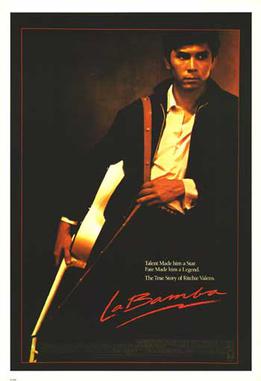
La Bamba (1987)

I must have learned about Ritchie Valens through Don McLean’s “American Pie.” Because there was a time when I was fascinated by all the musical references that seemed so oblique to my young mind. Eventually, the songwriter’s ode leads you to “The Day The Music Died” and if you know about Buddy Holly, you soon learn about The Big Bopper and Ritchie Valens.

The song “La Bamba” feels like a definitive track of a certain rock n roll era, and only now does it become easier to realize what an important cultural milestone it represents. The Mexican language went mainstream blending the rock craze with folk traditions of a people who felt well nigh invisible if no less important in the ’50s.

I do not know much about Luis Valdez, but as an emblematic figure in the Chicano movement of the ’60s and ’70s, he also gave us two of the most noteworthy Chicano movies of the 1980s. He turned his own play into Zoot Suit with Edward James Olmos, a film I was never able to fully connect with, but La Bamba feels like a more straight down-the-line biopic. He effectively brings to life one of the great Chicano heroes of the second half of the 20th century.

Lou Diamond Phillip’s vibrant performance glows with undeniable warmth and vitality. There’s not a disingenuous bone in his body, and he’s able to evoke the joy behind the microphone and the quiet fortitude that comes with his humble migrant background.

This is one of the most moving things about Valdez’s film because even almost 40 years on, these slices of life are still not always prevalent on the big screen. To see them in a period piece seems even more fitting because it’s a way of capturing the cultural moment for us lest we forget.

We see the plight and humble living conditions of migrant workers, there’s instability and broken families, but also the unbreakable bonds of extended families and communities looking out for one another.

La Bamba also has many of the beats of the biopic and since I don’t know the life of Valens intimately, I can only give conjecture on what’s fact and fiction. Part of the story involves his older half-brother (Esai Morales), who exists as the black sheep of the family opposite Ritchie. There’s the blooming of young love with the new girl in class, Donna (Danielle von Zerneck). His family and high school lives run in tandem with his meteoric rise after a record producer, Bob Keane (Joe Pantoliano), agrees to record some of his tracks.

Valens fear of flying, after a midair collision over his school, which killed his childhood friend and left him with recurring nightmares, has the ring of truth stranger than fiction. In keeping with this, the opening interlude of Santo and Johnny’s “Sleepwalk” feels apropos to represent the general mood of the era. What follows is a bit of a dream even as other moments sting with harsh realism.

There are so many narratives that could happen. There’s a bit of a Romeo and Juliet romance as Donna’s father tries to rebuff Ritchie’s sincere advances. Still, Donna remains devoted throughout the picture, and what a lovely thing is to see their euphoric joy together. The images suggest you don’t have to look like one another to fall in love. The fact the movie draws up this star-crossed romance between a 17-year-old and his 15-year-old beau feels of small consideration. It is a movie.

His brother knows how to make an entrance rolling up on his motorcycle, sunglasses on, cigarette between his lips. Or maybe this is only how we imagine him. Still, Bob’s demons could have been their own movie making him into a perturbing, abusive, drunken figure at the movie’s volatile center.

He’s effectively cast as Cain, never good enough or able to find favor in comparison to his thriving little brother. He spends the whole movie self-destructing and coming to terms with his brother’s burgeoning success. Later in life, it seems his real counterpart was able to resurrect his life and became a beloved member of his community.

Likewise, Bob Keane shows up in Ritchie’s life. We don’t really know how he got there or what all his motives are; still, there’s nothing too sinister in it. He helps Ritchie get big by recording and promoting him, and Valens is on top of the world.

It’s easy to see how all of these dynamics might have been either simplified or drawn up in such a way as to streamline the story or punctuate the dramatics. And yet I never begrudge the movie its choices, because it does feel like such a bountiful cultural artifact. The fact Los Lobos provided much of the soundtrack and even show up in a musical cameo is another notable distinction.

And the gutting, sinking feeling in the pit of our stomachs signals the dream cannot last. This talent taking the world by storm and rocking out with Eddie Cochran and Jackie Wilson will be snuffed out far too soon. So if everything else gets resolved in a Hollywood manner, our star is still going to be taken from us in the final reel. There’s no way to get around it.

McLean’s song mourned over it as “The Day The Music Died.” Thankfully, he was wrong. Yes, we no doubt lost out on years of musical output from Holly and Valens. Their young talents were undeniable, and yet their contributions to rock ‘n roll are far from dead. For their relatively short time in the public eye, they’ve cast very large shadows indeed. “La Bamba,” “Come on, Let’s Go,” and “Donna” feel like genre standards by now.

In his own way Valdez has guaranteed Valens won’t be totally disregarded (it was added to the National Film Registry in 2017), and Lou Diamond Phillips, bless his heart, made Valens far more than a hagiography of a deceased icon. He’s a young man with a warm, beating heart, a love for his family’s culture, and a love for rock ‘n roll. I can’t think of a better testament to Ritchie Valens than that.

4/5 Stars

Mystery Train (1989)

I hold an immediate affinity for the images at the core of Mystery Train: A Japanese couple (Youki Kudo and Masatoshi Nagase) riding a train. This is the ’80s so they’ve got a walkman with an audiocassette tape, and it’s blaring Elvis! It becomes apparent they are making a pilgrimage to Graceland so famously immortalized by Paul Simon. The song “Mystery Train” becomes an apropos and uncanny way to enter the story while paying homage to the King.

Jim Jarmusch always strikes me as such an open-minded and curious filmmaker. Modern society speaks in terms of diversity and inclusion, but the beauty of watching a Jarmusch picture, it’s the fact he’s not looking for these things in order to meet some quota. He seems generally interested by the stories and perspectives a whole host of characters can provide him, and his films benefit greatly from this enduring proclivity.

Regardless of where the funding came from, who else would consider making a film about two Japanese youth in search of Elvis Presley in the 1980s? They spend the first several minutes speaking a language that the primary audience probably does not understand. They likewise are bewildered by a upbeat yet motormouthed docent at Sun Records. Still, somehow shared passions for Carl Perkins, Jerry Lee Lewis, Roy Orbison et al., draw them together in inextricable ways.

There’s something perfectly fated about the whole thing with Screaming Jay Hawkins as a rather flamboyant hotel clerk aided by a youthful bellhop (Cinque Lee). I don’t know how to describe it but Hawkins has a command or a sway over the picture rather like Wolfman Jack in American Graffiti. His presence is felt and becomes so indelible in accentuating an aura. He comes to represent a certain era and a place in human form.

Jarmusch’s characters of choice often feel like sojourners, strangers in a strange land and Memphis is such a place. It is a film that features degradation — cracked pavements, garish neon lights, and portions of the world that are not perfectly manicured. What a concept. It’s almost like Jarmusch is giving us the real world albeit composed through his own cinematic lens. It’s no coincidence it has this kind of baked-in glow of Paris, Texas another film of geographical Americana captured so exquisitely by Robby Muller

It’s only a personal observation but my level enjoyment slightly decreased with each descending story. As someone who journeyed in Japan and went to one of the greatest concerts of my life in Yokohama, I feel this kind of kinship with these Japanese youths in their pilgrimage to Elvis and Carl Perkins. Also, on another level, this is a point of view we just don’t often see in movies of the 1980s or even today. Jarmusch is not using them as some kind of stereotypical punchline. He’s genuinely interested in their story and allowing it to play out in front of us.

Then, there’s Nicoletta Braschi in part two. She’s told a ghost story by a dubious stranger and gives him a tip to be left alone. She too seeks asylum for the night at the same hotel and gains a chatty roommate (Elizabeth Bracco) who is linked to our final vignette.

This last interlude with Steve Buscemi feels like it exists in the time capsule moment of a certain era where Tarrantino, the Coens, and others were making these stylized, often grotesque comedies. Elvis (Joe Strummer) gained his nickname inexplicably, but he’s also started to become unhinged because his girlfriend went up and left him. The cocktail of booze and firearms make his buddies Charlie (Buscemi) and Will Robinson (Rick Aviles) uneasy. Although it feels more like an absurd episode of The Twilight Zone than Lost in Space.

Regardless of my own preferences, Jarmusch still gives his world a sense of purposefulness. Again, it’s this serendipitous quality reminiscent of Jacques Demy’s fated films where lives cross paths and intersect in deeply poignant ways.

There’s something somehow elegant about the structure. It’s certainly premeditated and Jarmusch purportedly was inspired by classical literary styles in constructing his triptych, but it’s also a genuine pleasure to watch it unfurl.

The movie revolves on the axis of a few shared moments and places: A hotel, a radio DJ (Tom Waits) playing “Blue Moon,” and a gunshot. But it’s not like they’re all building to some kind of collective crescendo; it’s more so just a passing indication of how lives, whether they mean to be or not, are often interrelated.

Characters orbit each other and interact in these preordained ways that reflect the mind of the maker, in this case, Jarmusch. There’s something oddly compelling and comic about it, but there’s simultaneously a sense of comfort. We have order and a kind of narrative symmetry leading back out from whence we came.

Jarmusch is calling on the poetry of the ages and so in a movie that seems to have a free and laissez-faire attitude, there’s still a very clear order behind it, three distinct threads end-to-end and yet still interwoven into a tapestry that we can appreciate. Mystery Train represents the best in cinematic storytelling — with purposeful composition and aesthetics — but also a sense of aura and inscrutability.

It’s funny and yet when it’s over there’s also satisfaction and a hint of wistfulness. I wish there were more of its ilk today. The movie that’s come the closest is Paterson — another modern jewel from Jim Jarmusch. I see that film in a new light as a much older, wiser, and more forthcoming Masatoshi Nagase sits down on a bench with Adam Driver.

Again, it is a story about the human journey, how we are all travelers in some sense, and what a beautiful thing it is to relish the road because it can lead us to so many beguiling places if we take the time.

4/5 Stars