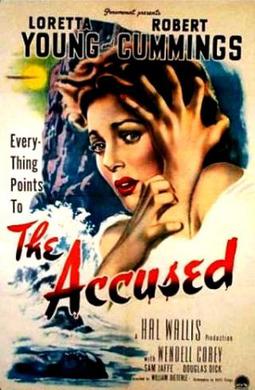
The Accused (1949)

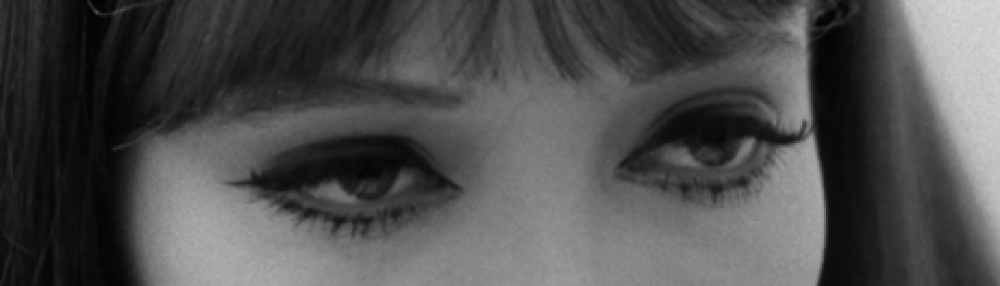
Loretta Young must own a pair of the most luminous eyes in the history of Hollywood, and in black and white, she’s incandescent. More important than that, she’s one of the great sympathetic heroines of Classic Hollywood. In The Accused, she plays both a woman in danger and a working professional. They don’t have to be mutually exclusive, and it makes for a far more nuanced character, especially for the post-war 40s.

Like poor Ida Lupino in Woman in Hiding, we meet her in the dead of night on the road. It’s evident she’s frantic and on the run from something. She gets picked up by a truck driver, though she’s not much for conversation, and he lets her off without much consequence.

A flashback introduces her pre-existing life as Dr. Wilma Tuttle, a professor of psychology at an unnamed university in L.A. It’s finals week as students take their exams and classes wind down.

We get an inkling of drama as we watch the wordless interaction between the fidgety teacher with a leering male student, mirroring her every move and, no doubt, turning in a Bluebook analyzing her own personal psychoses from biting on pencils to tugging on her hair. It’s a queasy relationship because, although she’s in a position of authority, she also seems helpless to do anything.

Douglas Dick does well as the slimy, if charismatic, co-ed who looks ready to entrap his teacher; he’s a kind of skeevy-eyed homme fatale playing teacher’s pet and coaxing his favorite instructor along — first offering her a ride home and then stopping by the seaside in Malibu.

Without using too much equivocation, it becomes a movie about assault and trauma, with the feminine victim becoming the accused, much like Anne Baxter in Blue Gardenia. There needn’t be a movie, but in the 1940s, she operates out of a position of fear in a predominantly male world.

Wilma’s internal monologue gets a bit oppressive, becoming a monotonous crutch, but the cavalcade of performers who come alongside Young are a worthwhile reason to stay the course. Robert Cummings and Wendell Corey aren’t showstoppers necessarily, and still, they have the prerequisite appeal to see them through the career of a reliable actor in Hollywood.

We meet lawyer Warren Ford (Cummings) and Lt. Ted Dorgan (Corey) together at Malibu police headquarters. The former was the boy’s guardian, and the policeman is investigating the case. After the boy’s body washed up on the beach, it was deemed an accident and no foul play.

No fingerprints were found in the car. Immediately, as an audience, we’re doing our mental calculations. Could this be, or is it merely a glaring plot hole? I’ll save you the trouble. Young was wearing gloves as a true lady does in the 1940s. Or else she wiped them…

The film’s asset comes with how it ties all of its primary relationships into twisted knots, all in the name of interpersonal tension. Warren has some personal connection with the deceased, but he quickly becomes enamored with the lady professor, and why wouldn’t he be? They effectively mix work and play, with Cummings being the smooth silk to Corey’s abrasive sandpaper approach.

In its latter half, The Accused becomes a Columbo episode from the inside out. We have our Hollywood star. There’s an opening prologue before the police get involved, and she falls in love. She also begins to feel trapped by what otherwise would be everyday occurrences as she tries to protect herself and cover her tracks.

One of her pupils is a primary suspect. She’s also requested to drop off the dead boy’s Bluebook, which might incriminate her. The truck driver who picked her up in the dead of night is called in as an eyewitness. Then, there’s the business of a missing note that she left for the dead boy and then misplaced. She must find and incinerate it.

Corey’s character is difficult to read. There’s something horrid about him, far worse than his incarnation in Rear Window, and yet he tries to play it off as an act or all part of the game he’s embroiled in on the daily as he does his job. It’s a bit of a curious surprise to see both Henry Travers and Sam Jaffe taking up positions in the police lab. There’s a rational inevitability about the work they do.

Wilma feels the heat, and a date at a boxing match brings out all her latent traumas to the surface again as she transposes the boxer in the ring with the boy she killed. In one sense, there needn’t be a movie because she is a victim, though she digs a bigger hole for herself.

Ultimately, the movie’s denouement is open-ended. The courtroom proceedings are just beginning, and her fate is far from settled, but as we stare into the dazzling eyes of Loretta Young, it’s easy enough to know she will beat the rap with a hedge of innocence around her.

If you dwell a little too much on the implications, the optics that Dorgan also observes might be a flaw in the justice system — if sympathetic appearances are taken as everything. However, in a movie about a woman who is assaulted and then plays the culprit out of fear, it’s at least par for the course.

There’s also a couple of oddities: Corey flirts with her in the courtroom, and Cummings is effectively defending her for killing his “nephew,” though they weren’t close. And still, Corey’s impish sense of humor and Cummings’s passionate orations for his beloved don’t change the bottom line.

This is Loretta Young’s movie, and even as she plays an intelligent woman often hassled and infantilized by the world around her, there’s something so winsome and generous about her performance. The noir elements burn off to make it a story of reclamation and vindication of a life. If you go digging, it does feel like a movie moderately ahead of its time, courtesy of screenwriter Ketti Fring and Young, respectively.

3.5/5 Stars
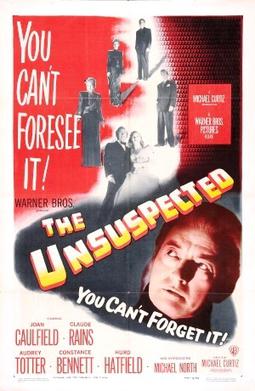
The Unsuspected (1947)

The Unsuspected has a delicious opening dripping with a foreboding chiaroscuro atmosphere. It’s the dead of night. There’s a woman on the telephone tucked away in a back room. The familiar face of Audrey Totter picks up on the other end of the line. She’s out enjoying herself at a club with some male company.

Someone emerges and descends on the flustered secretary. Moments later, she winds up hung from the ceiling — a grisly murder framed as suicide. For ’40s Hollywood, it doesn’t pull punches.

Since Totter is a consummate femme fatale, it’s easy to question what angle she could possibly have in this whole affair. We don’t have the answers, and so we must follow the rest of the film to find out; it’s a genuine pleasure to be afforded the opportunity.

If it’s not apparent already, we are in the hands of professionals with Warner Bros. stalwart Michael Curtiz directing a screenplay by Ranald MacDougall and the director’s wife, Bess Meredyth.

The film is dressed up nicely for a bit of noirish drama with the added benefit of the shadowy, gothic interiors when the story moves to the abode of one Victor Grandison (Claude Rain), a revered radio mystery performer who is reeling after the death of his secretary and the loss of his beloved niece who perished recently at sea.

Rains is an actor with such poise and regality, but building off his turn in Notorious, he plays another complicated figure. It’s a role worthy of his talents, and he anchors a packed menagerie of the usual suspects.

Totter as the sultry Althea always seems to take vindictive pleasure in playing the venomous harlot, and she’s just about one of the best from the era. With her arched eyebrows and intense eyes, she reflects the perfect epitome of an opportunistic, venomous vamp. Though it’s possible she only looks the part. Other people are willing to stoop to murder.

Her inebriated wet noodle of a husband (Hurd Hatfield) feels like a non-entity in comparison, and that’s precisely the point. Fred Clark always has a shifty authority about him, and he’s a close associate of Grandison. Over time, we realize he’s actually the local police detective, a handy man to have as a friend…

The ubiquitous Classic Hollywood heavy Jack Lambert is introduced in one lingering shot, looking out the window of some dive hotel window. What could he have to do with all of this? It’s difficult to implicate him immediately, but we know he’s waiting there for something.

Constance Bennett might just be the finest addition to the cast. She was the wit and experience like Eve Arden a la Mildred Pierce, both beautiful and able to trade banter and wisecracks with just about anyone. She lends a sense of levity to a movie that might otherwise feel oppressively dour. In some ways, she lives above the fray of everyone else, providing a kind of narrative escape valve for the audience.

If you think you already have a line on The Unsuspected, it’s a joy to mention it’s a movie full of perplexing wrinkles. A mysterious stranger (Michael North) shows up on their doorstep unannounced like a specter, and he asks to see Grandison. His next claim is even more outlandish: This young man, Steven Howard, was secretly married to Grandison’s niece Matilda.

Then, a dead person is resurrected like an apparition. Joan Caulfield’s character suffers from a cruel lapse in memory. What happened to her? I should have noted it sooner, but she has the aura like Gene Tierney in Laura, down to the portrait.

Like that picture, it’s a movie spent deciphering people’s motives; it feels like everyone is keeping secrets and no one wants to tell. Is it a case of elaborate gaslighting? It’s not unthinkable in the noir worlds of the 1940s, and Caufield is a ready victim, so sweet and innocent.

What are we to think? Who can we trust? In taxicabs, we find conspirators of a different kind — those trying to ascertain the truth behind a suicide. Because they know there is more than meets the eye.

Matilda returns to her home, lighting it up with the glow of her virginal white countenance in the dark recesses of the family mansion. It feels like oil and water. She does not belong there, but the story is still unresolved. There are several skin-crawling moments as Matilda is subjected to danger with a touch of Hitchcock’s Suspicion (1941). Something’s not quite right, but perhaps her mind is playing tricks…We know she’s not crazy.

It might be low-hanging fruit, but the crucial nature of the antagonist makes the film feel like an early precursor to the Columbo series. Although we don’t know everything right away, eventually the audience is given the keys to the murder, and we must sit back in earnest to watch how they play out, from botched murders to car chases with the police toward the city dump.

I’m also intrigued by the trappings offered by murder mystery radio programs, and though they are used in other films like Abbott and Costello’s Who Done It?, to my knowledge, they aren’t as prevalent in Classical Hollywood as one might imagine.

There’s a delightful meta-quality with Grandison narrating plotlines that played out in the story around him, adding another perturbing layer for the filmmakers to play with. It feels especially fitting here, thanks to Rains’s mellifluous voice and the continued prevalence of mystery and true crime stories to this day. It seems like we still can’t get enough of them over 75 years later. The Unsuspected represents the best of Warner Bros. and the mystery genre, wrapped up in a movie that rarely gets talked about.

4/5 Stars

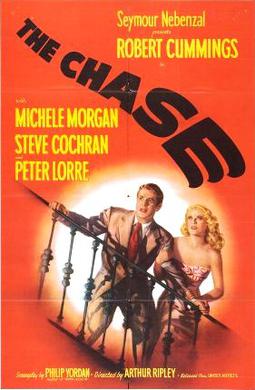
The Chase (1946)

The Chase opens as a wonderful contrivance of noir done up in a couple of successive visuals. A bedraggled man (Robert Cummings) stares through a shop window at a griddle laden with fresh bacon and hot cakes. He leans in so his hat brim mashes up against the glass, and proceeds to cinch up his belt. He doesn’t have any dough.

Then, he looks down right at that precise moment and notices a wallet at his feet stacked with cash. Any person in the real world would have seen it immediately, but it’s set up perfectly for the camera. He proceeds to treat himself to breakfast and a cigar, and after he has a full belly, he decides to pay a visit to the address inside the wallet.

You get a sense of the milieu with a mention of a standoffish Peter Lorre staring through a peephole and questioning what the stranger wants. Our hero is unwittingly cryptic, saying he wants to see one Eddie Roman — he has something to give him…

It could be a belly full of lead or something more innocuous, and, of course, it’s the latter. They give him the once over and reluctantly let him in. The room’s stacked high with statues and ornate antiquities; somehow, they make the interiors feel not just capacious but hollow.

Who lies down the corridors is anyone’s guess because this isn’t where ordinary folks dwell, only cinematic creations. Sure enough, the ex-Navy man Chuck Scott has just happened to fall in with a psychotic lunatic (Steve Cochran). We’re introduced to his temperament when he gives his manicurist a slap for screwing up and sends her simpering out the front door.

Still, he’s impressed by Chuck: An honest guy shows up on his doorstep, and he even tells him he treated himself to breakfast for a dollar and a half (those were the days!). For being such a standout guy, he repays him with a gig as his chauffeur. When you’re destitute, you don’t bite the hand that feeds you.

There’s an uneasy tension in everything Cochran and Lorre, his right-hand man, have their hands in. The controlling Eddie is married to a young lady (Michèle Morgan) named Lorna; he’s hardly allowed her out of the house in 3 years. It says so much about their relationship.

The sadistic slant of the movie becomes increasingly apparent as they stick a different dinner guest in the wine seller to be ripped apart by Eddie’s prized pooch. He has something they want for their business dealings, and any semblance of hospitality burns off as his bubbly conversationalism quickly turns into despair.

For a time, The Chase becomes a kind of contained chamber piece drama. It’s not obvious if it will break out and be something more as Chuck forms an uneasy existence between the backseat driving of his new boss and the despondency of Lorna, who stares out at the crashing waves of the ocean, all but bent on presaging Kim Novak in Vertigo by jumping in and ending it all.

Lorna and her newfound advocate book two tickets to Havana and are prepared to skip out together. Even these scenes evoke a foreboding mood more than anything more concrete because there’s only a vague sense of plot or purpose. From here, it builds into this debilitating sense of obscured conspiracy in the bowels of Havana.

There are obdurate carriage drivers, slinking foreigners, and cloak-and-dagger antics that find his woman harmed and Chuck fleeing from the authorities. The surreal tones of the story just continue to proliferate with novel characters and new environs materializing rather than moving systematically from one scene to the next.

This inherent sense of surreal atmosphere might place the picture ahead of its time, with a select few films of the era. However, it comes off as rather stultifying after auspicious beginnings because it doesn’t accomplish what many of the great Classical Hollywood films managed by telling compelling three-act stories with a sense of economy.

The underlying perplexing tension set against a dreamscape, siphoned from Cornell Woolrich’s source material, is not enough for The Chase to fully pay off on the goods. It feels more like an intriguing experiment than a successful crime drama.

3/5 Stars