Recently I got the chance to sit down with a group of friends and watch 12 Angry Men together. Many of them had never seen it and hearing their reactions was immense fun for me. But as we talked for a few minutes afterward, I began to realize that really each of these characters represents something in myself or perhaps something I see in others. Each man represents a fault or a warning sign, or even a shining example for how I want to lead my own life. And like any film 12 Angry Men is far from perfect. One of my friends pointed out, rightly so, the glaring omission of any women in the film. And it’s true. The film lacks a high degree of diversity and yet at the core of each of these characters is something that I can take away.
So I would like to go down the line and pay a few words to each of the jurors. Because although they work so well on a collective level, it is their individual personality traits and characteristics that turn this courtroom classic into a fascinating study of human nature and interpersonal communication. Without further ado, this is what I learned from 12 Angry Men:
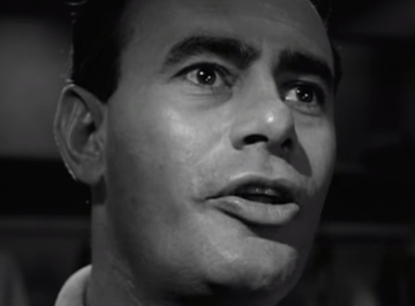
Juror # 1 (Martin Balsam): He takes on the role of foreman and leads the conversations. He’s not a big personality but he remains fair and level-headed. Even though he starts out on the guilty side of the verdict, I always deeply respect his demeanor. His feathers do get ruffled so he’s not impervious but he lends a nice degree of order to the proceedings. And that is needed within any body of people — someone who is willing to take the lead.
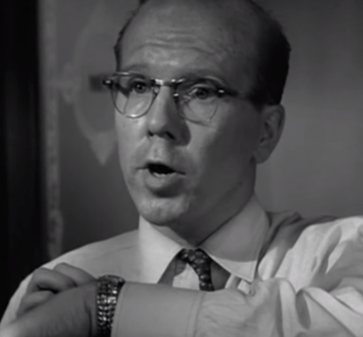
Juror # 2 (John Fiedler): I’m a big fan of John Fiedler and he plays the type of character he was generally best known for. A timid bank teller who is easily dominated by the larger personalities around him. He’s also noticeably younger than many of the men on the jury. However, he reminds me that though I too am a quiet personality, there is still need at times to speak up and most importantly to stand by your convictions. Furthermore, never allow others to look down on you simply because of your years. You can still bring something to the table since you have a different perspective on life that is valuable.
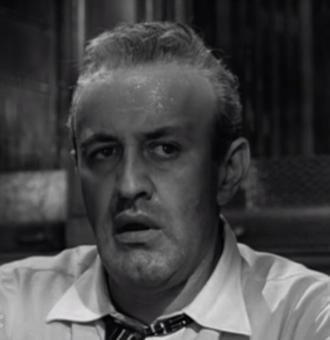
Juror # 3 (Lee J Cobb): He is always the antagonistic force of the film and his role in the film always acts as a bit of a reminder not to allow the root of bitterness infect my life so that it clouds my judgment. For your peripheral relationships to be healthy it is vital that your relationships to those closest to you are flourishing. Family is important. Do your best to foster those relationships whether it’s with parents, siblings or children.
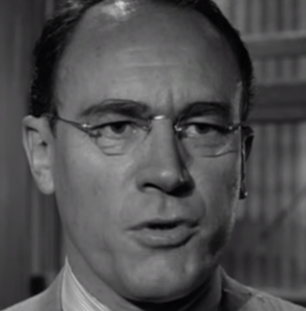
Juror # 4 (E.G. Marshall): Rational thinking and intellect are wonderful and necessary things in this world that we live in. After all, humanity is blessed with brains and it seems like a good thing to put them to use. However, it’s also important to not allow your whole existence run on intellect alone. Things like emotions and feelings have a place in life too because while we are rational beings we are also empathetic ones. We were not meant to live life like machines. Do not become a slave to intellect. Do not become unfeeling.
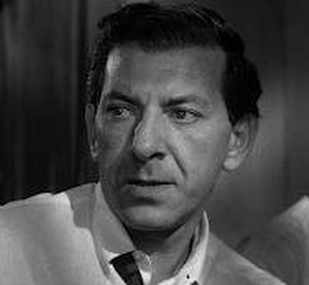
Juror # 5 (Jack Klugman): Here’s a man who is fairly quiet and unassuming at first. But he’s a different sort than juror # 2. It’s less about his temperament and more the fact that he has probably lived his entire life in the shadow of other people. People who keep him down and tell him that his people are no good. But ultimately he gains resolve to stand up for himself. The way he was brought up and the convictions that course through his veins. He too is granted a voice in this forum and notably others begin to listen. He has his own kind of wisdom to offer up as do I.
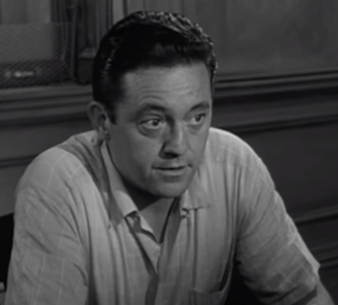
Juror # 6 (Edward Binns): While not the most intellectual of the men sitting around the juror’s table, there’s something quietly noble and upright about this man. He doesn’t talk all that often. He’s not one for deeply thoughtful statements. But he’s a humble, straightforward man who believes in a bit of chivalry still — standing up for others when necessary. That’s something I deeply admire in other people. I know I’m not the brightest mind in the room, but humility and genuine character goes a long way sometimes.

Juror # 7 (Jack Warden): Jokes are a wonderful thing. Laughter is good for the soul and it can add tremendous richness to conversation and human interactions. But there’s also a time and place for playing the clown. We cannot just go through life making light of everything, trying to spin every situation into a joke, because life cannot function like that. There comes a time for being serious and growing a backbone for that matter. Don’t simply go along with others in an attempt to hang with the crowd or get by with the least amount of resistance.

Juror # 8 (Henry Fonda): Obviously he is our hero as a man who is willing to go against the grain and be the voice in opposition of the norm. He shows tremendous integrity and courage to ask the honest questions and even admit his own doubt. That is a man to be admired. Because while he does want to talk it out and consider the gravity of the situation, he very rarely takes the unnecessary high road of self-righteousness. He openly admits he doesn’t know what the truth is but he’s willing to at least dialogue about it. Those are the people that we need more of. Open, honest, and genuine folks who are willing to talk, willing to listen to reason, and most importantly stand up for their personal convictions. That’s what I want to strive after in my own life.
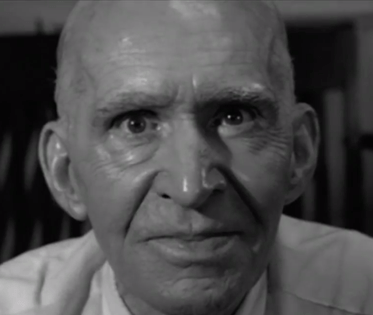
Juror # 9 (Joseph Sweeney): Here is an older gentleman who reminds us that there is a great deal of wisdom that can be gleaned from our elders. We should rightfully so pay them the respect that they are due because there is so much that they can offer us since they often come from a different time and place than we ourselves know. This differing perspective is something to be valued. They often carry insights and values that we might initially disregard, only to find out that they have a great deal that they can impart to us.
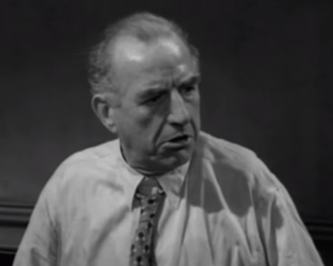
Juror # 10 (Ed Begley): There are few things as abhorrent and insidious as narrow-minded viewpoints. Because it is these people — people who fall prey to prejudice and the categorization of others — who are quick to pass judgments. They allow bigotry to dictate what they say. There is no room for nuance or listening to other people’s voices. In fact, through their actions, they are inhibiting others and leaving no room for any type of dialogue. It’s this interpersonal dialogue which 12 Angry Men is all about and more broadly our own lives as well. I don’t want to be a person who is too closed off to at least listen to people and try to undertand where they are coming from.
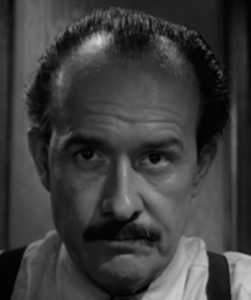
Juror # 11 (George Voskovek): He is one of the most notable jurors because in this day and age he represents so much. In the film, he is the one obvious outsider, the foreigner, the other, and yet he is represented as a thoughtful and articulate man. Most importantly he has a tremendous reverence for the American way of life and the statutes it was founded on. We can learn so much from him because he time and time again subverts most of the labels that are often put on people who are different. But, in fact, those “others” are often the very people we need. Because they bring yet another perspective to facilitate richer, deeper dialogue.
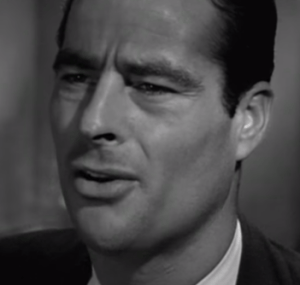
Juror # 12 (Robert Webber): Let your ‘yes’ be ‘yes’ and your ‘no’ be ‘no.’ Don’t be a flip, flopper. This resonates with me so deeply. Sometimes even if you shy away from conflict or crossing others, it’s absolutely imperative to take a stand. Once again, jokes can be a wonderful way to ease tension but there comes a point where you have to face the reality. If someone’s life is hanging in the balance, you have to come to terms with the gravity of the situation.
That’s some of what I learned from 12 Angry Men…
12 people means 12 different viewpoints — 12 perspectives that we can learn something new from. I will always return to this film for those very reasons. In many ways, it models real life for me.

 As the film opens we watch a foot slowly wiggling its toes. It’s nothing extraordinary because we’ve undoubtedly seen this millions of times. If not on film then at least in our own lives. But it’s what the foot does that piques our interest. Quite dexterously but still straining, it manages to pull a record out of its sheath, set it down on the player, and lay down the needle before music finally emanates out. This simple act gives us some profound insight into the story that we are about to invest ourselves in.
 Peter Pan was immortalized by Disney in 1953, but as with many of the great fairy tales that they have adapted, it’s easy to forget that there was an earlier spark. These stories do not begin and end with Disney. They have a far more complex origin story and ensuing history. So it goes with J.M. Barrie’s Peter Pan.
 Coming out of a psychology background I was familiar with Stanley Milgram’s famous social experiment back in high school during Intro to Psych. Even back then it was a striking conclusion on conformity and just how far people will go. It was also ruthlessly contrived and even more methodically executed. Inspiration came from Milgram’s own background working with psychologist Solomon Asch, as well as his own Jewish ancestry, nights watching Candid Camera, and a fascination in the Adolf Eichmann trial.
 “Two people shouldn’t know each other too well if they want to fall in love. But, then, maybe they shouldn’t fall in love at all.” – Vittoria
 The initial scene in the stock exchange is gloriously tumultuous and it never lets up. This is the dashing young Piero’s (Alain Delon) domain that he rushes through with lithe business savvy. What this arena becomes is the quintessential Italian marketplace, a hectic theater of business made up of all kinds, involved parties and observers alike. Vittoria (Vitti) is one of those who looks on with mild interest and really throughout the entire film she is a keen observer as much as she is a person of action.
 And the narrative becomes perhaps even more tantalizing than love because it’s the prospect of romance that keeps it going. But it never seems fully realized. It’s frustrating, unfulfilling in a sense, like most of his films. Whether it’s an unsolved mystery or the most perplexing conundrum mankind has ever faced romantic attraction, he always leaves us an open-ended denouement.
 Steven Spielberg is this generation’s
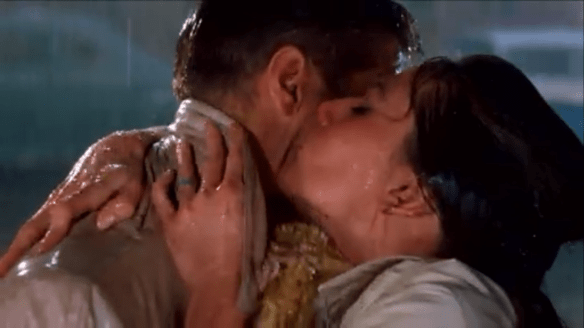
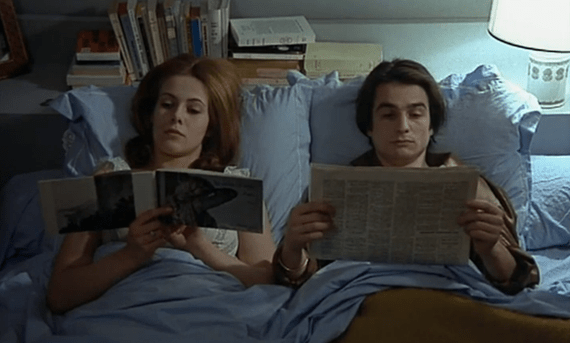 Arguably the greatest French comic was Jacques Tati and like Chaplin or Keaton he seemed to have an impeccable handle on physical comedy, combining the human body with the visual landscape to develop truly wonderful bits of humor. Bed and Board is a hardly a comparable film, but it pays some homage to the likes of Mon Oncle and Playtime. There’s a Hulot doppelganger at the train station, while Antoine also ends up getting hired by an American Hydraulics company led by a loud-mouthed American (Billy Kearns) who closely resembles one of Hulot’s pals from Playtime. Furthermore, there are supporting cast members with a plethora of comic quirks. The man who won’t leave his second story apartment until Petain is dead and buried at Verdun. No one seems to have told him that the old warhorse has been dead nearly 20 years. The couple next door that is constantly running late, the husband pacing in the hallway as his wife rushes to make it to his opera in time. There’s the local strangler who is kept at arm’s length until the locals learn something about him. The rest is a smattering of characters who pop up here and there at no particular moment. Their purpose is anyone’s guess, and yet they certainly do entertain.
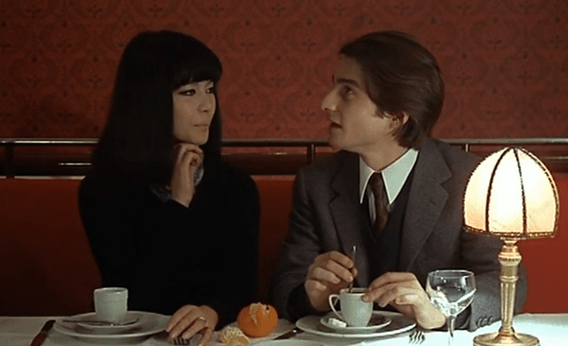 But as Truffaut usually does, he digs into his character’s flaws that suspiciously look like they might be his own. Antoine easily gets swayed by the demure attractiveness of a Japanese beauty (Hiroko Berghauer), and he begins spending more time with her. Thus the marital turbulence sets in thanks in part to Antoine’s needless infidelity –revealed to Christine through a troubling bouquet of flowers. It’s hard to keep up pretenses when the parent’s come over again and Doinel even ends up calling on a prostitute one more. It’s as if he always reverts back to the same self-destructive habits. He never quite learns.
 If you’ve read any of my reviews on the original trilogy, you undoubtedly know that Star Wars had a tremendous impact on my childhood. That’s true for many young boys. It was the film franchise of choice, and it wasn’t just a series of movies. The beauty of Star Wars is that it encompasses an entire galaxy of dreams beyond our own. It’s a world that reflects ours in many ways — the difference is that they have lightsabers. But not just lightsabers. Aliens. Spaceships. Planets. The Force. Characters who for all intent and purposes live like us. Good, that is in constant conflict with the evil in the world. It’s a struggle that is constantly evolving.
