Unknown's avatar

About 4 Star Films

I am a film critic and historian preserving a love of good movies. Check out my blog, 4 Star Films, and follow me on Twitter @FourStarFilmFan or Letterboxd. Thank you for reading!

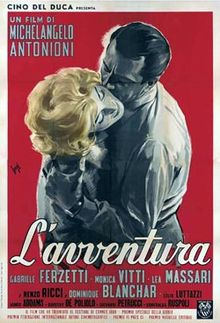
L’avventura (1960)

L'avventuraSmallL’avventura is one of those films that it is difficult to make a cohesive review for. If you are watching it purely to be entertained, you have it all wrong, because that is not its main purpose. Its greatest attribute is the special place it has in the pantheon of film art.

It is a film about a group of high society adventurers who go on a boat trip through some islands, only to have a woman passenger literally disappear, practically into thin air. Her boyfriend and her best friend search for her in the ensuing days, only to fall for each other, and that is about it. This is, of course, the most superficial level possible.

L’avventura is quite interesting visually and I wish I could have seen it on the big screen. The reality is, oftentimes, not a whole lot is happening, but it causes you to actually focus on the images in the frame. Michelangelo Antonioni gives us numerous settings all over Italy, and most have something to do with the wanderings of natural beauty Claudia (Monica Vitti) or her companion Sandro.

Anna (Lea Massari), despite her early importance, is hardly in the film. She is only a wisp in the wind and the mystery surrounding her is of lesser importance. The outcome is what matters as her friend and boyfriend become lovers. Theirs is the relationship that is explored as it develops, evolves, and becomes fully tested.

In the final moments, Antonioni toys with us, suggesting just possibly that Anna might be in the picture again. In fact, he must have a very cruel sense of humor indeed. Here in L’avventura as well as Blow-up (1966) he waves a mystery in front of our nose and leaves it unresolved. It is absolutely maddening, in some respects, and yet he makes us look at something else altogether. He also had the gall to name a film with a meandering plot like this L’Avventura! The nerve of it all, and yet I respect him for it because it messes with our conventions and forces us to be uncomfortable.

It is understandable that this was a polarizing film at Cannes in 1960, and I can only imagine that it has the same effect over 50 years later. One thing is for sure. This is no Gilligan’s Island with a three-hour cruise set in Italy. There is a lot more to it than the plot. Not my favorite adventure, but I respect its pure audaciousness of form.

4.5/5 Stars

Blow-Up (1966)

40940-blowup_posterDepicting the time and place of Swinging London in the 1960s, this film is directed by Michelangelo Antonioni and it stars Peter Hemmings as the protagonist. He is a fashion photographer in a hopping city. He spends his day working with models with countless photo shoot after photo shoot. He is skilled at his job and as such he is temperamental and at times irritated by his fashionable but arduous occupation.

After one such string of photo shoots he goes off on an excursion to an antique shop and a park where two lovers have met. He sticks around and snaps pictures of them before he is chased off by the woman. The next day the attractive woman comes to him asking for the negatives and at first he refuses. After she has left he develops the negatives and blows them up only to find something very intriguing. He goes back to the park at night and finds something very perilous indeed. He returns to his flat and then he spots the woman at a club only to lose her during a concert.

Following the lively evening he returns once more to the park, this time to find something even more unusual. Despite all his efforts everything is still a complete mystery that he cannot hope to solve or understand. There seemed to be some superfluous scenes in this film but it was interesting to watch it unfold. The photographer has an intriguing lifestyle but he is not a very likable character. Following the blow up of the image everything begins to change and we begin to sympathize with him. When the film ends and the mystery is still unresolved, it forces him as well as the audience to simply accept it and move forward. This is an anti-mystery if there ever was one.

4.5/5 Stars

The Best Films of Spencer Tracy

1. Judgment at Nuremberg
2. It’s a Mad Mad Mad Mad World
3. Captains Courageous
4. Adam’s Rib
5. Guess Who’s Coming to Dinner
6. Fury
7. Libeled Lady
8. Bad Day at Black Rock
9. Inherit the Wind
10. Northwest Passage
11. Father of the Bride
12. Woman of the Year
13. Pat and Mike
14. The Seventh Cross
15. Boys Town
16. San Francisco
17. Thirty Seconds Over Tokyo
18, Edison, The Man
19. Desk Jet
20. How the West was Won

The Best Films of Bette Davis

1. All About Eve
2. The Little Foxes
3. What Ever Happened to Baby Jane?
4. Now, Voyager
5. Jezebel
6. The Letter
7. Petrified Forest
8. The Man Who Came to Dinner
9. It’s Love I’m After
10. Hush…Hush, Sweet Charlotte
11. Dark Victory
12. The Old Maid
13. All This, And Heaven Too
14. Old Acquaintance
15. The Whales of August
16. The Corn is Green
17. Mr. Skeffington
18. The Catered Affair
19. It This Our Life
20. Of Human Bondage

My passions were all gathered together like fingers that made a fist. Drive is considered aggression today; I knew it then as purpose.

Interstellar (2014)

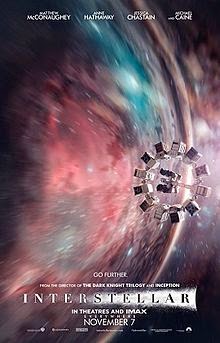
77062-interstellar_film_posterAs has always been his calling card, Christopher Nolan has an eye for grand, expansive, thought-provoking experiences wrapped up in cinema. Perhaps his aims are too ambitious at times, but you can never accuse him of making an everyday film. He always shoots for the moon (or better yet a wormhole) and so his projects are ultimately better than most, even if they miss the target a bit. The reason being, Interstellar is still full of enough questions and concepts to leave us thinking for a good long time after we leave the theater.

Although approximately 2 hours and 49 minutes, hardly anyone could call Interstellar too long, because it is more often than not engaging, as we try and decipher where Nolan is going to take us next. His story starts on a world that is certainly earth but strangely dystopian compared to the planet that we know and love. Reminiscent of When Harry Met Sally or something, old folks speak of the way the world was when the dust first hit and the corn crops had to be burned. Not much explanation is given but it is what it is.

This is the climate that the engineer-turned-farmer Coop (Matthew McConaughey) has to raise his two kids after his wife passed away. They are good kids for the most part. Murph blames a so-called “ghost” for accidents that happen around the house and her brother teases her some. But they hardly complain about this life they have they; just push forward.

However, their father has always been an explorer at heart, a pilot who never got to truly test the vast seas of space or spread out his wings fully. That changes when he and his daughter come across an old relic from the past. No, it’s not a monolith but something far more human. He somewhat reluctantly teams up with his old professor Brandt (Sir Michael Caine) and the professor’s daughter Amelia(Anne Hathaway) in a major undertaking.

They want Coop to pilot a mission to a wormhole which is just out of humanity’s reach. It was seemingly miraculously gifted to the human race by some unknown third person. This is their chance to A: find a new planet for a mass exodus or B: restart a colony on a far away destination. The first option is far less grim. Coop takes the mission in the hopes of saving his kids, but he knows the ramifications. Since time is all relative he does not know when he is coming back. He does not even know what he will find or if he will be successful. He heads off as an angry Murph tearfully watches him fall out of her life.

In a match cut of his own, Nolan transports Coop from his truck to the outer reaches of the galaxy. The real adventure has begun. The mission is clear. Save humanity from most certain extinction. It does not make it easier however that messages are constantly being relayed from earth. Coop and his three colleagues set up a plan of action. Their first target is a water covered environment that looks promising. Not so. Next, Coop overrules Brandt and they head to a desolate world that a previous explorer had labeled as inhabitable. To put it bluntly, he lied and he was not the only one.

Now Murph is older (Jessica Chastain) and she still has a hard time reconciling the departure of her dad. In an especially impactful scene, a still ageless Coop watches tearfully as his older son’s life literally passes before his eyes through the video communications that have been relayed up.

Coop has no way to reply. He can only watch and push forward to try and find a solution. But the answers are few and far between as time continues to move rapidly faster on earth than with the crew of the Endurance. In one final act of selfless valor Coop heads into a black hole and thus begins his own mind-blowing leg of his space odyssey. Some connections are made and when all the pieces are put together all that really matters is his inextinguishable love and family. In the end, Coop spends a nice moment with his daughter under very different circumstances. Together they saved the human race. Together they survived.

For a film that was made for Physic nerds with talk of black holes, worm holes, relativity, quantum mechanics, Newton’s Third Law, gravity and the like, Nolan’s conclusion has a universal ring. As Amelia Brand claims, “Love is the one thing that transcends time and space.” There are still scientific questions left to be debated for years to come, but we know that love is one thing that is forever true.

There are obviously numerous comparisons that can be made between Interstellar and 2001. I would rather focus on the differences very briefly. In Nolan’s film, A.I. is actually useful and more reliable and kind than humanity itself. It is Man who lies, cheats and reverts to animalistic behavior all in the name of survival. Interstellar has a lot of scientific theory behind it (which I will acknowledge I do not know the ins and outs of), however, it also has a very human component. It is grounded on earth with Coop’s kids.

The visuals in Interstellar are often breathtaking but we would probably expect that for such an ambitious space saga. What I really took out of this film was the score and juxtaposition of sound. Hans Zimmer’s compositions were full of pounding organs that somehow fit the mood with their majestic and still austere sound. Furthermore, this film had a lot of dialogue and tense moments of noise, however, when we are outside the spacecraft it is almost completely silent reminding us of the reality of space. It is more often than not a vast, silent unknown.

I am reminded of when Coop explains to his daughter why she was named after Murphy’s Law which seems to be bad. He replies that “Murphy’s law doesn’t mean that something bad will happen. It means that whatever can happen, will happen.” And that was good enough for Coop and his late wife. In some ways I think these words can be used to describe Interstellar. With Nolan, there is the potential that whatever can happen, will. There is excitement and magic in that, even if it sometimes overshoots its bounds. It’s not necessarily a bad thing and that’s good enough for me.

4/5 Stars

Do not go gentle into that good night,
Old age should burn and rave at close of day;
Rage, rage against the dying of the light.
~ Dylan Thomas

Kelly’s Heroes (1970)

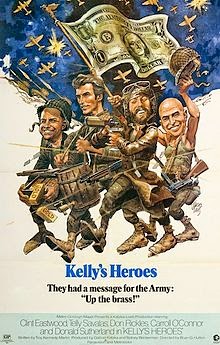
89761-kellyKelly’s Heroes suffers from the same deliberate pacing problem that The Dirty Dozen has. However, if you accept that and accept that this is not your typical war film, you will learn to enjoy it. With a name that hearkens back to Hogan’s Heroes, Clint Eastwood plays Kelly, a man intent on going behind enemy lines to grab his weight in gold bars during WWII.

The lure of gold proves tempting enough to bring many men on board for this ludicrous mission. Among the gang you have Telly Savalas, the always whining Don Rickles,  Donald Sutherland, Gavin Macleod, and Stuart Margolin. Overall the cast was a fun mix of stars of the big and small screens. Do not assume that this is simply a comedy. It has its fair share of explosions and drama. In other words this film has Don Rickles (comedy) sure, but it has Clint Eastwood (action) to bring it back.

All in all Kelly’s Hereos is a decently fun romp right up there with The Dirty Dozen and Where Eagles Dare.

3.5/5 Stars

The Best Films of Orson Welles

1. Citizen Kane
2. Touch of Evil
3. The Third Man
4. The Magnificent Ambersons
5. Chimes at Midnight
6. The Lady from Shanghai
7. The Trial
8. The Stranger
9. Macbeth
10. Othello
11. Jane Eyre
12. The Long, Hot Summer
13. Compulsion
14. Catch-22
15. A Man For All Seaons

*Films as a director and actor

“The absence of limitations is the enemy of art”

The Best Films of Buster Keaton

1. The General
2. Steamboat Bill Jr.
3. Sherlock Jr.
4. Seven Chances
5. Our Hospitality
6. The Cameraman
7. The Navigator
8. Go West
9. Three Ages
10. College
11. Sunset Boulevard
12. Limelight
13. It’s a Mad Mad Mad Mad World

Not including his shorts

Raw Deal (1948)

5453f-rawdeal2Anthony Mann may be most widely known for his westerns often headlined by Jimmy Stewart, but he most definitely honed his craft earlier on. Raw Deal is everything you want and expect from film-noir. Our protagonist is a man who breaks out of the State Penitentiary, you have your potential femme fatale, the moral ambiguity, and most of the other necessary hallmarks.

As a lover of black and white cinematography, Raw Deal is highly appealing with its chiaroscuro, silhouettes, and framing of characters. But after all, that’s often part of the allure of noir.

Claire Trevor’s matter of fact voice-over backed by the theremin is highly effective in dictating the disconcerting mood for the entirety of the film. All our previous predispositions tell us the stage is set for a chilling ending but we can hardly imagine what it is at this point.

After Joe (Dennis O’Keefe) busts out of prison, we get much of what you would expect. A tense manhunt involving a dragnet crossing multiple state lines and a fugitive at large with accomplices. There is violence and melodrama galore as Joe dodges the police while also trying to reconnect with a crooked mob boss named Rick (Raymond Burr), who leveraged an escape attempt so Joe would get knocked off.

With the circumstances as they are, he’s not too keen on giving Joe the 50Gs that he is owed and so Rick wants the fugitive knocked off if the cops don’t get to him first. Put in this light, the film feels analogous to many other noir staples like White Heat, Out of the Past, Gun Crazy or The Big Heat to name a few. However, it has its own wrinkle that makes it interesting.

Joe has his femme fatale to be sure, but the kicker is that there are two dames pulling at his heart strings. Pat (Claire Trevor) is more the dame since she was born in a bad area and has been waiting around for Joe a long time. She’s faithful even to the point of helping him escape, but she’s not the most endearing of characters. Ann (Marsha Hunt) on the other hand is the tender social worker who has been trying to help Joe the legal way. When he breaks out she is taken as a sort of hostage and has difficulties reconciling her feelings for him with what she sees in front of her.

However, he’s certainly not all hardened criminal and so that is part of what makes the rest of the film so interesting. Each character walks the thin line of morality and each one crosses over to the other side even if its only for an instant.

For, Pat the clock continues to tick and her conscience ultimately catches up with her. As the drama reaches its near apex we see Joe’s true feelings, and in a sense, who he has become compared to who he was earlier. However, we cannot help feeling a tinge of remorse in the end. So you see, the film succeeded in doing the near impossible, making me sympathize for Claire Trevor’s character. She seemingly often plays undesirables, but they are never cookie cutter and the same can be said for Raw Deal.

4/5 Stars

“You’re something from under a rock” ~ Ann Martin

Little Big Man (1970)

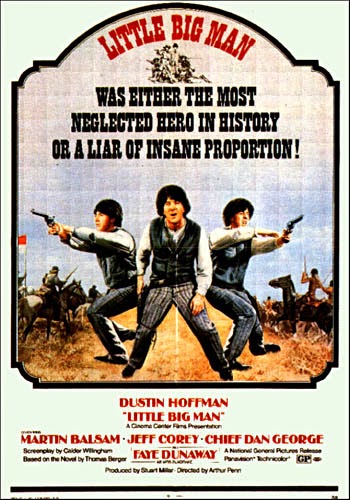
9a376-little_big_manAlthough the film certainly had so good parts for some reason it did not quite jell with me. Focusing on the positive first, this was a revisionist western that tried to depict an alternative picture of the American west from the eyes of Native Americans. Although not perfect it was trying. Dustin Hoffman also gave an impressive performance that found him drifting between the worlds of “the White man” and “the Indians.”

Here is where I get into the main problem that I had with the film. Most of it had to do with age and casting. It was brave and somewhat strange that Dustin Hoffman portrayed his character from his teen years up until he was over a century old. For the most part Hoffman pulled it off. I also was kind of uncomfortable with his sister Caroline who looked like she was 30 even though she was only supposed to be a child. Then, you have Faye Dunaway. That had to be the strangest thing in the film. Although younger in real life, she was Dustin Hoffman’s adopted mother for a time and she played it up.

In some ways this film reminded me a bit of The Butler because we have a main character who grows old in front of us and he ultimately has a role in many diverse bits of history. Like that film, Little Big Man is quite interesting and at times entertaining, but the implausibility of the plot can get to you.

In defense of this film, I really did not know what I was getting myself into and so it surprised me with its mix of violent drama and a sprinkling of comedy. I would have liked to have seen more of Faye Dunaway and Martin Balsam, but it is what it is. Chief Dan George was the breakout character for sure. He was very enjoyable to listen to as he mentored Little Big Man.

3.5/5 Stars