
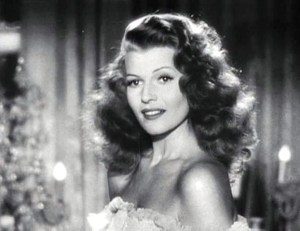
 If you’re worried about Johnny Farrell, don’t be. I hate him~Gilda
And he hates you. That’s very apparent. But hate can be a very exciting emotion. Very exciting. Haven’t you noticed that?…There’s a heat in it that one can feel. Didn’t you feel it tonight? ~Ballin
Gilda became synonymous with Rita Hayworth and for good reason. She was the embodiment of so many of the things found desirable by many men from a certain age. Frisky. Sultry. Beguiling. Teasing men, leading them on, and leaving them. Hating them as much as she loves them. That’s where the passion derives from — very volatile beginnings.
It’s true that Hayworth’s playfully ravishing seductress was forever immortalized in Shawshank Redemption and really in the mind’s eye of anyone who ever has seen her singing “Put the Blame on Mame” even once. She’s also, consequently, the epitome of the deadly lineage of femme fatales at times both tragic and destructive, alluring and lively. It’s difficult not to get drawn in like a moth to the flame.
But underlying such a performance is something a little more disheartening as this is only a cinematic depiction. It is not reality and yet it brings to mind a paraphrased quote that I will attribute to Hayworth, perhaps recalling her turbulent union with Orson Welles or maybe all the men who found their way into her life. “They go to bed with Gilda and wake up with me.”
The implications, of course, are far-reaching suggesting just how much this fawned over female ideal was a pure fabrication. It’s not real. Rita Hayworth could never measure up to that fantasy nor should she have to. Because while Gilda’s tantalizing as a cinematic siren, in real life she could never exist. Her passions impinge on her entire existence where she sees hatred, lust, and love all in synonymous terms. She hates Johnny and she loves him. She doesn’t want him and she does for those very reasons.
While not to downplay the negative impact the role may have had for Hayworth’s personal life, there’s no doubt of its cultural clout even today and it helps make this film-noir directed by Charles Vidor a high water mark of the dark genre for the very reasons mentioned before. Jo Eisinger’s script is also a strikingly perverse number as it begins to draw up the relationships between Gilda and her men.
Because it doesn’t end with her. Gilda needs others to play with and she’s given the perfect counterparts in Johnny Farrell (Glenn Ford) a man who willfully counters anything she offers up in the areas of sexual tension, embittered ridicule, or psychological warfare. It’s like they enjoy to torture each other — they enjoy to be able to make each other reel and fume. It’s all part of the twisted game they play of love and hate. He seethes with a vindictive coiled anger just waiting to be unleashed and he lets it go time after time. Sometimes upon provocation and other times out of sheer malice.
It all finds roots in a past we can only presume about and it’s true that all three of our leads are shrouded in some mystery when we’re introduced to them. First, Johnny Farrell a smart aleck gambler who gets himself a job as the right-hand crony for Ballin Mundson (George Macready) a man who is far more than a simple casino magnate. His business dealings run a little broader and more clandestine than he initially lets on.
Farrell’s a quick learner and ambitious so he moves up the ranks and soon he’s got the most prized position by Ballin’s side as his closest confidante and most importantly of all he’s there to watch over the other man’s wife — his favorite treasure to flaunt — the one and only Gilda.
It’s in that unspoken past that Gilda and Johnny learned to disdain each other and it stokes the flames of their relationship. It’s brutality mixed with sensuality which is at one time disconcerting but at the same time hard to pull away from. Again, moths to the flame. It’s so wickedly twisted with rage and passion and all those human emotions that make us despise one another one moment only to make us no be able to live without each other in the next.
At a certain point, there’s no longer any sense in trying to draw up sides whether it’s feeling sorry for Gilda or empathetic toward Farrell and the thoroughly uncomfortable position he has been placed in as keeper of the bosses wife. Both of them have the makeup of true noir protagonists.
Otherwise, Rudolph Mate’s gorgeous imagery is absolutely fantastic and is certainly worthy of simply being marveled at on multiple occasions for its delicious compositions and use of shadow. Hayworth is rendered even more beguiling and Macready becomes an even more perplexing figure masked in darkness. Meanwhile, the Carnival celebrations are cast as stunning spectacle and over the top extravagance that’s also rudely disrupted by murder.
One could take it as a metaphor suggesting that the post-war era had commenced with a flourish but that cannot completely get rid of the sour taste left over from the war. A veil of darkness still remains. Along similar lines, there’s a bit of Casablanca’s tension running through this film, and its atmosphere, while not quite on par with its predecessor, still rings with a lot of character.
The roulette wheels are in fine form and the establishment is full of its own rogue gallery of humorous and foreboding figures alike. The always lovable Uncle Pio provides a dose of good humor but there are also treacherous Germans, numerous rich boy toys, and a surprisingly civil government agent who all make a habit of frequenting the most popular casino in Buenos Aires.
It might be true what Johnny says about gambling and women not mixing but then again with the lens of film-noir they prove to be a high octane combination, representing vice and sensuality, two of its most readily available commodities.
4.5/5 Stars
 The rain is pouring down. A group of men sits in silence in truck cabs their heads full of all sorts of thoughts. Two more sit in the rear hoping the explosives sitting in their stead don’t decide to go Kablooie over the next bump. Nary a word is spoken, the entire sequence playing out in silence except for the inner monologues of each man.
 In the 1970s political paranoia involved issues in the realm of Watergate. Government conspiracy and that type of thing perfectly embodied by some of Alan Pakula’s best films. But it’s important to realize in order to better understand this particular thriller, the 1980s were a decade fraught with fears of Soviet infiltration compromising our national security. The Cold War was still a part of the public consciousness even after being a part of life for such a long time already. So No Way Out has a bit of Pakula’s apprehension in government and maybe even a bit of the showmanship of Psycho with some truly jarring twists.
 Are you always drawn to the loveless and unfriended? ~ Edward Rochester
 In an animation market saturated by the likes of Disney, Pixar, and Dreamworks, those that have become some of the foremost names of the latest wave of animation, we sometimes forget that there are other voices as well. Song of the Sea is one of those alternative stories that is ripe for discovery.

 Previously, whenever I thought of Elvis and films, my first inclination was to think musical and then secondly because, by some form of osmosis the culture had taught me this, Elvis went with Ann-Margret. In truth, they were astoundingly only ever in this one picture together but what a picture for them to be in. It left an indelible impact on both stars as much as it did their audience.
 It’s my prerogative to respect films that dare to leave me questioning their ambitions and their outcomes. Clouds of Sils Maria is such a film. At times it gets so caught up in its own meta-narrative perhaps too much so.
 It’s happened in some well-documented cases that the same actor has played two characters that feel nominally similar and based on this cursory level of comparison the general public has been forever befuddled. You could cite some notable examples being Bogart playing Sam Spade and Phillip Marlowe the archetypal pulp private eye heroes of Dashiell Hammett and Raymond Chandler.
 Anyone who takes the time to search out this movie whether the reason is a young Jack Nicholson who wrote, helped finance, and starred in this western or because it’s directed by cult favorite Monte Hellman, they probably already know it was shot consecutively with The Shooting. Whereas the first western has an unnerving existential tilt as the plot takes us through an endless journey across the oppressive desert plains, you could make the claim that Ride in the Whirlwind is a more conventional western.
 4 Star Films