Review: Mr. Smith Goes to Washington (1939)

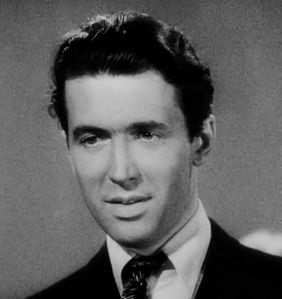
James_Stewart_in_Mr._Smith_Goes_to_Washington_trailer_cropThe opening credits roll and recognition comes with each name that pops on the screen. Jean Arthur, James Stewart, Claude Rains, Edward Arnold, Guy Kibbee, Thomas Mitchell, Eugene Palette, Beulah Bondi, H.B. Warner, Harry Carey, Porter Hall, Charles Lane, William Demarest, Jack Carson, and of course, Frank Capra himself.

We are met with the ubiquitous visage of Charles Lane calling in a big scoop on the telephone. A senator has died suddenly. The likes of Porter Hall and H.B. Warner fill the Senate Chamber presided over by a wryly comic VP, Harry Carey. Corruption is personified by the flabby pair of Edward Arnold and Eugene Palette while Claude Rains embodies the tortured political journeyman. The eminent members of the press include not only Lane but the often swacked Thomas Mitchell and a particularly cheeky Jack Carson.

To some people, these are just names much like any other but to others of us, linked together and placed in one film, these figures elicit immense significance and simultaneously help to make Mr. Smith Goes to Washington one of the most satisfying creations of Hollywood’s Golden Age from arguably “The Greatest Year in Cinematic History.”  The acting from the biggest to the smallest role is a sheer joy to observe as is Capra’s candid approach to the material.

As someone with a deep affection for film’s continued impact, it gives me great pleasure that stories such as Mr. Smith exist on the silver screen if only for the simple fact that they continually renew my belief in humanity, whatever that means. Because it’s an admittedly broad, sweeping statement to make but then again that’s what Frank Capra was always phenomenally skilled at doing. He could take feelings, emotions, beliefs, and ideals synthesizing them into the perfect cultural concoctions commonly known as moving pictures.

But his pictures always maintained an unfaltering optimism notably in the face of all sorts of trials and tribulations. He never disregarded the corruption dwelling in his stories–it was always there–in this case personified by the stifling political machine of Jim Taylor gorging itself off the lives of the weak and stupid.

The key is that his narratives always rise above the graft and corruption. They latch onto the common everyday decency, looking out for the other guy, and in some small way uphold the great commandment to love thy neighbor.

Politics have never been my forte. Like many others, I’m easily disillusioned by “politics” as this becomes a dirty word full of arrogance, partisanship, and scandal among other issues. It seems like the founding principles that laid the groundwork for this entire democracy often get buried under pomp & circumstance or even worse personal ambitions.

Although this film was shot over 75 years ago everyone who’s been around the block lives as if that’s the case then too and so they’re not all that different from today at least where it matters. Cynicism is a hard thing to crack when it runs through the fabric of society from the politicians, to the newspapers, all the way down to the general public. It’s not hard to understand why. Still, the genuine qualities of a man like Jefferson Smith can act as a bit of an antidote. He as a character himself might be a bit of an ideal, yes, but I’d like to have enough faith to believe that people with a little bit of Jefferson Smith might still live today.

Common, everyday people who nevertheless are capable of extraordinary things like standing up for what’s right when they know that no one else will or when they know all that waits for them at the end of the tunnel is disgrace. But the promise of what is beyond the tunnel is enough. That is true integrity to be able to do that and those are the causes worth cheering for when David must fight Goliath and still he somehow manages to overcome. That’s the chord Mr. Smith strikes with me. thanks in part to Capra’s vision but also Stewart’s impassioned embodiment of those same ideals.  He has a knack for compelling performances to be sure.

Time and time again James Stewart pulls me in. His career is one of the most iconic in any decade, any era no questions asked. There are so many extraordinary films within that context perhaps many that are technically or artistically superior to Mr. Smith by some  estimations, but he was never more candid or disarming than those final moments in the senate chambers as he fights for his life — clinging to the ideals that he’s been such a stalwart proponent for even as his naivete has been mercilessly stripped away from him.

In the opening moments, his eyes carried that glow of honest to goodness optimism, his posture gangly and unsure represented all that is genuine in man. Now watching those same ideals and heroes come back to perniciously attack him, he presides with almost reckless abandon. Is he out of his mind? At times, it seems so, but as he wearies, his hair becomes more disheveled, and his vocal chords have only a few rasps left he still fights the good fight. There’s an earnest zeal to him that’s positively palpable.

As our stand-in, Saunders (Jean Arthur) first writes him off as a first class phony or at the very least a political stooge ready to do another man’s bidding but she does not know Jefferson Smith though she does grow to love him. And Arthur’s performance truly is a masterful one because without her Smith would hardly be the same figure. She brings out his naivete by sheer juxtaposition but she also puts the fight back into him because he brought a change over her that in turn rallies him to keep on pushing. They’ve got a bit of a mutually symbiotic relationship going on in the best way possible. You might call it love.

Capra repeatedly underlines Smith’s honesty and genuine nature not only through numerous rather simplistic montages of Capitol Hill and the surrounding national monuments but in the very way his character carries himself around others. He never assumes a position of superiority. He’s always humble. He sees the inherent need to raise up young people well so that they might progress to become the leaders of tomorrow with a great deal to offer our world. He fumbles with his hat in the presence of pretty girls and holds his idols in the highest esteem. It’s all there on Stewart’s face and in his actions. We too comprehend the solemnity and the gravity that he senses in the office of the Senate.

While this was not Jimmy Stewart’s debut and it was only at the beginning of a shining career as has already been noted, it was in these moments that the cinematic world fell in love with him. He can’t be licked and for good reason. He was never one to give up on lost causes just like his father before him.

I guess this is just another lost cause, Mr. Paine. All you people don’t know about lost causes. Mr. Paine does. He said once they were the only causes worth fighting for, and he fought for them once, for the only reason any man ever fights for them: Because of one plain simple rule: Love thy neighbor. ~ James Stewart as Jefferson Smith

5/5 Stars

Review: Mr. Deeds Goes to Town (1936)

Gary_Cooper_in_Mr._Deeds_Goes_to_Town_trailer“He could never fit in with our distorted viewpoint, because he’s honest, and sincere, and good. If that man’s crazy, Your Honor, the rest of us belong in straitjackets!” ~ Jean Arthur as Babe Bennett
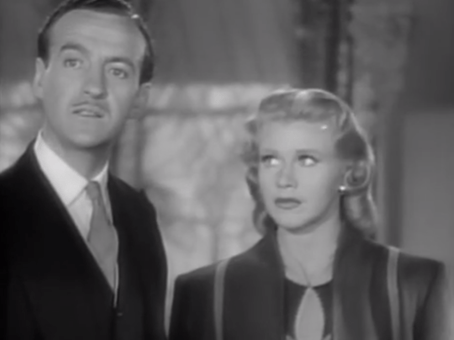
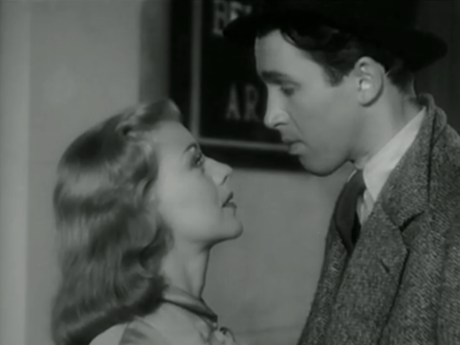
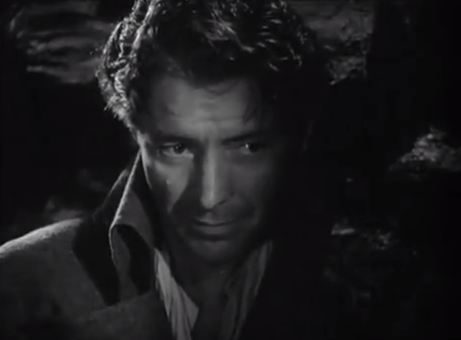
Mr. Deeds Goes to Town is a true treasure of idealism and Americana. People, especially now, may have many quibbles with the films of Frank Capra because he was the undisputed champion of feel good cinema that revelled in happy endings, stalwart honesty, and the little guy being permitted a fighting chance.

It’s no wonder that he made such good use of the likes of Gary Cooper and James Stewart because they embodied common, everyday American decency like few other actors could ever claim. Admittedly it’s easy to belittle his pictures as saccharine and sentimental to the nth degree but beyond that Capra always seemed to have an inherent sense of what America stood for or at least what he believed it could and still can stand for.

Every man deserves a certain amount of respect. You might call them inalienable rights like life, liberty, and the pursuit of happiness. And any force that tries to impede that is in simple terms an affront to all humanity. Because though we might all think we’re different, we share a lot more similarities than we often want to concede. It’s easy for us to forget that and that’s what happens here.

Longfellow Deeds (Cooper) becomes the overnight talk of the town because his rich uncle dies in a horrible car crash and bequeaths his wealth to his unsuspecting nephew. It’s the kind of good fortune that others drool over but in Deeds’ hands, he takes it in stride. He comes off as a real Yokum from the one horse town of Mandrake Falls but if anything Deeds is incredibly smart. He realizes he can have contentment out of the limelight and with very little. He enjoys quiet days oftentimes filling idle hours with his prized tuba and poetry that he writes for postcards.

But his new status as a millionaire forces him into the life that he doesn’t much want. Mansions and butlers, folks looking for handouts, ravenous newspapermen (and women) and conniving lawyers. Front and center is Mr. Cedar (Douglass Dumbrille). It’s these very individuals who see Deeds as a ridiculous outsider to be belittled and taken advantage of.

The brilliance of Capra’s movie is that he makes his hero, while simple and practical, still very astute. He may have his many quirks but there’s a surprising amount of business acumen and common sense flowing through his veins that consequently sends everyone else for a loop. He spies phonies from a mile of away and he looks to reform the local opera while finding ways to spend his newfound fortune sagaciously.

The only thing he’s not watching out for is a pretty girl, journalist Louise “Babe” Bennett (Jean Arthur) is ready to nab him, capturing his heart and simultaneously giving the whole city a front row seat to his exploits about town from quarrels with a snooty circle of poets to an evening jaunt ending on a fire engine. She’s a pro at spinning the tale into one of a first class boob, christening him the “Cinderella Man” that the whole world laughs at. They eat it up and they want to see him fall–this idiotic nobody suddenly being scrutinized by society for his good fortune. It’s all rather unfair but oftentimes that’s the way the world turns. It’s a cruel and sometimes curious place.

Because while Deeds grows fed up with this whole lifestyle, ready to leave it all behind him, Babe finds herself truly falling for her project since he models something she rarely sees in a man — real honest to goodness integrity that guides his every action. There’s never a false pretense or a veiled intention. What you see is what you get. Ironically enough, in this land of fakes, she’s the only “real” person he thinks he’s met. And she knows what’s been going on, going so far as to tell her editor that she’s quitting. There’s no way she can keep up the charade only injuring the character of the one she loves more and more.

But of course, everything dives into the depths of despair when Deeds is sent to trial calling into question his sanity after he resolves to use $18,000,000 to portion off acres of land to destitute farmers to work for him. It’s utter lunacy, isn’t it? The workers line up around the block leading into his home as he offers them a chance at a real life without starving children and food lines every day. This is what Cedar, Cedar, Cedar, and Blumenfeld are bringing him to court for or is it the fact that they want a portion of his fortune? Yes, that just might be it.

Anyways, far worse than that fate is the fact that he thinks his girl has betrayed him and she has in a sense, but she’s also devoted to him by now. She watches helplessly as her man gets railroaded. She began as the one to crucify him in the tabloids and now she prepares to watch him get crucified in the courtroom. In these moments, he does take on a Christ-like post watching all the proceedings without a word. He never makes any effort to defend himself after accusation after accusation is thrown his direction.

But the bottom line is that he does not have to let himself be destroyed. Being the martyr, in this case, is not his job and Capra lifts him out of the pit and resurrects him. The fact that Louise fights for him and numerous others including his cynical right-hand man Cornelius Cobb (Lionel Stander) and the local newspaper editor (George Bancroft), not to mention a legion of grateful farmers. So Mr. Deeds ends with a tumultuous courtroom finale befitting one of Capra’s finest pictures. It brims with goodness and bubbles over with humor that constantly underlines this feel good classic.

Though Gary Cooper represents Capra’s love of the every man with common decency and common sense, Jean Arthur remains equally crucial to the worlds that he creates. It has to do with her quality as an actor that allows her to play the snappy, witty, world-wearied types. Because she represents all the many people with that very same cynical streak and yet the very fact that her heart can be melted and her whole mindset can be changed suggests that there might be hope for all of us. That hope burgeons up from Mr. Deeds and leaves us with a warm feeling indeed.

4.5/5 Stars

Bachelor Mother (1939)

bachelor mother 1.png

Of course, Bachelor Mother is a blatant oxymoron and it’s a perfect summation of that vestige of a genre the screwball comedy — a genre that’s about marriage and divorce and the gray areas in between conveniently skirting past issues such as adultery or people “living in sin” as it were. The norm was not a genre of divorce but of remarriage.

As such this Ginger Rogers vehicle has her playing a woman who doesn’t actually have a child out of wedlock but it’s assumed as much and that’s where the roots of the comedy get their traction. Because therein dwells so many societal taboos that are subsequently turned into marvelous fodder for misunderstanding though no actual moral statutes have been broken. It’s that line of dramatic irony that the rom-com, in general, has always needed in order to survive.

Just think how perfectly it all happens. In one moment Polly Parish (Ginger Rogers) finds herself laid off from her department store gig just in time for Christmas and between the unemployment agency and home she happens upon a lady leaving a cute little bundle of joy on the doorstep of the local orphanage. She says it’s not hers. She found it somewhere and now she’s leaving.

But Ginger Rogers being our concerned heroine can’t just let the baby sit there so she takes a course of action, delivering the child inside and enlightening the staff about the situation. Of course, they all believe she’s simply shirking her maternal responsibility and running out on her child and they pass the news along to David Merlin (David Niven), one of her former employers.

By now, Polly is already long gone. She’s agreed to take part in a dance competition at the local hall the Pink Slipper. There’s $50 in it for her and her partner Freddie (Frank Albertson of It’s a Wonderful Life prominence) if they can win. Waiting, babe in arms and valet in tow, Mr. Merlin tries to rectify the situation and get Polly to take back her child.

If the film was born on the steps of the orphanage, then it is solidified right here as a full-fledged screwball comedy of motherhood and misconstrued circumstance. Polly finds herself called into Mr. Merlin’s office and is offered her old post as long as she takes her child back. Still, they don’t listen to her renunciation so she has no course but to become a mother, after all, babies are cute. They can’t be that much work…

The fact that this is a screwball and not so much a domestic comedy is made clear by the fact the baby is more of a plot element than an actual character and Rogers and Niven find time to fall in love even with the added strain of motherhood.

What seems to do it is a lovely night together on New Year’s Eve which is highlighted by an extended gag where Niven introduces Rogers as his date from Sweden who conveniently does not speak a lick of English. It’s punctuated by the definitive punchline of the film. Simultaneously, Rogers struts her stuff all night long (though we miss Fred Astaire) in a reverie of pure joy.

But that’s not all that’s capped off amid the pandemonium of the festivities. Love Affair is far from just the movie up on the nearby theater billboard. It’s also something coming to fruition between our two stars. However, if this was the end it could hardly claim the name screwball. That’s when the baby comes in. J.B. Merlin (Coburn) finds his son with this single mother and draws conclusions of his own and…he’s very happy to be a grandfather and not so happy with the spineless conduct of his son.

What follows is a mad dash by our two leads to try and conjure up other stand-ins for a game of Who’s the Father? Three eligible contenders are brought in to play the charade. We already know Merlin, then there’s the dancing fiend and disgraced floorwalker Freddie, and the landlady’s bespectacled son.

In the end, everything is squared away nicely and the corkscrew comes full circle. Though Charles Coburn plays a very small part it proves to be a crucial one. Meanwhile, I adore Ginger Rogers and once more following Stage Door and Vivacious Lady, she proves in yet another film her genuine skills as an actress of immeasurable smarts and humor. Sometimes I’m admittedly unfair to David Niven — he’s never been the most compelling actor — but he’s fine in this picture.

This film also shares much the same world as the Devil and Miss Jones (including Charles Coburn) and the toy store environment provides the perfect arena for a terrifically comical shoplifting sequence full of excitement. It’s this movie to a tee. Positively quacking.

3.5/5 Stars

Vivacious Lady (1938)

vivacious lady 1.png

The first moment Pete Morgan (James Stewart) actually catches sight of alluring nightclub singer Francey (Ginger Rogers), the gangly botany professor proceeds to knock over a drink cooler. He’s enamored. In the movies, it’s that magical trope called “love at first sight.” For other pictures that’s where they go to die as the two loved birds get wrapped up in the throes of romance exploring New York City together. With Stewart and Rogers as our guides, there’s no place we’d rather be. Soon they are married and on their way to meet the parents in the idyllic town of Old Sharon.

Except they never get there or rather they get to the town but Pete never gets to the part about telling his parents he’s married. Charles Colburn is bullish as Peter Morgan Sr. the obdurate, overbearing intellectual who will not allow his son to get in a word edgewise. That’s aggravated by the fact that in his typical manner Stewart is always beating around the bush, never quite able to get the words out and so the happy news never finds an audience.

Besides Mr. Morgan has his sights on his son marrying the prim and proper Helen (Frances Mercer) while he turns his nose at the blonde woman that his nephew Keith (James Ellison) is traipsing around with it — that undoubtedly unsophisticated creature who also happens to be his actual daughter-in-law!

Thus, begins the film’s longest digression as wife becomes a student for the sake of being close to her husband and Pete tries his darndest to break the news to his parents while still getting time with his wife. But the guise of student and teacher isn’t helping much. They probably broke the whole code of conduct book on student-teacher relations circa 1938.

One of the favorite hot spots for late night extracurriculars just happens to have an outboard motor right next to it and it can make quite the din if accidentally pulled. Otherwise, Pete has an awful time trying to see his wife as the lobby clerk (Franklin Pangborn) is a real stickler and so the only access to her room is of a clandestine nature up the fire escape.

And still his father won’t listen to him and his former fiancee is still trying to nab him. It’s getting so hopeless that Francey thinks it might be best if she leaves Old Sharon behind for good. A memorable dance party with the parents in Francie’s room proves the kicker. Though she forms a bit of a rapport with the kindly but frail Mrs. Morgan (Beulah Bondi in 1 out of her 5 turns as Stewart’s mother), an indignant Mr. Morgan will have none of this tomfoolery.

Soon enough Francey decides to leave town of her own accord.  But even at the cost of his professorship if need be, good ol’ Jimmy Stewart won’t let her get away that easily. Whether or not this film drags a bit in the latter half is beside the point because you couldn’t have two more likable stars than Stewart and Rogers nor a Hollywood director more competent than George Stevens in balancing the breadth of slapstick comedy and romantic drama.

If the material is simply adequate enough, they are the type of talents that take us along and we will willingly be their audience through every complication. It’s our privilege.

In case there was any doubt whatsoever Ginger Rogers is awesome and it’s put on full display when she has a slap fight with her archnemesis before taking her in a headlock. If you liked her before simply for dancing prowess, she proves to be a savvy cat fighter as well.

Jimmy Stewart was still in the fairly latent stages of his illustrious career but Rogers recommended him for the role and he provides his homespun charm and length to every frame like we are accustomed to seeing from him. Not to mention his forays in home brewing. They’re quite impressive.

The only major blot on the film is an appearance of the prolific Willie Best playing his typical googly-eyed waiter — the walking stereotype that always feels like a cringe-worthy addition to any picture of old as does a cameo by Hattie McDaniels. At least there weren’t any chinamen. Not that there’s much consolation in that. Shall we just say that Rogers’ vivacity and Stewart’s universal affability make for a quality viewing experience and leave it at that?

4/5 Stars

A Tale of Two Cities (1935)

a tale of two cities 1.png

It’s no surprise that this adaptation begins with that oft-repeated bit of poetic parallelism. “It was the best of times it was the worst of times” etc. Of course, in its abridged format the opening suggests the universal quality of those iconic words. It was a period very much like the present.

The scene is set. What follows are images that prove to be deliciously atmospheric with a loving mixture of British colloquialism and Hollywood storytelling all stirred together in an agreeable period drama.

Perhaps the highest compliment I can pay this film, directed by Jack Conway, is that it manages to capture some of the essence of Dickens’ novel even if it does not wholly enrapture me as the source material did those many years ago in my freshman honors English class.

The beauty of literature is that it allows you to create pictures in your head — to let your imagination run rampant — the magic of film is how it allows for such spectacles to be brought to us visually though they might come out imperfectly. Owing to length and practicality, it cannot completely transcribe every last detail onto the screen resorting to jumps in time and abridging of the text.

In fact, a slight criticism is that the film resorts to title cards too much. Still, there are some inspiring moments including the climactic storming of the Bastille sequences courtesy of that inspired combination of Val Lewton and Jacques Tourneur. It’s simultaneously harrowing and marvelously condenses the sweeping forces of the mob rule’s swift rise during the French Revolution into a matter of brief images that overwhelm with their sheer scope and ferocity.

Also, whether this film succumbs to pure histrionics or is instead an impassioned interpretation of Charles Dickens’ material is up for debate but there is no denying that there is a pleasing texturing to many of the most prominent characterizations.

Though a minor part, Basil Rathbone that legendary villain turns in one of his myriad performances as a heartless French nobleman. Whereas Miss Pross is played with endearing yet resolute defiance by Edna May Oliver. Both Lucie Manette and Charles Darnay exude a certain geniality that we’ve come to attribute to the roles. They are less interesting but necessary for the story to have any magnitude.

The most telling difference in depictions for me was in the character of Mr. Lorry (Charles Gillingwater) likened to a crotchety old coot though Dickens paints a picture of him that feels much more reserved and similarly steadfast. I would know because out of all the many figures, I always resonated with him a man who remained a supporting player but nevertheless reflected fine qualities of loyalty and quiet integrity.

But of course, we must inevitably come to Sydney Carton. In the book, he transforms into our hero coming to the fore among a wide array of other characters but with Ronald Colman undoubtedly the biggest star in our film we are conveniently tipped off to his crucial importance and he is vital to the story.

It could have been all too probable that like The Prisoner of Zenda, Ronald Colman could have taken a double role because (SPOILER ALERT) Dickens’ original novel hinges on the likeness of Charles Darnay and Sydney Carton. But in this case, it’s almost a stroke of good fortune that Colman was only given one part.

In it, Ronald Colman plays the brilliant young solicitor who nevertheless spends most of his evenings with his snout in a bottle wasting so much of his talent toward purposeless diversions. He’s a charming fellow but he seems hardly a person of note. But that’s not the final word.

Colman is aptly able to focus all his energies on the man and he’s further allowed to embody one of the great redemption tales in all of English literature. It seems he knew it too, willingly relinquishing his iconic and beloved mustache in deference to the role which no doubt was one of the defining moments of his career.

There’s also no denying the transcendent themes that course through this narrative and reveal themselves much as we would expect. Because this is a story of ultimate sacrifice and a very overt evocation of the Christ story.

Thus, it seems no small coincidence that as Carton takes part in a selfless act that will define his life the trills of “Come All Ye Faithful” quietly play in the background. The inference is plain. Though, it’s a political fable as well a spiritual one, Carton’s words are what entrench themselves into the viewer’s consciousness, “It is a far, far better thing that I do, than I have ever done; it is a far, far better rest that I go to than I have ever known.” Some might vehemently disagree but this is a Christmas film if ever there was one. Because it points to hope even in the darkest times. That’s how those paradoxical lines can stand true. It was the worst of times but also the very best.

4/5 Stars

Way Out West (1937)

Way_Out_West_PosterWhen put up against more sophisticated brands of humor and satirical wit, it would be easy to call the likes of Laurel & Hardy the lowest form of comedy. It sounds degrading but it’s also quite true. Their pictures are short. They’re for all intent and purposes plotless aside from one broad overarching objective. Their gags are simple. Pratfalls. Mannerism. Foibles. Visual gimmicks. More pratfalls and mayhem. It’s not brain science. It’s not reinventing the wheel. So, yes, it might be the simplest brand of comedy but it also might just be the funniest and most universal comedy out there.
People crashing through floorboards and chasing after each other frantically, laughing hysterically is hardly revolutionary but at the same time, most everyone can enjoy that at a visceral level. That’s why as a young man I loved Laurel & Hardy and I still love them to this day. You would be hard-pressed to find a greater, more timeless, more idiosyncratic comic duo than the two of them.

And it really is their dynamic that is at the core of all their comedy. It’s their close relationship that while antagonistic and full of bickering and manhandling has something also very sincere underneath it. Visually they’re so apparently different. Each man has his own look and routine.

Stan Laurel is the pencil-thin Brit with a bowler to match a pair of squinting eyes and a penchant for high shrieking laughter and sniveling. His tuft of hair is iconic. His nonchalant execution of supernatural feats unparalleled  (ie. lighting his thumb).

Meanwhile Oliver Hardy is the rotund fellow. The dominant personality who is always leaning on his counterpart both figuratively and literally. He’s also the one that believes he has the brains and the manners to help them pass as normal in their contemporary society. Of course, the key to all the comedy is that they’re both buffoons. Playing with their hats. Fussing with their ties. Awkwardly undressing to complete a business transaction.

They’re really made for each other. They’re inseparable. A perfect reflection of this being the very comical moment when they both go to sit down in a drawing room. Ollie rests his legs and Stan promptly props himself on his companion’s knee only to get brushed away to another chair. They really are conjoined at the hip despite how visually disparate they are.

But of course, none of this talks about Way Out West in particular and although there seems little need to talk about the film because the film is Laurel & Hardy, here’s a bit of definition all the same. Brushwood Gulch embodies all the western tropes you could possibly imagine. Bars, stagecoaches, floozies, and locals who hang around the avenues ready to break out into a western ballad at a moment’s notice.

Stan and Ollie’s arch nemesis James Finnalyson is also planted in the town as the opportunistic bar proprietor who looks to snatch away the deed to a mine that our intrepid yet idiotic heroes are meant to bestow upon the meek Mary Roberts. The ornery Irishman’s raised eyebrow shtick is in constant demand as he gets thwarted by Laurel and Hardy’s bungling at nearly every turn.  Although they still find time to make an utter shambles of the whole situation, getting chased out of town only to sneak back in to get the deed back so it can be delivered to its rightful owner.

Over the course of an hour, we get the joys of watching our two heroes do the oddest choreographed dance routine you’ve ever seen, seeing Stan eat a bowler hat, and having Ollie get synched up to a second story landing with the most disastrous results involving a pack mule. Any chance at a stealthy entrance goes out the window in a matter of seconds. That and the fact that they’re theme song tips everyone in the audience that trouble is afoot. Because there’s no pair that can make a fine mess of things as beautifully wonderfully chaotic as Laurel & Hardy. They’re imbeciles of the highest order and subsequently eternally endearing. Bless their souls.

4/5 Stars

Show Boat (1936)

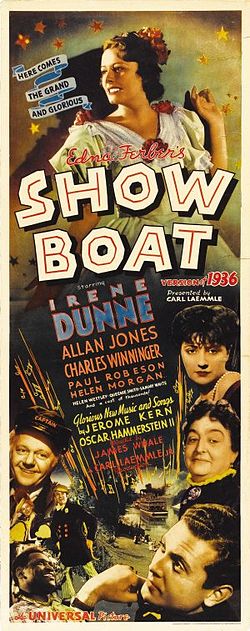
ShowboatposterMost of what I know about riverboats can be gleaned from Mark Twain, Davy Crockett and the River Pirates, and that ever beloved Snoopy incarnation The World Famous River Boat Gambler. The 1936 musical Show Boat falls into that very same rich tradition but some clarification is in order.

In truth, this is not the most remembered or even the first adaptation, for that matter, of the wildly popular stage hit of the 1920s. Those laurels go to the 1951 version starring Kathryn Grayson and Howard Keel and then the original partial-talkie released in 1927. But it’s easy to go out on a limb and reckon this is the best of the lot.

James Whale noted for such reputed monster movies as Frankenstein and The Invisible Man proves an equally compelling helmsman of musicals. Here his obvious attention to period authenticity is highlighted making the riverboat world of Missippi circa the 1880s incredibly atmospheric.

The story starts exactly where its title suggests with a Show Boat and the traveling crew of performers who turn up in every town to add a little gaiety and charm into every man, woman, and child’s life. The personable mastermind of it all Cap’n Andy Hawks promises big things to the general public who turn out in droves to get a chance on the entertainment.

But as is the case with any such narrative the true meat and potatoes is either on the stage with every song and dance or behind the curtains where people are living life and trying to get by the best they know how. Hawk’s wife is constantly nagging him and demanding that their daughter never become an actor. Instead, young Magnolia (Irene Dunne) is relegated to sit behind the piano.

Still, there is another plot thread with major implications on the contemporary constitution of race relations. I personally had no idea what was at the core of Edna Ferber’s Show Boat. I assumed it was only a musical perhaps bred in the rather sorry tradition of Gone with the Wind and other such pictures when it comes to depictions of African-Americans.

It’s true that there are some of those stereotypes present but this is a surprisingly forward-thinking narrative at first because at its core is miscegenation–in simpler terms the marriage of a white man with a woman of color. The two tragic lovers are actually depicted in a sensitive light while at the same time giving Magnolia her break with their sudden ignominious departure in the midst of the public scandal.

Still, in this small way,  it’s not unlike Ferber’s later work Giant in how it begins to dissect the hypocrisy in society. For his part, singing giant and future blacklist casualty Paul Robeson’s epic rendition of Old Man River is one of the true capstones of the film imbuing the story with even more meaning and power. For another minor instant, it seems like the point of view of the downtrodden and marginalized is, at the very least, being acknowledged and given a place of significance. as if to say even for a split second that there are dignity and worth there.

Of course, it loses all the credibility it could have in one regrettable stage number where the happy notes make the blackface feel even more abhorrent. Though I have no major qualms enjoying this movie on a whole, any discussion must come with a substantial caveat.

In its second half, Show Boat does admittedly succumb to some pacing problems hitting its peak early on and slowly dropping off from its frenzied and energetic openings to more wistful conclusions that are understandingly less diverting even purely from a tonal perspective. It seems to even acknowledge its own weaknesses by condensing decades for the sake of time and the audience’s attention span.

It all began with lively commotion, spirited passion, and young love. In the end, it settles for a sentimental reunion of two lovers torn apart by destitution and time itself. It’s a lovely feel-good conclusion but it’s not nearly as satisfying as it could have been if Show Boat had kept its steam from the starting gates.

Though this is far from being Irene Dunne’s greatest role, she still gives a winning performance that memorably showcases her vocal training opposite her romantic co-star the rich-toned tenor Allan Jones.  As a side note, she also exhibits the most unique churning dance you’ve seen rather like a caterpillar in a dress–only surpassed by Lauren Bacall’s shoulder shimmy in To Have and Have Not.

Still, Paul Robeson stands as one of the titans of this film. I hope he got the respect that he deserved for this role and if nothing else time seems to have honored him as “Old Man River” still remains one of the great musical numbers out there.

4/5 Stars

Morocco (1930)

Gary_Cooper_and_Marlene_Dietrich_in_Morocco_trailer_2.jpgBefore the exoticism of Casablanca, Algiers, or even Road to Morroco, there was Josef Von Sternberg’s just plain Morocco but it’s hardly a run-of-the-mill romance. Far from it.

Although it involves soldiers, it’s also hardly a war film but instead set against a backdrop that presents an exotic love affair as only Sternberg could. With a sultry Marlene Dietrich matched with a particularly cheeky Gary Cooper, it instantly looks to be an interesting dynamic because they couldn’t be more different.

She, a radiant German beauty with an evocative pair of eyes to go with a somewhat sullen demeanor. He, America’s ruggedly handsome ideal of what a man should be. And it in Sternberg’s film neither of them is what we’re used to.

He’s a renegade soldier in the French Foreign Legion. She’s a cabaret singer (that hasn’t changed) but she also manages to be French, not German. Somehow it’s easy enough to disregard because it’s not necessary to get caught up on the particulars.

All that matters is that they both find themselves in Morocco. He is traipsing through town with his division and spends some free time taking in her floor show along with the rest of the rowdy masses. Neither one of them has found someone good enough for them — they’re equal of sorts. He’s a gentleman cad if you will and she’s hardly an upstanding woman, making a living in a dance hall but there’s more to her. It’s hinted that she once had love, perhaps.

It takes so long for them to actually speak to each other but they’re flirting from the first moment they lay eyes on each other. They say so much through simple expressions all throughout the cabaret show. Things proceed like so. She slips him a flower, then an apple, and finally a key. At this point, he gets the drift and we do too.

Later that evening he winds up at her flat and they spend their most substantial time together. It’s full of odd exchanges, meandering conversations that run the risk of sounding aloof. In fact, their entire relationship is replete with oddities.

Another man (Adolph Menjou) is smitten with Amy but he’s never driven to jealousy. He’s good-natured and generous in all circumstances. People like him must only drift through the high societies.

She holds onto some wistful longing for the tall dashing Legionnaire who drifted through her life. But she’s slow to act. Meanwhile, he hardly seems to take it as a blow to his love life when she resigns to stay behind. After all, he’s quite the ladies’ man. He probably doesn’t need another woman. He’s always got several draped over each arm.

Morocco is a film interesting for the spaces that it creates and not necessarily for the story it develops. Visually, by the hands of the director and then simultaneously by Cooper and Dietrich as they work through their scenes both together and apart. Though it might in some ways lack emotional heft, its stars are still two invariably compelling romantic stars of the cinema.

Somehow it still manages to be quite lithe and risque when put up next to its contemporaries. It exudes a certain mischievousness of the Pre-Code Era. It’s not so much licentiousness and debauchery but it wishes to suggest as much. It can be implied without actually going through all the trouble of showing it.

Dietrich sums it up perfectly in her little diddy about Eve (What am I bid for my apple/ the truth that made Adam so wise? On the historic night/ when he took a bite/ they discovered a new paradise). In essence, the world got a lot more exciting when sex and deceit were brought into the equation. Maybe she misses the implications the Fall of Man but that’s precisely the point. Still more Pre-Code sauciness case and point.

In the final moments, where Dietrich abandons her heels and goes slinking across the sand chasing after her man, it feels less like a romantic crescendo or even a tragic turn and more like a ploy by the director to make his leading lady the focal point of his story one last time. She is granted the final bit of limelight. Because in many ways Gary Cooper could not win when it came to upstaging Marlene Dietrich orchestrated by her devoted partner/director Sternberg. Thus, Morocco turns out to be a rather curious love story different than some of the more typical Hollywood fare.

4/5 Stars

The Whole Town’s Talking (1935)

the_whole_towns_talking_1935_posterComic mayhem was always supercharged in the films of the 1930s because the buzz is palpable, the actors are always endowed with certain oddities, and the corkscrew plotlines run rampant with absurdities of their own.  Penned by a pair of titans in Jo Swerling and Robert Riskin, The Whole Town’s Talking opens with an inciting incident that’s a true comedic conundrum.

Bald and beady-eyed Mr. Seaver is called upon to fire the next employee who comes in late to work. A tough proposition to begin with but it gets worse.  Arthur Ferguson Jones has not been late to work in 8 years and of course, today’s the day his alarm clock doesn’t work. Although he gets a reprieve. Still, the next person walking in isn’t so lucky. The hardy, wisecracking Miss Clark (Jean Arthur). And that’s our introduction to our main players.

But the real wrench comes from an age-old device that’s easy to scoff at initially. There’s a doppelganger. Yes, the same upstanding, timid Arthur Ferguson Jones is cut in the spitting image of Public Enemy No. 1, Killer Mannion. But before you check out, consider what this does for this ruckus of a story. It ties it up in knots.

Jones is the talk of the town. Exploding flashbulbs. Cover stories. Tumult. Back in the glory days when the press ran in a pack like hyenas.  His boss invites him to dinner, wants an autograph for his boy. He’s being ribbed by his coworkers and Miss Jones takes an interest in his literary endeavors. This leads to a gig ghostwriting the gangster’s life story in the local paper.

Meanwhile, the police argue about what to do about him. They finally decide to give him a special passport. It says he’s not Killer Mannion. And hapless little Mr. Seaver still badgers his employee to finish up his waiting caseload. What no one expects is that Mannion will sneak into Jones’ home and sets up camp.

And from that point on, everything gets confused. Robinson gets a chance at a great deal of range sometimes having his two diverging roles playing off each other in the same frame. All you need to know is the gangster is looking to leave his new benefactor holding the bag for his numerous crimes. Whether it works out or not is quite another story.

This a particularly odd film for the talent assembled. It doesn’t especially feel like a John Ford film and not simply because it’s not a Western. But at this point in his career, his stock company isn’t even assembled.

Edward G. Robinson will always be identified with gangster pics and it’s true he was tired of that association. Here he’s playing comedy. He has one foot in his usual wheelhouse but the other seems utterly alien to his usual persona. As such it’s great fun.  And his timid common man isn’t even a tragic figure like Chris Cross (Scarlet Street). The comedy is far more apparent and that in part stems from Arthur.

She shows up late to work, gets fired, and still has quips coming out of her ears. She plays all the journalists trying to pump her for facts and at the same time falls for this dope who has her picture framed by his bedside. Perhaps better than anyone she perfected how to be cheeky but still wholesome and caring. Arthur feels most at home in this film more than anyone else, given her comedic pedigree but she and Robinson bounce off each other well.

In a few years she would play a Miss Jones but for right now she’s content calling her colleague by the pet name “Jonesie” and (tiny spoiler) she does become Mrs. Jones. So an oddball romantic pair they might be, but that doesn’t make the partnering of Robinson and Arthur any less amusing. They’re both on their A-game in The Whole Town’s Talking and thankfully there would be many more arresting performances to come.

4/5 Stars

Angels with Dirty Faces (1938)

angelswithdirtyfaces-theatricalposterWhaddya hear, whaddya say ~ Jimmy Cagney as Rocky Sullivan

If he hadn’t been on the stage and screen, it’s easy to get the sense that James Cagney, born and bred on the streets of the Lower East Side of Manhattan could have easily been a gangster. And it’s true that in films like Public Enemy and White Heat he embodied gangsters for ensuing generations solidifying his own legend.

Angles with Dirty Faces features another stellar performance as Rocky Sullivan, but what makes it truly unique are the intertwining worlds of faith and crime that meet and ultimately provide the major conflict in the narrative. It’s at these crosswords — the moral fabric of the film — where things get fascinating and to understand those things it’s necessary to see where Angel with Dirty Faces opens.

Two young hoodlums get caught in the act of snitching from a train car and in the ensuing chase one gets nabbed by the cops while the other slips away from their clutches to live another day. This succinct scene is a fitting reflection of all that happens thereafter. The one fellow will grow up to be the notorious gangster extraordinaire Rocky Sullivan who will be at odds with the authorities from his first moments in juvie to his final days.

Meanwhile, Jerry (Pat O’Brien) becomes a local priest who makes it his life’s work to reform the young men in the community who are more than likely destined for the life of Rocky and his fellow gangsters. Through a certain amount of kindness and quiet strength, he attempts to mold the boys through constructive activities like basketball, choir, and other extracurriculars. However, the bad boys (the real life Dead End Kids ensemble, less actors than personified hellraisers) are not quite swayed by his regimen, more content rough-housing, causing mayhem, and idolizing their rebellious hero the great Rocky Sullivan.

When he finally gets out of his stint in prison, Rocky has some choice words for his crooked lawyer (Humphrey Bogart) who hands over a load of cash to save his neck although he’s not looking to be swindled. But although he continues to have his hand in the local corruption and crime scenes, Rocky still maintains his ties with his old friend while renting a room from the girl he used to rib, the now stunning Laury Martin (Ann Sheridan). Here the core relationship between Rocky and Jerry becomes paramount as Jerry vows to tackle corruption in the city with the help of a local paper, even if his old buddy gets in the way.

So Jerry begins his full-fledged crusade against vice because he sees it as a threat to his parish — made up of the impressionable boys in his stead. But just as crucial is the boy’s idol worship, namely of Rocky. This is Jerry’s final goal to bring their idol tumbling down and it doesn’t involve simply destroying the aura surrounding a gangster — it involves two old friends making one final promise. The crime syndicate is thrown into an uproar as Rocky is wanted for murder, cornered, and finally apprehended.  Oh how the mighty have fallen, although he’s not about to go yellow because that’s the only thing he has left–his own bullish sense of moxie.

Still, Jerry asks him to imbue a different kind of courage (Not the courage or heroics of bravado but the kind that you, me, and God know about). And as the electric chair looms in front of Rocky as an arbiter of justice, you could easily make the claim that this is his modern-day cross with him as the martyr. But this gets into the ultimate dilemma where everything begins to break down. Either Rocky committed his final act out of undying affection for an old friend (and not remorse) or more feebly still he was not repentant at all but was, on the contrary, legitimately groveling in the face of death.

The first time seeing this film I mistakenly mistook Rocky’s actions as heroic in the end because as our protagonist that’s what we like to project onto him but it simply does not line up. The way he’s so belligerent before breaking down as he gets ready to meet his maker. The way the priest looks on with tears in his eyes, newspaper men too awestruck to jot down a single note. I mistook Cagney’s astonishing acting for Rocky’s own showmanship. However, the more astounding conclusion is that Rocky is hardly high and mighty in the end. His rough veneer is equally easy to shatter as his being is brought to the ultimate low, death.

It reflects the moral ambiguity of man that these angels with dirty faces are not in the singular sense but the sum of man in his plurality. We are all prone to evil just as we are all capable of good. But we can hardly save ourselves just as we are not always wholly good or wholly evil. The best we can do is make the way better for other people. If this film is any indication sometimes it’s extremely difficult to parse through the differences between the altruism versus the evil versus just plain cowardice.

Films about friends on diverging paths have continued to exist from Cry of the City to Mystic River but Angels with Dirty Faces is arguably one of the most compelling. Once again, Cagney steals the film with his usual no holds barred approach.  It electrifies the screen like very few others, making Angels with Dirty Faces an undisputed gangster classic and one of his very best.

Furthermore, the often discounted Michael Curtiz shows his versatility with the foremost of Warner Bros. winning craftsmen including directors William A. Wellman and Raoul Walsh. Notably, each man paired with Cagney with great results, because, after all, he is without question the king of the gangsters.

4.5/5 Stars