Young Mr. Lincoln (1939)

youngmr1Hailing from a year laden with numerous American classics, Young Mr. Lincoln is undoubtedly overlooked in deference to other titles like Gone with the Wind and The Wizard of Oz. Even John Ford’s own Stagecoach, starring John Wayne, overshadowed this autobiographical work headed by Henry Fonda. Then the next year they came out with The Grapes of Wrath and that title garnered praise for both men. But again, it seems like most have forgotten about Young Mr. Lincoln.

It really is a shame, because this is a quintessential Ford film, and Henry Fonda gives an iconic turn as one of the great historical giants of all time. Except instead of focusing on his major accomplishments, trials, or fatal death, this story contents itself with a simpler story. The focus is the fledgling law career of Abraham Lincoln, who back in 1857 is only a lanky country boy with a hankering for learning. He sees tragedy at a young age when people pass away around him and yet out of those formative years rises a man who is wise beyond his years, because he understands his fellow man and cares deeply about justice.

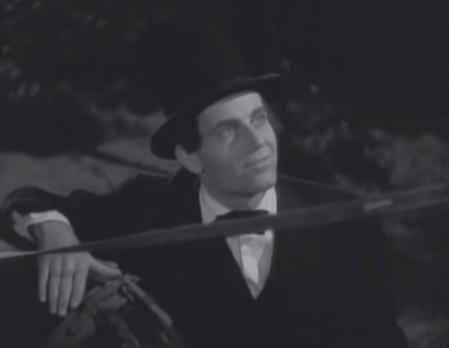
Lincoln is hardly a lawyer of any repute, and he seems hardly a political figure compared to the likes of the great Stephen Douglas. But the people respect him because he wins them over with his common sense and homespun witticisms. Aside from his ubiquitous top hat, he willingly judges pie eating contests, and play the Jew’s harp with feet reclined at his desk.  One of his dear admirers is the young socialite Mary Todd who takes an immense liking to him. He’s the kind of figure that the elite and common folk alike can truly respect.

So when two brothers are accused of murdering another man after a fight one night, it is Mr. Lincoln who avoids a lynching and appeals to the morals of the locals. He, in turn, promises the mother of the boys that he will do his very best to win their freedom and he does all he can to gain her trust.

When the trial begins he carefully picks the jury and faces off against a venerable prosecutor with much greater experience than himself. The mother of the accused saw the squabble, but she cannot bear to implicate her sons. Lincoln pleads on her behalf.  It also looks like the key witness and friend of the deceased man will put a seal on the case, but young Mr. Lincoln is not done yet.

Thus, the film ends and Lincoln is most certainly on the rise, but we get to imagine his future knowingly, on our own, because none of that length of the story is told. In that way, it’s rather interesting to juxtapose Ford’s film with Spielberg’s more recent biography Lincoln, starring Daniel Day-Lewis. They represent different generations of filmmaking, because the latter film takes a monumental moment in history, the passing of the 13th amendment, and places a magnifying glass to it. Focusing on all the individuals involved, and it is certainly going for an amount of period realism, starting with the impressive performance by Day-Lewis as our 16th president.

Young Mr. Lincoln is a lot simpler because it does not need to focus on the highlights. It takes as great of an interest in Abe’s origin story so to speak. On his part, Henry Fonda plays the role wonderfully using his mannerisms and plain speaking delivery to give a homey quality to Lincoln. He’s believable, but in a different way than Day-Lewis. It’s not better or worse necessarily, just different. That being said, Young Mr. Lincoln deserves a place among the exulted classics of that legendary year of 1939. Hopefully, it will continue to receive the respect that it deserves, because it is a moving and surprisingly very witty film. Probably in the way Abraham Lincoln was.

4.5/5 Stars

You Only Live Once (1937)

youonlylive1There are two types of lover-on-the-run narratives. There’s the Bonnie and Clyde/Gun Crazy extravaganza full of shoot-outs and bloodshed. Then you have the more sensitive approach of a film like They Drive By Night. You Only Live Once fits this second category thanks to two bolstering performances by Henry Fonda and Sylvia Sydney. Fonda is forever known for his plain, naturalistic delivery full of humanity. He has that quality as 3-time loser Eddie Taylor certainly, but he also injects the role with a somewhat uncharacteristic rage. In many ways, he has a right to be angry at a world that so easily writes him off and is so quick to pronounce guilt. There is very little attempt to rehabilitate the reprobate and Taylor is an indictment of that.

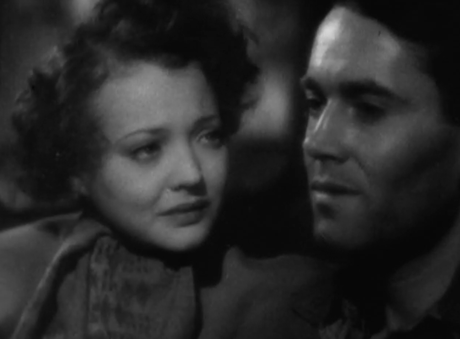
youonlylive2Secretary Jo Graham (Sylvia Sydney) is positively beaming the day they are releasing her boyfriend Taylor because he is finally getting the second chance he deserves. A glorious marriage follows soon after until reality breaks into the lovers’ paradise. Few people aside from Father Dolan and a few forward thinkers are willing to give Taylor grace. He is prematurely fired from his job and has no way to make the payments on the house that his wife has been sprucing up for him. Adding insult to injury, a brazen bank robbery is committed which he is wrongly accused of. It’s back to the clink and then the electric chair.

Jo is beside herself and Taylor is angered at the way the law deals with him. This justice is the most unjust imaginable, and he is about to pay the price. But Jo desperately gets him help and he tries to make a break for it.

youonlylive4That’s what makes a wire proclaiming his innocence all the more ironic because he will have none of it. He takes a man’s life and now his acquittal goes down the drain as quickly as he got it since he has a murder to his name. Eddie and Jo go off on the road together, looting banks and surviving the best they can with their newborn son. This is not two joyriding youngsters trying to get rich without an honest day’s work. Fritz Lang develops a more complex story with people who tried to live by the rules and found they were dealt an unfair hand.

As one of Lang’s earliest works in America, you can see some remnants of German Expressionism exported here with foggy clouds of mist engulfing the screen at times. His tale also has an interesting ambiguity suggesting that crime is not always black and white. Perhaps it has less to say about the moral degenerates or corrupt individuals in our society and more about the faulty structures that our justice system often get built around. It’s mind-boggling to think that this film came soon after the Depression meaning the bitter taste of those years was still fresh in peoples’ mouths. Nevertheless, this film is an interesting crime-filled character study.

4/5 Stars

Lost Horizon (1937)

LostHorizonPosterCertainly this is not the most well known or the best film of Capra. It is, in fact, quite different from a lot of his filmography. That is not to say that it is not an enjoyable film about a man who finds a little piece of Utopia called Shangri-La. Ronald Colman was certainly a likable fellow in the lead role and Jane Wyatt was pleasant during the time she was on screen.

What I really enjoyed in this film was the quibbling and bickering of Thomas Mitchell and Edward Everett Horton’s characters. These are two tremendous character actors who represent all that was great about the stock characters of Hollywood’s Golden Age. They are so recognizable and though not the stars they seemingly steal their scenes.

Because some of this film was lost, parts were understandably choppy since there was no visual aside from photos to go with the dialogue during certain moments. Despite this, the film is an enjoyable, albeit dated, 1930s fantasy.

4/5 Stars

The Petrified Forest (1936)

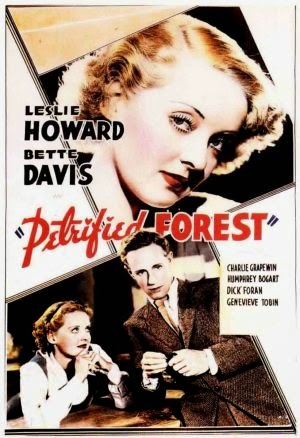
The Petrified Forest (1936)If I dare say this film begins as a rather dull budding love story between a philosophical drifting author (Leslie Howard) and a inquisitive young server (Bette Davis) at a roadside gas station in Arizona. It looks like it’s not to be as he is intent on moving on but then comes murderer Duke Mantee (Humphrey Bogart) with his thugs and things heat up a little bit. His arrival brings up some interesting points of contention and Leslie gains some new found conviction. But that’s not the half of it.

This film comes from the stage with Bogart reprising his star making role as a gangster. It is often talky and sometimes stagnant but the supporting characters and Bogart have enough personality to at least make it passable and a tad interesting. I was never a great fan of Davis, but I have to admit at least she does not look scary in this one. She’s still young and on the rise when this film came out. Leslie Howard is enjoyable with his pleasant delivery but Bogart really lights it up. His glowering face and growling voice are hard to clear from your mind. That’s for sure.

The film also has immense commentary on the survival of the fittest, women, the mythical Old West and fascist ideology that are a sign of the times.

3.5/5 Stars

Love Affair (1939)

Love Affair (1939)Imagine meeting someone through a porthole, that’s what happens in this film when a gust of wind sends Michel Marnet’s letter flying. The lady who is kind enough to return it is the friendly Terry McKay. The two acquaintances enjoy each others company and strike up a friendship in the few days before they dock in New York. Both of them have fiancees waiting for them. They begin seeing a lot of each other, but they also start to notice that the other passengers are looking on.

One day they make a stop and Michel pays a quick visit to his grandmother. Terry agrees to come along and strikes up a fast friendship with the elderly woman who really likes her. As they get close to New York Michel and Terry agree to meet in 6 months at the top of the Empire State Building. By then he will know if he can carry a job to support her. So it goes.

The 6 months finally passes and the time of the meeting arrives. An excited Terry rushes off to “get married” but tragedy strikes. Michel waits all alone and she never shows. For a long while they lose all contact as Terry recuperates and Michel continues to paint while nursing a broken heart. When he finally tracks her down, they share a slightly awkward introduction. In a marvelous sequence, Michel tells her about how “he” missed the meeting and apologizes for what “she” must have gone through. She knows what happened now, but Terry still will not tell him what happened to her, because she did not want to be a burden. In a eureka moment, Michel figures it out and goes to embrace his love. As she did the whole film, Terry accepts the hardship and meets it with a joyful heart.

Love Affair is just that, but it fails to lower itself to uninhibited passion and romance without any substance of character. Its leads are not that superficial. They are better than that and certainly more complex. In all honesty, I never have been a big fan of Charles Boyer. I see his appeal as a suave, debonair Frenchmen with an accent, but he never did anything for me. Here I saw him as more than a playboy. He filled that expectation at first, but the scenes with his kindly grandmother and then when he thinks Terry have forgotten him, show a softer, more vulnerable side.

I do not quite know why, but Irene Dunne is especially enjoyable to watch. Whether it is her skill as a comedienne with comic timing or the expressions on her face, I find her endearing every moment on the screen. She makes me smile just as she smiles. In many ways, she reminds me of another actress of the 1930s, Jean Arthur. However, Arthur I know far better because of films like Mr. Smith Goes to Washington. With Dunne, I have seen very little and yet I have been so impressed by her. Love Affair was another film that proved her genial appeal.

Furthermore, Leo McCarey does not get enough credit, because he is a great director with some great films to his name like The Awful Truth. He would later remake Love Affair as An Affair to Remember, which was a success in itself.

4/5 Stars

The Women (1939)

 6d603-womenHere is a film full of personalities. In fact there is so much personality that it nearly bowls you over with its impact and frenetic force.

In the center of it all is Norma Shearer who is the respectable socialite who is losing her husband to another woman. Joan Crawford is the gold digging woman who is as detestable as ever. Rounding it out is the equally repulsive gossip played to a tee by Rosalind Russell. There is the ever innocent Joan Fontaine and a spunky divorcee played by Paulette Goddard. Throw in numerous other memorable women and you have a cast that completely overwhelms, but in a good way.

Husbands and lovers seem to being switching hands so easily and the whole film is focused on the women who are swapping them. It begins with Mary Haines’ husband only to continually get more complicated as more gossip is divulged and mud is thrown. Not to mention a few angry fists and slaps to go with the caustic words.

There is a lot to admire about this film, because it does what it set out to do very well. It creates some empathy, some laughs, and yes, a whole lot of loathing.

However, as I contemplated the film I realized although the Women is from 1939 and the clothes often seem laughable, the people and issues in the film often seem all too real. Divorce hits close to many homes literally and gossip certainly has not gone instinct. Thus, despite the passage of time, in many ways this film still feels fresh and relevant today.

4/5 Stars

Our Relations (1936)

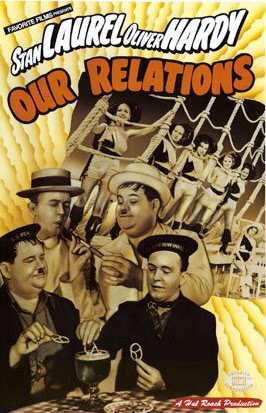
405a7-l26h_our_relations_1936How can you get sick of Laurel & Hardy? Maybe it’s possible, but I always enjoy coming back to them, because they are easy on the eyes and the mind. They have the mayhem of The Marx Brothers or The Three Stooges, but they remain, perhaps, even more endearing more often than not. They may not be as witty as Groucho or as belligerent as Moe and his crew, but they have heart and every “fine mess” that they get into is usually a pleasure to watch.

Our Relations is another one of their short features and it borrows its main plot device from the long overused identical twin trope. We have undoubtedly seen it countless times on many a movie and most definitely a TV show. But before I harp on them too much, I will give them some slack because it was the 1930s, not 2014. That being said, the confusions and mix-ups that occur as a result of this situation are a segue to some fun comedy.

The story begins with a strangely well to do Ollie and Stan having a nice time with their wives. It is their two seafaring twins who cause trouble at a bar and hold onto an invaluable ring. They get more than they bargain for having to navigate two angry wives, two angry girls, an angry waiter, an angry sailor, some angry gangsters and the always miffed James Finlayson. Notice I didn’t specify which pair of twins, because each set has their share of grief.

It gets difficult telling them apart after a while as they keep playing “the shell game” and our only cues are their ties and some theme music that tips us off.  Most definitely this is a fun romp with our two…four heroes. The facial expressions of Stan Laurel always crack me up (including his sniveling), and Ollie is forever a klutz with the help of his bumbling buddy.

It culminated with the wonderfully hilarious scene in the cement that was the goofy apex of a solid Laurel and Hardy film. If you want culture or high brow humor please go somewhere else. As for me and myself, I will continue to enjoy what these two men gifted us all those years ago. It also had a moral to the story. There is nothing quite as important as our relations. Scratch that. Maybe it was just made for us to laugh, and there is nothing much wrong with that.

3.5/5 Stars

Block-Head (1938)

71c93-l26h_block-heads_1938There are short films and then there are feature films. This is your typical Laurel and Hardy short feature which falls somewhere in between.

This Hal Roach-produced comedy romp pulls its plot from current events such as WWI, big game hunting, and Middle American suburban life. But forget that, the most important part is that Laurel and Hardy are up to their usual gags playing their usual selves in this laugh-laden story with a typical bouncy score.

It starts off with an oblivious Stan guarding his trench for over 20 years as the story moves from 1917 in France to the year 1938. Don’t question it, just accept that Stan is stupid and he has a mountain of ration cans to prove it.

When he finally is brought back to civilization there’s one man who is especially surprised, his good ol’ buddy Oliver who is just about to celebrate an anniversary with his wife.

The friends finally get their reunion at the old soldiers home where Stan is laid up and the fun begins. Because Stan and Ollie are the perfect antithesis, they always lead to the greatest of guffaws.

The laughs continue to spew out whether it’s Stan’s supposedly amputated leg or a truck piled high with dirt. And that’s before they even arrive home where they must deal with 13 flights of stairs and the ever present James Finlayson ready to trade some choice words and fists with Ollie.

Ollie also has some marital problems of his own that are complicated by the pretty young wife that lives across the hall. He and Stan manage to do what they do best by completely decimating their house and blowing up their kitchen. The end title card drops as our two heroes gallop away followed by a jealous husband with an elephant gun. Sounds about right.

I dearly hope I never grow tired of Laurel and Hardy, because if I do it will almost feel like I lost just a bit of my humanity. They are often so dumb, so mean to each other and to others, but at their core, they are always a lovable duo. By now they are caricatures in appearance and for their buffoonery, but they are also so beloved by the masses. I would like to think, even to this day.

Ollie with his fiery temper and bossing of Stan. Stan with his stupidity and often surprising talents (smoking a hand-pipe and pulling down the shadow of a window blind just to name a few). I wish there had been more screen time for Billy Gilbert, but otherwise, this is a wholly worthwhile addition to the L & H legacy.

4/5 Stars


Nothing Sacred (1937)

 13094-nothingsacred2Before His Girl Friday (1940) came, there was another screwball comedy about journalism, the perfect scoop, and deception. After getting on the bad side of his boss, newsman Wally Cook (Frederic March) is demoted from the living and forced to write obituaries. It’s quite the awful setup and Cook desperately looks for another story to get him in the good graces of the Morning Star’s editor.

The perfect news flash has just come up in the form of a woman who is soon going to die of radium poisoning, and so Wally Cook goes to meet her. Heading up from New York, he ends in the one horse town in Vermont. He meets a lot of unobliging people whose vocabulary is limited to “Yup” and “Nope.” He finally comes across the crying girl who has just left an appointment with a doctor. He comforts the girl cheering her up by promising a trip to the big city where she will be treated like royalty (And he’ll get his story). So Hazel Flagg soon becomes the sweetheart of New York with public appearances at Madison Square Garden, parades, poems, articles and special honors. It’s all going according to Cook’s plan, the only thing is that Hazel is not actually ill.

That’s a wrench in the plan and soon it becomes evident that Cook will look like a cad. To make matters worse, he’s falling for her and his editor Oliver Stone is all over him. Now he must take part in Hazel’s charade, despite his annoyance. She too is annoyed and ends the game so the two lovebirds can elope. Still, the story of Hazel is given a romanticized ending that the public deserves.

Frederic March is decent as the desperate and long-suffering journalist. Carole Lombard is her typical light-headed, whimsy, high-strung, scatterbrained, sniveling self. It proves to be a volatile combination partnered with Ben Hecht’s script. The news industry loses a lot of its self-respect for the sake of laughs because nothing’s sacred. Some might be interested to know that it was shot in glorious technicolor and it was the only time Lombard would appear in a technicolor film. She would, of course, die in a tragic plane crash in 1942.

This film was quite short so the story moved quickly and there were definitely some screwy moments. I am however partial to His Girl Friday and some of the other more well-known screwballs.

3.5/5 Stars

The Roaring Twenties (1939)

e08f7-the-roaring-twentiesHere is a retrospective gangster film reminiscing about the Jazz Age and Roaring Twenties extending from the post WWI period  of prohibition to the election of FDR.
Two mainstays of the genre including the original gangster James Cagney and hard-boiled Humphrey Bogart star as two men in a group of three soldiers who meet during World War I. In the ensuing years Eddie Bartlett (James Cagney) initially has difficulty getting back into society, but after meeting Speakeasy owner Panama Smith (Gladys George) he finds himself climbing the ranks in the bootlegging business. Soon through grit and a ruthless drive Eddie makes good racketeering by utilizing taxis with booze to make it big. 

Through it all Eddie becomes smitten with a young singer he used to know when she was a young girl (Priscilla Lane), except she does not share his affection. Pretty soon his ol’ buddy George (Bogart) comes back into the picture, with a some shifting dealings of his own. Eddie practically runs the town now but when the Crash happens he gets pushed out by George and now Jean is off and married to her lawyer beau. Eddie is a washed-up taxi driver still hanging around Panama and he has time to do one last favor for Jean.

This is one of the last great gangster films of the 1930s following in the wake of other Cagney classics like The Public Enemy and Angel with Dirty Faces. Raoul Walsh directs this film and it develops as another dynamic, action packed film with a lot of drama and heart thanks to Cagney and George. It is however different from previous gangster flicks in that it plays out as a history although it keeps the nitty-gritty look of the previous films. Like Angel with Dirty Faces especially, there are also some sentimental moments because Cagney is not a complete scoundrel, just mostly. Not wanting to continue being typecast Cagney took a break from the genre not coming back until White Heat in 1949. He did pretty well for himself during the 1940s though with performances in The Stawberry Blonde and Yankee Doodle Dandy. There was another fellow who did not do too bad in that interim period either, new found leading man Humphrey Bogart.

“What was his business?”
“He used to be a big shot.”
 
4/5 Stars