Pride of The Marines (1945): John Garfield Plays Al Schmid

pride of the marines.png

During WWII there’s no question John Garfield was integral to the war effort despite having never served in the military. He did yeoman’s work when it came to morale, through his pictures at Warner Bros, originating the famed Hollywood Canteen with Bette Davis, and going on war bond tours with the likes of John Basilone.

No question he was a devoted champion of the Allied cause and so when he learned of the true-life heroism of marine Al Schmid, flipping through the pages of Life magazine one day, he started the wheels turning in Hollywood. Schmid was a Philadelphia native who was deployed in the deadly warzone of Guadalcanal in 1942. He and two mates held onto their gunnery outpost against hundreds of enemy soldiers. Their valor was not without sacrifice.

There are certain stories you could hardly write better for the cinema screen and The Pride of The Marines is one of them. As such, Schmid’s story fits fluidly into three distinct segments. It begins as a bit of a hometown romance. In the opening voiceover Garfield, in character as Al, explains how Philly and the Liberty Bell is all he’s known and although this is his life, it could have just as easily been someone else’s. There’s no missing that Delmer Daves’ film is a universal flag-waver for the whole country to get behind.

Like any red-blooded American, Al’s a confirmed bachelor, though he loves the company of his landlords, the genial Merchant clan. Jim (John Ridgely) is always good-naturedly tinkering on everything with varied success. His wife Ella May (Ann Doran) is just about the warmest beacon of hospitality one could ever meet. And if they are both benevolent spirits, their bubbly daughter Loretta (Anne E. Todd) is equally so. Al is affectionate toward them all, even as he remains fiercely independent. No girl the resident matchmaker tries to set him up with will make him think otherwise.

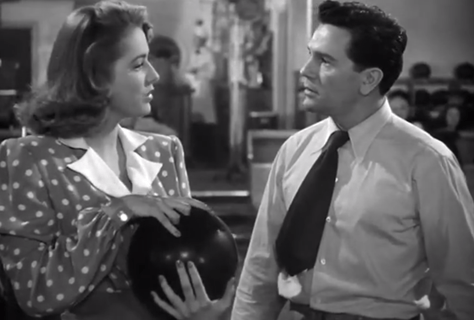
It’s much the same when he finds a quivering Ruth Hadley (Eleanor Parker) at the front door in the dark. A fuse is blown. The lights are out. The family scurries around as a brusque Garfield lets her in. He’s prepared to tear her apart as she confirms all his assumptions about the typical girl-next-door.

This is the rockiest of meet-cutes but I must say, I like it because there is this instantaneous conflict. No disrespect to Dennis Morgan in The Very Thought of You, but Garfield brings his brand of tougher authenticity that’s far more compelling. The beauty of Parker is not simply being an attractive face — on par with any of the Hollywood starlets of the 1940s — there is an earnestness and a feistiness present in her very being.

It comes out over a miserable bowling date tacked onto their already awful evening. She’s been continually humiliated, and she retaliates with her bowling ball and a forceful march out the front doors, which receives whoops and hollers from all the patrons. This is when we realize we have a story and with it a true love affair.
pride of the marines 2.png

At first, it’s tentative. The second stint begins as Al prepares to ship out after Pearl Harbor. Nothing has been agreed upon between them. He’s noncommittal. She’s not one to beg and plead, though she has her own private desires. Their hours together are dwindling and in one final burst of emotion, he asks for a promise: to wait for him and he provides a token of his faithfulness. They’re tied together now like we always knew they would be. There were too many sparks for it to be any other way.

The war can really be summed up in one extended scene played out within the morass of war. Enemy “Japs” wade across the divide toward their waiting machine gun encampment, mowed down in the mayhem. They taunt them throughout the night, coming relentlessly, hour after hour, only to be stopped dead in their tracks, piling up everywhere.

I couldn’t help feeling some amount of conflict in witnessing all this. I am an American and I love John Garfield as much as the next fellow but this senseless killing — even in a fairly chaste old Hollywood movie — still feels like too much. The problem is it featuring war at its most intimate.

“Don’t shoot until you see the whites of their eyes” is a practical axiom, but it also makes hand-to-hand combat far too personal. The film tries, but you cannot keep the enemy completely at arm’s length. Watching something like Fire on The Plains (1959) and we get an idea of what their side of the story might be. In this case, a stir-crazy Schmid holds them off in a gutsy stand that, nevertheless, leaves him without the use of his sight.

Phase three is arguably the most significant yet. He must start to grapple with this new reality, even as he’s rehabilitated in an army hospital in San Diego with some of his wounded buddies. He’s lying to himself, believing an operation will give him back his vision. The letter he dictates to be sent to a concerned Ruth paints much the same tale. Unfortunately, it doesn’t work that way.

The best shot comes in the moment of truth when the bandages are off in the darkness and as a flashlight is about to be brought up to his face, the camera focuses on his jet black hair and goes black as the voices keep talking. The image says enough already. We know the outcome without seeing anything or, precisely, because we don’t see anything…

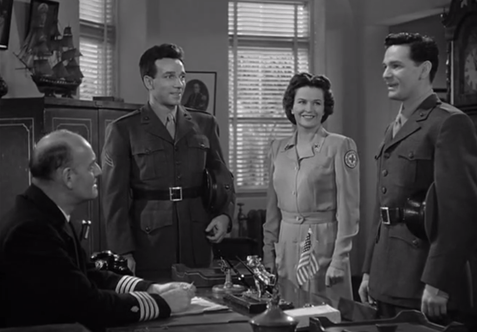
Still, Al’s not ready to come to terms with reality nor is he prepared to tell Ruth. He wants to disappear so she’s not burdened with his disability; he’s even more dismayed to learn the presentation of his Navy Cross will take place back home. Because a “Marine doesn’t lean on nobody.”
pride of the marines 3.png

The old conundrum is not a foreign one. Each one of us wants to be loved, but what if you come back and we are not the same person — disabled or maimed in some way — that our significant other fell in love with? Will they still take you back or loathe the very sight of you? The answer is not always obvious.

Ultimately, it is his solicitous caretaker Virginia (Rosemary DeCamp) and the moral support of his buddies, including Lee (Dane Clark), pushing him forward. In one private phone call, the nurse confirms her suspicions. Ruth fits into the unconditional love category. She’s not going down without a fight, even if it’s a battle over the heart and soul of her disconsolate husband.

We need not dwell on what happens next. The imagination can all but fill it in. A bit of deception, the warmest of welcomes home, and the long haul ahead, forged by two people together as one. Al Schmid would die in 1982 and receive burial in Arlington Cemetery, while his beloved wife would follow him there in 2002.

Predating the likes of Best Years of Our Lives and The Men, The Pride of The Marines digs into the trials of soldiers coming home from war. Garfield is the most capable man I can think of to bear the brunt of this trauma. He battles the demons with his usual grit.

When he’s not at the center of the drama, it falters a bit into the typical didacticism. All the boys with honest, real-life problems, nevertheless, feel like they’re being used to preach to the audience about the plight of the G.I. It’s real, but the heavy-handed roundtable instigated by Daves gets in the way of everything of interest.

The starry-eyed adulation Loretta showers upon him about his exploits in Guadalcanal is also peculiar to me. “You killed 200 Japs, didn’t you Al?” She sounds breathlessly incredulous at this gargantuan feat; it’s like a trophy. I couldn’t help feeling a bit queasy about the statistics in this domestic context. It just goes to show my conflicted nature as a Japanese-American (who lived a stint in Japan) trying to parse through the complexities of World War II.

What’s not difficult to comprehend is just how brilliant Garfield and Parker are as a couple and if they do a fine job, then their real-life counterparts are even more extraordinary. Because they weren’t picking up a salary from Warner Bros. They were out in the trenches in the real world, living life, and facing everything together.

3.5/5 Stars

Classic Hollywood Baseball Movies

Gary Cooper and Babe Ruth

Given its hallowed place as American’s original national pastime, I thought it would be worthwhile to share some of the best baseball movies classic Hollywood ever offered during its heyday.

I’m not sure if the industry ever made a baseball masterpiece during the Golden Age, but it did highlight some of the great talents of the era both on the field and in front of the camera.

If nothing else, they play a bit like comfort food, between fairy tale romances and warm humor, highlighting men who overcame obstacles to become world-class talents in the Major Leagues.

Pride of the Yankees (1942)

Here is, arguably, the standard-bearer of all baseball movies of a similar ilk. Gary Cooper stars as another famed All-American superstar, Lou Gehrig. Teresa Wright costars as his loving wife Eleanor. The Iron Horse became one of the most formidable ballplayers ever, despite being overshadowed by Babe Ruth. His final days, stricken with ALS, remain a stirring tragedy to this day. There’s hardly a dry eye as he “considers himself the luckiest man on the face of the earth” only to walk off the field for good.

It Happens Every Spring (1949)

This unabashed comedy relies on a crackling premise: a university professor comes upon a curious new formula in his laboratory. No, it’s not flubber but methylethylpropylbutyl. It’s most noteworthy trait is its repellence of wood! Soon the bookish baseball fan is touting his pitching abilities and goes from a nobody to carrying his ball club toward the pennant. Ray Milland stars alongside Jean Peters and Paul Douglas.

The Stratton Story (1949)

Here is a picture certainly in the mold of Pride of The Yankees. This time it’s James Stewart playing Monty Stratton with June Alyson as his crush and future wife. Although Stratton is hardly as well-remembered today, the heart of the romantic drama involves his rehabilitation after he undergoes an amputation. Through grit and determination (and the support of his wife), he made a comeback from his injury to pitch another day.

Take Me Out to the Ballgame (1949)

Although it has much more in common with the other MGM musicals of the day, between Gene Kelly and Frank Sinatra on the ball field (making up a Tinker to Evers to Chance combo with Jules Munshin), and Esther Williams, it’s hard not to enjoy this bright and cheery Technicolor singalong. The shakeup of new female ownership is a good excuse for sparks to fly and quality entertainment to abound courtesy of Busby Berkeley and Arthur Freed.

The Jackie Robinson Story (1950)

There are not necessarily a lot of dramatic thrills to this feature adaptation of Jackie Robinson’s life, but unlike all these other movies, there’s something distinctly special about Jackie portraying himself. With Ruby Dee as his steadfast wife Rachael, we watch Jackie as he is signed by Branch Rickey and rises up the ranks to break the color barrier in baseball, becoming a stalwart of the Brooklyn Dodgers’ team even as he faces an onslaught of prejudice and intimidation. He’s the definition of a sports hero.

Angels in the Outfield (1951)

It plays as a slight and fluffy fantasy story with a demonstrative big league manager (Paul Douglas) receiving some angelic intervention only if he agrees straightens up his act. He goes from being universally reviled by the world to a newsworthy curio. As he starts to change, the team’s fortunes pick up, and romance flowers between him and Janet Leigh. There’s not too much more to it. Donna Corcoran gives an adorable portrayal of a young girl who can see the angels.

The Pride of St. Louis (1953)

The arguments for making a movie about the life of Dizzy Dean seem somewhat slim. Granted, he was a thoroughly colorful figure, born in the backwoods of the Ozarks only to become one of the big leagues preeminent pitchers along with his brother Paul. Dan Dailey and Joanne Dru form a chemistry of contrasts, as Dizzy learns what it is to love someone else and have his will crossed. It’s hardly on par with Gehrig’s or even Stratton’s career trajectory, at least in purely Hollywood terms, but it’s an agreeable story from top to bottom.

Fear Strikes Out (1957)

Here is a baseball biopic that takes the conventional formula while slotting in a younger star in Anthony Perkins to portray up-and-coming outfielder Jimmy Piersall. Far from having his career behind him, it was very much a current event highlighting the ballplayer’s battle with mental health problems, in this case, bipolar disorder (although it was not described as such initially). The two crucial relationships in his life are with his overbearing father (Karl Malden) and his wife (Norma Moore).

Bonus: That Touch of Mink (1962)

While it’s not explicitly a baseball movie, this New York Rom-Com has one of the great baseball cameos with Cary Grant and Doris Day joining the Yankees’ dugout only to see their famed trifecta of Mickey Mantle, Roger Maris, and Yogi Berra all unceremoniously tossed from the game by the agitated umpire. Although it’s hardly as enjoyable, Jerry Lewis’s Geisha Boy similarly features cameos from some of the LA Dodgers’ ballplayers from 1958 for the west coast aficionados.

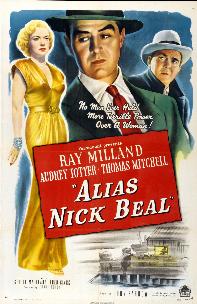
Alias Nick Beal (1949): Ray Milland’s a Devil

Alias_nick_beal (1)

This is my entry in the CMBA Politics on Film Blogathon.

Alias Nick Beal handily flips the paradigm of cinematic angels in vogue with Hollywood, specifically during the 1940s. You could make a whole subgenre out of them. As its name suggests, the lynchpin character of the entire movie is Nick, though this is admittedly only a pseudonym. Across time and space, he’s come in many forms, under many names, including the serpent, Lucifer, or the Devil.

Ray Milland portrays him in bodily form, providing a deliciously evil turn in fine threads. He’s not quite the “blonde Satan” out of Dashiell Hammett’s Sam Spade literature, but he’s almost there, about as close as you might possibly come in the flesh. With such a devious figure pulling the strings, Alias Nick Beal becomes noir mixed with myth and allusion in a rather unusual manner. It is the first of its kind: a Faustian noir.

The story itself opens in more conventional territory. There’s an earnest, hard-working district attorney named Foster (Thomas Mitchell) who is looking to clean up local corruption, manifested as always by cigar-chomping Fred Clark with his host of slot machines and bookies just looking to rake in the dough.

Try as he might, he’s never been able to deal the definitive blow to the town’s graft. Regardless, he’s an upstanding man of principle with a devoted wife (Geraldine Wall) of many years and a solid base of friends, including local minister Reverend Garfield (George Macready). Of course, even someone like him falls to temptations; they seem innocent at first even honorable. The trajectory of his entire political career starts to change for the better, although his personal relationships are poisoned beyond repair. More on that later.

For now, he has an inauspicious meeting at the local watering hole, the dubious China Coast Cafe. It’s the kind of joint that can only exist in the foggy back lots of some Hollywood studio (in this case Paramount Pictures).

It’s the cheap, low-lit atmospherics of such an obviously stylistic or phony facade that make Alias Nick Beal feel like low-grade entertainment. With noir, however, this often proves more of a blessing, and what’s more remarkable is how impressive the cast manages to be. The cafe also happens to be a fitting place to meet the devil’s incarnate.

No, Foster doesn’t go and sign the pact right then and there. His new acquaintance is far too cunning, far too diabolical to be so direct. But it comes soon enough as his new undue influence makes an insidious impact on the politician’s life. Isn’t it true that small habits compound as days, weeks, months, and years go by before you realize how much you’ve actually changed? Whether good or bad.

Simultaneous with his public ambitions, Foster’s reverend friend helps run a boys’ home not unlike similar storylines in Boy’s Town or Angels With Dirty Faces. It’s a conventional if generally uninteresting element. The one moment prodding the movie’s core conflict with a stick comes with the daily Bible reading.

Nick doesn’t want to be caught dead near the good book, but the minister opens it all the same as is his practice reading the following words to his charges:

“The earth is the Lord’s, and the fullness thereof; the world, and they that dwell therein. For he hath founded it upon the seas and established it upon the floods. Who shall ascend into the hill of the Lord? Or who shall stand in his holy place? He that hath clean hands, and a pure heart; who hath not lifted up his soul unto vanity, nor sworn deceitfully. He shall receive the blessing from the Lord, and righteousness from the God of his salvation.”

If they’re not obvious already, the passage is an implicit call for Foster — to make him take heed — a warning against his current trajectory. Nick knows if Foster heeds the words, all his tireless work in interference will be thwarted. However, he’s still got some tricks up his sleeve.

One of them is named Donna Allen (Audrey Totter), a dame he found out on a street corner by the same upstanding establishment he just happened to meet Foster at. Audrey Totter does her gloriously acerbic rendition for this strange character and plays it nice and tender as well. It’s a fluid performance for a peculiar role calling for a hooker to get promoted in status to that of a campaign manager and confidante.

Suddenly, the works of devils and angels don’t look altogether dissimilar. After all, he raises this woman of ill-repute out of the gutter, gets her an apartment, drapes her in mink coats and stoles. However, it’s the ulterior motives that are most revealing.

Because eventually, Nick has worked his way up — greasing the wheels of Foster’s ego as it were — so they can start talking about the murky grays of politics. His line of arguments are deceptive to the point he has his victim finds himself conceding on the same points of moral bedrock as Claude Rains in Mr. Smith Goes to Washington.

They buy into the lie that this is the only way to get anything done. Maybe it is partially true. Who am I to say? Conveniently, in the other picture, Thomas Mitchell was the wisecracking journalist who could observe from a comfortable distance. In this one, he’s embroiled right in the middle of the mess.

With Nick Beal constantly needling him and all the conflicting forces and voices in his life swelling, it really is a tug-of-war for his soul. Everyone wants a piece of it. His wife, the reverend, Nick, even Donna. It’s the intent that colors their true character.

Thus, Alias Nick Beal is an impeccably noirish take on spiritual warfare — the necessity of “pinning the devil to the mat” — before he totally makes you into a self-serving, arrogant person. Given the context it’s already working within, Nick Beal is a creative riff on Faust, but it never feels like full-fledged noir since the moralism is laid on a bit thick.

Neither of these elements is altogether detrimental, but it does feel like the movie is diluted in all its efforts. It’s this curious amalgam of disparate points of interest and self-reflexive in its orchestration with Milland being allowed to be villain and impresario. Again, the pieces and the resulting performances are intriguing, but it feels too cut-and-dry in the scripting department.

There’s never the great intrigue of watching a movie where we imbibe the sense of drama, romance, laughter, or whatever else. It feels like a story is being spun for the sake of Nick Beal so we can see him pulling the strings in front of the camera. Meanwhile, other themes are either cast aside or never fully explored. They could have been the building blocks for another movie entirely.

All told, I’d put it a couple rungs under the likes of The Bishop’s Wife and Here Comes Mr. Jordan. And it’s not quite on par with director John Farrow’s The Big Clock or His Kind of Woman. Milland is enough to make it nearly worth it.

3/5 Stars


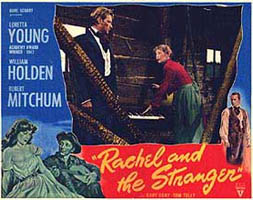
Rachel and The Stranger (1948): Indentured Servitude

Rats1948.jpg

It becomes increasingly apparent Rachel and The Stranger is a peculiar little movie that would have no place in the modern landscape, and not simply because RKO Studios is no longer in existence. It feels like arguably its biggest star is off-screen more than he is on because he was probably in at least 3 or 4 other pictures in the same year. When he is present, Robert Mitchum is altogether jolly, always wandering into the story with a guitar and a song on his lips. It’s a slightly different iteration from the rogues he was normally called on to play.

Likewise, Loretta Young isn’t her usual effervescent self for much of the picture, made to look dowdy and such given the territory. These were the days before William Holden had yet to come into his own. He’s likable in a movie like Apartment for Peggy or here, but he hardly has a voice. There’s nothing alive and individual about what he brings to the part. He’s not yet a romantic heartthrob, and he doesn’t have his cultivated sardonic edge.

Mind you, this is all before even getting to the content at hand. Because Rachel and the Stranger concerns itself with subject matter we rarely see in Hollywood either. Rather than consider it a conventional western, it’s more of a colonial drama taking on the pioneering days of the likes of Natty Bumppo and Davy Crockett.

David Harvey has just recently lost his wife to some unnamed affliction. He is comforted by his friend Jim Fairways (Robert Mitchum), even as he is faced with the seemingly insurmountable task of raising his son Davy (Gary Gray) on the harsh frontier with some element of civility. To uphold the honor of his wife, he wants to impress upon his boy the importance of education, praying before meals, and such puritan disciplines.

He knows he’s not able to give that to the boy as his own know-how is all of a practical nature, about survival out in the wilderness. The only alternative is to find a suitable wife, not a romantic partner, but someone who might be a good maternal presence in young Davy’s life. As women are scarce, David finds the next best thing in Rachel.

Historically, a step before mail order brides, there was something even more archaic: indentured servitude. This is before the chattel system of African slaves when we had another outdated economy where people were beholden to others to pay off debts. So David buys Rachel from her previous owner so she might fulfill the surrogate duties of a mother. One is led to inquire, “How in the world did Loretta Young end up as a bondservant, to begin with?”

As is all but expected, there are growing pains and chafing as Davy is unimpressed by this woman who is a shadow of his own mother’s talents when it comes to shooting guns and running a home. But Rachel has a will to prove herself and earn their undying respect.

In one sense, it’s somewhat difficult to consider the story soberly, given how the material plays, but Susan is quite a unique character, especially given the time period. Her point of view is typically unsung and unseen. For this reason alone it’s a slightly intriguing proposition.

The story escalates gradually with the men fighting over the woman. Because when Jim drifts back into their lives as he has a habit of doing, he brings out contours of Rachel they have never seen before. Her love of music. The warmth of her smile. Laughter. David realizes she is far more than he gave her credit for, and her personality is far more intricate than he ever took the time to find out.

However, this ensuing battle also asks the implicit question, “What say does she have in the turn of events?” If we wanted to use more current vernacular, we would need to consider her personal agency. Thankfully, she has a moment to fight back with a few choice words of her own.

The tone changes completely with a midnight onslaught by some militant Shawnee out on the warpath. It’s as if we needed a reminder of where our setting is. It does its job by blowing over the tiff between friends. It puts it in perspective so they can start afresh with a new lease on life. For once, this is a story about husband and wife — not man and servant.

True, there’s a controversial verse from the Old Book that reads, “Wives submit to your husbands” just as another entreats, “slaves obey your masters.” But there is a flip side to these seemingly patriarchal ordinances. Husbands are told to love their wives, “just as Christ loved the church and gave himself up for her.” Then, “masters, treat your slaves in the same way. Do not threaten them, since you know that he who is both their Master and yours is in heaven, and there is no favoritism with him.”

David Harvey without question is familiar with these words. This movie is an exercise of him grappling with the weight of their meaning, just as it is a tale of a woman coming into her own as a beautiful, unique individual.

3/5 Stars

Review: On The Town (1949): MGM’s New York Musical

on the town 1.png

There is an immediate understanding that goes with the opening image of a construction worker arriving at the docks, still sleepy, as the world wakes up with him. And he does something that while still theatrical has roots in a very human urge, to bring in the new day with song.

If we look at the MGM catalog many of them have themes based around stage productions, film, or the arts. In their own way, such topics make completely logical sense as they make it much easier to transition into song and dance that feels pertinent to the performers in front of us. And yet when you think about it, at least for me, some of the most sublime of these old numbers are never connected with the big opulent stage productions being put on with giant routines.

Certainly, they are impressive for their scope and the intricacies of their execution, but where is the real magic? It’s Gene Kelly dancing in the rain because he’s in love and he’s got to articulate it. It’s Fred Astaire dancing on the ceiling overcome with joy of his own in Royal Wedding (coincidentally directed by Stanley Donen). And so when three sailors burst into view, scampering off their ship gleefully, with a whole day to gallivant around New York City, those emotions come across as incredibly genuine.

Gabey (Gene Kelly), Chip (Frank Sinatra), and Ozzie (Jules Munshin) break into a chorus of “New York, New York” no doubt heard all across town. Their subsequent adventure, tailored by the dynamic duo of Adolph Green and Betty Comden, truly is the quintessential, streamlined MGM musical.

It was plucked from the stage play dream team of choreographer Jerome Robbins and eminent composer Leonard Bernstein. The film itself was directed by Kelly and Donen who would maintain a fruitful yet increasingly bitter partnership together until It’s Always Fair Weather (1955). It’s nearly impossible to assume where one man’s influence began and the other’s ended. All we have are the results that speak for themselves.

Maybe I’m simply a sucker for ambling films like this where the prospects seem endless. Because, after an initial clip show and a decent amount of on-location footage, taking them all over, the boys finally settle on the fact that they need to find some girls while they’re in the big city.

Kelly is especially girl crazy when he spies, “Miss Turnstiles” (Vera-Ellen), plastered all over the Subway on posters, only to run across her moments later, getting her picture taken nearby. She’s quick to head off to her next engagement, and yet he’s immediately smitten and intent on reuniting with this beautiful, cultured girl who seems way out of his league.

Meanwhile, Sinatra is the one intent on seeing the sights. Much like Take Me Out to The Ball Game, he feels miscast in the naive role as their lady cabbie (Betty Garrett) chases after him, all but chauffeuring them around town free of charge as long as she’s compensated in male companionship. Poor Chip finds himself forced into the front seat constantly subjected to the lady’s amorous assaults. He’s a goner.

on the town 2.png

As the search for the local celebrity continues, Ozzie runs into Claire (Ann Miller), a woman conducting research at the Museum of Anthropological History, ceaselessly fascinated with prehistoric man,which Ozzie seems to be a perfect descendant of. It seems like everyone else is striking it rich as Gabey searches hopefully. And in its most movie-like moment, he’s rewarded for his tireless casing of the city. Sure enough, he wanders in on her as she balances on her head as nice you please.

It turns out that Ivy Smith is more of a girl-next-door than a big-name socialite and yet when Gabey finally tracks her down, she leads him on, playing the part to impress him. They solidify their chemistry with the winsome “Main Street,” personifying a universal portrait of small-town American, pretty girls, and light-hearted, good-natured romance. Later, their swiveling and maneurving on a ballet barre somehow manages to be seamless while further instilling their relationship.

Like all fated New York romances, a rendezvous for the top of the Empire State Building is planned. It’s a party! It also provides the backdrop for the deceptively romantic “You’re Awful,” allowing Sinatra to break out of his film persona for just one moment to croon as only he can croon. Betty Garrett proves she’s far more than a cab-driving clown, with tenderness to give as well.

Now everyone is together. You have the three sailors and their three All-American gals, each wonderfully color coordinated in bright Technicolor-worthy dresses and we finally feel as if things are complete.

The sense of camaraderie by this point is undeniable, and along with the New York setting, On The Town is bolstered by such a sentiment. Not only does it mean that we have a plethora of quality performers, but there’s a sense that they’re all in on this big beautiful extravaganza together, and they all have something to bring to the party. It makes for a delightful showing.

on the town 3.png

“You Can Count on Me,” says as much even as Gabey’s Cinderella rushes off without an explanation and his friends find it necessary to cheer him up.

“A Day in New York — A Comedy in Three Acts” seems a rather strange aside, and yet here you see an instance where Kelly (and Donen) gets to exercise a specific vision, aided by dancer/choreographers Carol Haney and Jeanne Coyne. Because this whole film is an ensemble piece and still, even this single scene shows glimpses of some of Kelly’s more inventive numbers ,which would come to fruition in the near-future. Again, deciphering the dividing line between Kelly, Donen, and the involvement of others is nearly impossible. But why bother with quibbling at this point? The results speak for themselves.

When the storyline wraps up and the three sailors have to bid adieu to their girls, the bittersweet melancholy of saying goodbye is unavoidable as is the continuity of life. Even on the way out, a new group of sailors is already bursting forth to see New York — the same crane operator observing their eagerness with a smile. The daily cycle begins again. What a city it is! Such a wonderful town. In fact, “Ol’ Blues Eyes” would sing about it again one day.

4/5 Stars

Easter Parade (1948): Judy & Fred Together At Last

easter parade 2.png

There’s a slight disclaimer that must go with Easter Parade. It has very little to do with Resurrection Sunday. More so, it’s a premium excuse for a lavish musical. At least in this regard, it thoroughly accommodates its audience.

The show starts off gloriously, not with dialogue, but with song, reminiscent of the great operettas of old or the future works of Jacques Demy where the film is buoyed by a range of voices imitating the joyous chorus of life. Here we have the seemingly ageless Fred Astaire strutting down the street greeting folks, doing some window shopping, picking out a hat as models file by and everyone chimes in with “Happy Easter!”

What becomes immediately apparent, even as we are thrust right into song, is the immaculately colored world, bright and cheery, personifying the holiday festivities and simultaneously satiating audiences who come to expect such glorious decadence from Technicolor movie musicals of the age. It rarely disappoints in terms of pure opulent set design.

When Astaire spies a bunny in a toy store window, it inspires his finest number in the picture, a worthy precursor in fact to his shoeshine number in The Band Wagon (1953). Because what sets it apart is how alive, lithe, and playful it is. Gene Kelly was imbued with this ability too, but you have to witness it to completely understand the magic when environment and inspiration coalesce.

They could animate the world around them by taking lifeless objects and turning them into tools to personify emotion. Like all the preeminent performers, they take the tirelessly rehearsed and make it feel like the epitome of the organic, in a way that suggests we are discovering something precisely at the same moment they are. We are part of the magic born out of the moment.

Astaire banging on drums and xylophones. Twirling sticks and tossing toys like, well, a kid in a toy store. The story hasn’t even started yet, and he’s already made Easter Parade into something special. It’s when you’re reminded that these lavish musicals were at their best when they momentarily lost their plotlines through acts of artistry and inspiration that still managed to somehow advance the narrative.

easter parade 1.png

At some point, the exposition must arrive and with it a plot. It comes in the form of Don’s ravishing and vain dance partner. Nadine (Ann Miller) is intent on striking out on her own and commanding a larger audience. In fact, she’s already made up her mind and signed a contract with Ziegfeld, leaving Don to start from scratch with a new partner. Regardless, there’s no denying the chemistry they had together. Astaire and Miller absolutely light it up in “It Only Happens When I Dance With You.”

However, now feeling betrayed and saddled with a bit of a Pygmalion complex, he convinces himself that he can turn any second-rate performer into his costar, and he just happens to pick Hannah Brown (Judy Garland). The unassuming starlet splits her time as a waitress at a local bar while struggling to differentiate her left foot from her right. She looks like a hopeless case. Not so!

Fresh off his quality success in MGMs Good News (1947) from the year prior, Peter Lawford is inserted in the storyline as the close friend of Don and Nadine, caught in the middle of their personal and professional squabble. When he meets Hannah in the rain, it only makes things more complicated. One could wager that the handsome and youthful Lawford is partially miscast, but he has a good-natured charm that makes us disregard any of that. We like him as much as we’re supposed to.

From their initial encounter, the Astaire and Garland relationship is front and center, evolving into the film’s most important dynamic. So far the movie is coming through on its promises. Again, we’re not all that interested in their acting per se, unless I’m just speaking for myself.

What actually strikes my curiosity is seeing them perform in tandem because they were consummate professionals who knew the Hollywood circuit like the back of their hand by now. Astaire, though still looking so spry, had years already logged with Ginger Rogers and others, not to mention stints on Vaudeville and the stage. Garland of course, though still quite young, had, since adolescence, been trained up and groomed in the ways of Hollywood. The shining examples early on, of course, being The Wizard of Oz and then her onscreen partnership with Mickey Rooney.

“Couple of Swells” endears itself as a delightfully corny number with our stars ruefully ditching the fine attire for artful dodger, tramp-like garb. Buying into their affectionate relationship by this point is no difficult task. They’ve made us believe in it.

easter parade.png

In truth, Garland had never met Astaire before their teaming though she had purportedly wanted to work with him for many years because he was the tops — the best of the best.

The rest of the production’s background is tumultuous, and the actual details sketchy at best. Scriptwriters Frances Goodrich and Albert Hackett were initially called upon only to have their draft touched up by Sidney Shelton. Vicente Minnelli was removed as director at the behest of Garland’s psychiatrist, deeming it better for her to work without her husband.

We might also call it an odd chance of serendipity as Gene Kelly (Garland’s co-star in many MGM musicals) was also slated for this project until he broke his ankle playing volleyball (right before production commenced).

Who was coaxed out of retirement to take on the role instead? Only the best: Fred Astaire. And Astaire would retire numerous other times thereafter, but you just cannot keep a man who was born to dance like he was away from the floor. Thank goodness he would come back for numerous more efforts. His successes in the 50s are too innumerable to count.

Simply put, he makes every movie he’s in worth watching for the mere chance that you will glimpse something spectacular. Paired with Garland, a world-class performer in her own right, there’s no missing, even if both have more iconic pictures. That’s probably more a testament to their iconic careers than the merits of Easter Parade. Because it all but delivers on everything you come to expect from the two names written above the title.  There’s a good chance you’ll be left with a broad smile on your face.

4/5 Stars

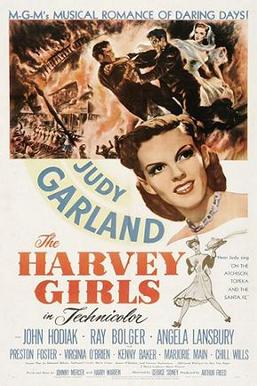
The Harvey Girls (1946): The Painted Desert Meets The Musical

Harvey_Girls_poster

It was during a pit stop along a cross-country trip through the Petrified Forest that I first became aware of The Harvey Girls. Because you see, The Painted Desert Inn is a bit of a relic of the past, and it preserves a history of the famous waitresses who helped pave the way for a certain brand of civility in the Southwest. They brought the sensibilities, respectability, fine china, and world-famous sirloin steaks from back east to forsaken lands normally ruled by saloons and brothels.

So while The Harvey Girls (1946), a cheery musical directed by George Sidney, does not have the same mythological quality in the taming of the West as a John Ford picture, the same process is being captured, albeit in more practical (and more musical) terms.

We get a taste of where all these girls come from thanks to the very catchy, “On the Atchison, Topeka, and the Santa Fe,” which suggests the vital importance that the transcontinental railroad played in such an endeavor. The recording would prove a viable hit for star Judy Garland and many others, taking on a subject akin to “The Trolley Song” out of Meet Me in St. Louis.

In that regard, Garland is out of sorts residing on the pioneering prairie with their dive saloons and floozies of ill-repute. But that’s exactly her charm. She traveled to this far-off, unknown destination as a mail order bride; her only correspondence with her future matrimonial partner is through letters.

He’s quite eloquent with a pen and yet she meets the colloquial but good-natured H. H. Hartsey (Chill Wills) and receives the shock of her life. All of a sudden they’re both a bit flustered and decide to dispense with the marriage on amicable terms.

As a result, Susan decides to join The Harvey Girls in their newly formed restaurant to bring entertainment and quality diversions to this godless territory of Sand Rock. Their main competition comes from a man named Ned Trent (John Hodiak) who runs the local watering hole replete with gambling, drinking, a whole host of dancing girls. One of them, Em (Angela Lansbury) is deeply in love with him, and it shows.

Trent conveniently has a partnership with the local Judge who has made it a practice to scare off anyone with a smidge of decency. He even ran a preacher out of town and his scare tactics include a gunshot fired into the Harvey Girl dormitory.

Though only a recent recruit, Susan soon mobilizes the women who are trained up by (Majorie Mann) ready to fight back against their opposition. Her distaste and inexperience with guns are endearing just as her plucky fearlessness gains her a certain amount of admiration.

Trent proves to be a far more complex man than he’s given credit for even as he tries to distance himself from the Judge and push the Harvey Girls out fair and square. It’s still a competition, but at least it’s honorable. Simultaneously, Em begins to see the twinkle in his eyes as he becomes enamored with Susan. Her principles and feisty nature are attractive, but Ems not about to lose him without a fight nor does Susan particularly fancy Trent. The romantic triangle is firmly in place.

In one sense, Lansbury feels poorly miscast, no fault of her own because they all but dubbed her singing voice to make her seem American. Her charm has to do precisely with the fact she is not one of us. And yet remarkably, she does a fine job as a sympathetic antagonist, if you will, that we grow to admire.

John Hodiak is easily clumped with actors of the 40s like Brian Donlevy or Cornel Wilde who are not quite buried in obscurity. However, because there is nothing that can be deemed electric about them, it’s easy for them to get lost in the fray. All that being said, I rather like Hodiak opposite Garland. He’s both slightly antagonistic but genial when he has to be.

“It’s a Great Big World” provides a fine showcase for Garland and her companions to dream together. On her own, Virginia O’Brien provides a comic aside singing “Wild Wild West” and giving the town’s jumpy new blacksmith (Ray Bolger) a capable helping hand. I must say I hardly recognized the young Cyd Charisse who earned her first speaking role to kick off a shining career in Hollywood as one of its preeminent dancers.

The most comedically gratifying scene has to be when the two rival factions resort to physical catfights to exert their dominance and show that they have a right to stay. The Harvey Girls also throw a party where Bolger’s length on taps is positively charming. It’s the old story that a dancer must be highly skilled to make their style look so very idiosyncratic, and I kept on thinking how I would never in a million years be able to pull of such a routine.

What follows is a Waltz that has everyone dancing even as the town is plagued further by arsons and a heated fistfight to right a few wrongs. We are getting down to the wire. However, with the outbound train about to leave, decisions must be made and one could wager that our leads make the right one, though fate and Em give them a helping hand in the end.

The Harvey Girls, produced by the Arthur Freed unit, and blessed with the song-smithing of Harry Warren and Johnny Mercer, delivers a repeatedly delightful western musical experience, despite the very fact that it was not initially supposed to be. However, a drama earmarked for Lana Turner got a facelift and pulled Judy Garland away from working with Vincente Minnelli and Fred Astaire to score her a low-stakes, lightweight hit.

To make things even better, she would finally get her chance to work with Astaire two years later in Easter Parade (1948). For now, let’s relish this one for the frothy pleasures it affords. My sojourning through the painted desert was almost 10 years ago, so it’s a pleasure to finally get around to see The Harvey Girls. 

3.5/5 Stars

Stormy Weather (1943): Bill Robinson and Lena Horne

stormy weather 1.png

Stormy Weather, as a musical, is nearly unprecedented, and to my knowledge, there is only one other film to truly rival it as a spectacular showcase for African-American talents during this same period. That would be MGM’s Cabin in the Sky (1943).

But it’s not simply the case that this is a gathering of an all-black cast. Often we look at a film or a director based on extenuating circumstances. Sometimes it feels like we’re starved for certain types of portrayals and that can be the same for many minority representations. Thus, when you get anything passable, you’re bound to turn a blind eye to mediocrity because simply in discovering its existence, you have found a valuable cultural artifact.

If you can bear with my explanation, Stormy Weather might have been such a film since it is fairly unique among the seas of its contemporaries. But its individual uniqueness should not obscure the fact that these are some truly fantastic performers put on the stage, and they are deserving of more people singing their praises. People did back in the day, despite the racial intolerance, and they continue to deserve the recognition, so that’s what I’ll try to give them.

However, another interesting point of discussion is the production itself given the fact, behind the scenes, it was undoubtedly business as usual, with mostly whites calling the shots and pulling the strings. They have sculpted a bit of a faux reality where everything is fine and dandy in a segregated society and Bill “Bojangles” Robinson sits on a porch with all the neighborhood children regaling them with tales of his life thus far. And what a life it was!

He of course famously danced down the steps with a precocious Shirley Temple and got a dubious nod in Top Hat (1935) from Fred Astaire somewhat marred by blackface. In other words, Bojangles rightfully deserves this showcase, out of the shadow of other performers, with the limelight shining brightly on him for once.

In this highly fictitious and glossy rendition of his life story, he returns home from The Great War with his buddy Gabe Tucker (Dooley Wilson) who’s always trying to make himself out to be bigger than he is. Meanwhile, Bill looks to put his penchant for toe-tapping to good use.

He’s reunited with Selina Rogers (Lena Horne) the grown-up little sister of a childhood friend, and they hit it off. Little does he know she’s on the rise as a nightclub singer because besides having talent, she’s a class act, a first-rate personality, and really a knockout.

Somehow you lose track of the massive age difference between Robinson and Horne as they play so affably opposite one another and anyway we’re hardly hanging around Stormy Weather for the plot. It’s a musical. Let them dance.

Following suit, for the rest of the film, Robinson is bouncing around, meeting a minstrel show on a riverboat as he does a sand dance before they pogo around on their taps together. It was the first moment that feels truly electric.

Then, he’s pinch-hitting as a waiter at a little joint run by Ada Brown with the jovial Fats Waller yammering away to accompany his piano. Time has passed and Selina is doing well, calling in a favor to get Robinson a gig so he can get away from his menial existence. He gets a rousing round of applause soft-shoeing over big barrel drums only to get fired for hamming it up.

But the film goes out on top with the moment we’ve all been waiting for. Horne sings the title number, which in itself is a fine rendition, but Cab Calloway brings his scat singing, baggy pants-swishing energy into the picture followed by the apogee of it all.

The last 5 minutes or so are pure magic highlighted by one of the most spectacular numbers you’ll ever lay eyes on, and I’m trying my best not to exaggerate. The Nicholas Brothers are that extraordinary. Fred Astaire has already been mentioned due to his admiration for Bojangles, but he was equally quick to laud “Jumpin’ Jive” as the most spectacular of numbers. I won’t dare spoil it. Regardless, The Brothers do it all with their legs. Their skills are jawdroppingly dextrous. It verges on the superhuman.

Even as the comedy isn’t that hilarious and there are some jarring visuals like bonnets featuring golliwogs and the like, that’s not what this picture leads me to dwell on. More than anything, I marvel. As a viewer, I’m reminded that predominantly African-American urban centers really were places of immense culture and expression, as underrepresented as they might be on the silver screen.

Stormy Weather takes that Reinassance and a vast collection of talent from vaudeville and Broadway to Hollywood and lets it shine. Despite its share of flaws, what remains is a phenomenal array of artists, performers, and visionaries. Stormy Weather is an important remembrance and historical document, lest we forget how diverse and rich American culture really is.

4/5 Stars

Ziegfeld Girl (1941): See It For The Stars

ziegfeld girl 1.png

Thank you HOLLYWOOD GENES for having me in the Ziegfeld Blogathon!

Few would claim Ziegfeld Girl to be anything close to a landmark masterpiece, but it’s got star power in spades thanks to MGMs robust lineup during the war years and that alone, followed up with a few spunky numbers, backstage melodrama, and minor laughs, is a fine starting point.

Ziegfeld was wildly popular with Hollywood in that day and age from The Great Ziegfeld and Ziegfeld Follies, both bookending this musical extravaganza.

In this particular tale that shares beats with any number of backroom industry dramas from 42nd Street to Valley of the Dolls, three women from very different walks of life find themselves given the once-in-a-lifetime opportunity to be part of the biggest revue in the land: Ziegfeld’s Follies.

Though Ziegfeld himself goes all but unseen, he has a couple talent hounds sniffing around and more important than talent are beautiful girls. Edward Everett Horton is one of the men who follows up on a pretty elevator operator who made a striking impression.

Pretty soon Sheila (Lana Turner) goes from obscurity, living in her family’s humble home with a boyfriend (James Stewart) trying to eke by as a trucker, and all the sudden she’s hit the big time with a salary and a new class of men calling on her. At first, life seems like the best of both worlds until the glamorous one wins out and Sheila begins to be completely disenchanted with the old ways. Gilbert diagnoses her problem; she’s trying to be two places at once and winds up not being any place at all.

She watches her loving boyfriend distance himself as he joins the company of bootleggers at first to hold on to her and then just to make the money that comes with such a life. But the stakes are high, and he winds up in prison. Whether you buy Stewart taking on such a seedy vocation is slightly beside the point.

ziegfeld girl 2

Susan Gallager (Judy Garland) was born and bred on the Vaudeville circuit, trained up by her journeyman father (Charles Winninger) and part of their inseparable family act. The thought of breaking up the team plagues her even as the bright lights of the Ziegfeld Follies beckons her on. Her stirringly melodic rendition of “I’m Always Chasing Rainbows” all but seals the deal, without her father attached.

Figuring out what to do with Pop is of utmost importance to her as she knows full well he would do everything to promote her success even if it means failing out on the road by himself. Her struggle is balancing the dreams that she has always aspired to with a proud father she wants to support as best as she can.

Our final star, Sandra (Hedy Lamarr), is compelled to take a role not from want or desire but out of necessity as her husband (Phillip Dorn) is a struggling violinist who is too skilled for the gigs he’s trying to win. He needs to be in Carnegie Hall not some saucy song and dance routine with a menagerie of pretty girls. To provide for them and keep his beloved violin from being hocked she joins the Follies. Her beauty is unsurpassed and it brings with it the friendly advances of another man. It’s relative fluff. The best moment comes when she meets the man’s loving wife. They both realize they love their husbands and they leave it at that. There’s no homewrecker between them.

ziegfeld 3.png

Sheila undergoes a stunning downfall into drunkenness that finds her tipsy on stage and ultimately canned for good. It’s a decline that feels all too real because we know that the same meteoric rise and subsequent demise plagued numerous such figures.

A subsequent reunion with Gilbert follows at the family homestead. There’s something about Stewart feeding Turner soup that’s endearing with the gangly fellows textbook brand of nervous muttering called upon to fill the space. She’s just looking up into his eyes and seeing the person that she once loved — the person she still loves.

This is not an offering that will earn new converts to the glories of the classical Hollywood system but for those already firmly engaged with its stars, its nevertheless a treat. Lana Turner is perky, Judy Garland proves as sweet as ever, and Hedy Lamarr remains dazzlingly aloof masking an inquisitive brain well on the way to inventing frequency hopping which would provide the framework for WiFi. No big deal.

However, look at the real lives of each lady and there are obvious strains of personal tragedy that present themselves in each case. It’s the undeniable undercurrent to the movie that cannot be ignored.

Though it seems like it’s really the gals who own the picture, rightfully so, James Stewart still garners top billing and it makes partial sense given his latest forays included Mr. Smith Goes to Washington and The Philadelphia Story. However, he was getting WWII fever as well and after joining the military that same year, he would not be back to moving pictures until a little box office flop called It’s a Wonderful Life in 1946.

Although the nation was on the cusp of an event that would redefine human history and inject a patriotic tinge into all film productions, Ziegfeld Girl seems content to hang onto the opulent nostalgia just a little bit longer. It’s far less appealing now, but if any of the many names on the marquee catch your fancy, then give it a watch, and enjoy it heartily for what it is.

3/5 Stars

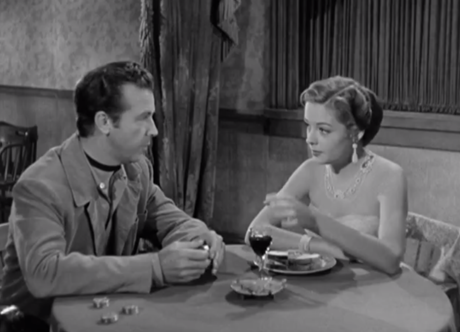
Station West (1948): Starring Dick Powell and Jane Greer

station west 1.png

First impressions suggest Dick Powell doesn’t fit the boots of a western hero as he did the fedoras of noir. Like Bogart or even Cagney, his physique isn’t imposing and yet he makes up for it with a wry wit. Running off his mouth as he often does fits the cynicism of noir.

Not that it can’t have a place in the old west as well, but with other actors, it feels like second nature and yet when he gets off the stagecoach, it really does feel like he has just entered western country for the first time.

As the film evolves, it plays a bit in his favor because this is a version of the West suited for his talents. Granted, The Tall Target (1951) is not a western, but in that film, Anthony Mann made a bit of a Civil War-era noir with a similar milieu. However, unfortunately, by reputation, Sidney Lansfield is no Mann so I’m not sure the material is ever injected with a similarly visceral and engaging energy.

Events simply happen, characters interact, and there is a resolution. Thankfully Station West serves up one major plot twist, suggesting there is more than meets the eye in this out-of-towner who all but picks a fight with a soldier boy in the local saloon.

Maybe Haven is more Phillip Marlowe than we were initially led to believe. Regardless, he’s immediately taken by the local lounge singer, since the quizzical look of Jane Greer does that to people. He is quite forward in looking to make her acquaintance and ends up having a run-in with the local muscle (Guinn Williams).

There are moments where the fighting between them feels genuinely frenetic blended with hokey shots that look horribly fake. I’m not sure what to feel but for the sake of the story, Haven is now a big shot and news gets around about him. It’s all just a smokescreen; he wants to investigate a suspiciously missing shipment of gold.

Still a few years away from his much-deserved starring stint on Perry Mason, Raymond Burr plays a relatively uncharacteristic Lilly-livered loser. I love Burl Ives as much as the next fellow, however, his ballad singing feels forced and frankly, inorganic. It breaks up the scenes in a strange way as he keeps his guitar handy, welcoming guests to his very stingy hotel.

What remains to be seen is the identity of Charlie, the person who has their hand in all the town’s major dealings. Our snooping hero has a feeling discovering this information along with staging another gold run might get him some much-needed leads.

It’s not quite a black pool forming around him, but he does get whacked over the head in the middle of a gold run. It’s another added complication in the mystery to settle who is masterminding these robberies. It might be a testament more to the cut of the picture I saw. Regardless, Station West winds up a bit disjointed.

The payoffs are barely satisfying, and there’s never much of a motor to the picture’s action even amid the burning of a warehouse and some gunfire. Qualms about Powell’s performance aside, the greatest disappointment was Jane Greer. It just never feels like she has anything interesting to do even as her part has inherent possibilities. The opportunities afforded feel wasted. Then again, it could come down to chemistry, and it’s hard to top what she was able to conjure up with Robert Mitchum in not only Out of The Past but The Big Steal as well.

3/5 Stars