Murder, My Sweet (1944) – Film-Noir

murder my sweet

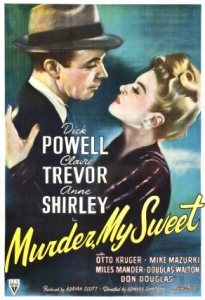
This film-noir adaptation of the Raymond Chandler novel stars Dick Powell, Claire Trevor, and Anne Shirley. It opens with a blinded Philip Marlowe being interrogated and so he agrees to spill everything he knows.

It all started one evening in his office when a big thug named Moose came in to get his help in finding a girl. Marlowe agrees to take the case and he questions a drunken bar owner but all is not right. He returns to his office where a man named Marriot wants his protection during a ransom drop off. However, at the location Marlowe is knocked out and the man is left dead. Through a series of events he meets Helen Grayle and her significantly older husband, who are both involved with a necklace. Also involved is the shady psychic adviser Jules Anthor, not to mention Mr. Grayle’s protective daughter Anne. Marlowe is forced to meet with Anthor and he eventually finds himself locked up in a facility. He gets away and after a meeting with Anne they head down to the Grayle’s beach house. There they have a confrontation with Helen. Now Anther is dead and Marlowe agrees to show Moose his girl Velma. They head down to the beach house and Marlowe puts all the pieces of the case together in front of Helen. Then Ann, Mr. Grayle, and finally Moose all burst onto the scene in a final chaotic finale.  Despite this bleak conclusion, there is also a hint of a happy ending. Much like the Big Sleep this film at times becomes incomprehensible but it just means your brain must work fast to catch up. Dick Powell I felt was a great Marlowe and Anne Shirley was a strong heroine. This is a quintessential film noir to say the least.

4/5 Stars

Criss Cross (1949) – Film-Noir

c8a9b-crisscrossStarring Burt Lancaster and Yvonne DeCarlo, this Robert Siodmak-directed film-noir revolves around a heist and a love triangle gone bad.

The film opens with Lancaster secretly meeting with his lover with plants to eventually run away together. Then he enters the bar and fights with his love’s gangster husband. However, when a policeman friend comes in, Lancaster will not press charges and non one talks. Little does the policeman know what is really going on. The next day Steve drives an armored car full of money to its destination. As he nervously drives, in a flashback he recalls how it all began.

He had finally returned home after a long absence. His main reason was to see his former wife and yet although they still had feelings for each other, she had remarried a gangster named Slim. Despite the circumstances  both lovers began meeting more often. In order to save himself and Anna, he suggested a robbery of the armored car with Slim.

Then, back in the present the wheels begin to turn and the armored car is ambushed. However, Slim does not stick to his word and there is a firefight. Steve is called a hero but he is left helpless in the hospital. After bribing the man who was to betray him, Steve rendezvous with Anna. However, all is not well and she is ready to leave him behind since Slim is obviously on his way. But she is not quick enough. This film reveals the nature of two double crosses which ends in a deadly criss cross.

4/5 Stars

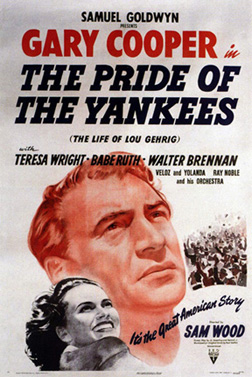
The Pride of the Yankees (1942)


Starring Gary Cooper as Lou Gehrig and Teresa Wright as his wife, this movie honors Gehrig’s life after a tragic death from ALS. From the time he was a boy, Lou could play ball but his immigrant mother wants him to become an engineer. The quiet, young man goes to Columbia and plays some ball. There he is seen by the Yankees who agree to sign him. Despite her disapproval at first his mom becomes his biggest fan. With the Yankees Lou seems slightly out of place being an introvert. Pretty soon he meets Eleanor Twitchell (Wright) however and then gains a spot as the starting first baseman. The two of them fall in love and get married as Gehrig flourishes in the shadow of Babe Ruth. With his career still going strong, Gehrig becomes captain and plays 2,000 straight games. It cruelly comes to an end when he begins feeling weak and is diagnosed with ALS. His career is over and yet in his farewell speech Gehrig gratefully considers himself the luckiest man on the face of the earth. He walked out of the limelight and died soon after, dearly missed. This is one of those truly moving films.

“I consider myself the luckiest man on the face of the earth.” You just cannot make up stuff like that. Here’s to you Lou!

4.5/5 Stars

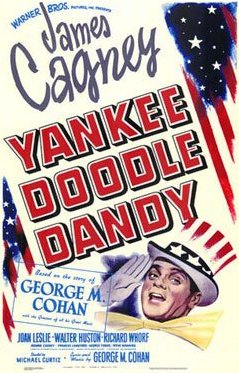
Yankee Doodle Dandy (1942)

Starring James Cagney and an array of others, the film tells the real life story of writer, singer, and dancer George M. Cohan. The story begins with an older Cohan recounting his life story. He began his career with his family in Vaudeville. Slowly he made a name for himself in Broadway and married his love. He and his partner kept making musicals and then the Cohans reunited for one last show. Eventually everyone in the family settled down before they died. The only one left was George who was living with his wife. In his final performance, Cohan gets the country to rally around the flag again as he has done his whole life. This movie has many commendable moments but there is an apparent conflict between biography and musical. Cagney for his part gives a stellar performance as the energetic and ambitious Cohan. The film also doubled as a nice piece of propaganda during World War II.

4.5/5 Stars

Scarlet Street (1945) – Film-Noir

Similar to Woman in the Window, this film-noir was directed by Fritz Lang and it stars Edward G. Robinson, Joan Bennett, and Dan Duryea. Chris Cross is a shy employee who has been working for the same man 25 years. While walking home Chris rescues a beautiful woman from an assailant, not knowing it is her brutish boyfriend. Amused Kitty agrees to have coffee and Chris who is an amateur artist, begins talking art, but Kitty gets the idea he is a wealthy painter. Because Chris is stuck in a hopeless marriage he becomes infatuated with kitty and she takes full advantage. Chris scrounges for money to pay Kitty’s rent and unbeknownst to him, Kitty’s boyfriend tries to sell the artist’s work. A critic is impressed and so Kitty masquerades as the artist. Chris finds out eventually and confronts her but the conniving femme fatale manipulates him again. Chris is delighted his work is appreciated and he is content with Kitty continuing to take the credit. An unexpected turn of events mean he can leave his wife and marry Kitty finally. However, he finds her with Johnny and after his genuine proposal she belittles him.An enraged Chris commits murder but it is pinned on Johnny. A miserable wanders the streets without a job or recognition for his art. Furthermore, he must live with his guilty conscience tormenting him until the end of his days. Woman in the Window is good but this film is more biting and powerful when it is all said and done.

4/5 Stars

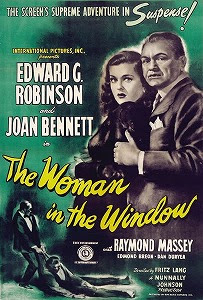
The Woman in the Window (1944) – Film-Noir

Starring Edward G. Robinson and Joan Bennett, this film-noir involves an ordinary psychology professor and a beautiful woman. The story begins at the club where the professor and his friends begin to discuss an enchanting portrait of a woman in a store window. He stays behind for a while longer and before he leaves he takes one last look at the painting. And there he meets the woman herself who then invites him over for a drink. However, her angry boyfriend comes by and he is left dead after a scuffle. Now the two perpetrators must cover up their murder and dispose of the body. That task goes to the professor and he naively dumps it out in the country leaving behind numerous clues. One of the professor’s friends is the district attorney and so he finds himself invited back to the scene of the crime. The professor is not suspected but the woman is blackmailed by a low life ex-cop who threatens to expose them if he doesn’t get his money. Much to the woman’s relief the blackmailer is killed but it comes too late for the professor. Or does it? This noir directed by Fritz Lang focuses on a mysterious woman and psychology. It also has one of the most abrupt, out of the blue endings. Every movie should not be resolved this way but I rather liked it one time around.

4/5 Stars

The Lady from Shanghai (1947) – Film-Noir

Starring Orson Welles and Rita Hayworth, the film is narrated by an Irish sailor (Welles) who meets a beautiful but unhappily married woman (Hayworth). Michael is given a job on the yacht of the wealthy lawyer Arthur Bannister and he is near the alluring Elsa once again. While he is aboard the yacht, Bannister’s partner Grisby asks Michael to fake a murder so Grisby can disappear and claim the insurance money. Michael is suppose to confess to the crime but Grisby will be long gone and there will be no evidence. However, things go awry when Grisby kills another man and then he himself ends up dead. This leaves an innocent Michael facing the gas chamber. Only after he makes a desperate escape from court does he learn who was behind the murder of Grisby and also actually in league with him. In a surreal climax ending in the hall of mirrors, Elsa, Michael, and Bannister all face each other. However, only one survives. Despite a slow beginning the exciting second half of this film is a credit to the directing of Welles.

4/5 Stars

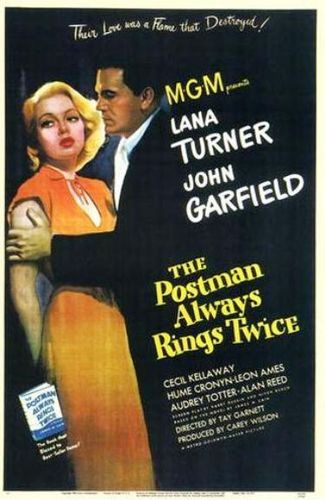
The Postman Always Rings Twice (1946) – Film-Noir

Starring John Garfield and Lana Turner, the film begins with a drifter taking a job at a roadside diner for a jolly older man with a beautiful young wife (Turner). After initial conflict, Frank and Cora fall passionately in love. They try one disastrous attempt to take the husband’s life, and in desperation they try again, this time succeeding in getting rid of him. Soon they are in court fighting the murder rap. Miraculously the two of them get out of it but ironically by the time the trial is over they hate each others guts. They live in constant loathing of each other but after thwarting a blackmail scheme their wild love is rekindled. In an equally cruel twist of fate, they both end up paying for their actions the second time around. With the voice-over, femme fatale, cinematography, and twisting plot, this is a quintessential film-noir that I really enjoyed. I would consider it the landmark performance for Lana Turner and maybe John Garfield as well. They learn the hard way that the postman does always ring twice and there is nothing you can do about it.

4.5/5 Stars

Gilda (1946) – Film-Noir

*This May Contain Spoilers

This film-noir and twisted love story stars Glenn Ford and Rita Hayworth. Johnny Farrell is a shady gambler who has just arrived in Buenos Aires. Through certain  circumstances, he quickly meets a mysterious man. Soon he learns this man is a casino owner and Farrell gains a job as his right-hand man. However, things get complicated when Farrell’s boss marries Gilda, a beautiful woman who Farrell had been involved with a long time ago. Quickly their mutual dislike becomes evident but Mr. Mundy has Johhny constantly watching over Gilda. Seeing her flirting with many other men increases Johhny’s hatred for her. Soon he learns his boss is in something much bigger and after a murder, Mr. Mundy attempts to escape on a plane. Johnny sees it crash but little does he know his boss is alive. To get at Gilda, he marries her and keeps her confined. Despite their hatred, they still hold complicated feelings for each other. But then Mr. Mundy comes back seeking revenge on both Johnny and Gilda. However, his plans fail and the romance is complete. If there was ever an essential femme fatale, Hayworth’s character certainly would fit that category. Her performance of  “Put the Blame on Mame” is definitely memorable.

4.5/5 Stars

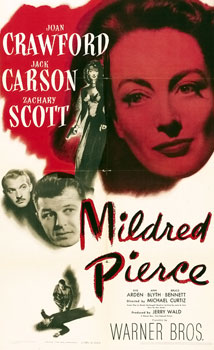
Mildred Pierce (1945) – Film-Noir

Starring Joan Crawford, this classic film noir is intriguing because it revolves around a successful woman. The film begins with a murder and Pierce is taken in for questioning. From that point on she tells the story of her life with her first husband and two daughters. However, Pierce was in conflict with her husband about their spoiled daughter Veda and they split. She was forced to go it alone in the business world and make something of herself. However, her spoiled daughter and complex relationships with men made her life painful. She was now a wealthy restaurant owner but Veda no longer loved her. Pierce tried in every way to win back this love However, her efforts were not enough to save Veda from her fate. This film is certainly enjoyable and Crawford does a wonderful job because for once you actually feel sorry for her. She has a solid cast behind her including Ann Blyth, Eve Arden, and Jack Carson.

4.5/5 Stars