The Killers (1946) – Film-Noir

Starring Burt Lancaster in his debut as well as Ava Garner, the film begins with two gunmen killing “The Swede” (Lancaster) in a small town. Interested in the mystery, an insurance investigator named Reardon (Edmund O’Brien) tries to piece together the past of the dead man. He works to gather more information and talks to “The Swede’s” former friend as well as a hotel worker, and a past cell mate. Through a series of flashbacks Reardon slowly strings together the past including “The Swede’s” boxing career, his time in prison, and especially an alluring woman, Kitty Collins (Gardner).In the climatic scene Reardon finally meets the beautiful Kitty. Only after a series of events and her quick getaway does he grasp the whole truth. Kitty was a deadly double crosser. However, in a cruel twist her partner in crime is killed and her fate is sealed. This is an exciting film noir with solid acting and a great style of storytelling. This was my first experience with director Robert Siomak, and I must say I was quite impressed.

4.5/5 Stars
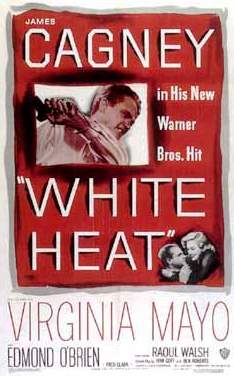
White Heat (1949) – Film-Noir

Starring James Cagney, Edmund O’Brien, and Virginia Mayo, once again Cagney does the gangster role. However, his Cody Jarret is older and more psychotic than ever as he leads his band of thugs. Although he has a beautiful wife, the main woman in Jarret’s life is his mom who watches over him. After an initial robbery, Jarret beats the rap by confessing to a smaller crime. While he is in jail the police plant one of their men (O’Brien). Eventually the pair and a crew of cronies break out and plan their next move. However, the undercover man cleverly tips off his colleagues and they follow in hot pursuit. Pretty soon the only one left is Jarret and he is isolated near high above near a gas storage tank. In a crazy fit, Jarret yells to his ma that he has made it to the top of the world as he goes up in flames. This movie has wonderful suspense in the end and Cagney is chilling yet again.

5/5 Stars

The Lost Weekend (1945)

c5841-the_lost_weekend_posterStarring Ray Milland and Jane Wyman, the film follows a former alcoholic writer as he goes on a binge, sinking into the depths of despair. With his brother gone and his girlfriend tied up with work, he finds himself frequenting bars across town and then wandering home to sleep it off. Amid the flashbacks of his past, nightmares, and a stay at the hospital, he finds his state becoming increasingly worse. His brother has given up on him and his often faithful girlfriend is on the verge. Finally, he decides to end it one way or another. Ultimately, with the support of his girlfriend he resolves to put “The Lost Weekend” down on paper so he can over come it. Director Billy Wilder does a wonderful job with this somber if not shocking story. Milland and Wyman both give very good performances which make this drama hit hard. The unearthly-sounding theremin is also very effective in the film’s soundtrack.

4.5/5 Stars

The Third Man (1949) – Film-Noir

In this film starring Joseph Cotten, Valli, and Orson Welles, an American western writer (Cotten) travels to post-war Vienna to meet a friend. Upon arriving he learns that his buddy has been killed in an accident. Not quite satisfied, he does some of his own investigating and along the way meets his friend’s beautiful lover (Valli). Together they try to cope and make sense of the loose ends. However, neither of them expected the shocking evidence which was to come. Who is the Third Man and where is he? Made in the film-noir fashion, The Third Man utilizes lighting and contrasting black and white cinematography effectively. The actual on location shooting in post-war Vienna helps add to the gritty realism. Although simple, the score comprised solely of zither music is no less powerful.

This movie will have you engrossed in the mysterious occurrences since The Third Man simply has some good twists. Whether Holly Martins is whisked away in a car, Harry Lime makes a dramatic entrance or Lime runs away into the sewer system, many of the moments are full of intrigue. I also think this is one of Orson Welles finest performances, because although his screen time is minimal, he has such a tremendous impact on the film. He portrays a very mysterious character in Harry Lime who certainly has his complexities. The ironic and abrupt ending seems to close the film just as it began. However, so much happens in the course of events. The film is even realistic in the language and dialogue, showing the differences between people. Because when it all comes down to it this film may revolve around one man, but it is really about the varying relationships between people.

5/5 Stars

Adam’s Rib (1949)

Starring Spencer Tracy and Katharine Hepburn as a married pair of lawyers on the opposite sides of a case, this film begins with a bang. A distraught wife followed her husband home to find him cheating and she shot a gun off. In the ensuing days she is being charged with assault and the case is getting major publicity. Adam Bonner is the district attorney put on the case believing the law must be upheld but much to his chagrin she chooses to represent the other side. Thus begins an uproarious battle of the sexes. The pair continually spar inside the courtroom then return to their normal lives at home. However, after some bad publicity they are pulled apart by the case and their marriage is in trouble. After the case is won by Amanda Bonner a seemingly angered Adam shows up with a gun. Hilarity ensues along with a fight, however importantly in the end the Bonners reunite. They realize they cannot live apart. As always Tracy and Hepburn are wonderful together and they have a good supporting cast behind them including Judy Holliday, Tom Ewell, and Jean Hagen.

4/5 Stars

The Bicycle Thief (1948)

This Italian post-war neo-realist film, directed by Vittorio De Sica, is about a man who has his bicycle stolen and then must find it in order to continue working. Antonio Ricci is a man desperate for a job and he is fortunate enough to get an opportunity. However, he needs a bike and he sold his trying to provide for his family. He gets enough money to buy it back and he starts his days work pasting posters up in Rome. While his back is turned his bicycle is stolen and the culprit gets away. Because it is his livelihood Antonio desperately searches first with his friends and then with his son Bruno. After much looking he believes he has found the thief but with no proof the boy gets off. As the day ends Antonio chooses the one option left with no avail. This film is wonderfully simple and beautifully realistic. You feel deeply for this man who is by no means perfect, in fact he has many faults. But he is simply human. In a sense we are left with a cliffhanger ending that leaves us anxious for him.

5/5 Stars

Mrs. Miniver (1942)

Starring Greer Garson, Walter Pidgeon, Teresa Wright, and directed by William Wyler, this film tells the touching if not sad story of an English family. We follow their life from the happy moments before World War II to the hardships in the midst of it. Through it all Mrs. Miniver is a quietly strong wife and mother who holds her family together. Whether she is waiting in a bomb shelter, capturing a German parachutist, or simply taking care of her family, she exhibits amazing courage and fortitude. She is a testament to those fighting on the home front  Mrs. Miniver is not a part of Dunkirk like her husband. She is not flying like her son but her role is just as important. Even in the closing when tragedy has hit Britain, the country and its Mrs. Minivers stay resilient. First used as a propaganda device in the 1940s this film is till moving today. When you see any of these people rejoice or suffer you too are moved.

4/5 Stars

The Little Foxes (1941)

Starring a cast including Bette Davis, Herbert Marshall, and Teresa Wright, the film opens in the South circa 1900 and it revolves around a greed woman and her two conniving brothers who hope to make millions off mills. Regina sends her innocent daughter Alexandra to bring her ill father home so the deal can be settled. He returns very worn down and he will not take part in the venture. It leaves his wife angry and her brothers dishonestly acquire the rest of the funds they need. Horace inadvertently finds out but he will not let Regina tell on them. However, Regina coldly looks on when the sick man needs her most and very soon after he passes away. Now she has her brothers where she wants them, allowing her greed to show through completely. She has gained so much and yet in the process she loses something so valuable in her daughter. The title comes from the book of Songs of Solomon and it perfectly describes these greedy people. I felt the main actors did a wonderful job in this film under the direction of the great William Wyler.

4.5/5 Stars

Stray Dog (1949)

Directed by Akira Kurosawa and starring Toshiro Mifune and Takashi Shimura, the plot revolves around a rookie cop who has his gun swiped on a trolley in Tokyo. The young man is obsessive about getting his weapon back and after reporting the missing gun, he walks the streets looking for answers. His searching leads to a gun racket and after a crime is committed the rookie partners with an old vet on the case. They eventually wind up at a baseball game and begin searching for a man named Yusa. Another crime is committed and now the pair question a reluctant show girl. The older Sato follows the trail of Yusa and meets with trouble. Finally, the girl talks and the desperate rookie searches for the mysterious Yusa. In their final showdown he rights everything and retrieves his gun. I found this film-noir very atmospheric with post-war Tokyo and heat and humidity that you can almost feel. The two main characters have a solid chemistry because only together can they catch the Stray Dog.

4/5 Stars

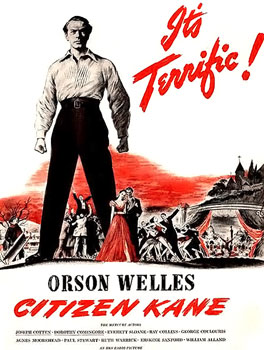
Citizen Kane (1941), original review

b57c4-citiza_kane

Disclaimer: I have since changed my opinions on this film but this capsule review stands as a reminder of how greatly things can change. 

As far as all the hype is concerned, Citizen Kane was a major disappointment. It is a film which has been lauded as one of the greatest cinematic masterpieces of all time. However, in my mind, overall it is nothing that amazing. This movie has an important context that has to be taken into consideration first of all. One of these points is that the film is supposedly a semi-autobiographical account of the famous journalist William Randolph Hearst. In this way, it is a satire of his life because he acquired great riches but no happiness. Other pioneering aspects of this film are the storytelling devices and the camera work. In the realm of storytelling, Citizen Kane relies on both flashback and various narrators in order to try and explain Kane’s past. Furthermore, the cinematographic process of sharp focus is also used, allowing the screen to be in complete focus.  For being so highly praised Citizen Kane left me disappointed and also dumbfounded about how it gained such status.

4/5 Stars